

How to optimise your AC for energy savings in the UK
TL;DR:
- Proper building insulation and shading greatly reduce cooling demand and energy costs.
- Maintaining steady, moderate temperatures with smart controls improves AC efficiency.
- Regular professional servicing and passive measures are essential for optimal energy savings.
Summer energy bills landing on your doormat can feel like a cold shock, especially when you know the air conditioning has been running constantly. For UK homeowners and business managers, the pressure is real: energy costs have climbed sharply in recent years, and a poorly optimised AC system can quietly drain hundreds of pounds each season. The good news is that a few targeted changes to how you set up, operate, and maintain your system can make a significant difference to your bills, without leaving you sweating through the hottest days of the year.
Table of Contents
- What to check before optimising your air conditioning
- Step-by-step guide: optimising your AC for maximum energy savings
- Maintenance essentials: keeping your AC running efficiently
- How to check results: monitoring and verifying energy savings
- Why UK homeowners get AC optimisation wrong (and what actually works)
- Get expert help with energy-efficient AC
- Frequently asked questions
Key Takeaways
| Point | Details |
|---|---|
| Start with insulation | Improving your home’s insulation can cut cooling energy demand by up to 40 percent. |
| Optimise operation habits | Use steady, smart settings and minimise sudden changes for best AC efficiency. |
| Maintain your system | Clean filters and annual servicing can deliver ongoing energy savings. |
| Track your progress | Monitor energy use to confirm your efforts are actually lowering costs. |
What to check before optimising your air conditioning
With a clear motivation to save energy, it is vital to start with the basics before adjusting any technical settings. Think of this stage as your pre-flight check. Skipping it means any adjustments you make later are built on shaky foundations.
Start with your building fabric. The single biggest factor in how hard your AC works is how well your building retains a comfortable temperature in the first place. Passive measures reduce cooling demand by 20 to 40%, while mechanical ventilation with heat recovery (MVHR) systems recover 70 to 90% of ventilation heat. In plain terms, insulating your loft, sealing gaps around doors and windows, and fitting quality glazing means your AC unit runs less often and for shorter periods. These are not glamorous fixes, but they are often the highest-impact ones.
Assess your current AC unit honestly. How old is your system? Units over ten years old are significantly less efficient than modern inverter-driven models. Check whether the unit is correctly sized for the space. An oversized unit will short-cycle (switch on and off rapidly), wasting energy and causing unnecessary wear. An undersized unit will run continuously without ever achieving your target temperature. Our HVAC diagnostics guide walks through how to identify whether your system is performing as it should.
Consider passive cooling measures alongside your AC. Simple additions like window shutters to reduce energy loss can meaningfully reduce the solar heat gain entering your building. South and west-facing windows are the biggest culprits in summer, and blocking direct sunlight before it enters the room is far more effective than trying to cool a space that has already absorbed that heat.
Pro Tip: Fit external shutters or internal blackout blinds to south and west-facing windows before the warm season. Blocking sunlight at the glass is far more efficient than cooling a room that has already absorbed solar heat.
Here is a quick reference for preparation steps and their typical impact:
| Preparation step | Typical energy saving | Difficulty |
|---|---|---|
| Loft and wall insulation | 20 to 40% cooling demand reduction | Medium |
| Window shutters or blinds | 10 to 20% cooling demand reduction | Low |
| Sealing draughts and gaps | 5 to 15% cooling demand reduction | Low |
| MVHR system installation | 70 to 90% ventilation heat recovery | High |
| AC system assessment | Varies by system age and sizing | Low |
If you are considering upgrading your air conditioning entirely, this preparation stage is the right moment to do it, so your new system is sized and specified for a building that already benefits from passive measures.
Key preparation steps at a glance:
- Assess insulation in loft, walls, and around windows and doors
- Check AC unit age, manufacturer rating, and last service date
- Identify solar gain problem areas and fit appropriate shading
- Consider whether an MVHR system is appropriate for your building
- Review current thermostat settings and control options
Step-by-step guide: optimising your AC for maximum energy savings
Once your AC system and environment are ready, it is time to put energy-saving practices into action. This is where behaviour and technology combine to deliver real reductions in your electricity bills.
Step 1: Set your thermostat at a steady, sensible temperature. For most UK homes, 24°C strikes the right balance between comfort and efficiency. Resist the temptation to set the thermostat much lower when you arrive home hot. Dropping the target temperature does not cool the room faster; it simply makes the unit run longer than necessary.
Step 2: Understand how your heat pump or inverter AC actually works. This is where most people get it wrong. Heat pumps run most efficiently at a steady, consistent temperature rather than cycling on and off. This is the opposite of how many people approach traditional heating, where you might turn the boiler off completely and reheat from cold. With a heat pump, maintaining a mild, steady indoor temperature uses less energy overall than letting the space warm up significantly and then demanding rapid cooling.
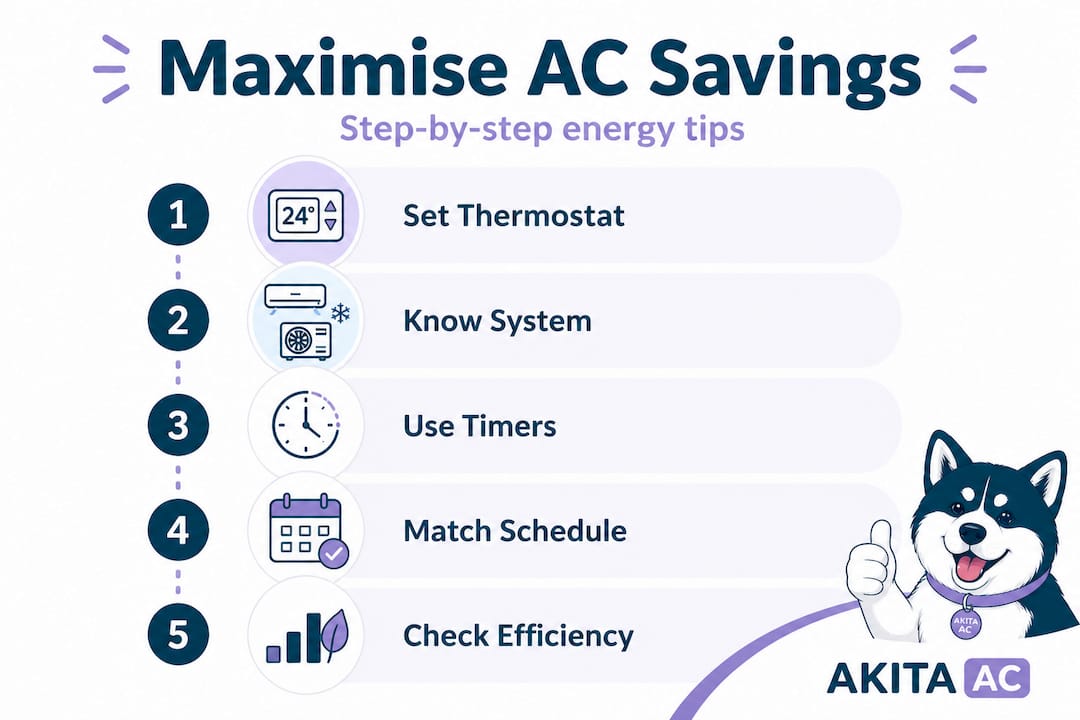
Step 3: Use built-in timers and smart controls. Most modern AC units include programmable timers. Set the system to begin cooling your home or office 30 minutes before you arrive, rather than blasting it the moment you walk in. Smart thermostats and Wi-Fi-enabled controls go further, learning your patterns and adjusting operation automatically. You can also boost air conditioning efficiency through zoning, which means only cooling occupied rooms rather than the entire building.
Step 4: Match your cooling schedule to actual occupancy. An office that is empty from Friday evening until Monday morning does not need to be maintained at 24°C all weekend. A home where everyone is out during the day can be allowed to warm slightly, with pre-cooling programmed for the hour before people return.
Step 5: Review your AC unit’s energy efficiency rating. If you are considering a new installation, units rated A+++ use dramatically less electricity than older A-rated models. Our guide to choosing energy-efficient AC covers what the ratings mean in practice and which specifications to prioritise.
Pro Tip: Schedule your AC to begin pre-cooling or pre-heating based on when people actually arrive, not simply on outdoor temperature. A space that stays at 23°C all day uses less energy than one that swings from 28°C to 20°C repeatedly.
Here is a comparison of manual versus smart thermostat approaches:
| Feature | Manual thermostat | Smart thermostat |
|---|---|---|
| Scheduling | Fixed times only | Learns occupancy patterns |
| Remote adjustment | Not possible | Via app, anywhere |
| Energy waste | Higher (fixed settings) | Lower (adaptive control) |
| Upfront cost | Low | Moderate |
| Estimated annual saving | Baseline | Up to 15 to 20% additional |
Maintenance essentials: keeping your AC running efficiently
Good habits alone will not deliver optimal results without regular maintenance. A system that has not been serviced properly will work harder than it needs to, consuming more electricity to achieve the same result.
Change air filters regularly. A clogged filter forces the fan to work harder and reduces airflow across the heat exchanger, meaning the system runs longer to achieve the target temperature. For most residential units, filters should be checked monthly during periods of heavy use and cleaned or replaced every three months. Commercial units with higher throughput may need more frequent attention.

Inspect and clean vents and ductwork. Even in split systems without traditional ducting, the indoor unit’s air intake and outlet should be kept clear of obstructions. Furniture, curtains, or stored items blocking the airflow path waste a surprising amount of energy. For ducted systems, blocked or leaking ducts can waste 20 to 30% of the conditioned air before it reaches the room it is intended for.
Watch for signs of trouble early. Unusual noises, ice forming on the indoor or outdoor unit, warm air from a unit set to cool, or a sudden rise in electricity bills are all warning signs. Catching faults early is far cheaper than allowing a small refrigerant leak or failing component to go unaddressed. Our HVAC servicing best practices guide covers the early warning signs worth knowing.
Book annual professional servicing. A trained engineer will check refrigerant levels, electrical connections, fan performance, and system pressures. They will also clean components that are not accessible to you, such as the condenser coil on the outdoor unit.
Regular professional servicing can reduce AC energy consumption by up to 15% and significantly extend the operational life of your system, making it one of the highest-return investments you can make in your climate control setup.
Key maintenance tasks and their recommended frequency:
- Monthly: Check and clean air filters during heavy use periods
- Every 3 months: Inspect vents and indoor unit for obstructions
- Every 6 months: Check outdoor unit for debris, leaves, and blockages
- Annually: Book a professional AC service with a qualified engineer
- As needed: Address unusual noises, odours, or performance drops immediately
Keeping a simple maintenance log with dates and observations makes it much easier to spot patterns and gives any engineer who visits a clear picture of your system’s history.
How to check results: monitoring and verifying energy savings
After applying the right habits and maintenance, it is important to make sure efforts are actually reducing costs. Without tracking, you are flying blind.
Step 1: Record your baseline energy use. Before making changes, note your electricity meter readings weekly during warm weather, or pull the data from your smart meter app if you have one. Note the dates and outdoor temperatures alongside the readings. This gives you a genuine “before” figure to compare against.
Step 2: Check your electricity bill for AC-related patterns. Most UK households see a noticeable uptick in electricity consumption between June and September. If your supplier provides half-hourly data through a smart meter, you can identify exactly when your AC is drawing the most power and whether that aligns with the times you actually need it.
Step 3: Compare monthly or weekly figures after optimisation. Give any changes at least four to six weeks before drawing conclusions. Weather varies, and a cooler spell will naturally reduce consumption regardless of your optimisation efforts. Comparing equivalent periods (for example, this July against last July) gives a more reliable picture. Our overview of energy-efficient air conditioning includes practical benchmarks for what well-optimised systems typically achieve.
Step 4: Revisit your plan seasonally. Optimisation is not a one-time exercise. As seasons change, your occupancy patterns, solar gain, and outdoor temperatures all shift. A schedule set for July may not be optimal in September.
Here is a simple tracking table you can adapt for your own records:
| Week | Meter reading (kWh) | Avg outdoor temp (°C) | AC hours in use | Notes |
|---|---|---|---|---|
| Pre-optimisation week 1 | Record here | Record here | Estimate | Baseline |
| Pre-optimisation week 2 | Record here | Record here | Estimate | Baseline |
| Post-optimisation week 1 | Record here | Record here | Estimate | Changes made |
| Post-optimisation week 2 | Record here | Record here | Estimate | Ongoing |
Keeping even a basic version of this log for one season gives you genuinely useful data to guide future decisions.
Why UK homeowners get AC optimisation wrong (and what actually works)
Here is an uncomfortable truth: the most common piece of advice people follow, which is to switch the AC off whenever possible to save money, is often counterproductive when applied to modern heat pump systems.
The conventional logic comes from older electric heaters and boilers. With a resistance heater, running it less always means spending less. But heat pumps operate most efficiently when they maintain a steady temperature over a longer period, rather than cycling on to correct a large temperature swing. Switching a heat pump off for six hours and then demanding it cool a space that has absorbed significant solar heat is genuinely less efficient than running it continuously at a modest level.
Most UK homeowners also dramatically underestimate the value of passive measures. They spend money on smart thermostats and app-controlled systems, which are genuinely useful, but neglect the loft insulation that would reduce cooling demand by 20 to 40%. The smart thermostat optimises a system that is still working far harder than it needs to.
The approach that actually delivers consistent savings combines three things in the right order. First, reduce the load on the system through insulation, shading, and sealing. Second, maintain the system properly so it runs at peak efficiency. Third, operate it smartly with steady temperatures and scheduled pre-conditioning. Skipping step one and focusing only on steps two and three leaves significant money on the table.
For anyone who wants to explore the full picture of energy-efficient cooling for UK homes, the starting point is always the building fabric, not the unit itself.
Get expert help with energy-efficient AC
Optimising your air conditioning system is achievable with the right knowledge, but having a professional assess and configure your setup removes the guesswork entirely and ensures you are not missing efficiency gains that are hard to spot without specialist equipment.
At Akita Air Conditioning, we work with homeowners across Suffolk, Norfolk, and Essex to install and service systems that are genuinely optimised for the UK climate. Whether you are looking at domestic AC installation for your home or commercial AC solutions for your workplace, our engineers assess your building, recommend appropriately sized systems, and configure controls to suit your occupancy patterns. If you want a straightforward starting point, our fixed price AC installation option makes budgeting simple. Get in touch to find out how we can help your system work smarter, not harder.
Frequently asked questions
What is the cheapest way to run air conditioning in the UK?
Set your heat pump or AC to maintain a steady, comfortable temperature around 24°C, and use insulation to reduce cooling demand by 20 to 40% before the system even switches on. Running the system low and slow at a consistent temperature is more economical than repeated on-off cycling.
How often should I service my AC to save energy?
Annual professional servicing is the standard recommendation, as it addresses refrigerant levels, coil cleanliness, and electrical performance, all of which directly affect how much electricity your system consumes. Neglecting servicing allows small inefficiencies to compound over time.
Do smart thermostats save more energy than manual ones?
Yes, smart thermostats can reduce AC energy use by up to 15 to 20% by automatically matching operation to your actual occupancy patterns rather than running to a fixed schedule regardless of whether anyone is home.
Can window coverings really make a difference?
Shutters and blinds on south and west-facing windows can cut solar heat gain significantly, reducing the cooling load on your AC system and meaning it needs to run for shorter periods to maintain a comfortable temperature.
What temperature should I set my AC for cost savings?
Setting your AC to around 24°C balances comfort and efficiency well for most UK homes; every degree lower you set the target temperature typically increases energy consumption by around 6 to 8%.
Recommended
- Boost air conditioning efficiency: expert steps for UK homes – Akita AC
- Top air conditioning solutions for UK summer heat – Akita AC
- UK AC Maintenance Guide 2026: Cut Energy Use by 20% – Akita AC
- Why Choose Energy Saving Aircon for UK Homes – Akita AC
- Smart ways to reduce HVAC costs in 2026 and beyond - Amazon Air Duct Cleaning