

HVAC diagnostics guide: save 30% energy at home
Even a brand-new, energy-efficient HVAC system can quietly haemorrhage up to 30% of its energy through undetected faults. Most homeowners never realise this is happening until their energy bills spike or the system breaks down entirely. HVAC diagnostics changes that. Whether you have a heat pump, a split-system air conditioner, or a full climate control setup, understanding how diagnostics works gives you real control over your home’s comfort and running costs. This guide walks you through everything from simple DIY checks to advanced fault detection technology, all tailored for UK homeowners who want efficiency, compliance, and lower bills.
Table of Contents
- What is HVAC diagnostics?
- DIY diagnostics you can do at home
- Professional HVAC diagnostics: methods, tools and costs
- Advanced diagnostics and smart fault detection
- Diagnostics and energy savings: what the data shows
- Common pitfalls and expert tips for getting diagnostics right
- Getting the most from your HVAC system—with expert support
- Frequently asked questions
Key Takeaways
| Point | Details |
|---|---|
| Diagnostics boost efficiency | Detecting even minor faults can save up to 30 percent in wasted energy annually. |
| DIY has limits | Homeowners can tackle basics, but professional diagnostics are crucial for complex or sealed system faults. |
| Advanced tech adds value | Smart systems and machine learning pinpoint faults early and can further improve comfort and savings. |
| Regular checks pay off | Annual professional assessment and monthly DIY checks keep your HVAC system at peak performance. |
| Legal compliance matters | Some tasks, especially those involving refrigerants, require certified engineers to meet UK regulations. |
What is HVAC diagnostics?
At its core, HVAC diagnostics is the systematic process of identifying faults, inefficiencies, or performance issues within your heating, ventilation, and air conditioning system. Think of it like a health check for your home’s climate control. Rather than waiting for something to break, diagnostics finds problems early, before they cost you money or comfort.
For UK households, this is especially relevant. Modern homes increasingly rely on heat pumps and inverter-driven air conditioning units, which are sophisticated systems with many components that can drift out of optimal performance without any obvious warning signs. Diagnostics supports energy savings in UK homes by catching these drifts early and keeping systems running at peak efficiency.
“A system that appears to be working fine can still be operating at a fraction of its potential efficiency. Diagnostics is what bridges that gap.”
The importance of regular maintenance cannot be overstated, and diagnostics is a core part of that process. Here is what a proper diagnostic check can identify:
- Blocked or dirty filters reducing airflow
- Refrigerant leaks causing efficiency loss
- Thermostat or control errors leading to incorrect operation
- Electrical faults affecting performance or safety
- Ice build-up on coils indicating deeper system problems
- Gradual efficiency loss that standard alarms miss entirely
DIY diagnostics you can do at home
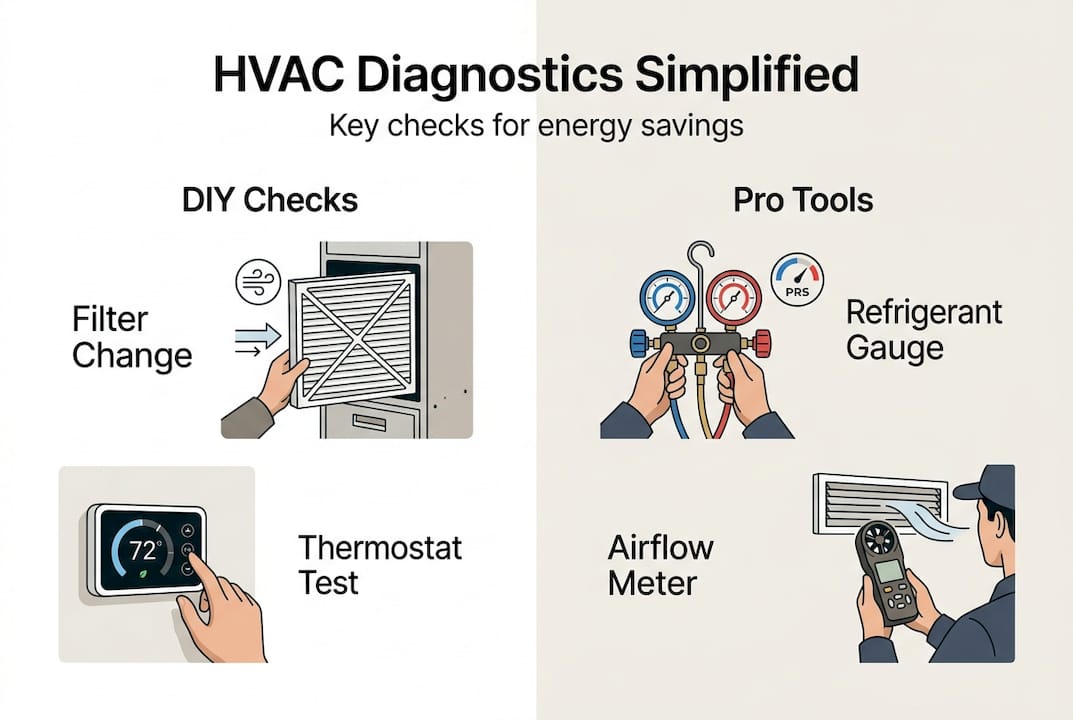
Now that you know what diagnostics are, here is what you can check yourself, safely and effectively. Basic homeowner checks include inspecting filters, verifying thermostat settings, checking circuit breakers, listening for unusual noises, and looking for leaks or ice build-up. These steps take minutes but can prevent expensive call-outs.
Here is a practical sequence to follow each month:
- Check your thermostat settings. Confirm the temperature and mode are correct. A thermostat stuck in the wrong mode wastes energy constantly.
- Inspect and replace your air filter. A clogged filter is the single most common cause of reduced efficiency. Replace or clean it every four to eight weeks depending on usage.
- Check your fuse box and circuit breaker. A tripped breaker is often the culprit behind a system that simply will not start.
- Listen for unusual noises. Rattling, grinding, or hissing sounds are early warnings of mechanical or refrigerant issues.
- Look for leaks or ice build-up. Ice on the indoor or outdoor unit signals a refrigerant or airflow problem that needs attention.
- Clear the area around outdoor units. Leaves, debris, and overgrown plants restrict airflow and reduce efficiency significantly.
Use this home maintenance checklist to keep your checks organised, and pair it with simple energy-saving steps for maximum impact between professional visits.
Some jobs must stay with qualified engineers. Refrigerant handling, sealed system work, and anything involving F-Gas regulations require a certified professional. Attempting these yourself is not only dangerous but also illegal under UK law.
Pro Tip: Set a recurring monthly reminder on your phone labelled “HVAC check” and run through the list above. Consistency is what makes DIY diagnostics genuinely effective.
Professional HVAC diagnostics: methods, tools and costs
While you can handle the basics, certain diagnostics need specialist tools and knowledge, and getting them right can save you far more in repairs and energy usage than the service fee costs.
Professional diagnostics involve electrical testing, refrigerant analysis, airflow measurement, and combustion analysis. Engineers use calibrated instruments that simply are not available to homeowners, and they interpret results against manufacturer specifications and UK compliance standards.
| Diagnostic test | Tools used | Faults detected |
|---|---|---|
| Electrical testing | Multimeter, clamp meter | Wiring faults, motor issues |
| Refrigerant analysis | Manifold gauges, leak detector | Leaks, incorrect charge |
| Airflow measurement | Anemometer, balometer | Blocked ducts, poor distribution |
| Combustion analysis | Flue gas analyser | Inefficient burning, safety risks |
| Thermal imaging | Infrared camera | Hidden leaks, insulation gaps |
Service costs typically range from £300 to £800 for a full professional diagnosis, which prevents misdiagnosis costs of £500 to £2,000. A UK heat pump evaluation typically costs £60 to £300 depending on system complexity. That investment looks very reasonable when you consider the alternative.
Review the professional maintenance checklist to understand what a thorough engineer visit should cover, and consider the lifecycle cost overview to see how diagnostics fits into the long-term picture.
Pro Tip: Always confirm your engineer holds F-Gas certification before any refrigerant work begins. This is a legal requirement in the UK, and using an uncertified engineer can void your warranty and expose you to liability.
Advanced diagnostics and smart fault detection
To stay ahead, it is worth understanding how next-generation technology is reshaping diagnostics and boosting efficiency for UK homeowners.

Advanced Fault Detection and Diagnostics (FDD) uses rule-based, data-driven, or hybrid methods, often drawing on Building Automation System (BAS) data to identify faults automatically. This is a significant step beyond traditional reactive maintenance.
| FDD method | How it works | Best suited for |
|---|---|---|
| Rule-based | Predefined fault thresholds trigger alerts | Simpler systems, clear fault patterns |
| Data-driven (ML) | Machine learning detects anomalies in usage data | Complex systems, gradual faults |
| Hybrid | Combines rules and ML for broader coverage | Modern heat pumps, large installations |
Integrating IoT sensors and machine learning enables predictive diagnostics for heat pumps, meaning faults are flagged before they cause noticeable performance drops. For UK homeowners with modern inverter systems, this translates to better Seasonal Coefficient of Performance (SCOP) scores and lower annual running costs.
Key benefits of smart FDD for your home:
- Continuous monitoring without manual checks
- Early detection of gradual faults that standard alarms miss
- Automatic alerts sent to your phone or engineer
- Improved SCOP and reduced energy waste over time
- Better data for planning servicing and replacements
Explore servicing best practices to see how smart diagnostics fits into a modern service plan, and read our guide on choosing an efficient HVAC system if you are considering an upgrade.
Diagnostics and energy savings: what the data shows
Let us get practical. What do diagnostics actually deliver in pounds and kilowatts saved? The evidence is compelling.
FDD achieves 5 to 30% energy savings, with a median of 9 to 10% in office environments, and fault detection rates of 88 to 97%. For a typical UK home spending £1,200 per year on heating and cooling, that median saving represents over £100 annually from diagnostics alone.
“Reactive maintenance waits for failure. BAS alarms catch obvious faults. FDD finds everything in between, and that middle ground is where most energy is wasted.”
Here is how different approaches compare in practice:
- Reactive maintenance: Lowest upfront cost, highest long-term waste. Faults go undetected until failure.
- BAS alarms only: Catches major faults but misses gradual efficiency loss, which accounts for the majority of wasted energy.
- Full FDD diagnostics: Highest detection rate, lowest energy waste, best return on investment over a system’s lifetime.
Beyond the financial case, there are real comfort and environmental benefits. A properly diagnosed system maintains consistent temperatures, reduces humidity fluctuations, and operates with a smaller carbon footprint. For UK families trying to reduce their environmental impact, energy efficient HVAC combined with regular diagnostics is one of the most effective steps available.
Common pitfalls and expert tips for getting diagnostics right
With all this knowledge, here is how to avoid classic mistakes and put expert advice into practice.
The most common errors homeowners make include ignoring small drops in efficiency, failing to keep records of checks and repairs, and skipping professional input when faults are beyond basic DIY scope. Multi-mode data analysis and hybrid FDD deliver better results than any single approach, and machine learning systems require a proper data baseline to function accurately, so consistency matters from day one.
Avoid these pitfalls:
- Assuming a system is fine because it is still running
- Skipping filter checks during low-use seasons
- Ignoring unusual sounds or smells, even brief ones
- Attempting refrigerant or electrical work without certification
- Failing to document checks, which makes fault patterns invisible
Review servicing best practices regularly to keep your approach current as technology and regulations evolve.
Pro Tip: Keep a simple logbook, either a notebook or a free app, where you record every check, filter change, engineer visit, and energy bill. Over time, this data reveals patterns that even smart systems can miss, and it is invaluable if you ever need to make a warranty claim.
Getting the most from your HVAC system—with expert support
Proactive diagnostics is one of the smartest investments a UK homeowner can make. It protects your system, reduces your bills, and keeps your home comfortable year-round. But knowing what to look for is only half the equation.

For the checks that go beyond DIY, Akita Air Conditioning provides professional diagnostics, servicing, and repairs carried out by F-Gas certified engineers across Suffolk, Norfolk, and Essex. Whether you need a full system health check, a fault resolved quickly, or a new domestic air conditioning installation that is sized and configured for maximum efficiency, the team is ready to help. If something has already gone wrong, air conditioning repairs are handled with transparent pricing and no hidden costs. Getting expert support is the natural next step after understanding your system.
Frequently asked questions
How often should I have HVAC diagnostics carried out?
Schedule a full professional diagnostic annually, and carry out your own DIY checks on filters and thermostats every month. Annual professional visits catch what monthly checks cannot.
What’s the main difference between regular maintenance and diagnostics?
Maintenance covers routine cleaning and adjustment to keep a system running. Diagnostics involves identifying faults and performance issues that are not visible during standard servicing, making it a deeper and more targeted process.
Can I do HVAC diagnostics myself?
You can safely handle basic checks such as filter changes and thermostat adjustments. However, DIY stops at sealed systems and refrigerant work, which require a certified engineer under UK F-Gas regulations.
Do diagnostics save money and energy?
Yes. FDD delivers 5 to 30% energy savings and prevents costly misdiagnosis repairs that can run into thousands of pounds. The return on investment is clear.
Are advanced diagnostics like AI-powered FDD available for homes?
Increasingly, yes. IoT sensors and ML diagnostics are now available for modern heat pumps and air conditioning units, giving homeowners the kind of predictive fault detection previously reserved for commercial buildings.