

HVAC Lifecycle Cost: True Value for UK Owners
Choosing a climate control system for your Suffolk, Norfolk, or Essex property rarely stops at the installation bill. Many homeowners and small business owners discover later that true cost means much more than just the upfront price. By considering lifecycle cost analysis, you see the complete financial picture—not just what you pay on day one, but the sum of energy bills, maintenance, and future repairs. Understanding these details helps you invest wisely in energy-efficient systems that bring lasting value and comfort.
Table of Contents
- HVAC Lifecycle Cost Defined and Debunked
- Major Components of HVAC Lifecycle Cost
- Energy Efficiency and Operating Expenses
- Choosing Energy-Efficient Systems for Savings
- How to Minimise Long-Term Ownership Costs
Key Takeaways
| Point | Details |
|---|---|
| Lifecycle Costs Include All Expenses | True lifecycle cost analysis accounts for initial costs, maintenance, energy consumption, and eventual disposal over the system’s lifespan. |
| Cheapest Initial Price May Not Save You Money | Opting for the cheapest system often leads to higher energy bills and maintenance costs in the long run. |
| Regular Maintenance Is Essential | Committing to annual servicing can prevent costly emergency repairs and extend the lifespan of your HVAC system. |
| Energy Efficiency Matters | Investing in high-efficiency models pays off through lower energy costs, with significant savings over time. |
HVAC Lifecycle Cost Defined and Debunked
Lifecycle cost analysis (LCA) sounds technical, but it’s simply the complete financial picture of owning an HVAC system. Most UK homeowners focus only on upfront installation costs. That’s a mistake.
True lifecycle cost includes everything: the initial purchase price, installation fees, ongoing maintenance, energy consumption, repairs, and eventual replacement. When you add these together over 10-15 years, the numbers tell a completely different story.
What Lifecycle Cost Actually Means
LCC represents the total financial commitment required to own and operate a climate control system from day one until it no longer works. Intelligent financial analysis goes beyond choosing the cheapest or most expensive option. It evaluates quality, energy efficiency, comfort, reliability, and environmental impact alongside cost.
Here’s what gets included:
- Initial purchase and installation cost
- Annual energy bills for heating or cooling
- Routine maintenance and inspections
- Emergency repairs and replacements
- System decommissioning or removal costs
- Tax implications and potential rebates
Lifecycle cost analysis reveals that the cheapest system upfront often becomes the most expensive choice over time.
The Common Myths About HVAC Costs
Myth 1: Buy the cheapest system available. A budget air conditioning unit might cost £2,000 less initially but consume 30% more energy annually. Over 12 years, that extra energy consumption costs £1,500-£2,500 in wasted electricity.
Myth 2: More features always cost more to maintain. Modern systems with smart controls actually reduce maintenance because they operate more efficiently and alert you to problems before they become expensive.
Myth 3: Maintenance is optional. Skipping annual services seems like saving money. In reality, regular HVAC maintenance prevents costly breakdowns that occur during peak demand when repair costs spike 40-60% higher.
Myth 4: All systems last equally long. Quality installations with proper maintenance extend system lifespan by 3-5 years. That’s a significant difference in total ownership cost.
Why Suffolk, Norfolk, and Essex Homeowners Need This Analysis
Your region experiences variable weather patterns—cool winters and increasingly warm summers. Systems sized incorrectly or poorly installed waste money year-round. Conducting a proper lifecycle cost assessment ensures your investment matches your actual climate needs.
A £6,500 high-efficiency unit installed correctly today might save you £800-£1,200 annually in energy costs compared to a £4,500 basic model. That difference repays the investment within 5-7 years, then delivers pure savings.
Pro tip: Request a 10-year lifecycle cost comparison from your installer before deciding, not just the upfront price quote.
Major Components of HVAC Lifecycle Cost
HVAC lifecycle cost breaks down into five distinct categories. Understanding each one prevents surprises and reveals where your money actually goes over time.
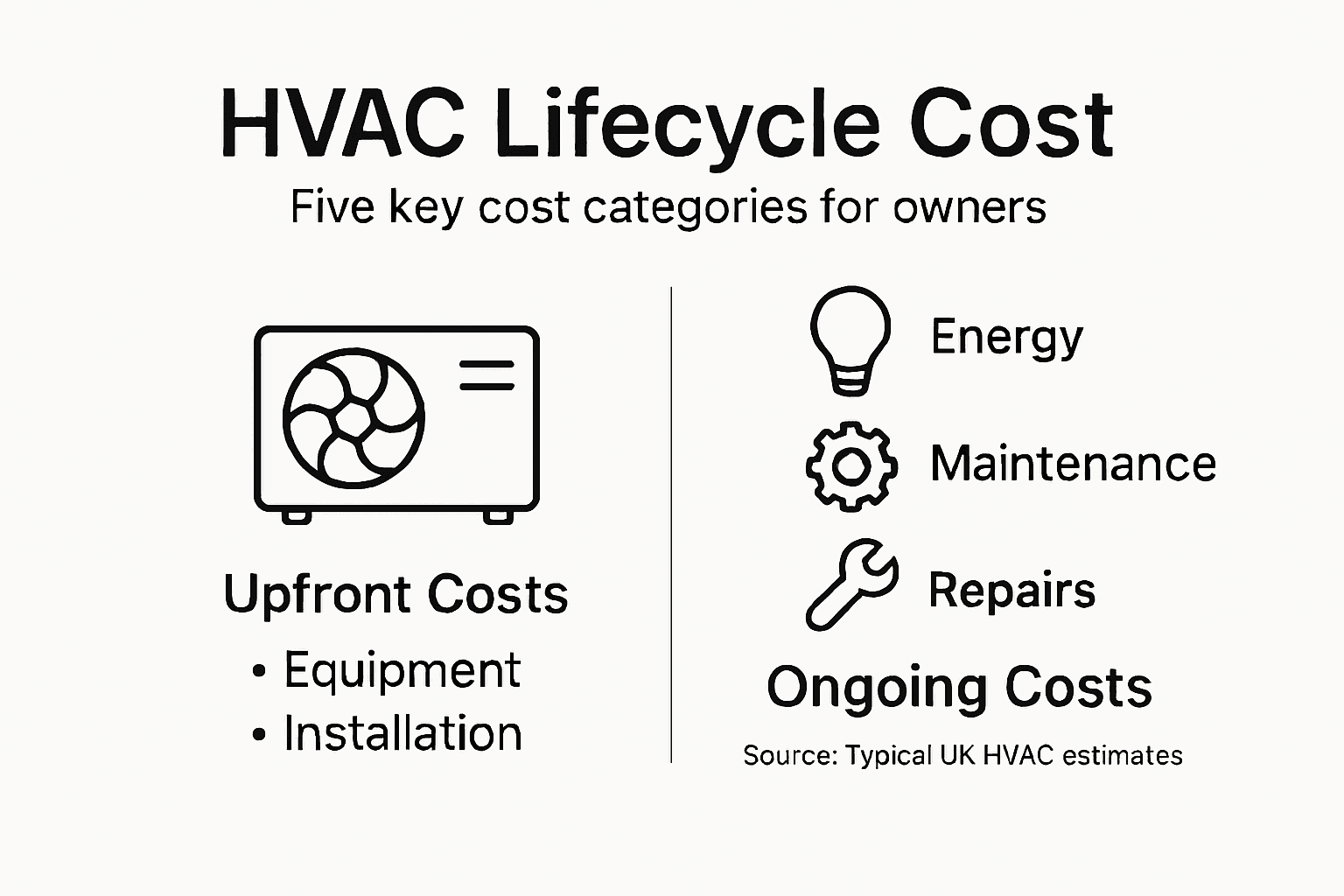
Most homeowners see only the first component: the upfront bill. The other four components—operating costs, maintenance, replacements, and disposal—often dwarf that initial investment when calculated across 10-15 years.
Initial Equipment and Installation
This is the sticker shock moment. The equipment cost includes the outdoor unit, indoor components, controls, and all ancillary parts. Installation labour adds hundreds to thousands of pounds depending on system complexity and your property’s layout.
For a typical Suffolk home, expect:
- Air conditioning system: £3,500-£7,500
- Installation labour and materials: £1,500-£3,500
- Permits and inspections: £200-£400
- Disposal of old system: £300-£600
This lump sum feels significant, but spread across 12-15 years, it becomes roughly 20-30% of your total lifecycle cost.
Here is a summary of the main factors that influence total HVAC lifecycle cost:
| Cost Component | Typical Proportion of Total Cost | Example Cost Range | Potential for Savings |
|---|---|---|---|
| Initial Installation | 20–30% | £5,500–£10,000 | Optimise equipment selection |
| Energy Consumption | 40–50% | £20,000–£28,500 (12yrs) | Choose high-efficiency models |
| Maintenance & Servicing | 12–20% | £2,400–£4,800 (12yrs) | Commit to annual plans |
| Repairs & Replacements | 8–15% | £1,500–£6,000 | Prevent via regular service |
| Disposal & Removal | 2–5% | £300–£600 | Plan for end-of-life early |
Initial cost matters, but it accounts for less than one-third of total ownership expenses.
Operating Costs: Energy Consumption
Energy bills represent your largest recurring expense. A poorly chosen system runs inefficiently every single day. Over one year, an inefficient unit consuming an extra 2-3 kilowatts daily costs roughly £200-£300 in surplus electricity.
Multiply that across 12 years, and you’re looking at £2,400-£3,600 in wasted energy—money that could have bought a superior, high-efficiency system initially.
Factors affecting energy costs:
- System seasonal energy efficiency ratio (SEER) rating
- Local electricity rates (currently rising across Norfolk and Essex)
- How frequently you actually use the system
- Thermostat settings and usage patterns
- Building insulation quality
Maintenance and Service Costs
Key HVAC lifecycle components include routine maintenance that keeps systems running properly. Annual servicing typically costs £150-£300 per visit, usually performed once yearly.
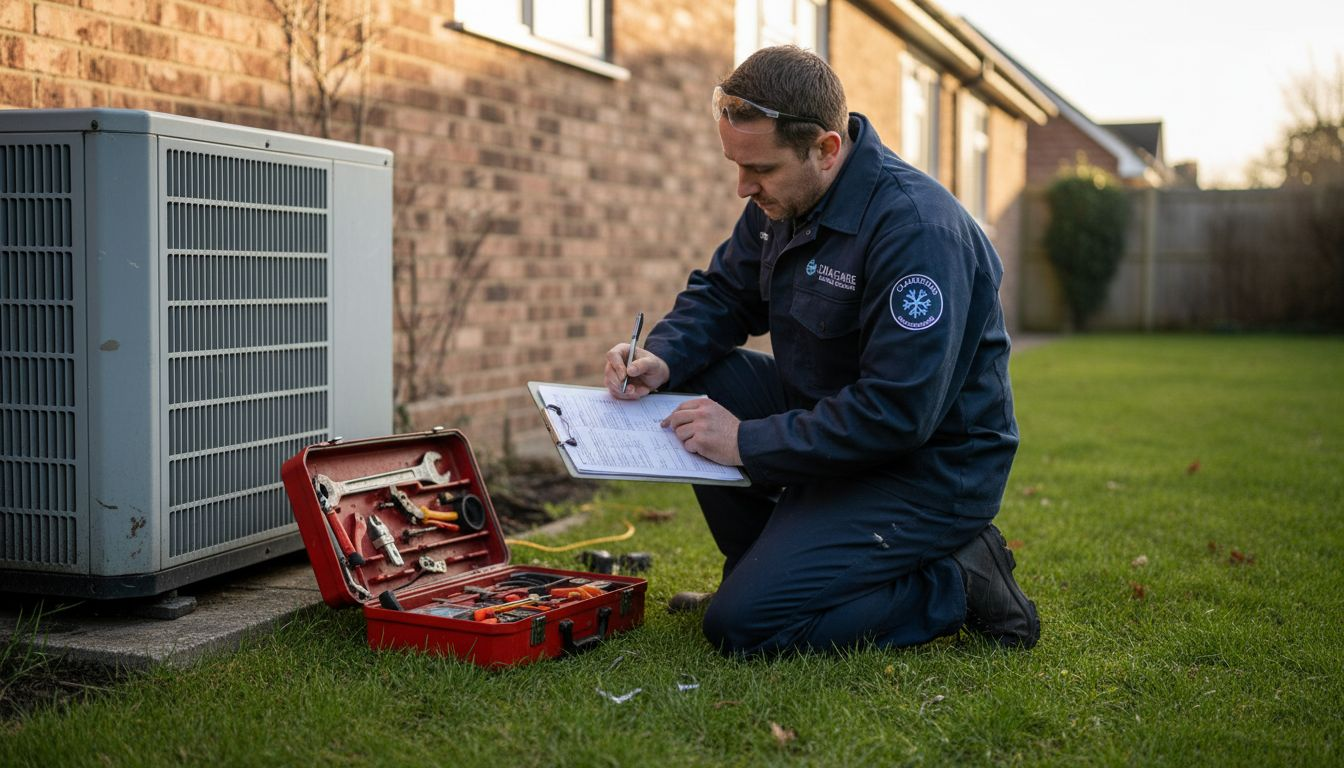
That’s manageable. What’s not manageable is skipping maintenance entirely. Neglecting annual inspections leads to expensive breakdowns exactly when repair technicians charge premium rates.
Regular maintenance plans extend system lifespan significantly and prevent emergency repairs.
Typical maintenance expenses over 12 years:
- 12 annual inspections and filters: £1,800-£3,600
- Minor repairs and adjustments: £400-£800
- Refrigerant top-ups if needed: £200-£400
Replacement Parts and Major Repairs
Compressors fail. Capacitors burn out. Fans seize up. Budget roughly £150-£500 annually for unexpected component replacements during years 5-12 of ownership.
A full compressor replacement costs £1,500-£3,500. Most systems experience at least one major repair during their lifespan.
Disposal and System Removal
When your system finally reaches end-of-life (typically 12-18 years), removing and disposing of it costs £300-£600. Environmental regulations require proper refrigerant recovery and recycling.
This cost is often forgotten during initial planning but adds to total lifecycle expense.
Pro tip: Request itemised cost breakdowns for each component when calculating total ownership cost, then multiply maintenance and repair estimates by your expected system lifespan to reveal true financial commitment.
Energy Efficiency and Operating Expenses
Energy costs dwarf everything else in your HVAC lifecycle budget. A system running for 12 years consumes thousands of pounds in electricity. The difference between an efficient unit and an inefficient one? Thousands more.
This is where smart choices at the beginning save real money at the end.
How Energy Efficiency Drives Operating Costs
Efficiency ratings directly determine your annual energy bills. Systems with higher SEER (Seasonal Energy Efficiency Ratio) ratings consume less electricity to deliver the same cooling performance.
The maths is straightforward. A SEER 16 unit uses roughly 25% less energy than a SEER 13 unit. Over 12 years, that difference equals £2,500-£4,000 in energy savings depending on your usage patterns and local electricity rates.
Energy consumption significantly influences your total lifecycle cost. This is particularly true in regions like Norfolk and Essex, where cooling demands have increased substantially over the past decade.
Real-World Energy Cost Comparison
Let’s compare two systems for a typical Suffolk property:
Budget System (SEER 13)
- Annual energy consumption: 8,500 kWh
- Annual cost at 28p/kWh: £2,380
- 12-year total: £28,560
High-Efficiency System (SEER 18)
- Annual energy consumption: 6,200 kWh
- Annual cost at 28p/kWh: £1,736
- 12-year total: £20,832
The efficiency premium (roughly £1,500 extra upfront) repays itself in just two years. Years 3-12 deliver pure savings.
This table compares how energy efficiency impacts long-term costs for UK homeowners:
| System Type | Upfront Cost | 12-Year Energy Cost | Total 12-Year Cost | Years to Recover Premium |
|---|---|---|---|---|
| Basic (SEER 13) | £4,500 | £28,560 | £33,060 | Not applicable |
| High-Efficiency (SEER 18) | £6,000 | £20,832 | £26,832 | Approximately 2 years |
The most expensive system upfront becomes the cheapest when operating costs are included.
Factors Affecting Your Energy Bills
Beyond the efficiency rating, several factors influence actual consumption:
- Thermostat settings: Each degree lower in summer increases cooling energy roughly 3-5%
- System maintenance: Dirty filters and clogged coils force harder operation, raising consumption 10-15%
- Building insulation: Poor insulation means your system runs longer to maintain comfort
- Usage patterns: How many hours daily you operate the system directly impacts annual costs
- Age of equipment: Systems lose efficiency gradually; a 15-year-old unit operates 10-20% less efficiently than new
Calculating Your Potential Savings
Determine your baseline consumption by checking recent electricity bills during warm months. If your current system uses 800 kWh monthly during summer, upgrading to energy-efficient cooling systems could reduce this to 600 kWh monthly—saving £56 monthly or £672 annually.
Multiply that annual saving by your system’s expected lifespan to reveal true value.
Operating Costs Beyond Electricity
Energy consumption isn’t the only operating expense. Efficient systems typically require less maintenance because they run cooler and experience less component stress.
Less strain means fewer emergency repairs and extended component lifespan—adding another £1,500-£2,500 in savings over 12 years.
Pro tip: Request the annual energy consumption estimate (in kWh) for any system you’re considering, then multiply by your local electricity rate and 12 years to compare true operating costs before deciding.
Choosing Energy-Efficient Systems for Savings
Selecting an energy-efficient HVAC system isn’t about picking the most advanced model. It’s about matching the right efficiency level to your home’s actual needs and climate zone.
Most UK homeowners struggle here because efficiency ratings feel abstract. What does SEER 16 actually mean for your Suffolk home versus SEER 13? Let’s make it concrete.
Understanding Efficiency Ratings in Context
SEER (Seasonal Energy Efficiency Ratio) measures cooling efficiency. Higher numbers mean lower energy consumption. A SEER 16 system delivers the same comfort as a SEER 13 unit whilst using approximately 20% less electricity.
For air conditioning, prioritise units rated SEER 15 or higher. For heat pumps (which heat and cool), look for HSPF ratings above 8.5 to ensure winter efficiency matters too.
But numbers alone don’t tell the complete story. A high-efficiency system installed poorly or sized incorrectly wastes those efficiency gains.
The Selection Process: Key Criteria
Systematic evaluation of lifecycle cost requires balancing efficiency, quality, buildability, and function. You’re not just choosing an air conditioning unit; you’re choosing a 12-15 year investment.
Consider these factors:
- Building characteristics: Square footage, insulation quality, window orientation, and current ductwork condition
- Climate demands: Norfolk winters are mild; cooling matters more than heating in your region
- Usage patterns: How many hours daily do you actually need climate control?
- Installation quality: A perfectly efficient unit installed by inexperienced technicians performs poorly
- Maintenance capability: Can you commit to annual servicing to maintain efficiency gains?
Selecting an energy-efficient system requires matching equipment specifications to your actual building and lifestyle needs, not just chasing highest ratings.
Smart Controls Amplify Efficiency Gains
Modern systems with smart thermostats and zoning controls can reduce energy consumption by an additional 10-15% compared to standard systems. These controls learn your patterns and adjust automatically.
Smart HVAC control systems optimise energy use throughout the day, reducing operating expenses significantly over your system’s lifespan.
The upfront cost is modest (£200-£500 extra) but compounds to thousands in savings when multiplied across 12 years.
Making the Right Choice for Your Home
Don’t chase maximum efficiency ratings blindly. A SEER 22 system costs significantly more but may not suit your climate or usage patterns. SEER 16-18 represents the optimal balance for most UK homeowners—high enough to deliver substantial energy savings, affordable enough to maintain reasonable upfront costs.
Request detailed calculations showing:
- Estimated annual energy consumption (in kWh)
- Annual operating cost projections
- 12-year total cost including maintenance
- Expected annual savings versus your current system
Compare these figures across multiple options. The system with the lowest 12-year total cost wins, not the cheapest initial price.
Pro tip: Ask your installer to model energy costs for systems at three efficiency levels, then calculate payback period for each upgrade tier to identify the sweet spot balancing savings against upfront investment.
How to Minimise Long-Term Ownership Costs
Minimising ownership costs requires a deliberate strategy. You can’t control initial equipment prices completely, but you control everything else: maintenance discipline, energy management, installation quality, and replacement timing.
These decisions compound over 12-15 years into thousands of pounds in savings or unnecessary expenses.
Embrace Preventative Maintenance
Annual servicing prevents expensive emergency repairs. A £150 annual inspection catches failing capacitors before they damage your compressor. That £150 investment prevents a £2,000-£3,500 replacement cost.
Skip three years of maintenance and face a 40% higher repair bill when something finally breaks during peak summer demand, when technicians charge premium rates.
Predictive maintenance and performance data reduce unplanned failures significantly. Track your system’s performance annually: refrigerant pressure, airflow, electrical consumption, and component temperatures.
Declining performance signals approaching problems months before failure occurs.
Monitor and Optimise Energy Consumption
Energy consumption drifts upward silently. A system that consumed 7,500 kWh annually in year 3 might consume 8,200 kWh by year 8 if maintenance lapses and efficiency degrades.
That 700 kWh increase costs £196 annually (at current rates). Over four years, it’s £784—roughly the cost of the maintenance you skipped.
Track monthly consumption. Sudden spikes indicate problems:
- Dirty filters restricting airflow
- Refrigerant leaks reducing cooling efficiency
- Thermostat calibration drift
- Compressor degradation
Plan Replacement Timing Strategically
Don’t wait for catastrophic failure. Systems gradually lose efficiency after year 10-12. Replacing a failing system costs more (emergency labour rates) and forces you to accept whatever stock your installer has available.
Scheduling timely replacements optimises lifecycle management. Plan replacement at year 12-13, giving you time to research options, compare quotes, and arrange financing.
A planned replacement saves £1,500-£2,000 versus emergency replacement rates.
Select Quality Installation from Day One
Installation quality determines whether your efficiency rating becomes reality or fantasy. Poor ductwork sizing, incorrect refrigerant charge, or improper thermostat placement wastes that high-efficiency equipment’s advantages.
Request:
- Detailed system sizing calculations
- Ductwork pressure testing before completion
- Proper refrigerant charging to manufacturer specifications
- Multi-point thermostat placement assessment
- Written performance guarantees
Leverage Maintenance Plans
Many providers (including Akita) offer annual maintenance plans bundling inspections, filter replacements, and minor adjustments at fixed rates. These spread costs predictably and encourage regular servicing.
Plans typically cost £120-£200 annually versus £150-£300 per individual service call—saving roughly £400-£600 over 12 years whilst ensuring consistency.
Disciplined maintenance and strategic planning reduce long-term ownership costs by 20-30% compared to reactive, crisis-driven approaches.
Pro tip: Document every maintenance visit, energy bill, and repair in a spreadsheet, then review annually to spot efficiency trends before problems become expensive emergencies.
Discover the True Value Behind Your HVAC Investment
Understanding the full lifecycle cost of your HVAC system is essential for homeowners in Suffolk, Norfolk, and Essex who want to avoid costly surprises and maximise long-term savings. The article highlights that upfront installation costs are only a fraction of total ownership expenses. Key challenges include managing energy consumption, ensuring proper maintenance, and selecting high-efficiency systems with smart controls to reduce operating costs and extend system lifespan.
Akita Air Conditioning specialises in providing transparent, energy-efficient climate control solutions tailored to your home or business needs. With expert installation, maintenance memberships, and flexible finance options, we help you turn lifecycle cost analysis into real financial benefits. Our team focuses on:
- Precise system sizing and professional installation to achieve promised efficiency
- Annual maintenance plans that prevent expensive breakdowns
- High-efficiency units featuring smart controls for reduced energy bills

Take control of your HVAC lifecycle costs today by partnering with Akita. Visit Akita Air Conditioning to request your personalised 10-year cost comparison and experience how smart choices pay off in comfort, sustainability, and savings.
Frequently Asked Questions
What is HVAC lifecycle cost?
HVAC lifecycle cost is the total financial commitment required to own and operate a heating, ventilation, and air conditioning system, covering initial purchase, installation, energy consumption, maintenance, repairs, and eventual disposal or replacement.
How can I estimate the total lifecycle cost of my HVAC system?
To estimate the total lifecycle cost, consider the initial installation fee, projected energy bills over its lifespan, maintenance costs, anticipated repairs, and disposal costs at the end of life. Adding these together over 10-15 years provides a comprehensive financial picture.
Why is energy efficiency important when selecting an HVAC system?
Energy efficiency is critical as it directly impacts your ongoing operating costs. A more efficient system consumes less energy, leading to substantial savings on energy bills over time, making it a better investment long-term compared to a less efficient model.
What maintenance is necessary for my HVAC system to reduce costs?
Regular maintenance is essential and should include annual inspections, filter replacements, and minor repairs. This proactive approach prevents costly breakdowns and extends the lifespan of your system, ultimately saving you money in the long run.