

Boost air conditioning efficiency: expert steps for UK homes
TL;DR:
- Fixing insulation, sealing leaks, and proper maintenance greatly improve air conditioning efficiency.
- Selecting the right system depends on property size and usage, with heat pumps being generally recommended.
- Ongoing efficiency relies on regular maintenance, smart controls, and treating improvements as a continuous process.
Poor air conditioning efficiency costs UK homeowners and businesses far more than most realise. Heat loss through poor insulation can account for 10 to 33% of unnecessary energy use, meaning a significant portion of your energy bill funds nothing but waste. The good news is that most of these losses are entirely preventable with the right approach. Whether you run a busy office in Norwich or cool a family home in Suffolk, this guide walks you through every practical step to cut costs, boost comfort, and get the most from your climate control system.
Table of Contents
- Assessing your current air conditioning efficiency
- Essential preparations: insulation, sealing, and smart controls
- Selecting the most efficient air conditioning system for your space
- Maintenance and usage: maximising efficiency every day
- Advanced controls and best practices for businesses
- What most guides miss about air conditioning efficiency in the UK
- Upgrade your air conditioning now for lasting efficiency
- Frequently asked questions
Key Takeaways
| Point | Details |
|---|---|
| Insulation comes first | Enhance insulation and seal air leaks to instantly boost any air conditioning system’s efficiency. |
| Choose the right system | Match the AC or heat pump type to your property’s needs for the best long-term energy savings. |
| Routine maintenance | Consistent, professional and user maintenance is essential for optimal performance and lower costs. |
| Smart controls matter | Upgrade to smart thermostats and occupancy sensors to automate and maximise savings. |
| Businesses require compliance | Commercial properties save most by integrating advanced controls and ensuring regulatory compliance. |
Assessing your current air conditioning efficiency
Before spending a penny on upgrades, take stock of what you already have. A quick self-assessment often reveals the biggest opportunities for savings, and it takes far less time than most people expect.
Start by checking for these common signs of inefficiency:
- Uneven cooling: Some rooms are cold while others stay warm, suggesting poor airflow or an undersized unit.
- Constantly cycling system: Your AC switches on and off frequently, which wastes energy and strains the compressor.
- Rising energy bills: Costs creep up year on year without a clear reason.
- Unusual noises or odours: These often signal blocked filters or failing components.
- System age over 10 years: Older units typically operate well below modern efficiency standards.
Next, gather some basic data. Pull together 12 months of energy bills, note your system’s age and model, and check when it was last serviced. This information is invaluable before any engineer visits.
| Efficiency indicator | Good sign | Warning sign |
|---|---|---|
| Monthly energy cost | Stable or falling | Rising year on year |
| Cooling evenness | Consistent across rooms | Hot and cold spots |
| Service history | Annual professional check | No record of servicing |
| System age | Under 10 years | Over 12 years |
Variable occupancy and poor insulation are significant causes of energy loss, particularly in UK properties with older building fabric. Understanding how these factors interact with your controls and occupancy patterns is the foundation of any efficiency improvement. Following a structured HVAC maintenance checklist gives you a reliable starting point, and learning about energy savings in HVAC helps you set realistic targets.
Pro Tip: Take a photo of your system’s data plate (usually on the side or back of the indoor unit). The model number lets an engineer quickly identify efficiency ratings and known issues before they even arrive.
Essential preparations: insulation, sealing, and smart controls
Once you know where your efficiency gaps are, the highest-impact fixes are usually the least glamorous. Insulation, draught sealing, and smart controls consistently outperform expensive hardware upgrades when the building fabric is poor.
Here is a step-by-step approach to getting your property ready:
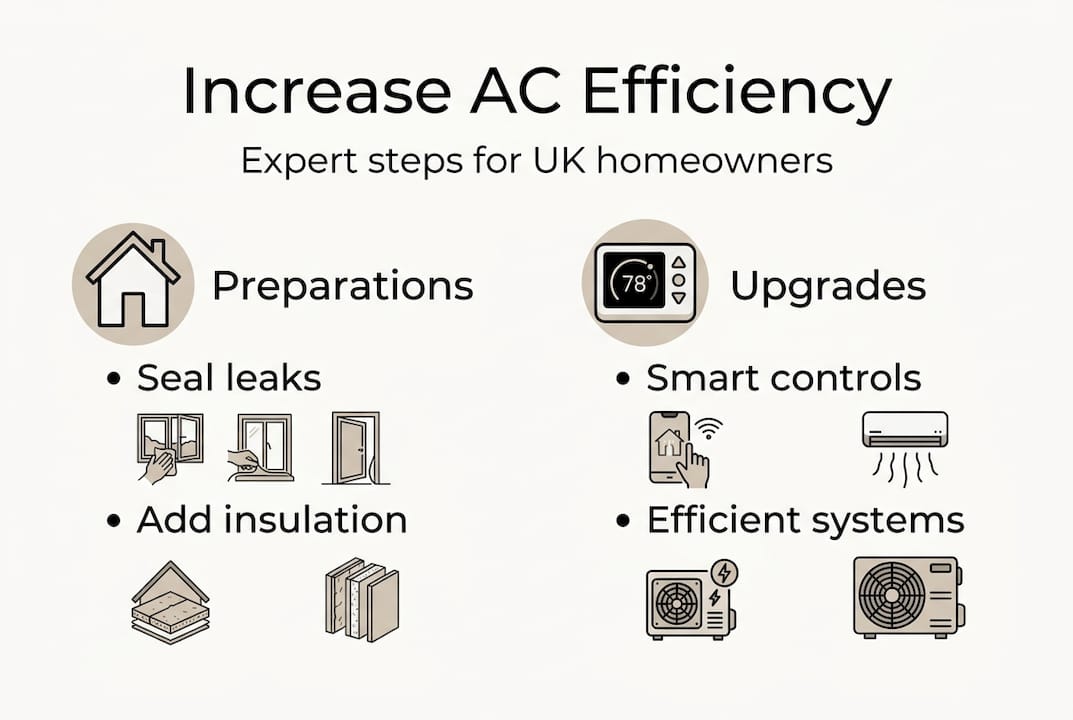
- Audit your insulation: Check loft, wall, and floor insulation levels. Inadequate insulation forces your AC to work harder for longer.
- Seal air leaks: Focus on window frames, door seals, loft hatches, and any penetrations where pipes or cables pass through walls.
- Insulate ductwork: If your system uses ducts, uninsulated runs through unconditioned spaces waste significant energy.
- Upgrade your thermostat: A programmable or smart thermostat allows precise scheduling, remote control, and occupancy-based adjustments.
- Zone your controls: Where possible, only cool occupied areas rather than the whole building.
Sealing air leaks and improving building insulation can reduce cooling load by 10 to 20%, which directly translates to lower bills without touching the AC unit itself. The Energy Saving Trust provides practical, region-specific guidance on insulation standards worth bookmarking.

| Improvement | Typical cost | Estimated energy saving |
|---|---|---|
| Loft insulation | £300 to £600 | Up to 25% of heat loss |
| Draught sealing | £50 to £200 | 5 to 10% |
| Smart thermostat | £150 to £400 | 10 to 15% |
| Duct insulation | £200 to £800 | 5 to 15% |
For a deeper look at how these preparations feed into upgrading for efficiency, it is worth reading about what modern systems expect from the buildings they serve.
Pro Tip: Draught-proof your property on a windy day. You will feel leaks around frames and skirting boards that are invisible on calm days, making it much easier to target your sealing efforts.
Selecting the most efficient air conditioning system for your space
With your property’s envelope in good shape, choosing the right system type becomes far more straightforward. The wrong choice here can mean years of overspending, so it pays to understand your options properly.
Here is how the main system types compare:
| System type | Best for | Key advantage | Limitation |
|---|---|---|---|
| Split system | Homes, small offices | Low cost, easy install | Single zone only |
| VRF/VRV | Large commercial | Multi-zone, high efficiency | High upfront cost |
| Air source heat pump (ASHP) | Most UK homes | Heating and cooling combined | Less efficient in very cold snaps |
| Ground source heat pump (GSHP) | Rural, larger properties | Highest year-round efficiency | Significant installation cost |
Heat pumps are generally more efficient than traditional air conditioning, with ground-source models excelling in extreme climates, though air-source units suit the vast majority of UK properties well. For businesses and larger sites, VRF systems can reduce consumption by 36.6% and inverter-driven units are 30 to 40% more efficient than fixed-speed alternatives.
Key factors to weigh up when choosing:
- For homes: Available space, budget, whether you need heating and cooling combined, and existing infrastructure.
- For businesses: Number of zones required, occupancy patterns, compliance obligations, and total cost of ownership over five to ten years.
Exploring the full range of types of systems available in the UK helps you avoid being oversold on features you will never use. You can also review specific energy-saving options to find the right balance of upfront cost and long-term savings.
Maintenance and usage: maximising efficiency every day
Even the best system degrades quickly without proper care. Maintenance is not optional if you want sustained efficiency, and many of the most impactful tasks are straightforward.
Here are the top five daily and seasonal habits that make the biggest difference:
- Clean or replace filters monthly: Blocked filters force the system to work harder, raising energy use and risking damage.
- Keep coils clean: Dirty evaporator and condenser coils reduce heat transfer efficiency significantly.
- Set thermostats sensibly: Every degree above 24°C in summer saves roughly 3 to 5% on cooling costs.
- Use window treatments: Blinds and curtains on south-facing windows reduce solar gain and cut cooling load during peak hours.
- Book an annual professional service: A qualified engineer checks refrigerant levels, electrical connections, and controls in one visit.
Important: Skipping professional maintenance for even one season can lead to efficiency losses of 20% or more, turning a well-chosen system into an expensive disappointment.
Routine maintenance is crucial to sustained efficiency, and the difference between a serviced and unserviced system is often visible on the very next energy bill. A detailed air conditioner maintenance checklist keeps you on track between professional visits, while understanding the full maintenance steps helps you know what your engineer should be doing. The value of routine maintenance compounds over time, protecting your investment and keeping warranties valid.
Pro Tip: If your system is working harder than usual but the temperature has not changed, check the filter first. A clogged filter is the single most common cause of sudden efficiency drops and takes under five minutes to fix.
Advanced controls and best practices for businesses
For businesses and larger commercial properties, basic efficiency measures are just the starting point. Regulatory obligations and the scale of energy use mean that advanced controls and compliance matter enormously.
Three technologies stand out for commercial settings:
- Demand-controlled ventilation (DCV): Adjusts airflow based on actual occupancy using CO2 sensors, preventing the common problem of cooling empty rooms at full capacity.
- Variable refrigerant flow (VRF): Delivers precise, zone-by-zone control across large buildings, recovering heat from one area to cool another simultaneously.
- TM44 inspections: A legal requirement for air conditioning systems over 12kW in commercial buildings, ensuring systems are operating efficiently and safely.
Regulatory note: Failing to comply with TM44 inspection requirements can result in financial penalties and may affect your building’s energy performance certificate rating, which matters when renewing leases or attracting tenants.
| Advanced control | Typical ROI period | Compliance benefit |
|---|---|---|
| DCV | 2 to 4 years | Supports EPB regulations |
| VRF upgrade | 4 to 7 years | Reduces energy certificate rating |
| TM44 inspection | Immediate compliance | Avoids regulatory penalties |
| Smart BMS integration | 3 to 5 years | Centralised monitoring and reporting |
Businesses should focus on DCV, VRF, and TM44 compliance to maximise savings under EPB regulations. Reviewing EPB compliance guidelines gives commercial property managers a clear picture of their obligations and the incentives available for proactive upgrades.
Common regulatory pitfalls to avoid:
- Missing TM44 inspection deadlines due to poor record-keeping.
- Installing new systems without checking whether they trigger updated compliance requirements.
- Overlooking DCV in meeting rooms and spaces with variable occupancy.
What most guides miss about air conditioning efficiency in the UK
Here is something most efficiency guides will not tell you: the biggest gains rarely come from the AC unit itself. After working with hundreds of properties across Suffolk, Norfolk, and Essex, we have seen a consistent pattern. Owners invest in premium systems, then feel underwhelmed by the savings. The reason is almost always the building, not the hardware.
A property with poor insulation and draughty windows will exhaust even the most advanced system. We have seen businesses cut their cooling costs by 18% simply by sealing ductwork and fitting smart controls, without changing the AC unit at all. The system they already had was perfectly capable. It was just fighting a losing battle against the building.
The uncomfortable truth is that efficiency is a journey. It is not a single purchase. The properties that achieve the lowest energy costs are those where the owners treat insulation, controls, maintenance, and system choice as an ongoing programme rather than a one-off project. If you want to understand why this matters so deeply, reading about efficient cooling in the UK puts the full picture in context.
Upgrade your air conditioning now for lasting efficiency
If this guide has shown you anything, it is that real efficiency gains come from getting the fundamentals right and working with people who understand the full picture.
At Akita Air Conditioning, we work with homeowners and businesses across Suffolk, Norfolk, and Essex to deliver tailored solutions that genuinely reduce running costs. Whether you are looking at domestic air conditioning for your home, a commercial air conditioning upgrade for your business, or want to start with a fixed price AC install, our team handles everything from assessment through to aftercare. Get in touch today for a no-obligation consultation and take the first step towards a genuinely efficient system.
Frequently asked questions
What are the quickest ways to reduce air conditioning energy costs?
Improving insulation, sealing air leaks, and keeping up with routine maintenance can cut cooling energy costs by as much as 20%, often without replacing the system at all.
Is upgrading to a heat pump always more efficient than traditional AC?
In most UK settings, heat pumps offer better efficiency overall. GSHPs are more efficient year-round but carry higher upfront costs, while ASHPs suit the majority of UK homes very well.
How often should air conditioning systems be professionally serviced?
Most engineers recommend at least one full professional service per year. Routine maintenance prevents efficiency losses and keeps your system running safely and within warranty conditions.
What business regulations affect air conditioning efficiency in the UK?
EPB regulations require regular TM44 inspections for commercial systems over 12kW. Businesses should prioritise compliance with TM44, DCV, and VRF standards to avoid penalties and qualify for energy performance incentives.