

Types of air conditioning systems: UK homeowner's guide 2026
Choosing the wrong air conditioning system can add hundreds of pounds to your annual energy bills whilst leaving rooms too hot or too cold. UK homeowners and businesses face a bewildering array of AC types, each with different costs, efficiency ratings, and maintenance demands. This guide cuts through the confusion by explaining the key criteria that matter, comparing common system types, and matching each to specific property needs so you can make an informed, cost-effective choice.
Table of Contents
- How To Choose An Air Conditioning System: Key Criteria For UK Homes And Businesses
- Common Types Of Air Conditioning Systems
- Energy Efficiency And Environmental Impact
- Installation And Maintenance Considerations
- Summary Comparison And Situational Recommendations
- Explore Expert Air Conditioning Installation In East Anglia
Key takeaways
| Point | Details |
|---|---|
| Clear criteria simplify choice | Energy efficiency ratings, installation complexity, and maintenance frequency determine long-term value and running costs. |
| Split systems suit most UK homes | They balance upfront affordability with solid energy performance and straightforward annual servicing. |
| VRF systems excel in larger buildings | Variable refrigerant flow technology offers the highest efficiency and precise multi-zone control for commercial or large residential properties. |
| Installation and upkeep vary widely | Ducted systems cost 20-30% more to install than split units, whilst VRF needs specialist bi-annual servicing. |
| Smart controls cut energy use significantly | Adaptive temperature regulation and remote monitoring reduce consumption by up to 20%, lowering bills and environmental impact. |
How to choose an air conditioning system: key criteria for UK homes and businesses
Before comparing AC types, establish what matters most for your property. Six core benchmarks guide effective evaluation.
Start with energy efficiency. Seasonal Energy Efficiency Ratio (SEER) ratings measure how much cooling output you get per unit of electricity consumed. Higher SEER values mean lower running costs. Modern split systems typically achieve SEER 18-22, whilst premium VRF units can reach SEER 25 or above. Understanding energy efficient air conditioning principles helps you spot genuine savings opportunities versus marketing claims.
Installation complexity directly affects your budget and timeline. Portable units plug in and go. Split systems require wall mounting and outdoor condenser placement. Ducted and VRF installations involve extensive pipework, ceiling access, and specialist labour, pushing costs thousands of pounds higher.
Maintenance frequency shapes lifetime ownership costs. Simple systems like portable units need monthly filter checks but little else. Multi-split and VRF systems demand professional servicing twice yearly to maintain warranty coverage and peak performance. Factor in these recurring expenses when budgeting.
Property size and usage patterns dictate suitability. A small flat benefits from a single split unit. A multi-room office needs zone control, making multi-split or VRF systems cost-effective. Commercial spaces with variable occupancy gain most from adaptive VRF technology.
Environmental factors now carry legal weight. UK regulations mandate low Global Warming Potential (GWP) refrigerants like R32, phasing out older, high-impact alternatives. Choosing systems with compliant refrigerants avoids costly retrofits and regulatory penalties.
Smart control integration offers substantial additional savings. Wi-Fi thermostats, occupancy sensors, and remote monitoring enable adaptive temperature regulation. These features reduce wasted cooling during unoccupied periods and optimise performance automatically.
Pro tip: Request SEER ratings and annual maintenance cost estimates from installers before committing. Compare total five-year ownership costs, not just purchase price, to identify genuine value.
Common types of air conditioning systems
Five primary AC system types dominate the UK market, each suited to different scenarios.
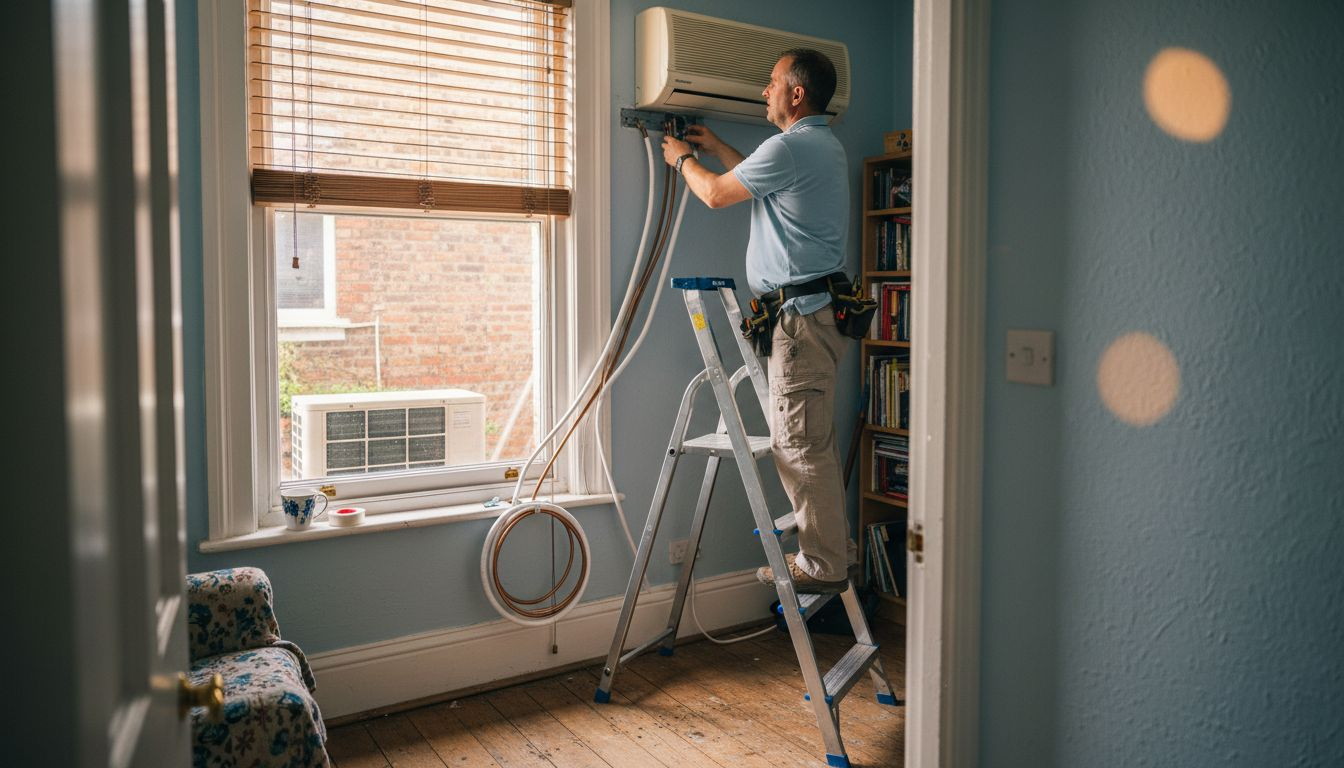
Split systems comprise an indoor wall-mounted unit and an outdoor compressor connected by refrigerant lines. They deliver reliable cooling for single rooms or small homes without requiring ductwork. Installation takes a day for most properties. Split system air conditioning balances affordability with solid SEER ratings between 18 and 22, making them the most popular residential choice across the UK.
Portable units sit on castors and vent hot air through window kits. They offer ultimate flexibility for renters or temporary cooling needs. However, efficiency suffers due to poor insulation and constant air exchange with outdoors. SEER ratings rarely exceed 10. Running costs quickly surpass fixed systems, limiting portables to occasional or short-term use.
Ducted systems cool entire buildings through ceiling or floor vents connected to a central air handler. They hide equipment from view and provide uniform temperature control across multiple rooms. Installation requires extensive ceiling access and ductwork fabrication, driving costs 20-30% higher than split systems. Maintenance involves cleaning ducts, replacing filters quarterly, and annual professional servicing.
Multi-split systems connect multiple indoor units to a single outdoor compressor. They provide independent zone control, letting different rooms maintain separate temperatures. Offices and medium-sized homes benefit from this flexibility. Installation complexity sits between split and ducted systems. Maintenance resembles standard splits but covers more indoor units.
VRF (Variable Refrigerant Flow) systems represent the premium tier, using advanced inverter technology to adjust refrigerant flow precisely to each zone’s demand. They achieve the highest SEER ratings whilst supporting simultaneous heating and cooling in different areas. Large homes, hotels, and commercial buildings gain maximum value from VRF. The trade-off involves higher upfront investment and specialist servicing requirements.
Each system type serves distinct needs. Energy saving aircon capabilities vary significantly, affecting both environmental impact and operating costs. Understanding these differences prevents mismatched installations that waste money. Consider whether upgrading HVAC systems makes sense for older properties with inefficient existing equipment.
Energy efficiency and environmental impact
SEER ratings provide the primary energy performance benchmark. A system with SEER 20 uses half the electricity of a SEER 10 unit for identical cooling output. Over a typical UK cooling season, that difference translates to £150-£250 annual savings for an average home.
Refrigerant choice carries growing importance. R32 has become the UK standard for new installations due to its low GWP of 675, compared to 2088 for older R410A. R32 systems also operate more efficiently, delivering 3-5% better performance than equivalent R410A units. UK regulations progressively restrict high-GWP refrigerants, making future-proof choices essential.
Smart controls amplify efficiency gains. Adaptive thermostats learn occupancy patterns and adjust temperatures automatically. Remote monitoring alerts you to performance issues before they escalate into expensive repairs. These features reduce energy consumption by up to 20% through precise temperature regulation and eliminating wasted runtime.
Government regulations accelerate the shift to sustainable cooling. The F-Gas phase-down limits refrigerant supply, pushing prices higher for non-compliant systems. Properties with old equipment face retrofit costs exceeding new installations. Choosing energy efficient cooling solutions now avoids regulatory headaches later.
Energy consumption varies dramatically across system types:
| System Type | Typical SEER | Annual Energy Cost (3-bed home) | CO₂ Emissions (kg/year) |
|---|---|---|---|
| Portable | 8-10 | £380-£450 | 520-615 |
| Split | 18-22 | £180-£220 | 245-300 |
| Multi-split | 19-23 | £170-£210 | 230-285 |
| Ducted | 16-20 | £200-£250 | 275-340 |
| VRF | 22-26 | £150-£185 | 205-250 |
Based on 1,200 annual cooling hours and £0.28/kWh electricity rate (2026 average).
VRF systems deliver the lowest running costs and environmental impact, though their premium purchase price requires careful ROI calculation. For most UK homes, high-SEER split systems provide the sweet spot between affordability and efficiency.
Commercial air conditioning installations must account for higher usage hours and more complex zoning needs. Businesses benefit disproportionately from energy efficient HVAC technologies due to extended operating schedules.
Pro tip: Calculate payback period by dividing the price premium of higher-efficiency systems by annual energy savings. Systems with payback under five years typically justify the investment.
Installation and maintenance considerations
Installation costs and complexity shape both immediate budgets and long-term satisfaction.
Split systems offer the most accessible entry point. Professional installation typically costs £800-£1,500 for a single indoor unit, including materials and labour. The process involves mounting the indoor unit, positioning the outdoor condenser, and running refrigerant lines through a small wall penetration. Most installations complete within four to six hours. Annual maintenance requires filter cleaning, refrigerant pressure checks, and condenser coil cleaning, costing £80-£120 per service visit.
Ducted systems demand significantly more investment. Installation costs run 20-30% higher than split systems due to ductwork fabrication, ceiling modifications, and extended labour hours. A typical three-bedroom home requires £4,000-£7,000 for ducted AC. Maintenance involves quarterly filter changes, annual duct cleaning, and biannual professional servicing, totalling £200-£350 yearly. Ceiling access complicates repairs, increasing callout costs.
Multi-split installations fall between splits and ducted systems in complexity and cost. Connecting three indoor units to one outdoor compressor typically costs £2,500-£4,000. The outdoor unit handles higher refrigerant volumes, requiring larger electrical circuits and more robust mounting. Maintenance mirrors single splits but multiplies across all indoor units, averaging £150-£220 annually for three zones.
VRF systems require specialist installation teams familiar with complex refrigerant piping networks and control systems. Small commercial installations start at £8,000-£12,000 for basic setups. Large buildings can exceed £50,000 depending on zone count and building layout. Bi-annual servicing by certified technicians costs £300-£500 per visit, but prevents expensive breakdowns and maintains warranty coverage.
Portable units avoid installation costs entirely. Purchase prices range from £200-£600 for reputable models. However, their inefficiency creates higher operating costs that quickly offset the savings. Maintenance involves weekly filter cleaning and annual condenser vacuuming, manageable without professional help.
| System Type | Install Cost Range | Install Complexity | Maintenance Frequency | Annual Maintenance Cost |
|---|---|---|---|---|
| Portable | £0 | Plug and play | Weekly filters | £0 (DIY) |
| Split | £800-£1,500 | Low-moderate | Annual professional | £80-£120 |
| Multi-split | £2,500-£4,000 | Moderate | Annual professional | £150-£220 |
| Ducted | £4,000-£7,000 | High | Bi-annual + quarterly filters | £200-£350 |
| VRF | £8,000-£50,000+ | Very high | Bi-annual specialist | £300-£500 |
Pro tip: Verify installer F-Gas certification before committing. Certified technicians handle refrigerants legally and maintain manufacturer warranties. Request proof of public liability insurance covering potential installation damage.
Proper UK AC maintenance prevents performance degradation and extends equipment lifespan. Neglected systems lose 5-10% efficiency annually, erasing initial savings within a few years. Budget for professional servicing when comparing total ownership costs.
Summary comparison and situational recommendations
Consolidating all factors reveals clear patterns for different property types and budgets.
| System Type | Best For | Energy Efficiency | Install Cost | Maintenance | Key Advantage | Main Drawback |
|---|---|---|---|---|---|---|
| Split | Small UK homes, single rooms | High (SEER 18-22) | Low | Simple annual | Affordable, reliable | Limited to one zone |
| Portable | Temporary cooling, renters | Low (SEER 8-10) | None | DIY weekly | Ultimate flexibility | High running costs |
| Multi-split | Small offices, 2-4 room homes | High (SEER 19-23) | Moderate | Annual | Independent zone control | Higher install than single split |
| Ducted | Whole-home cooling, aesthetics | Moderate (SEER 16-20) | High | Complex bi-annual | Hidden units, uniform cooling | Expensive install and maintenance |
| VRF | Large homes, commercial buildings | Very high (SEER 22-26) | Very high | Specialist bi-annual | Maximum efficiency, simultaneous heating/cooling | Premium pricing |
For small UK homes and flats under 100m², single split systems deliver optimal value. They provide sufficient cooling capacity without overspending on multi-zone features you won’t use. Choose models with SEER 20+ and R32 refrigerant to maximise efficiency and regulatory compliance.
Medium-sized homes (100-180m²) benefit from multi-split systems when cooling three to four rooms. This approach costs less than installing separate splits whilst maintaining independent temperature control per zone. It’s ideal for families with varying comfort preferences.
Large homes exceeding 180m² and commercial properties gain most from VRF technology. The higher upfront investment pays back through superior efficiency, reduced energy costs, and simultaneous heating and cooling capabilities. Offices with varying occupancy patterns see particularly strong ROI.
Renters and temporary situations suit portable units despite poor efficiency. The ability to move equipment between properties and avoid installation justifies higher running costs for short-term use.
Ducted systems make sense primarily when aesthetics trump cost concerns or when whole-building integration with existing ductwork is possible. New-build luxury homes often incorporate ducted AC for seamless architectural integration.
Budget-conscious buyers should prioritise split systems with high SEER ratings over premium features. A well-chosen split unit delivers 80% of the benefits at 40% of the cost compared to VRF.
Commercial buyers must factor in occupancy patterns, zone requirements, and future expansion. VRF systems offer modular scalability that fixed-capacity systems lack, making them cost-effective for growing businesses despite higher initial investment.
Explore expert air conditioning installation in East Anglia
Understanding AC system types is just the start. Professional installation ensures your chosen system delivers promised efficiency and reliability for years to come.

Akita Air Conditioning brings specialist expertise to air conditioning installation across East Anglia, helping homeowners and businesses select and implement the right climate control solution. Our regional knowledge ensures compliance with UK building regulations whilst optimising system performance for local climate conditions. Whether you need a straightforward split system for your Ipswich home or complex VRF technology for commercial premises, our certified engineers deliver installations that maximise energy savings and comfort. Discover why property owners trust the best air conditioning installers in Essex, Suffolk, and Norfolk for transparent pricing, flexible finance options, and comprehensive aftercare support.
FAQ
Which air conditioning system is best for small UK homes?
Split system air conditioners balance cost, efficiency, and maintenance simplicity perfectly for small homes. They provide reliable cooling without the complexity or expense of ducted or VRF systems, typically achieving SEER ratings between 18 and 22 for excellent energy performance.
How much does it cost to install a ducted AC system in the UK?
Ducted system installation typically costs 20-30% more than split systems, often ranging from £4,000 to £7,000 for a standard three-bedroom home. Complex installations with extensive ductwork or multiple zones can exceed £10,000 depending on property layout and specification.
Can smart controls really reduce air conditioning energy use?
Smart controls can cut AC energy consumption by up to 20% through adaptive temperature regulation, occupancy sensing, and remote monitoring. They eliminate wasted runtime during unoccupied periods whilst optimising performance based on actual usage patterns, delivering both cost savings and environmental benefits increasingly valued in modern UK AC maintenance strategies.
What is VRF and when does it make sense?
Variable Refrigerant Flow technology uses inverter-driven compressors to adjust cooling capacity precisely to each zone’s demand. VRF makes financial sense for large homes exceeding 180m², commercial buildings, or properties needing simultaneous heating and cooling in different areas, where its premium efficiency offsets higher installation costs.
How often should different AC systems be serviced?
Split and multi-split systems require annual professional servicing plus monthly filter checks. Ducted systems need bi-annual professional maintenance plus quarterly filter changes. VRF systems demand specialist servicing twice yearly due to complex controls and refrigerant management. Portable units only need weekly filter cleaning and occasional DIY condenser vacuuming.