

What is split system air conditioning: efficient home climate control
Many UK homeowners assume split system air conditioners only cool, overlooking their remarkable heating capabilities through heat pump technology. Modern split systems deliver both efficient cooling in summer and powerful heating in winter, making them versatile year-round climate solutions. This guide explains how split systems work, their energy savings potential, and practical buying tips specifically for homeowners in Suffolk, Norfolk, and Essex seeking enhanced comfort and lower bills.
Table of Contents
- Introduction To Split System Air Conditioning
- How Split System Air Conditioning Works
- Energy Efficiency And Cost Benefits For UK Homeowners
- Common Misconceptions About Split System Air Conditioning
- Comparing Split Systems With Other Cooling Solutions
- Maintenance And Longevity Of Split System Air Conditioning
- Making The Decision: Is Split System Air Conditioning Right For Your Home?
- Explore Professional Split System Air Conditioning Installation In East Anglia
- Frequently Asked Questions About Split System Air Conditioning
Key takeaways
| Point | Details |
|---|---|
| Dual function | Split systems provide both heating and cooling through reversible heat pump technology |
| Energy efficiency | Heat pumps deliver 3 kW of heat per 1 kW electricity, cutting bills by up to 25% annually |
| Ductless design | No ductwork means lower installation costs and zero energy losses through leaky ducts |
| Quiet operation | Modern inverter units run below 25 dB indoors, quieter than a whisper |
| Simple maintenance | Clean filters every 2-4 weeks and schedule annual professional servicing for longevity |
Introduction to split system air conditioning
A split system air conditioner is a ductless HVAC solution with separate outdoor and indoor units connected by refrigerant piping. The outdoor compressor unit houses the compressor and condenser coil, compressing refrigerant to facilitate heat exchange. Indoor units, mounted on walls, circulate conditioned air directly into living spaces without ductwork.
This design avoids the energy losses common in ducted central systems, which can lose 20-30% of conditioned air through leaky ducts. Refrigerant piping runs through a small hole in the wall, connecting indoor and outdoor units discreetly. You can install a single indoor unit for one room or multiple units throughout your home for zoned climate control.
Split systems suit diverse property types, from flats to detached homes. They work particularly well in period properties where installing ductwork would be invasive or impossible. The compact indoor units blend into most interior designs without dominating wall space.
Key components include:
- Outdoor compressor unit containing the compressor, condenser coil, and fan
- Indoor air handler with evaporator coil and fan for air circulation
- Refrigerant piping connecting both units through external walls
- Control system with remote or wall-mounted thermostat
- Drainage system for condensate removal
How split system air conditioning works
Split systems operate by circulating refrigerant between indoor and outdoor units to transfer heat. In cooling mode, refrigerant absorbs heat from indoor air and releases it outside, lowering indoor temperatures. The indoor unit’s evaporator coil allows warm air to pass over cold refrigerant, which absorbs the heat and becomes a gas.
The compressor in the outdoor unit then pressurises this gas, raising its temperature further. The hot, pressurised refrigerant flows through the condenser coil, where outdoor air cools it back into liquid form, releasing the absorbed heat. The cycle repeats continuously to maintain your desired temperature.
In heating mode, the heat pump reverses this process. The outdoor unit extracts heat energy from outside air, even in temperatures as low as -15°C, and transfers it indoors. This seems counterintuitive, but refrigerant can absorb thermal energy from cold air because it operates at even lower temperatures. The indoor unit then releases this concentrated heat to warm your rooms.
Modern inverter compressor technology adjusts motor speed continuously rather than switching on and off. This delivers several benefits:
- Maintains consistent temperatures without uncomfortable fluctuations
- Reduces energy consumption by avoiding start-up power surges
- Operates more quietly than older fixed-speed compressors
- Extends equipment lifespan through smoother operation
- Responds faster to thermostat adjustments
Installation typically takes one day. Technicians mount indoor units securely on interior walls, drill a small hole through the wall for piping, and position the outdoor unit on a concrete pad or wall brackets. Refrigerant lines, electrical wiring, and drainage tubing all pass through this single penetration point.
Pro Tip: Position indoor units away from direct sunlight and heat sources for optimal efficiency. Mount them high on walls where air circulates freely without obstruction from furniture.
Energy efficiency and cost benefits for UK homeowners
Split systems eliminate duct losses entirely, making them inherently more efficient than traditional central heating and cooling. Ducted systems typically lose 20-30% of energy through poorly sealed or uninsulated ductwork in lofts and wall cavities. Your split system delivers 100% of conditioned air directly into living spaces.

Heat pump technology provides exceptional heating efficiency through its Coefficient of Performance. A COP of 3 means you get 3 kW of heat output for every 1 kW of electricity consumed. Compare this to traditional electric heaters with a COP of 1, where you only get 1 kW of heat per 1 kW of electricity. This three-fold efficiency advantage translates directly into lower energy bills.
Homeowners in East Anglia typically see significant savings. Split systems can cut annual energy bills by up to 25% compared to electric heating in the Suffolk, Norfolk, and Essex region. With rising energy prices in 2026, these savings become increasingly valuable.
Installation costs for a single-room system start around £1,500-£2,500, while whole-home multi-split installations range from £4,000-£8,000 depending on capacity and number of zones. Most homeowners recover these costs through energy savings within 5-7 years. After payback, you continue enjoying reduced bills for the system’s remaining lifespan.
Additional financial benefits include:
- Dual heating and cooling eliminates need for separate systems
- Zoned control lets you heat or cool only occupied rooms
- Smart thermostats optimise runtime based on occupancy patterns
- Lower maintenance costs compared to boiler systems
- Increased property value from modern climate control
A Suffolk homeowner reported £400 annual savings after replacing storage heaters with a multi-split system. A Norfolk family reduced their combined heating and cooling costs by 30% within the first year. These real-world results demonstrate the practical benefits for East Anglia residents.
Common misconceptions about split system air conditioning
Many homeowners hold outdated beliefs about split system capabilities and installation requirements. Let’s address the most common myths with current facts.
Myth: Split systems only provide cooling. Modern split systems function as heat pumps, delivering both heating and cooling from a single installation. They extract heat from outdoor air even in freezing temperatures, warming your home efficiently throughout winter. This dual functionality makes them practical year-round climate solutions for UK homes.
Myth: These units are noisy and disruptive. Modern inverter-driven split systems operate below 25 dB indoors, quieter than a whisper or rustling leaves. Outdoor units produce 40-50 dB, comparable to a quiet conversation. You’ll barely notice them running during normal operation.
Myth: Installation requires extensive ductwork and renovation. Split systems are ductless by design. Installation involves mounting indoor units on walls and connecting them to the outdoor unit through a small 7-8 cm hole. Technicians complete most installations in a single day without major structural changes. This makes them ideal for listed buildings and properties where ductwork isn’t feasible.
Myth: Heat pumps don’t work effectively in cold UK winters. Heat pump technology has advanced dramatically. Modern systems extract usable heat from outdoor air down to -15°C, well below typical UK winter temperatures. In mild East Anglia winters averaging 4-6°C, heat pumps operate at peak efficiency, often delivering 3 kW of heat per 1 kW of electricity consumed.
Key facts to remember:
- Indoor units measure roughly 80cm wide and 25cm deep, fitting discreetly on most walls
- Installation causes minimal disruption to existing décor and structure
- Systems include built-in air filtration improving indoor air quality
- Smart controls enable precise temperature management room by room
“We thought air conditioning was just for cooling, but our split system heats our home more efficiently than our old electric radiators ever did. The monthly savings are remarkable.” - Norfolk homeowner
Comparing split systems with other cooling solutions
Understanding how split systems compare to alternatives helps you make informed decisions for your home’s climate control needs.
Split systems versus central air conditioning reveals distinct advantages. Central AC distributes cooled air through ductwork throughout your home, requiring significant installation work and ongoing energy losses. Split systems eliminate ducts entirely, delivering conditioned air directly to each room. You gain zoned control, heating or cooling only occupied spaces rather than the entire house. Installation costs less because no ductwork means less labour and materials. Maintenance proves simpler with accessible indoor units rather than hidden duct systems.
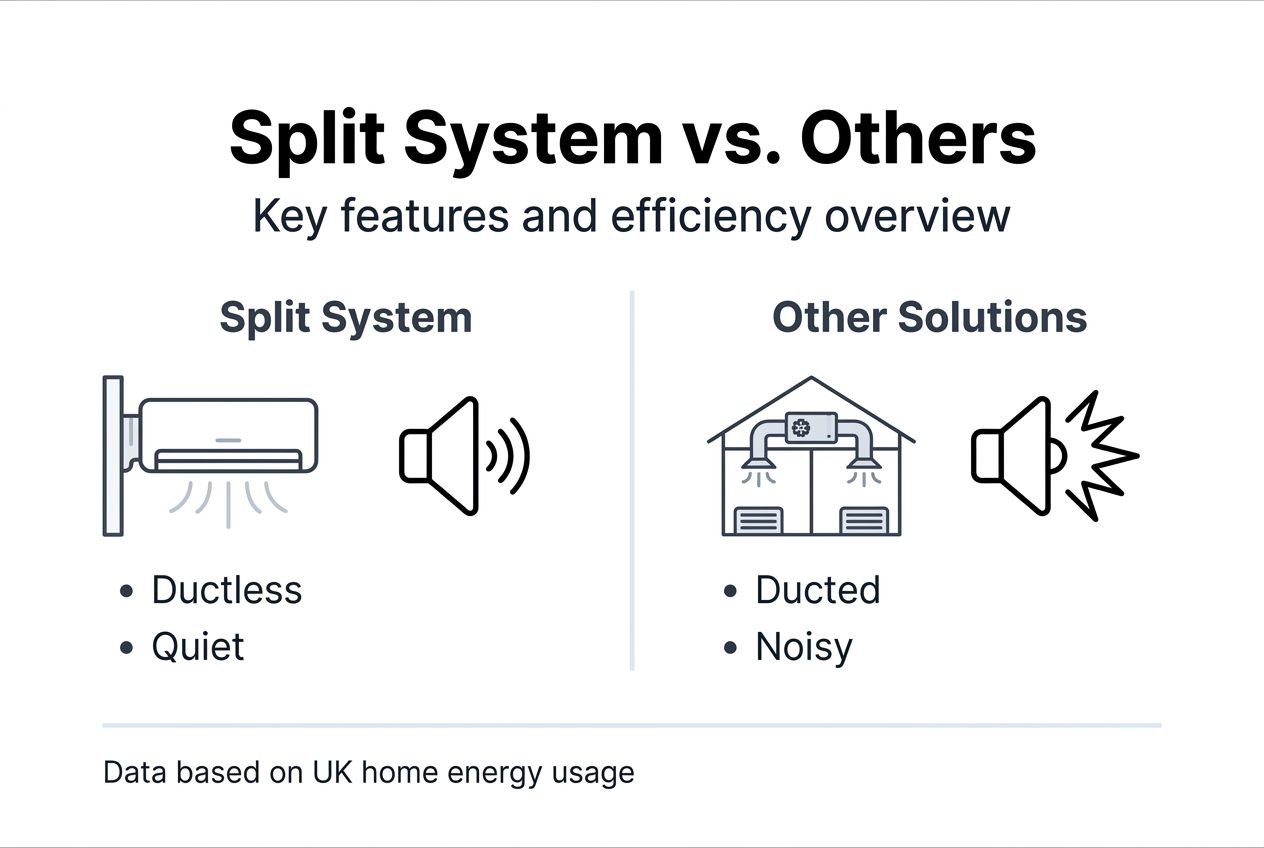
Split systems versus portable AC units shows even clearer benefits. Portable units consume more energy for equivalent cooling capacity, often using 30-40% more electricity. They generate considerable noise, typically 50-60 dB compared to split systems’ whisper-quiet 25 dB. Portable units require window venting with makeshift installations that leak conditioned air. Split systems provide permanent, professional installations with superior efficiency and aesthetics. The efficiency difference becomes especially apparent during extended use across summer months.
| Feature | Split System | Central AC | Portable AC |
|---|---|---|---|
| Installation cost | £1,500-£8,000 | £4,000-£12,000 | £200-£600 |
| Energy efficiency | Very high | Moderate | Low |
| Noise level indoors | 20-25 dB | 25-35 dB | 50-60 dB |
| Heating capability | Yes (heat pump) | No | No |
| Zoned control | Excellent | Limited | Single room |
| Maintenance needs | Low | Moderate | Minimal |
Installation complexity varies significantly. Central AC requires ductwork throughout your home, involving ceiling and wall modifications that take days or weeks. Split systems need only wall mounting and a single penetration point per indoor unit, typically completed in one day. Portable units require no installation but offer temporary, inefficient solutions.
Flexibility advantages make split systems particularly attractive. You can start with a single-room unit and expand to additional zones later without replacing existing equipment. Multi-split systems connect multiple indoor units to one outdoor unit, maintaining a tidy external appearance. This scalability suits growing families or changing space usage patterns.
Pro Tip: Choose the number of indoor units based on your home’s layout and usage patterns. Open-plan areas may need only one powerful unit, while separate rooms benefit from individual units for precise control.
Maintenance and longevity of split system air conditioning
Proper maintenance extends your split system’s lifespan and preserves its energy efficiency throughout years of service. Neglected systems lose efficiency gradually, increasing running costs while delivering diminished comfort.
Filter cleaning represents the most important routine task. Indoor unit filters trap dust, pollen, and airborne particles, protecting internal components whilst improving air quality. Clean filters every 2-4 weeks during heavy use periods. Simply remove the front panel, slide out the filters, rinse under warm water, and allow them to dry completely before reinstalling. This 10-minute task maintains optimal airflow and efficiency.
Annual professional servicing proves essential for long-term performance. Regular cleaning and professional servicing extend system life whilst improving efficiency by up to 20%. Qualified technicians check refrigerant levels, clean coils, inspect electrical connections, test safety controls, and identify potential issues before they become expensive failures.
Typical lifespan ranges from 12-15 years with proper care, though some well-maintained systems operate effectively for 20 years. Quality matters. Premium brands with robust components and good warranty coverage justify their higher initial cost through extended service life and fewer repairs.
Common failure points include:
- Compressor failure from refrigerant contamination or electrical issues
- Fan motor wear from continuous operation
- Refrigerant leaks at connection points
- Control board failures from power surges
- Blocked drainage causing water damage
Preventing these issues requires regular maintenance and prompt attention to warning signs. Strange noises, reduced airflow, ice formation on coils, or water leaks all signal problems needing professional diagnosis. Addressing minor issues early prevents cascading failures and expensive emergency repairs.
Maintenance costs remain reasonable. Annual professional servicing typically costs £80-£150 per system. Filter cleaning is free if you do it yourself. Compared to annual boiler servicing at similar prices, split system maintenance represents comparable ongoing investment for dual heating and cooling capability.
Energy savings from maintained systems add up significantly. A dirty filter reduces airflow, forcing the system to work harder and consume 10-15% more electricity. Clean coils improve heat exchange efficiency. Proper refrigerant levels ensure optimal performance. These maintenance benefits directly reduce your monthly energy bills.
Making the decision: is split system air conditioning right for your home?
Evaluating whether split system air conditioning suits your home involves balancing several practical considerations against your specific circumstances and priorities.
Installation costs versus long-term savings forms the primary calculation. Initial investment ranges from £1,500 for a single room to £8,000 for whole-home coverage. Split systems deliver ideal climate control for East Anglia homes, combining heating and cooling efficiently. Most homeowners recover costs through energy savings within 5-7 years, then enjoy continued savings for the system’s remaining 12-15 year lifespan.
Home suitability depends on several factors. Well-insulated properties maximise efficiency because less energy escapes through walls and windows. Properties with poor insulation benefit from upgrades before or alongside split system installation. Room layout affects indoor unit placement. Open-plan spaces may need only one unit, whilst separate rooms require multiple units for even coverage.
Consulting certified local installers familiar with East Anglia conditions ensures proper system sizing and placement. Regional climate patterns, typical temperature ranges, and local building characteristics all influence optimal equipment selection. Professional installers in Suffolk understand these nuances, recommending appropriate capacity and configuration for your specific property.
Smart control options enhance convenience and efficiency. WiFi-enabled systems let you adjust temperatures remotely via smartphone apps. Programmable schedules match heating and cooling to your daily routines, avoiding wasted energy when you’re away. Motion sensors detect occupancy, adjusting output automatically. These features maximise savings whilst maintaining comfort.
Maintenance planning ensures sustained performance. Budget £80-£150 annually for professional servicing. Commit to cleaning filters every 2-4 weeks during peak use. Factor these ongoing costs into your decision, recognising they’re comparable to boiler servicing whilst providing both heating and cooling.
Follow these steps for confident decision-making:
- Calculate your current heating and cooling costs to establish baseline spending
- Request quotes from certified installers for systems matching your home’s size and layout
- Compare projected energy savings against installation costs to determine payback period
- Evaluate financing options if upfront costs exceed available budget
- Consider starting with high-use areas then expanding coverage as budget allows
- Review warranty terms and local installer reputation before committing
Local expertise matters significantly. Installers familiar with Essex, Norfolk, and Suffolk conditions provide better guidance on system sizing and placement. They understand local building regulations, planning requirements, and typical installation challenges in period properties common throughout East Anglia.
Explore professional split system air conditioning installation in East Anglia
Ready to upgrade your home’s climate control with efficient split system technology? Akita Air Conditioning provides professional installation services throughout Suffolk, Norfolk, and Essex, bringing expert solutions to homeowners seeking year-round comfort and reduced energy bills.

Our certified installers deliver efficient, minimally invasive installations tailored to your home’s specific layout and requirements. We specialise in energy-efficient split systems with heat pump technology, maximising your savings whilst minimising environmental impact. From initial consultation through installation and ongoing maintenance, we ensure your system performs optimally for years to come.
Local expertise makes the difference. Our teams understand East Anglia’s climate patterns, building characteristics, and regulatory requirements. We’ve completed hundreds of installations across the region, from modern builds to listed period properties. Whether you need cooling for Saffron Walden, heating solutions in Halstead, or complete climate control in Colchester, we deliver professional service backed by comprehensive warranties.
Contact us today for a personalised quote and consultation. Discover how much you could save whilst enjoying enhanced comfort in every season.
Frequently asked questions about split system air conditioning
Can split system air conditioning work without ductwork?
Yes, split systems are specifically designed as ductless solutions. Indoor and outdoor units connect through a small hole in the wall carrying refrigerant piping, electrical wiring, and drainage tubing. This eliminates the need for extensive ductwork throughout your home, reducing installation costs and avoiding the 20-30% energy losses common in ducted systems.
How noisy are modern split system units inside my home?
Modern inverter-driven split systems operate extremely quietly, typically below 25 decibels indoors. This noise level is quieter than a whisper or the sound of rustling leaves. You’ll barely notice the indoor unit running during normal operation. Outdoor units produce 40-50 dB, comparable to a quiet conversation, and positioning them away from bedrooms minimises any disturbance.
What maintenance do split system units require yearly?
Split systems need minimal routine maintenance. Clean indoor unit filters every 2-4 weeks by rinsing under warm water, which takes about 10 minutes. Schedule annual professional servicing costing £80-£150, during which a technician checks refrigerant levels, cleans coils, inspects connections, and tests controls. This regular care extends system lifespan to 12-15 years whilst maintaining peak efficiency.
Can I install a split system myself or should I hire a professional?
You must hire a qualified professional for split system installation. The process requires handling refrigerant under legal regulations, making proper electrical connections, drilling through external walls precisely, and ensuring correct system charging for optimal performance. DIY installation risks equipment damage, voided warranties, refrigerant leaks, and building regulation violations. Professional installation typically takes one day and ensures safe, efficient operation.
Is a split system suitable for all UK home sizes and layouts?
Split systems suit most UK homes from flats to large detached properties. Single-room units handle spaces up to 40 square metres, whilst multi-split systems serve entire homes with multiple zones. They work particularly well in properties where ductwork installation is impractical, including period buildings, flats, and homes with solid walls. Open-plan layouts may need only one unit, whilst separate rooms benefit from individual units for precise temperature control in each space.