

Top air conditioning solutions for UK summer heat
TL;DR:
- UK summers now regularly exceed 35°C, making air conditioning a practical necessity.
- High-efficiency inverter systems with A+++ ratings save 30-50% energy and reduce running costs.
- Combining AC with passive measures like insulation and shading enhances comfort and efficiency.
UK summers are no longer the mild, overcast affairs they once were. Temperatures regularly breach 35°C in East Anglia, and older homes in Suffolk, Norfolk, and Essex, built long before cooling was a consideration, trap heat like an oven. Whether you manage a business premises or simply want a comfortable bedroom at night, choosing the right air conditioning system is now a practical necessity rather than a luxury. This guide walks you through the key selection criteria, the best system types for UK properties, how to maximise efficiency, and what to expect from costs and local installation in your area.
Table of Contents
- Key criteria for choosing air conditioning
- Best air conditioning systems for UK summers
- Maximising energy efficiency and comfort
- Costs, incentives, and finding local installers
- Our view: Why passive cooling still matters in the UK
- Move forward with expert cooling solutions
- Frequently asked questions
Key Takeaways
| Point | Details |
|---|---|
| Efficiency first | Modern inverter and A+++ systems use up to 50 percent less energy than older models. |
| Right-sized solutions | Correct system sizing and passive strategies are critical for comfort and low running costs. |
| Trust local experts | Choosing accredited local installers ensures tailored service and proper support in Suffolk, Norfolk, and Essex. |
| Take advantage of incentives | UK homeowners enjoy 0 percent VAT on domestic AC installs until 2027. |
Key criteria for choosing air conditioning
Before you browse systems or request quotes, it pays to understand what actually separates an efficient unit from an expensive one. The numbers that matter most are SEER (Seasonal Energy Efficiency Ratio) and EER (Energy Efficiency Ratio). SEER measures performance across a full cooling season, while EER measures it at peak load. A+++ energy label ratings represent the highest tier on the UK scale, with SEER values of 17 or above and EER values above 13 indicating genuinely high-efficiency systems.
Inverter technology is one of the biggest game-changers in modern air conditioning. Unlike older fixed-speed compressors that switch fully on or off, inverter units adjust their output continuously to match the room’s cooling demand. The result is that inverter AC systems use 30-50% less electricity than older models, with split systems capable of delivering 4kW of cooling from just 1kW of electricity input. That ratio, known as the Coefficient of Performance (COP), is what makes modern systems so cost-effective to run.
Sizing is where many installations go wrong. A unit that is too large for the room will cycle on and off constantly, wearing out components and wasting energy. A unit that is too small will run continuously without ever achieving the set temperature. Proper sizing requires a heat load calculation based on room dimensions, insulation quality, window area, and occupancy. Always ask your installer to show you these calculations before committing.
Building insulation and passive measures are your first line of defence. Loft insulation, draught-proofing, and reflective window film all reduce the cooling load your AC system needs to handle, which directly lowers your running costs. Our buying guide for UK air conditioning covers these pre-installation steps in detail.
Here is a quick summary of the key efficiency metrics to look for:
- SEER 14-16: Good efficiency, suitable for most UK homes
- SEER 17+: High efficiency, lower long-term running costs
- EER 11-12: Good for peak summer performance
- EER 13+: Excellent for hot spells like those seen in East Anglia
- A+++ label: Top-tier UK energy rating
| Metric | Good range | High efficiency |
|---|---|---|
| SEER | 14-16 | 17+ |
| EER | 11-12 | 13+ |
| UK energy label | A+ | A+++ |
| COP (cooling) | 3.5 | 4.0+ |
Pro Tip: Combine your AC system with simple passive cooling measures like blackout blinds and loft insulation. You will reduce your cooling load significantly, which means a smaller, cheaper system does the same job.
With core criteria in mind, let us explore the top energy-efficient air conditioning technologies available today.
Best air conditioning systems for UK summers
Not every system suits every property. The right choice depends on your building type, budget, and how many rooms you need to cool. Here is a breakdown of the main options suited to homes and businesses across Suffolk, Norfolk, and Essex.
Split systems are the most popular choice for UK homes and small offices. A wall-mounted indoor unit connects to an outdoor compressor, and the whole setup is quiet, discreet, and highly efficient. Brands like Daikin and Mitsubishi offer A+++ rated split systems that deliver excellent seasonal performance. Inverter models use 30-50% less electricity than older fixed-speed alternatives, making them the most cost-effective option for single-room cooling.
Portable AC units require no installation and can be moved between rooms. They are cheaper upfront, typically £300 to £600, but they are significantly less efficient than split systems and often struggle to cool rooms above 20 square metres. They also exhaust warm air through a hose, which needs to vent through a window, creating a gap that lets warm air back in. For anything beyond occasional use, they are rarely the best long-term investment.
Multi-split and VRF systems connect multiple indoor units to a single outdoor compressor. These are ideal for larger homes, offices, or commercial premises where you need to cool several rooms independently. Variable Refrigerant Flow (VRF) systems offer precise zone control and are common in commercial buildings across Norfolk and Essex.
For a clear comparison, see the table below:
| System type | Best for | Efficiency | Typical cost |
|---|---|---|---|
| Split system | Homes, single rooms | A+++ possible | £1,500-£3,000 |
| Portable AC | Temporary, small spaces | C-D rated | £300-£600 |
| Multi-split | Larger homes, offices | A++ to A+++ | £3,000-£8,000 |
| VRF/VRV | Commercial premises | A++ to A+++ | £8,000+ |
For a deeper look at all available formats, the guide on types of UK air conditioning systems is worth reading before you make a final decision. If you are concerned about upfront costs, there are also practical ways to save on AC installation in Suffolk and Essex without compromising on quality.
Now armed with selection criteria, consider which AC system format aligns with your property and goals.
Maximising energy efficiency and comfort
Installing the right system is only half the story. How you use and maintain it determines whether you actually see the efficiency figures promised on the label.
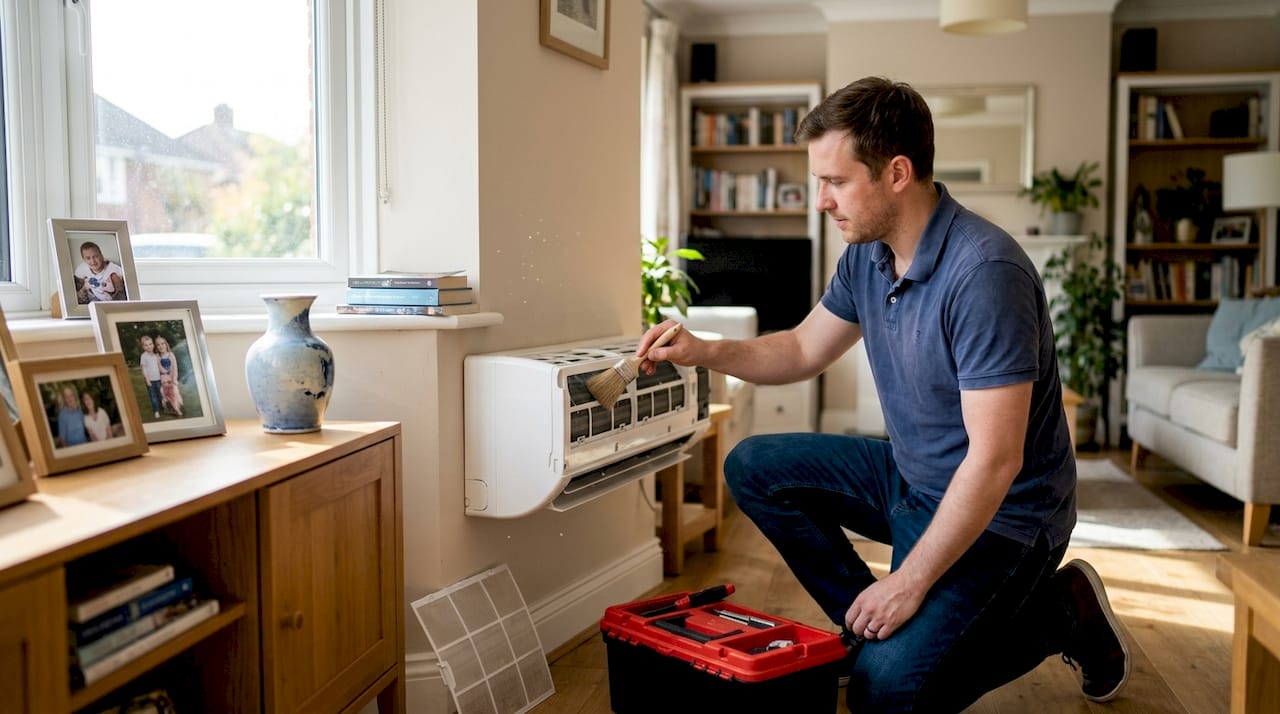
Professional installation is non-negotiable. Incorrect refrigerant charge, poor pipe routing, or badly positioned indoor units all reduce efficiency and can void your warranty. Once installed, an annual service keeps the system running at its rated performance. Filters should be cleaned every few weeks during heavy use, and outdoor units need to be kept clear of debris.
Passive cooling strategies work alongside your AC rather than against it. Night ventilation, where you open windows after sunset to flush out stored heat, reduces the temperature your system needs to overcome the next morning. Closing blinds or shutters on south and west-facing windows during the day can cut solar heat gain by up to 70%. Oversizing units reduces efficiency, and pairing AC with insulation and shading consistently delivers better results than relying on mechanical cooling alone.
“Insulation and shading are the foundation of any sensible cooling strategy. Air conditioning works best when it is the final layer, not the only layer.”
Smart thermostats and programmable controls are another practical tool. Setting your system to pre-cool a room before you arrive, rather than running it all day, cuts energy use substantially. Many modern Daikin and Mitsubishi units include Wi-Fi controls that let you manage the system from your phone.
Here are the key steps to get the most from your installation:
- Commission a proper heat load calculation before purchase
- Use a qualified, F-Gas registered installer
- Set the thermostat to 24-26°C rather than the lowest setting
- Clean filters every 2-4 weeks during summer
- Schedule an annual professional service
- Combine with night ventilation and window shading
Pro Tip: An A+++ system paired with external shading consistently outperforms a larger, lower-rated unit running without any passive measures. Invest in both for the best results.
For more detail on getting the best from your system, the tips on boosting AC efficiency and the case for upgrading for energy efficiency are both practical reads.
Costs, incentives, and finding local installers
Understanding the financial picture helps you plan realistically and avoid being caught out by hidden costs.
For a typical domestic split system installation in Suffolk, Norfolk, or Essex, expect to pay between £1,500 and £3,000 including labour and materials. Multi-split systems for larger homes start around £3,000 and can reach £8,000 depending on the number of indoor units. Commercial VRF installations vary widely based on building size and complexity.
Running costs depend on your system’s efficiency rating and how often you use it. A well-sized A+++ split system cooling a single room for eight hours a day typically costs between £0.50 and £1.20 per day at current electricity rates, significantly less than running an electric fan heater in reverse.
Local installers in Suffolk, Norfolk, and Essex such as Akita Air Conditioning offer A+++ rated systems from Daikin and Mitsubishi, with 0% VAT on domestic installations until 2027 and flexible finance options available. That VAT saving alone can reduce a £2,500 installation to £2,083, which is a meaningful difference.
Before committing to any installer, ask these questions:
- Are you F-Gas registered and fully qualified?
- Which brands and efficiency ratings do you recommend for my property?
- Can you provide a heat load calculation?
- What warranty and aftercare do you offer?
- Do you have local references or reviews in East Anglia?
- What finance options are available?
| Installer feature | What to look for |
|---|---|
| Certification | F-Gas registered, MCS accredited |
| Brands offered | Daikin, Mitsubishi, or equivalent A+++ rated |
| Finance options | 0% interest available |
| Aftercare | Annual service plans, warranty support |
| Local presence | Reviews and installations in Suffolk, Norfolk, Essex |
You can find qualified local AC installers across the region, with dedicated teams covering Suffolk AC services and Norfolk installation for both homes and businesses.
Our view: Why passive cooling still matters in the UK
It is easy to see air conditioning as the complete solution to UK summer heat, and we understand why. When temperatures hit 38°C and sleep becomes impossible, a split system feels like the answer to everything. But we think the honest view is more nuanced than that.
80% of UK homes overheated in 2022, which makes the case for mechanical cooling hard to argue against. Yet the same analysis flags real risks: widespread AC adoption puts enormous strain on the electricity grid during peak summer demand, and the cost of running these systems is not equally accessible to everyone.
Our experience installing systems across East Anglia tells us that the homes which benefit most from AC are those that have already addressed insulation, glazing, and ventilation. These properties need smaller, cheaper systems and spend less to run them. The homes that rely on AC as their only strategy end up with oversized units, high bills, and rooms that never quite feel right.
Investing in energy efficiency upgrades alongside a well-chosen AC system is the approach we consistently recommend. It is better for your bills, better for the grid, and better for long-term comfort.
Move forward with expert cooling solutions
If you are ready to keep your home or business cool through the summer months, the best next step is to speak with a local specialist who can assess your property and recommend the right system. Generic online quotes rarely account for the specific heat load, insulation quality, or layout of your building.
At Akita Air Conditioning, we install A+++ rated systems from leading brands across Suffolk, Norfolk, and Essex, with transparent pricing, 0% VAT on domestic installs, and flexible finance to spread the cost. Whether you need domestic installation for your home or a full commercial installation for your business premises, our local engineers are ready to help before the summer heat peaks.
Frequently asked questions
What is the most energy-efficient air conditioning system for UK homes?
Modern split or multi-split inverter systems with an A+++ rating offer the best efficiency, using 30-50% less electricity than older models.
How much does it cost to install air conditioning in Suffolk, Norfolk, or Essex?
Typical domestic installations range from £1,500 to £3,000 depending on system size, and 0% VAT applies to domestic installs until 2027, reducing the overall cost meaningfully.
Is it better to use passive cooling or air conditioning during UK heatwaves?
Experts recommend insulation and shading first, with AC as a supplement, since passive cooling is preferred to reduce grid strain and running costs.
What should I ask a local installer before committing?
Ask about F-Gas registration, which efficiency ratings they recommend for your property, available finance options, warranty terms, and whether they have local references from previous installations in East Anglia.