

How HVAC shapes energy savings and cuts your bills
TL;DR:
- HVAC systems account for up to 50% of UK building energy use, making them key to reducing emissions.
- Improving controls, maintenance, and upgrades can save over 30-40% energy, often without full replacement.
- Operational performance and proper commissioning are crucial, as actual energy use often exceeds model predictions.
Heating, ventilation, and air conditioning is frequently the single largest drain on energy in both UK homes and workplaces, yet most people focus on switching energy tariffs or buying the newest appliance rather than looking at what is already running constantly in the background. According to government housing data, HVAC systems are among the most significant consumers of energy across UK buildings, making them the single greatest lever for reducing bills and carbon emissions. The good news is that meaningful savings are within reach for almost every household and business, often without replacing everything.
Table of Contents
- Why HVAC systems matter for UK energy conservation
- How energy can be saved: Optimisation, upgrades and controls
- The performance gap: Why good design isn’t enough
- Key technologies for energy-efficient HVAC in the UK
- Making the right choices: Practical advice for homes and businesses
- Why operation matters more than specifications: A UK perspective
- Bringing energy-efficient HVAC to your home or business with Akita AC
- Frequently asked questions
Key Takeaways
| Point | Details |
|---|---|
| HVAC drives energy use | Heating, ventilation, and air conditioning make up a major share of UK energy bills and emissions. |
| Major savings possible | Upgrades and smart controls can cut HVAC energy costs by 25% or more in most cases. |
| Close the performance gap | True efficiency requires regular checks and smart controls, not just better equipment. |
| Choose and maintain wisely | Selecting the right system and maintaining it well ensures long-term savings. |
Why HVAC systems matter for UK energy conservation
Most people think of energy waste as lights left on or appliances on standby. The real culprit is usually climate control. HVAC systems are responsible for up to 50% of commercial energy use in the UK, and residential heating alone accounts for the majority of household bills. When you zoom out to the national picture, the figures become even more striking.
“Non-domestic operational energy is responsible for 23% of built environment emissions in the UK, making commercial HVAC optimisation a critical national priority.”
That is not a small problem. It means office blocks, retail units, warehouses, and hospitality venues are producing nearly a quarter of all built environment carbon. Improving how those systems operate is not just a cost-saving exercise; it is an environmental imperative.
| Building type | Estimated HVAC share of total energy use |
|---|---|
| Residential (UK average) | 55 to 65% |
| Commercial offices | Up to 50% |
| Retail and hospitality | 40 to 55% |
| Industrial units | 25 to 35% |
The reasons to focus on HVAC go well beyond the monthly bill. Here is why it matters:
- Cost reduction: Even modest efficiency gains translate to hundreds of pounds saved annually for homeowners and thousands for businesses.
- Carbon footprint: Cutting HVAC energy use directly reduces your property’s operational emissions.
- Comfort: Well-maintained systems deliver more consistent temperatures and better indoor air quality.
- Asset value: Energy Performance Certificate (EPC) ratings affect property values and rental eligibility, especially as regulations tighten.
- Regulatory compliance: Businesses face increasing legal pressure to demonstrate energy efficiency improvements.
You can read more about HVAC comfort and savings explained to understand how these factors interact in practice. Meanwhile, practical tips to reduce your energy bill show just how much of the low-hanging fruit sits within your HVAC setup rather than elsewhere in the building.
How energy can be saved: Optimisation, upgrades and controls
Understanding the scale of possible savings, we can now turn to closing the gap between what designs promise and how systems actually perform.
The evidence for HVAC savings is not theoretical. Empirical benchmarks from TM44 assessments show 30 to 40% energy savings are achievable, smart monitoring delivered 25% reductions in an office portfolio study, and occupancy-linked building management systems (BMS) produced 39.5% savings in documented cases. Those are not projections. They are measured results from buildings that made targeted changes.
The following table compares common UK upgrades and their typical energy savings:
| Upgrade or strategy | Typical energy saving |
|---|---|
| Smart thermostat installation | 10 to 15% |
| Demand-controlled ventilation (DCV) | 15 to 30% |
| Building management system (BMS) with occupancy sensors | 30 to 40% |
| Regular filter and coil maintenance | 5 to 10% |
| Replacing old R22 refrigerant systems | 20 to 30% |
| Upgrading to inverter-driven heat pumps | 25 to 45% |
These figures stack. A business that installs DCV, upgrades to a smart BMS, and commits to quarterly maintenance could plausibly cut HVAC energy consumption by more than half over time. The steps to get there are straightforward:
- Assess your current system. Understand what you have, its age, its efficiency rating, and its actual running costs.
- Maintain what you already own. Filter changes, coil cleaning, and refrigerant checks prevent efficiency degradation.
- Upgrade controls before replacing hardware. Smart controls often deliver rapid returns on investment without full system replacement.
- Monitor and adjust. Track performance data month by month and look for unexplained spikes in consumption.
Pro Tip: Smart thermostats and simple scheduling controls are among the fastest payback upgrades available. Many UK homeowners recover the cost within a single heating season, and businesses with multiple zones can see returns within months.
Following expert steps for efficient HVAC gives you a structured approach to each of these stages. If you are considering hardware changes as well, top HVAC upgrade tips cover the choices in depth.
The performance gap: Why good design isn’t enough
Closing the performance gap maximises savings, but which HVAC systems and technologies offer the best path forward for UK homes and businesses?
Here is an uncomfortable truth that the HVAC industry does not shout about loudly enough: a brilliantly designed system can perform terribly in practice. UK buildings use up to twice the modelled energy due to poor commissioning, inadequate controls, and operational neglect. This is known as the “performance gap,” and it affects new builds just as often as ageing stock.
The causes are surprisingly mundane:
- Systems are commissioned once at installation but never rechecked as usage patterns change.
- Controls are set by the installer and then left untouched for years.
- Occupancy changes are not reflected in ventilation or heating schedules.
- Filters and heat exchangers become clogged, forcing systems to work harder.
- Refrigerant levels drift below optimum, slashing cooling efficiency quietly.
Closing the performance gap does not require expensive new equipment in most cases. It requires attention:
- Routine recommissioning: Schedule a professional check every one to two years to verify that the system is operating as designed.
- Smart analytics: Modern BMS platforms flag anomalies before they become expensive failures.
- Ongoing monitoring: Real-time energy dashboards reveal when consumption spikes outside normal patterns.
- Occupancy-linked controls: Ensure ventilation and conditioning match actual building use, not an assumption from five years ago.
Pro Tip: Ask your HVAC engineer for post-installation performance data, not just the specification sheet numbers. If they cannot provide measured output figures after commissioning, push for them. The specification is a promise; the measured data is the reality.
Knowing where to start with HVAC maintenance steps prevents the slow efficiency decline that most buildings experience silently. If you suspect your system is underperforming, a structured HVAC diagnostics guide can help you identify exactly where energy is being lost.
Key technologies for energy-efficient HVAC in the UK
These technologies are the foundation for energy conservation, but knowing how to choose and apply them makes all the difference.

The UK’s existing heating stock tells an interesting story. Condensing boilers now make up 74% of UK homes, with an average Standard Assessment Procedure (SAP) rating of 67 nationally, while heat pumps are gaining ground rapidly thanks to IoT integration and machine learning controls that were simply not available a decade ago.
| Technology | Current UK adoption | Efficiency rating | Best suited for |
|---|---|---|---|
| Condensing gas boiler | 74% of homes | Up to 94% | Gas grid-connected properties |
| Air source heat pump | Growing rapidly | 250 to 400% (COP 2.5 to 4) | Well-insulated homes, new builds |
| Smart thermostat | Around 30% of homes | Saves 10 to 15% | All property types |
| Demand-controlled ventilation | Common in commercial | Saves 15 to 30% | Offices, schools, retail |
| BMS with IoT/ML | Growing in commercial | Saves 30 to 40% | Multi-zone commercial buildings |
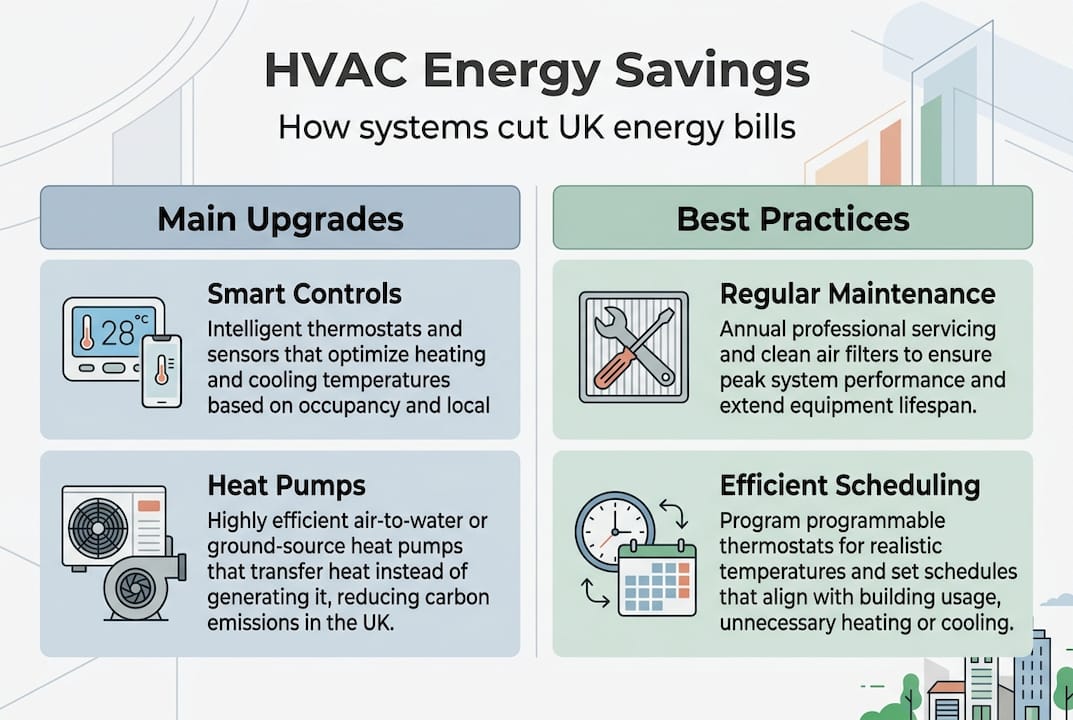
The technologies delivering the most significant real-world improvements right now include:
- Air source heat pumps: When paired with IoT monitoring, modern heat pumps can self-optimise their defrost cycles and output levels, reducing energy use compared to fixed-speed predecessors by a substantial margin.
- Condensing boilers with weather compensation: These adjust output based on outdoor temperature rather than running flat out regardless of conditions, cutting gas use noticeably.
- Smart thermostats with learning algorithms: Systems like these adapt to your routine rather than requiring manual scheduling, saving energy during periods you would not have thought to programme.
- Machine learning BMS platforms: In larger commercial settings, ML-driven systems analyse occupancy patterns, weather forecasts, and historical data to pre-condition spaces only when needed.
Pairing any of these technologies with good building fabric, such as energy-efficient shutters that reduce heat gain and loss through glazing, compounds the gains further. A thorough guide to choosing energy-efficient HVAC walks through how to match technology to your specific building. For those already weighing up a change, air conditioning upgrade guidance explains the practical and financial case clearly.
Making the right choices: Practical advice for homes and businesses
With this practical guidance, we can step back and consider what really drives lasting success in energy conservation.
The steps that deliver results differ slightly depending on whether you are managing a family home or a commercial property portfolio. Getting specific matters here because the wrong priority list wastes both time and money.
For homeowners, the recommended sequence is:
- Change filters every three months and have coils professionally cleaned annually.
- Install a smart thermostat and configure heating and cooling zones if your system supports them.
- Book a professional service inspection to check refrigerant levels, duct integrity, and controls calibration.
- Review your EPC rating. If it is below band C, identify which HVAC upgrades would improve it most cost-effectively.
- Consider whether a heat pump is viable for your property, especially if you are planning insulation improvements.
For business operators, the priorities shift toward systemic thinking:
- Commission a TM44 inspection if your building uses air conditioning, as this is a legal requirement for many commercial premises.
- Install demand-controlled ventilation sensors in meeting rooms, open-plan areas, and storage spaces where occupancy varies.
- Audit energy consumption by zone using sub-metering to identify which areas are consuming disproportionately.
- Evaluate whether a BMS upgrade with IoT monitoring would deliver a return on investment within two to three years based on your current energy spend.
- Set quarterly energy performance reviews and assign responsibility for acting on anomalies.
Pro Tip: One of the most common and costly mistakes businesses make is upgrading equipment without addressing controls first. Replacing an old chiller with a high-efficiency unit, then running it on the same poorly configured schedule as before, captures only a fraction of the available savings. Fix the controls, then upgrade the plant.
Whatever stage you are at, understanding the reasons to upgrade HVAC in full helps you build a business case that secures buy-in from decision-makers and landlords alike.
Why operation matters more than specifications: A UK perspective
There is a belief, widespread among both homeowners and facilities managers, that once you have installed a certified, high-efficiency system you are done. The hard truth is that the specification sheet is where efficiency potential lives. Operations are where it either materialises or disappears.
Real-world building performance can be 3.5 times worse than achievable, even in BREEAM-certified buildings. That certification confirms that a building was designed and constructed to meet certain standards. It says very little about how the systems are actually being run two years later, after the original commissioning engineer has moved on and the controls have been adjusted by whoever inherited the role.
This is the core insight that most energy efficiency guides miss: the certificate on the wall and the bill on the desk often tell completely different stories. We see this repeatedly when working with commercial clients who assumed their “green” building was performing as specified, only to discover through monitoring that actual consumption was running at multiples of what the model predicted.
The government is beginning to recognise this through Home Energy Model (HEM) metrics, which push for measurement of actual fabric performance, real heating output, and genuine smart control behaviour rather than just ticking compliance boxes. But policy moves slowly. The practical answer for any building owner or manager is to stop trusting labels and start trusting data.
Track comfort levels across zones. Monitor your energy bills against degree-days (a measure of how cold it has been, which normalises your consumption for weather variation). Set up alerts when consumption drifts outside expected ranges. That discipline, applied consistently, delivers more sustained savings than any single equipment upgrade ever will.
Understanding why efficient HVAC matters in the longer term reinforces why this operational focus is not optional but central to achieving genuine conservation outcomes.
Bringing energy-efficient HVAC to your home or business with Akita AC
If you have read this far, you understand that energy-efficient HVAC is not simply about buying the newest equipment. It is about design, installation quality, controls, and ongoing attention to how the system actually performs.

At Akita Air Conditioning, we work with homeowners and businesses across Suffolk, Essex, Norfolk, and the wider East Anglia region to deliver exactly that. From domestic air conditioning solutions that keep your home comfortable year-round with minimal running costs, to commercial air conditioning systems designed for multi-zone precision and measurable ROI, our approach centres on performance that you can actually see in your bills. We offer transparent pricing, flexible finance options, and ongoing maintenance memberships so that your system keeps performing long after installation day. If you are ready to take a practical next step, get in touch with our team for a no-obligation assessment.
Frequently asked questions
How much can I actually save on energy bills by improving HVAC?
Research shows 25% to 40% energy savings are achievable through smart optimisation, monitoring, and targeted upgrades, with the best results coming from combining controls improvements with regular professional maintenance.
What is the first step to make my HVAC more efficient?
Start with a professional inspection to establish a baseline, then address controls and scheduling before committing to equipment replacement, since poor commissioning and controls are the leading causes of HVAC energy waste.
Are heat pumps always better than boilers for UK homes?
Both can deliver high efficiency when properly installed and maintained; condensing boilers remain in 74% of UK homes and perform well in most conditions, while heat pumps excel in well-insulated properties where their higher coefficient of performance can be fully realised.
What is TM44 and do businesses need to comply?
TM44 is a mandatory air conditioning inspection for UK commercial buildings with systems above a certain output threshold, and compliance is a legal requirement in most workplaces, with studies showing TM44 inspections reveal 30 to 40% savings potential in assessed buildings.
Does a green building certificate guarantee low energy use?
No. Real-world performance can be 3.5 times worse than the modelled figures even in certified buildings, which is why ongoing monitoring and operational discipline matter far more than the certification alone.