

HVAC retrofitting explained: Upgrade your home for comfort and savings
TL;DR:
- HVAC retrofitting in UK homes emphasizes a whole-house approach, prioritizing insulation and air sealing.
- Proper assessment and measured heat loss data help specify appropriately sized, efficient systems, avoiding oversizing.
- Benefits include reduced energy bills, improved comfort, healthier indoor air, and lower carbon emissions.
Many UK homeowners assume the fastest route to lower energy bills is simply swapping their ageing boiler for the largest heat pump they can afford. In practice, that approach often backfires, producing oversized systems that cycle on and off inefficiently and drive up running costs instead of cutting them. HVAC retrofitting takes a more measured, whole-house view, addressing insulation, air leakage, and system sizing together to deliver genuine comfort and meaningful savings. This guide covers exactly what retrofitting involves, how the process unfolds step by step, and which solutions suit different property types across the UK.
Table of Contents
- What is HVAC retrofitting and why does it matter?
- Step-by-step: How HVAC retrofitting works in UK homes
- Retrofitting options: Choosing the right solution for your home
- Benefits of HVAC retrofitting: Comfort, savings, and sustainability
- A smarter approach: Why measured data and whole-house thinking trump guesswork
- Next steps: Get expert help with home HVAC retrofitting
- Frequently asked questions
Key Takeaways
| Point | Details |
|---|---|
| Measured data matters | Assessing real heat loss enables right-sizing and cost-effective retrofits. |
| Fabric-first approach | Upgrading insulation before HVAC leads to better comfort and prevents damp. |
| Multiple retrofit options | Choose from hybrid systems, discreet units, or underfloor heating for tailored solutions. |
| Government grants available | Schemes like BUS and ECO reduce the cost of energy-efficient upgrades. |
| Sustainable benefits | Retrofitting cuts bills, boosts health, and lowers your home’s carbon footprint. |
What is HVAC retrofitting and why does it matter?
HVAC retrofitting means upgrading or modifying your existing heating, ventilation, and air conditioning system rather than demolishing and replacing everything from scratch. The goal is to make the system more energy efficient, lower carbon, and better matched to the actual thermal needs of your home.
In the UK context, this matters enormously. Millions of homes were built before modern insulation standards existed, and many are still heated by oversized gas boilers running far above the temperatures needed for everyday comfort. Fuel costs have climbed sharply in recent years, and the government has set legally binding targets to decarbonise home heating. Retrofitting bridges the gap between where most homes are today and where they need to be.
A well-designed retrofit does not simply bolt a new appliance onto an unchanged building. It follows a structured philosophy often called the fabric-first approach, which means sealing air leaks, upgrading loft and wall insulation, and improving windows or doors before touching the heating system itself. The logic is straightforward: a leaky, poorly insulated home will overwhelm any heat pump, no matter how expensive. Fix the envelope first, and suddenly a much smaller, cheaper system becomes adequate.
“A fabric-first approach is essential to avoid damp and mould. Measuring actual heat loss using methods such as SmartHTC allows right-sizing of heat pumps, avoiding oversizing. Hybrid systems work well for transitional periods, and grants such as the Boiler Upgrade Scheme, ECO4, and the Great British Insulation Scheme all support the process.” Home Retrofit Guide
Key reasons UK homeowners should consider retrofitting:
- Lower energy bills through right-sized, efficient systems and reduced heat loss
- Improved comfort with even temperatures, fewer draughts, and better humidity control
- Healthier indoor air thanks to improved ventilation and reduced condensation risk
- Access to government grants that reduce the upfront cost significantly
- Higher property value as energy performance certificates improve
- Reduced carbon emissions in line with UK net-zero commitments
The financial case is particularly strong right now. Several grant schemes remain open, and the technology has matured to the point where installations are faster and more reliable than they were even five years ago.
Step-by-step: How HVAC retrofitting works in UK homes
Understanding the sequence of a retrofit removes a lot of the anxiety homeowners feel about committing to such a project. Each stage builds on the last, and skipping steps is where things go wrong.
-
Initial home survey. A qualified assessor visits the property to examine wall construction, loft insulation depth, window specification, and the existing heating system. They note draughty areas and record room dimensions. This stage gives a baseline picture of where energy is being lost.
-
Measuring actual heat loss. Standard desk-based calculations use assumed figures for insulation performance. Tools such as SmartHTC measure actual heat loss by monitoring indoor and outdoor temperatures over several days. This real-world data often shows that a home retains heat better than expected, which directly reduces the size and cost of the heat pump needed.
-
Fabric upgrades. Before any new equipment is specified, the survey findings drive targeted improvements. Typical work includes topping up loft insulation to current standards, installing cavity or external wall insulation where feasible, draught-proofing around doors and windows, and sometimes fitting secondary or double glazing. These measures reduce peak heat demand, which is the figure that determines system size.
-
System selection and specification. With accurate heat loss data in hand, an installer can specify the right heat pump size, decide whether a hybrid approach is needed, and design the distribution system, whether that is radiators, underfloor heating, or a combination. At this stage the HVAC diagnostics process also reviews existing ductwork or pipework to confirm it can handle the new system.
-
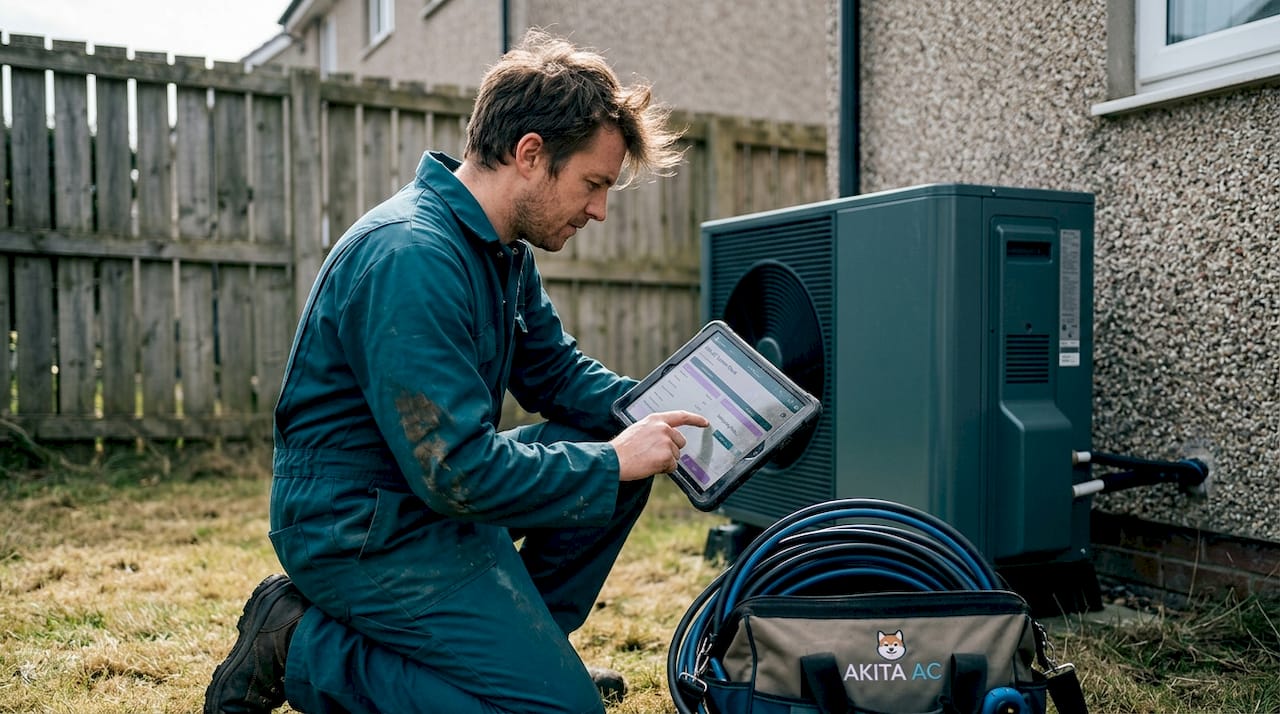
Installation by a certified engineer. In the UK, heat pump installers must hold MCS (Microgeneration Certification Scheme) accreditation for grant eligibility. The engineer fits the outdoor and indoor units, commissions refrigerant circuits, connects to the hot water cylinder, and integrates any smart controls. Good HVAC servicing practices at installation set the system up for long-term reliability.
-
Commissioning and monitoring. The system is tested under real operating conditions, settings are fine-tuned, and the homeowner is shown how to use the controls. Many modern systems include remote monitoring dashboards so that performance can be tracked and optimised over time.
Pro Tip: Ask your installer to provide the measured heat loss figure in writing before they specify any equipment. If they quote a heat pump size based purely on the floor area of your home without measuring actual loss, push back and request a proper assessment.
Retrofitting options: Choosing the right solution for your home
Not every home suits a straightforward air source heat pump installation. The UK housing stock is extraordinarily varied, ranging from Victorian terraces and 1930s semis to post-war concrete construction and modern new builds. Understanding the available options helps you have an informed conversation with your installer and choose a path that genuinely suits your property.
| Property type | Recommended approach | Key consideration |
|---|---|---|
| 1930s semi-detached | Hybrid boiler and heat pump | Cavity wall insulation often feasible first |
| Victorian terrace | Fabric upgrades then small heat pump | Solid walls need external or internal insulation |
| Listed building | Discreet AC units, underfloor heating | Preserving character requires specialist solutions |
| Post-war bungalow | Air source heat pump with underfloor heating | Low roof profile suits ground-mounted outdoor units |
| Modern new build | Heat pump or MVHR system | Already well insulated; system sizing straightforward |
For homes where a full heat pump swap feels like too big a leap, hybrid heating systems offer a practical middle ground. A hybrid setup pairs your existing gas boiler with a heat pump. The heat pump handles the majority of heating duties, running most efficiently at mild outdoor temperatures, while the boiler takes over on the coldest days. Running costs fall significantly because the heat pump generates roughly three units of heat for every unit of electricity it consumes.
Listed buildings and older properties with distinctive architectural features present a specific challenge. Planning constraints can prevent external wall insulation or large outdoor units. In these cases, retrofit specialists often specify discreet, low-profile air conditioning and heating units that blend into the building fabric, alongside underfloor heating installed beneath existing flooring with minimal disruption. Measured heat loss data for a 1930s home revealed that insulation performance was considerably better than standard assumptions predicted, which meant the heat pump could be sized smaller and at lower cost than the desktop calculation suggested.
Key things to consider when choosing your retrofit option:
- Whether your existing radiators are large enough to work at the lower flow temperatures heat pumps prefer
- The size and accessibility of your outdoor space for heat pump placement
- Your hot water demand, since heat pumps produce hot water differently from gas boilers
- Whether you want cooling as well as heating, which some energy-efficient HVAC systems can deliver from a single installation
Benefits of HVAC retrofitting: Comfort, savings, and sustainability
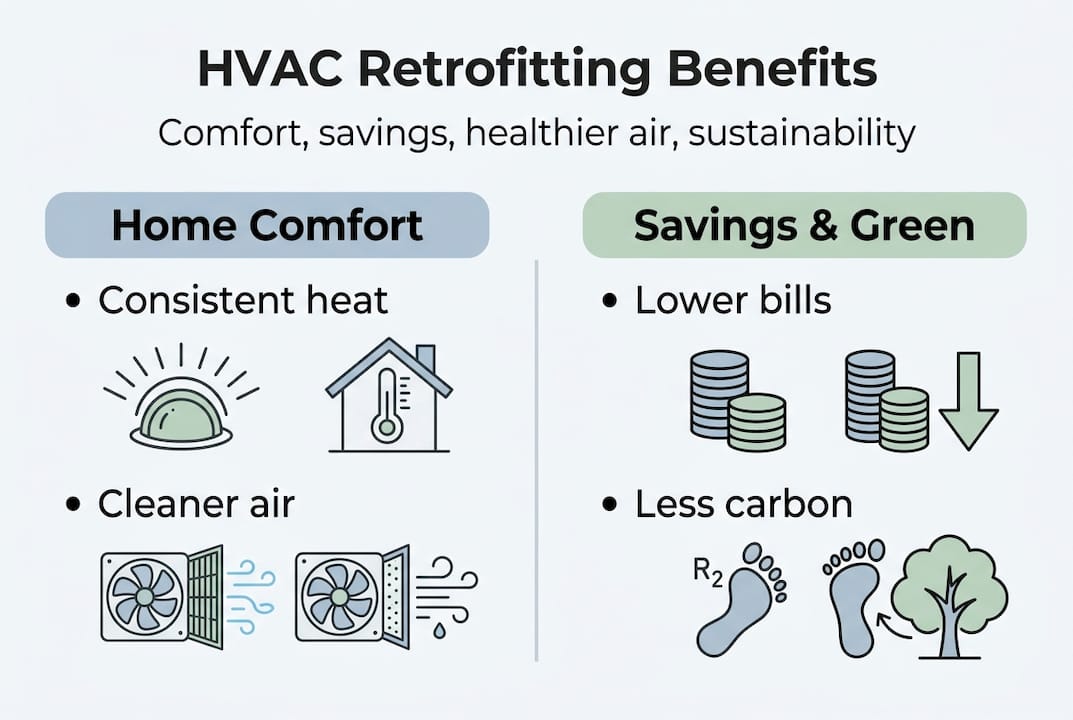
The case for retrofitting goes well beyond energy bills. The benefits stack up across financial, health, and environmental dimensions, making it one of the highest-return home improvement projects available to UK homeowners today.
Financial savings are the most immediate motivator. The Boiler Upgrade Scheme currently offers grants of £7,500 towards the cost of an air or ground source heat pump, and Warm Homes grants provide additional support for fuel-poor households. These incentives meaningfully reduce the payback period, especially when combined with lower running costs from a well-specified system.
| Benefit area | What retrofitting delivers |
|---|---|
| Energy bills | Reduction in annual heating costs, particularly when replacing old gas systems |
| Government grants | Up to £7,500 via BUS, additional ECO4 and insulation scheme support |
| Indoor air quality | Better ventilation reduces humidity, dust, and allergen build-up |
| Carbon footprint | Significant reduction when heat pump is powered by renewable electricity |
| Property value | Higher EPC rating increases saleability and mortgage options |
| Comfort | Even temperatures throughout the home, no cold spots or draughts |
Healthier indoor air is a benefit that often surprises homeowners. A poorly ventilated, cold house creates conditions where condensation forms on walls and windows, encouraging mould growth. Mould spores aggravate respiratory conditions and can be particularly harmful for children and elderly residents. A properly retrofitted home with mechanical ventilation and heat recovery (MVHR) continuously introduces fresh air while recovering the heat from outgoing stale air. The result is a warmer, drier, and genuinely healthier living environment.
The whole-house approach to HVAC upgrades also prevents expensive reactive repairs. Homes with chronic damp problems often end up spending thousands on plastering, decoration, and structural repairs that could have been avoided by addressing ventilation at the source.
Sustainability is increasingly important to homeowners who want to future-proof their investment. A heat pump running on the UK electricity grid today produces roughly a third of the carbon emissions of a gas boiler per unit of heat. As the grid continues its shift towards wind and solar generation, that carbon advantage grows automatically without any changes to your system.
Pro Tip: When calculating the payback period for your retrofit, include the value of any grants you qualify for and factor in the expected rise in energy costs over the next decade. The numbers usually look considerably more compelling than a simple upfront cost comparison suggests.
Thinking about comfort alongside energy savings is the right mindset. Many homeowners who retrofit report that the improvement in day-to-day living comfort matters more to them than the bill reduction, particularly in older properties that were previously cold, draughty, and damp.
A smarter approach: Why measured data and whole-house thinking trump guesswork
Here is something the HVAC industry does not talk about enough: oversizing is far more common than undersizing, and it causes real problems. A heat pump that is too large for the home it serves short-cycles, which means it switches on and off frequently rather than running in long, efficient stretches. Short-cycling causes wear, reduces efficiency, and can lead to the condensation problems homeowners were trying to avoid in the first place.
The traditional approach of sizing a system based on floor area and rule-of-thumb assumptions reliably produces oversized recommendations. It is not dishonest, but it is imprecise. Contractors who quote large systems are partly protecting themselves against complaints from cold customers. The result is that UK homeowners routinely pay for more equipment than they need.
Measured heat loss data consistently shows that real-world insulation performance in UK homes is better than desktop models predict. Walls and roofs accumulate additional insulating capacity over time as they are decorated, lined, and modified. Older homes often retain heat more effectively than their construction date implies.
The smarter approach is to boost system efficiency through evidence rather than optimism or caution. Measure the actual heat loss. Seal the envelope first. Then specify the smallest system that comfortably meets the measured demand. You end up with a cheaper installation, lower running costs, and a system that operates in long, efficient cycles rather than constant short bursts.
Whole-house thinking compounds this advantage. Treating insulation, ventilation, heating, and cooling as an integrated system rather than separate projects prevents the mismatches that create problems. A home that gets new triple glazing without addressing extract ventilation will experience condensation elsewhere. A home that installs a heat pump without checking radiator sizing will struggle to reach comfortable temperatures. The details interconnect, and getting them right requires a holistic perspective rather than a piecemeal one.
Our view is this: do not rush the specification stage. The time and money invested in proper assessment pays back many times over in a retrofit that performs as promised from day one.
Next steps: Get expert help with home HVAC retrofitting
Retrofitting your home is one of the most impactful improvements you can make for long-term comfort and energy savings. The key is working with installers who understand the whole-house approach and will take the time to measure your home properly before specifying a system.

At Akita Air Conditioning, we specialise in domestic air conditioning installation across Suffolk, Norfolk, and Essex, with a clear focus on right-sized, energy-efficient solutions. Whether you want to explore a fixed-price AC installation or need advice on a full retrofit for an older property, our team can help. We cover the full East Anglia region and are happy to discuss government grant eligibility as part of your initial consultation. Contact us today to take the next step towards a warmer, cheaper, and more sustainable home.
Frequently asked questions
What does a fabric-first approach mean for HVAC retrofitting?
A fabric-first approach focuses on upgrading insulation and sealing the home’s envelope before changing the HVAC system, which prevents damp and mould and ensures the new system is sized correctly. Fabric-first is essential because a leaky home will overwhelm even an expensive, well-specified heat pump.
Are grants available to help pay for HVAC retrofitting in UK homes?
Yes, the Boiler Upgrade Scheme currently offers £7,500 towards heat pump installations, and ECO4 and the Great British Insulation Scheme provide further support for eligible households. Checking your eligibility before specifying work can significantly reduce the net cost of your retrofit.
Is a larger heat pump always better for UK retrofits?
No, measured insulation data frequently shows that a smaller heat pump is sufficient, costs less to buy and run, and avoids the short-cycling that damages efficiency and longevity. Bigger is rarely better when the home’s fabric has been properly addressed first.
What are hybrid HVAC systems and when are they used?
Hybrid systems pair a traditional gas boiler with a heat pump, allowing each to operate when it is most efficient and providing a practical stepping stone for homes where a full heat pump installation is not yet feasible. They are particularly useful in older properties during transitional periods before full fabric upgrades are complete.