

Examples of climate control solutions for UK homes and businesses
TL;DR:
- Common climate control solutions for UK properties include heat pumps and air conditioning, affected by building specifics like insulation and space requirements. Proper sizing, smart controls, and boosting insulation are crucial for efficiency, cost savings, and regulatory compliance. Akita offers surveys and tailored recommendations to optimize home comfort and energy savings through suitable technology selection.
Common climate control solutions for UK properties include air source heat pumps, ground source heat pumps, split and ducted air conditioning, VRF/VRV systems, mechanical ventilation with heat recovery (MVHR), underfloor heating, hybrid systems paired with solar PV, and smart controls. Air source heat pumps deliver roughly three units of heat for every unit of electricity consumed, giving a coefficient of performance (COP) of approximately 3. Under the Energy Performance of Buildings Regulations, any air-conditioning system with an effective rated output above 12 kW requires a periodic inspection report covering efficiency, sizing, and improvement options.
Which solution fits your property depends on building age, insulation level, whether you need heating, cooling, or both, and whether you plan to add solar panels or battery storage. Akita surveys properties across Suffolk, Norfolk, and Essex and can advise on the right combination.
- Air source heat pump: best for well-insulated homes and most commercial spaces; pairs well with underfloor heating
- Ground source heat pump: steadier winter performance, higher groundworks cost
- Split or ducted air conditioning: rapid cooling, lower capital cost, suits offices and homes needing cooling only
- VRF/VRV system: multi-zone control for larger buildings
- MVHR: improves air quality in airtight buildings and recovers heat from extracted air
- Underfloor heating: low-temperature distribution, ideal with heat pumps
- Hybrid system (heat pump + solar PV + battery): highest potential savings, suits properties with roof space
- Smart controls and time-of-use tariffs: measurable bill reductions with minimal disruption
Table of Contents
- What are the main climate control technologies and where does each one fit?
- How do running costs and efficiency compare across these systems?
- What UK regulations and sizing rules do you need to know?
- How do smart controls and time-of-use tariffs cut your bills?
- How do you choose the right system for your property?
- Which system suits your building type?
- Key takeaways
- What installers wish you knew before the survey
- Akita can survey your property and recommend the right solution
- Useful sources and further reading
What are the main climate control technologies and where does each one fit?
Understanding how climate control works across different technologies helps you shortlist options before speaking to an installer.
Air source heat pumps extract heat from outdoor air and transfer it inside. A COP of around 3 means they are far cheaper to run than direct electric heating, and they work in temperatures well below freezing. They suit well-insulated detached and semi-detached homes, and many commercial buildings. Noise from the outdoor unit is modest on modern inverter-driven models, typically 45–55 dB at one metre.
Ground source heat pumps use buried pipework to extract heat from the ground, which stays at a more stable temperature than air. Performance is steadier in cold spells, but installation requires significant groundworks — either trenches or boreholes — and a larger upfront investment.
Split and ducted air conditioning covers everything from a single-room wall-mounted unit to a fully ducted system serving multiple zones. These systems cool quickly and efficiently, and modern units carry strong SEER (seasonal energy efficiency ratio) and SCOP (seasonal coefficient of performance) ratings. Capital cost is lower than heat pumps, making them a practical first step for homes or offices that need cooling rather than heating.
VRF/VRV systems use variable refrigerant flow to serve multiple indoor units from one outdoor unit. They scale well for larger homes, hotels, and commercial buildings where different zones need independent temperature control simultaneously.
MVHR recovers heat from stale extracted air and transfers it to fresh incoming air. It does not heat a building on its own, but it dramatically improves air quality and reduces ventilation heat loss in airtight new builds or deep retrofits.
Underfloor heating distributes warmth at low flow temperatures, which suits heat pumps perfectly. It is disruptive to install in existing floors but can be laid in screed during extensions or renovations.
Hybrid systems combine a heat pump with solar PV panels, battery storage, and a thermal store. Trials including GenGame and Wondrwall reported running cost reductions exceeding 50% in controlled settings when all components were integrated.
Passive measures — insulation, draught-proofing, and external shading — are not HVAC systems, but they reduce the load on every active system. Addressing them first often means a smaller, cheaper heat pump or AC unit.
Pro Tip: Before specifying any active system, ask your installer to run a heat-loss calculation. A building with poor insulation will need a larger, more expensive unit — and will still be uncomfortable.
How do running costs and efficiency compare across these systems?
Boosting air conditioning efficiency starts with understanding what the key metrics actually mean. COP measures heating output per unit of electricity; SEER measures cooling output over a season; SCOP measures heating output over a season. Higher numbers mean lower running costs.
| Technology | Efficiency signal | Capital complexity | Installation disruption |
|---|---|---|---|
| Air source heat pump | COP ≈ 3 | Medium | Medium (pipework, cylinder) |
| Ground source heat pump | COP ≈ 3 | High | High (groundworks) |
| Split/ducted AC | SEER/SCOP varies | Low–Medium | Low–Medium |
| VRF/VRV | SEER/SCOP varies | Medium–High | Medium |
| MVHR | Heat recovery 70% | Medium | Medium–High (ductwork) |
| Underfloor heating | Low flow temp (35–45°C) | Low–Medium | High (floor build-up) |
| Hybrid (HP + PV + battery) | COP + solar offset | High | High |
| Smart controls only | around 20% or greater bill reduction | Low | Very low |
Running costs depend on more than the headline COP figure. Insulation quality, control strategy, tariff choice, and how occupants use the system all shift the real-world number. A smart-grid-ready heat pump carries a typical upfront premium of £200–£700 but can deliver annual savings of £150–£380 depending on the home’s heating demand and tariff shape. Homes with larger heating loads benefit most, because there are more hours of operation to shift to cheaper overnight periods.
Air source heat pumps produce roughly three units of heat for every one unit of electricity consumed — making them one of the most efficient heating options available to UK homeowners today.
Payback timescales for higher-capital options like ground source heat pumps or full hybrid systems are longer, but pairing any heat pump with solar PV and a time-of-use tariff accelerates the return. Energy Saving Trust modelling across over a million combinations of heat pump, battery, and tariff options confirms that control strategy and renewable integration are the top levers for reducing household energy bills.
What UK regulations and sizing rules do you need to know?
Correct HVAC sizing is not just a technical nicety — it directly affects running costs, comfort, and legal compliance.
Under the Energy Performance of Buildings (England and Wales) Regulations 2012, air-conditioning systems with an effective rated output above 12 kW must have periodic inspection reports. Those reports must assess efficiency, sizing, and suggest improvements or alternatives. This applies to many small commercial systems and larger domestic installations.
Oversized systems short-cycle: they reach the set temperature quickly, switch off, and repeat — reducing efficiency and wearing components faster. Undersized systems run continuously and still fail to meet demand on cold days. Neither outcome is acceptable.
A professional survey should cover:
- Heat-loss calculation for every zone
- Radiator or emitter compatibility with target flow temperatures
- Electrical supply capacity (heat pumps often need a dedicated circuit)
- Ventilation requirements and any airtightness improvements planned
- Commissioning plan and expected timeline
Checklist to request from any installer:
- Target COP/SCOP/SEER figures for the proposed system
- MCS accreditation (or equivalent) evidence
- Projected running costs based on your actual usage pattern
- Disruption timeline and phasing plan
- Written commissioning report on completion
Pro Tip: Always ask whether the installer will balance radiators and tune weather compensation after commissioning. Many efficiency problems trace back to systems that were installed but never properly set up.
How do smart controls and time-of-use tariffs cut your bills?
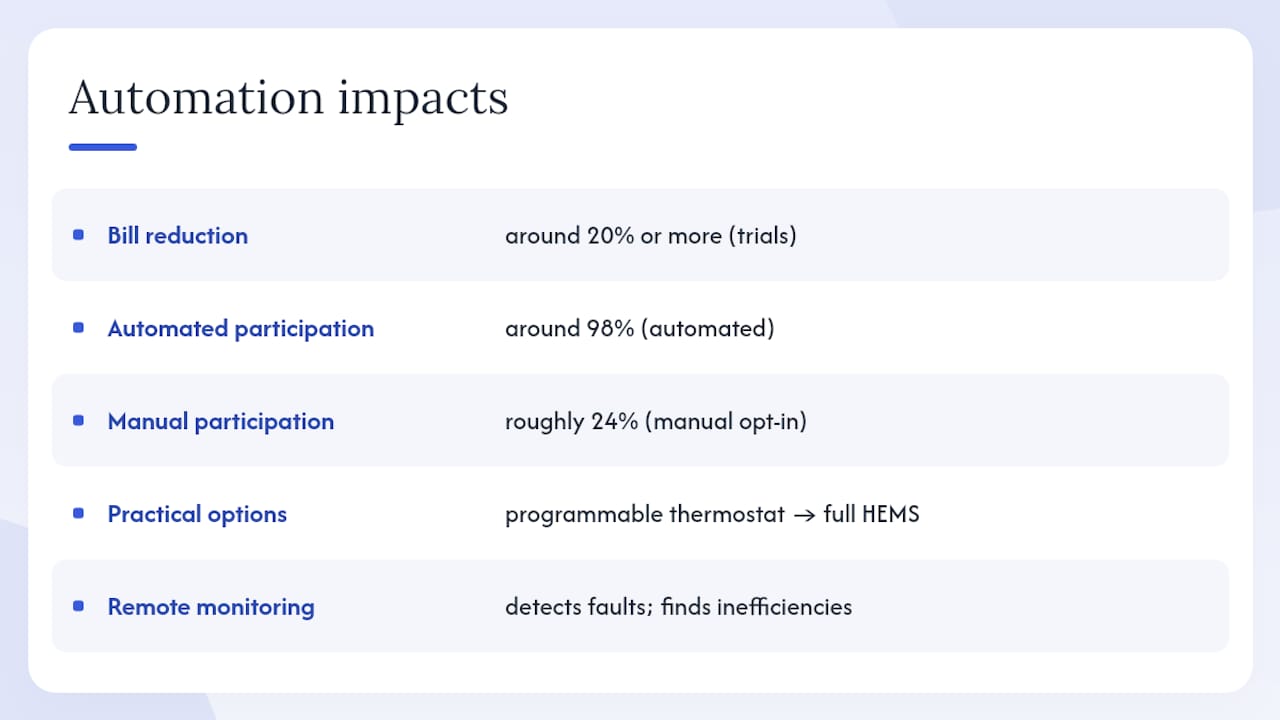
Automating a heat pump for smart climate controls and time-of-use tariffs can reduce electricity bills by around 20% or more without any loss of comfort, according to Heat Pump Ready project findings. That figure comes from real-world trials, not laboratory conditions.
Automation trial results showed bill reductions of roughly 20% or more when heat pumps were configured for weather compensation and time-of-use tariff operation.
The practical options range from a basic programmable thermostat to a full home energy management system (HEMS) that coordinates the heat pump, solar panels, battery, and EV charger. Weather compensation adjusts flow temperature based on outdoor conditions, which is more efficient than a fixed set-point. Load shifting moves operation to cheaper overnight periods on tariffs like Octopus Go or Economy 7.
Automated participation in grid flexibility events also matters. Heat Pump Ready trials found automated participation rates of around 98%, compared with roughly 24% when householders had to opt in manually each time. That gap represents real money left on the table.
Remote monitoring platforms can detect early faults and prompt recommissioning before efficiency degrades. Platforms trialled in Heat Pump Ready projects identified inefficiencies that occupants would never have noticed.
Pro Tip: Plan internet connectivity at the point of installation. Many heat pumps are installed without it, which locks out remote diagnostics, smart-tariff operation, and future firmware updates.
How do you choose the right system for your property?
Follow three steps: get a proper survey with a heat-loss calculation, shortlist technologies by fit and budget, then verify controls, integration, and aftercare before signing anything.
Questions to ask every installer:
- Are you MCS-accredited for this technology?
- How many similar buildings have you installed in?
- Will you provide a written commissioning report?
- How will weather compensation be configured?
- What provision is there for smart controls or future PV/battery integration?
Red flags:
- Sizing based on floor area alone, with no heat-loss calculation
- Refusal to test the system in situ after installation
- No commissioning report offered
- No discussion of emitter compatibility or insulation
Heat pump retrofit case studies consistently show that staged upgrades — insulation first, then emitter changes, then the heat pump — produce better outcomes than fitting the unit and hoping for the best.
Decision drivers to weigh:
- Building age and current insulation level
- Whether you need heating, cooling, or both
- Occupants’ comfort priorities (humidity, air quality, noise)
- Heating versus cooling balance across the year
- Plans for solar PV, battery storage, or EV charging
Which system suits your building type?
Detached older home (retrofit): Start with insulation and draught-proofing, then fit an air source heat pump with larger radiators or underfloor heating in any extension. A buffer tank smooths operation. Consider a hybrid approach if the gas boiler is still serviceable. Eco-friendly HVAC upgrades for older homes typically take two to four weeks including emitter changes.
Mid-terrace retrofit: Space is tighter, so a smaller air source heat pump or a high-efficiency ductless split unit for cooling often makes more sense than ground source. MVHR becomes worth considering if airtightness improves significantly. Timeline is typically one to two weeks for a straightforward installation.
Small shop or office: Ducted AC or a VRF/VRV system gives multi-zone control without a central plant room. If the total output exceeds 12 kW, inspection obligations apply from day one. A maintenance contract keeps the system compliant and efficient.
New build: Heat pump with MVHR and underfloor heating is the natural combination. Design for low flow temperatures (35–45°C), specify smart controls at the build stage, and leave conduit for future PV and battery integration. This is the lowest-disruption scenario because everything goes in before the finishes.
Key takeaways
Heat pumps, smart controls, and correct sizing are the three factors that most determine whether a climate control system delivers on its promise in a UK property.
| Point | Details |
|---|---|
| Heat pump efficiency | Air source heat pumps produce roughly three units of heat per unit of electricity (COP ≈ 3), making them the most efficient all-electric heating option. |
| Smart controls save money | Automating for weather compensation and time-of-use tariffs can cut electricity bills by around 20% or more without reducing comfort. |
| Inspection obligation | Air-conditioning systems above 12 kW effective rated output require periodic inspection reports under UK regulations. |
| Sizing matters | Always request a heat-loss calculation; oversized or undersized systems waste energy and reduce comfort regardless of technology. |
| Akita for local surveys | Akita installs and commissions heat pumps, AC, and smart controls across Suffolk, Norfolk, and Essex with written commissioning reports included. |
What installers wish you knew before the survey
The most common surprises on site are not technical failures — they are preparation gaps. Insufficient insulation means the heat pump has to work harder than the design assumed. Missing internet connectivity means smart-tariff operation and remote diagnostics are unavailable from day one. Radiators sized for a 70°C flow temperature from a gas boiler often need replacing or supplementing when the system switches to a heat pump running at 45°C.
Akita’s approach is to flag these issues during the survey, not after installation. A staged plan — insulation improvements first, emitter checks second, system installation third — consistently produces better efficiency and fewer callbacks than fitting equipment into an unprepared building. Retrofit case studies back this up: the homes that perform well are the ones where the installer and homeowner agreed on preparation steps before the unit arrived.
Written commissioning reports, remote monitoring options, and transparent maintenance contracts are not optional extras. They are how you verify the system is working as designed and catch problems before they become expensive.
Akita can survey your property and recommend the right solution
Choosing between heat pumps, air conditioning, MVHR, and smart controls is straightforward once you have accurate data on your building. Akita carries out detailed surveys covering heat-loss calculations, emitter compatibility, electrical supply checks, and smart-grid readiness — then recommends the system that fits your property, budget, and comfort priorities, not the one that is easiest to install.

For homeowners, Akita handles domestic air conditioning and heat pump installations across Suffolk, Norfolk, and Essex, with flexible finance options and a written commissioning report on every job. Business managers can book a commercial installation survey covering multi-zone systems, inspection compliance for systems above 12 kW, and ongoing maintenance contracts. Get in touch to request a quote or book a survey — Akita will confirm availability and outline a realistic timeline for your property.
Useful sources and further reading
- Air source and ground source heat pumps — Energy Saving Trust
- Smart and flexible heat pumps — Heat Pump Ready thematic report (DESNZ)
- The Energy Performance of Buildings (England and Wales) Regulations 2012
- A domestic heat pump: a year in review — UKGBC
- Approved Document L: Conservation of fuel and power, Volume 1: Dwellings
- MCS accreditation — check installer credentials