

Why correct HVAC sizing is essential for UK properties
TL;DR:
- Proper HVAC sizing matches the system’s capacity to the building’s actual thermal needs.
- Oversized or undersized systems lead to higher energy costs, discomfort, and equipment wear.
- Accurate heat loss calculations are essential for compliant, efficient, and long-lasting HVAC setups.
Most UK homeowners assume that when it comes to HVAC, bigger always means better. It’s an understandable assumption, but it’s wrong, and it costs people real money every year. An oversized system short-cycles, meaning it switches on and off too frequently, wasting energy and wearing out components faster than necessary. An undersized one runs constantly and still fails to keep you comfortable. Getting the size right is the single most important decision in any HVAC project, and yet it’s the step most often skipped or guessed at. This article explains what sizing really means, how it affects your bills and comfort, and what you need to do to get it right.
Table of Contents
- What is HVAC system sizing and why does it matter?
- How HVAC sizing affects energy efficiency and running costs
- Key factors influencing correct HVAC sizing in the UK
- Modern best practice: Sizing for heat pumps and low-carbon technologies
- How to ensure your HVAC system is sized correctly
- The common pitfalls and what most UK homeowners miss
- Expert help with HVAC sizing and installation
- Frequently asked questions
Key Takeaways
| Point | Details |
|---|---|
| Right-sizing matters | The correct HVAC size improves comfort, reduces energy bills, and extends the lifespan of your system. |
| Regulation-driven | UK laws now require detailed sizing calculations for efficiency and compliance, especially for heat pumps. |
| Unique UK factors | Insulation, solar gain, and property design all significantly influence HVAC sizing needs in Britain. |
| Professional assessment | Always rely on expert calculations—not guesswork—for your HVAC installation or upgrade. |
What is HVAC system sizing and why does it matter?
HVAC sizing is not about the physical dimensions of the unit. It refers to the heating or cooling capacity of the system, measured in kilowatts (kW), and whether that capacity matches the actual thermal demands of your property. Get it right and you have a system that runs efficiently, keeps you comfortable, and lasts for years. Get it wrong and you face higher bills, uneven temperatures, and premature equipment failure.
The science behind sizing relies on two core calculations. For heating, engineers assess heat loss: how much warmth escapes through your walls, roof, windows, and through ventilation. For cooling, they assess heat gain: how much warmth enters the building from the sun, occupants, and appliances. These calculations are not guesswork. Heat loss calculations use fabric loss (U-values multiplied by area and temperature difference), plus ventilation and infiltration losses, following standards such as BS EN 12831 and CIBSE guides.
Several factors feed into these calculations:
- Floor area and ceiling height of every room
- Insulation levels in walls, floors, and loft
- Window type and size (single, double, or triple glazing)
- Air leakage rate of the building
- Orientation and exposure to sun or wind
- Occupancy levels and internal heat sources
When a system is too large, it reaches the target temperature quickly and shuts off before completing a full cycle. This is called short-cycling, and it prevents the system from properly dehumidifying the air, leaving rooms feeling clammy even when the temperature reads correctly. It also causes mechanical stress on the compressor, which is the most expensive component to replace.
When a system is too small, it runs continuously trying to meet demand. It never quite gets there on the coldest or hottest days, and the constant operation accelerates wear.
“The right-sized system is not the most powerful one available. It’s the one that precisely matches your building’s real thermal needs.”
Understanding comfort and energy savings starts with accepting that sizing is a technical process, not a sales decision.
How HVAC sizing affects energy efficiency and running costs
With an understanding of what sizing is, let’s explore its real-world impact on efficiency and operating expenses.
The link between correct sizing and lower energy bills is direct. A properly sized system operates in longer, steadier cycles. This is far more efficient than the repeated start-stop pattern of an oversized unit, which draws a surge of electricity every time it restarts. Over a year, that adds up to a meaningful difference on your energy bills.
| Scenario | Energy use | Comfort level | Equipment lifespan |
|---|---|---|---|
| Correctly sized | Optimal | Consistent | Full expected life |
| Oversized | Higher than necessary | Uneven, humid | Shortened |
| Undersized | Very high | Poor, inconsistent | Severely shortened |
For UK properties specifically, the stakes are rising. UK Part L energy rules now mandate formal heat loss calculations before installing energy-efficient systems, require low flow temperatures of 55°C or below, and support the shift to heat pumps. The Future Homes Standard, due to take full effect in 2026, phases out gas boilers in new builds entirely. This means sizing is no longer just good practice. It is a legal requirement.
Pro Tip: Ask your installer to show you the actual heat loss calculation document before any equipment is ordered. If they cannot produce one, that is a serious warning sign.
For homeowners looking at energy efficient HVAC, correct sizing is the foundation everything else is built on. Choosing the most efficient unit on the market means very little if it is the wrong size for your home. Similarly, businesses reviewing options for choosing an energy efficient system should treat the sizing calculation as a non-negotiable starting point.
Practical steps to protect your running costs:
- Insist on a room-by-room heat loss calculation, not a whole-house estimate
- Verify that the calculation accounts for your specific insulation and glazing
- Check that the proposed system capacity falls within 10% of the calculated load
- Review your bills in the first winter or summer season after installation
If you are planning to upgrade your HVAC for comfort, getting the size right first is the most cost-effective decision you can make.
Key factors influencing correct HVAC sizing in the UK
So, what goes into deciding the correct size for your property’s HVAC system?
UK properties present a particularly varied challenge. You have Victorian terraces with solid brick walls sitting next to 2020s new builds with triple glazing and mechanical ventilation. Each requires a completely different approach.

Insulation and air tightness are the two biggest variables. A poorly insulated 1970s semi-detached home loses heat at a dramatically different rate than a modern passive house. Air changes per hour directly affect heat loss calculations, and default assumptions of 0.6 air changes per hour can be wildly inaccurate for draughty older properties, where the real figure might be 1.6 or higher.
| Property type | Typical insulation | Likely ACH | Sizing implication |
|---|---|---|---|
| Pre-1980 solid wall | Poor | 1.2 to 1.8 | Larger system needed |
| 1980s cavity wall | Moderate | 0.8 to 1.2 | Mid-range system |
| Post-2010 new build | Good | 0.4 to 0.7 | Smaller system viable |
| Commercial office | Variable | Depends on ventilation | Zone-by-zone assessment |
Here is a numbered breakdown of the key factors your installer must assess:
- Fabric heat loss: U-values for every wall, floor, ceiling, and window
- Ventilation and infiltration: Actual air change rate, not a default figure
- Solar gain: South-facing rooms with large windows need cooling capacity adjustments
- Internal gains: Occupancy, lighting, and equipment heat output (critical for commercial)
- Building exposure: Wind-exposed properties lose heat faster
- Zone requirements: Multi-room or multi-floor properties may need individual calculations per zone
For businesses, the calculation is more complex. A busy restaurant kitchen generates enormous internal heat. A server room needs continuous cooling regardless of outdoor temperature. These edge scenarios make professional assessment non-negotiable. Exploring system types for UK properties can help you understand which configurations suit different building types before you commission a survey.
Modern best practice: Sizing for heat pumps and low-carbon technologies
With those key factors in mind, how do modern heat pumps and low-carbon systems change sizing best practice?
Heat pumps work very differently from gas boilers, and this changes everything about how they should be sized. A gas boiler can be oversized with relatively little penalty because it simply modulates its output. A heat pump is far less forgiving. Oversizing a heat pump wastes energy because the COP (Coefficient of Performance, a measure of efficiency) drops significantly at low load conditions.
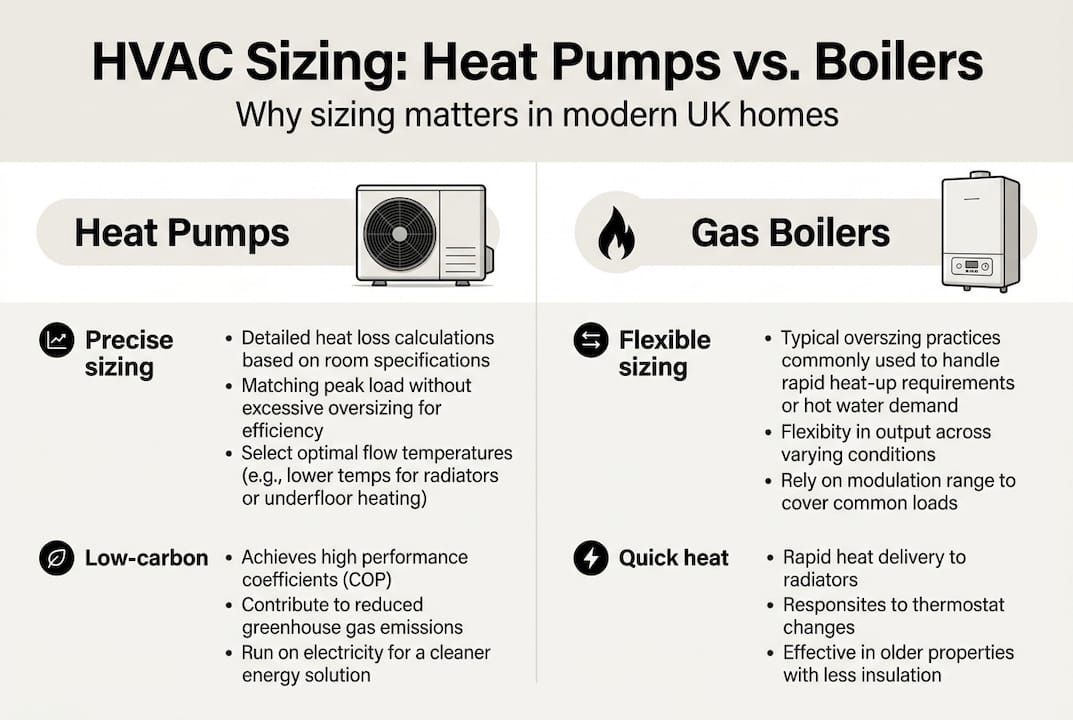
The COP is the ratio of heat output to electricity input. A heat pump running at its designed load might achieve a COP of 3.5, meaning it produces 3.5 kW of heat for every 1 kW of electricity consumed. An oversized unit running at partial load might achieve only 2.0 or lower. That difference directly increases your electricity bill.
Key principles for heat pump sizing:
- Size for low flow temperatures: Heat pumps work best delivering water at 35°C to 45°C, not the 70°C+ of a traditional boiler
- Match emitters to the system: Underfloor heating or oversized radiators are needed to distribute heat effectively at low temperatures
- Do not oversize for peak demand: A correctly sized heat pump handles 95% of heating hours; a backup element covers the coldest days
- Account for defrost cycles: In cold UK winters, heat pumps periodically defrost, briefly reducing output
Pro Tip: If your installer suggests a heat pump significantly larger than your calculated heat loss figure, ask them to justify it in writing. A 10 to 15% buffer is reasonable. Anything beyond that should raise questions.
For anyone considering whether to upgrade air conditioning for efficiency, understanding how heat pump sizing works is essential before committing to any system.
How to ensure your HVAC system is sized correctly
Ready to apply these insights? Here’s how to move from knowledge to a right-sized system.
The process starts well before any equipment is purchased. A proper sizing exercise follows a clear sequence:
- Commission a site survey: A qualified engineer visits your property and records all relevant data, including dimensions, construction type, insulation, and glazing
- Request a formal heat loss calculation: This must follow Part L regulations and reference standards such as BS EN 12831
- Review the output: You should receive a document showing the calculated heat loss or gain per room, and the total system capacity recommended
- Cross-reference with equipment specifications: The proposed unit’s rated output should match the calculated requirement within a sensible margin
- Verify after installation: In the first heating or cooling season, monitor whether the system maintains target temperatures without running continuously or short-cycling
“Demand a calculation, not a quote based on floor area alone. Any professional worth hiring will have no problem providing one.”
Warning signs that your system may have been incorrectly sized include rooms that never reach the set temperature, the unit running for very short cycles (under five minutes), unusually high energy bills from the first month, and excessive noise from the system working too hard.
Understanding the HVAC system lifecycle helps you recognise when sizing errors are causing premature wear. Investing in regular HVAC maintenance can also help catch sizing-related issues early. If you suspect a problem, an HVAC diagnostics guide can walk you through the signs to look for.
The common pitfalls and what most UK homeowners miss
After seeing a significant number of UK properties struggle with sizing mistakes, a pattern becomes very clear. The problem is almost never the equipment itself. It is the assessment that came before it, or more accurately, the assessment that never happened.
Rule-of-thumb sizing, such as assuming a fixed kW per square metre, is a shortcut that ignores everything that makes your property unique. UK housing stock is extraordinarily varied. A rule of thumb that works for a modern flat in Norwich will be completely wrong for a Victorian farmhouse in Suffolk.
What concerns us most is how the regulatory landscape is tightening. As carbon targets loom and the Future Homes Standard takes hold, installers who skip proper calculations will find themselves on the wrong side of compliance. That could leave homeowners with systems that fail building regulations sign-off.
Our advice is simple: demand transparency. Ask your installer for the calculation methodology, the standards they are following, and the specific output figure they are designing to. If they cannot answer those questions clearly, find someone who can. Proper sizing is what separates a system that genuinely delivers comfort and energy savings from one that simply looks right on paper.
Expert help with HVAC sizing and installation
If you want the peace of mind that comes with a right-sized system, here’s how we can help.
At Akita Air Conditioning, every installation begins with a thorough site survey and a formal heat loss or heat gain calculation. We do not guess, and we do not use shortcuts. Whether you are a homeowner looking for a reliable domestic air conditioning solution or a business in need of a precisely specified commercial air conditioning system, we size every project to your actual requirements.

Our team covers Suffolk, Norfolk, and Essex, and we are fully up to date with Part L requirements and the Future Homes Standard. Get in touch today for a no-obligation survey and find out exactly what your property needs.
Frequently asked questions
What happens if my HVAC system is too big for my home?
An oversized system short-cycles, switching on and off too frequently, which wastes energy and shortens equipment life. Oversizing a heat pump also causes the COP to drop significantly, meaning you pay more electricity for less heat output.
How do UK regulations affect HVAC system sizing?
Approved Document L requires formal heat loss calculations before installing systems such as heat pumps, and mandates low flow temperatures of 55°C or below to support energy efficiency targets.
What’s the first step to getting the right size HVAC for my property?
Always start with a professional site survey followed by a heat loss or heat gain calculation using recognised standards. Heat loss calculations following BS EN 12831 give a far more accurate result than any rule-of-thumb estimate.
Can insulation quality influence my HVAC requirements?
Absolutely. Better insulation reduces the rate of heat loss, which can lower the system capacity you need. Poor insulation increases loads significantly, meaning an undersized system will struggle and an oversized one will short-cycle even more noticeably.