

HVAC system types for UK homes and businesses 2026
Choosing the wrong HVAC system is a surprisingly costly mistake, yet most UK homeowners and business owners make the decision based on price alone. The reality is that upgrading HVAC systems can save up to 30% in energy costs, which over a decade adds up to thousands of pounds. With so many system types on the market, from compact wall-mounted splits to large commercial VRF networks, knowing which one suits your property is the difference between a comfortable, efficient building and an expensive headache. This guide cuts through the confusion and gives you a clear, practical breakdown of every major HVAC type available in the UK.
Table of Contents
- What is an HVAC system?
- Main types of HVAC systems explained
- How each HVAC system works
- Comparing HVAC systems for efficiency and cost
- Choosing the right HVAC system for your UK property
- Expert tips and pitfalls to avoid
- Find the right HVAC installation for your property
- Frequently asked questions
Key Takeaways
| Point | Details |
|---|---|
| Know your options | There are several types of HVAC systems each with unique pros, costs, and ideal applications. |
| Efficiency standards matter | Modern systems like heat pumps and variable flow units can deliver 20–60% energy savings. |
| Tailor choice to property | Choosing based on your property’s size, insulation, and layout ensures maximum comfort and value. |
| Invest for long-term benefits | Upgrading an HVAC system cuts bills, reduces emissions, and can increase your property’s value. |
What is an HVAC system?
HVAC stands for heating, ventilation and air conditioning. It is the umbrella term for all the technology that manages the temperature, air quality, and humidity inside a building. If you want a deeper look at the topic, our what is HVAC guide covers the fundamentals in full.
HVAC systems manage heating, ventilation and air conditioning for indoor environments, keeping occupants comfortable regardless of what the British weather is doing outside. Modern systems go well beyond a simple boiler and radiator setup. A single unit can now heat in winter, cool in summer, filter allergens, and control humidity year-round.
Here is what a complete HVAC system typically covers:
- Heating: Boilers, heat pumps, or hybrid systems that maintain warmth during colder months
- Ventilation: Mechanical or natural airflow that removes stale air and brings in fresh air
- Air conditioning: Cooling and dehumidifying indoor spaces during warmer periods
- Air quality control: Filtration systems that remove dust, pollen, and pollutants
- Controls: Thermostats, sensors, and smart systems that manage everything automatically
For UK properties, a well-chosen HVAC system is not a luxury. It is an investment in comfort, health, and energy efficiency.
Main types of HVAC systems explained
HVAC systems are categorised into split systems, ducted/central systems, VRF/VRV systems, and packaged units, each designed for different property sizes and use cases. Understanding the differences helps you avoid overspending on a system that is too large, or underspending on one that cannot do the job. You can also explore UK air conditioning types for a more detailed residential breakdown.
| System type | Best for | Typical installation cost | Key advantage |
|---|---|---|---|
| Single split | Single rooms, small homes | £1,500 to £3,500 | Simple, affordable |
| Multi-split | Larger homes, multiple rooms | £3,000 to £7,000 | One outdoor unit |
| Ducted/central | Large homes, offices | £8,000 to £15,000 | Discreet, whole-building |
| VRF/VRV | Commercial, large residential | £12,000 to £50,000 | Precise zoned control |
| Packaged unit | Retail, industrial sites | £5,000 to £20,000 | Compact, all-in-one |
| Portable/window | Temporary, budget use | £200 to £800 | No installation needed |
Here is a quick summary of each type:
- Split systems are the most common choice for UK homes. A wall-mounted indoor unit connects to an outdoor compressor. Single splits serve one room; multi-splits serve several rooms from one outdoor unit.
- Ducted systems push conditioned air through hidden ductwork, making them ideal for new builds or large offices where aesthetics matter.
- VRF/VRV systems use variable refrigerant flow to serve dozens of zones simultaneously, with each zone independently controlled. These are the gold standard for commercial buildings.
- Packaged units house all components in a single outdoor cabinet. They suit flat-roofed commercial premises where indoor space is limited.
- Portable and window units require no permanent installation but are the least efficient option. For more on AC system types, this external resource is useful.
Pro Tip: If you are retrofitting an older UK property without existing ductwork, a ductless split or multi-split system will almost always be the most cost-effective and least disruptive choice.
How each HVAC system works
Knowing the name of a system is one thing. Understanding how it actually heats, cools, and ventilates your space helps you make a smarter purchase and get more from your investment.

Heating in modern HVAC systems comes from three main sources. Traditional gas boilers burn fuel to heat water, which then circulates through radiators. Heat pump basics work differently: they extract heat energy from outside air or the ground and transfer it indoors, using far less electricity than they produce in heat. Hybrid systems pair a heat pump with a boiler, switching between the two depending on outdoor temperature for maximum efficiency.
Ventilation is where many property owners leave significant savings on the table. There are three main control strategies:
- CAV (constant air volume): Supplies a fixed amount of air regardless of demand. Simple but wasteful.
- VAV (variable air volume): Adjusts airflow to match actual demand in each zone. VAV saves 20 to 40% energy compared to CAV systems.
- DCV (demand-controlled ventilation): Uses CO2 or occupancy sensors to supply air only when and where it is needed. DCV can save 40 to 60% compared to constant-volume systems.
Cooling is delivered through direct expansion (DX) units, which are the refrigerant-based systems found in most splits and VRF setups, or through chillers, which cool water that is then circulated through fan coil units in larger buildings. Inverter technology is worth understanding: an inverter-driven compressor ramps up and down to match demand rather than switching fully on and off, which cuts energy use significantly.
“The choice of ventilation control strategy is one of the most impactful decisions you can make for long-term energy performance in any building.”
For a full breakdown of how controls affect performance, our guide to HVAC controls is an excellent next read.
Comparing HVAC systems for efficiency and cost
Efficiency ratings can feel like alphabet soup, but three matter most for UK buyers. SEER (Seasonal Energy Efficiency Ratio) measures cooling efficiency over a season. SCOP (Seasonal Coefficient of Performance) measures heating efficiency. COP (Coefficient of Performance) is a snapshot efficiency at a single operating point. Higher numbers always mean lower running costs.
Upgrading from SEER 9 to SEER 14 can cut running costs by 30%, and heat pumps typically achieve an SCOP of 3.5 to 4.5, meaning they produce 350 to 450 units of heat for every 100 units of electricity consumed. No gas boiler can match that ratio.
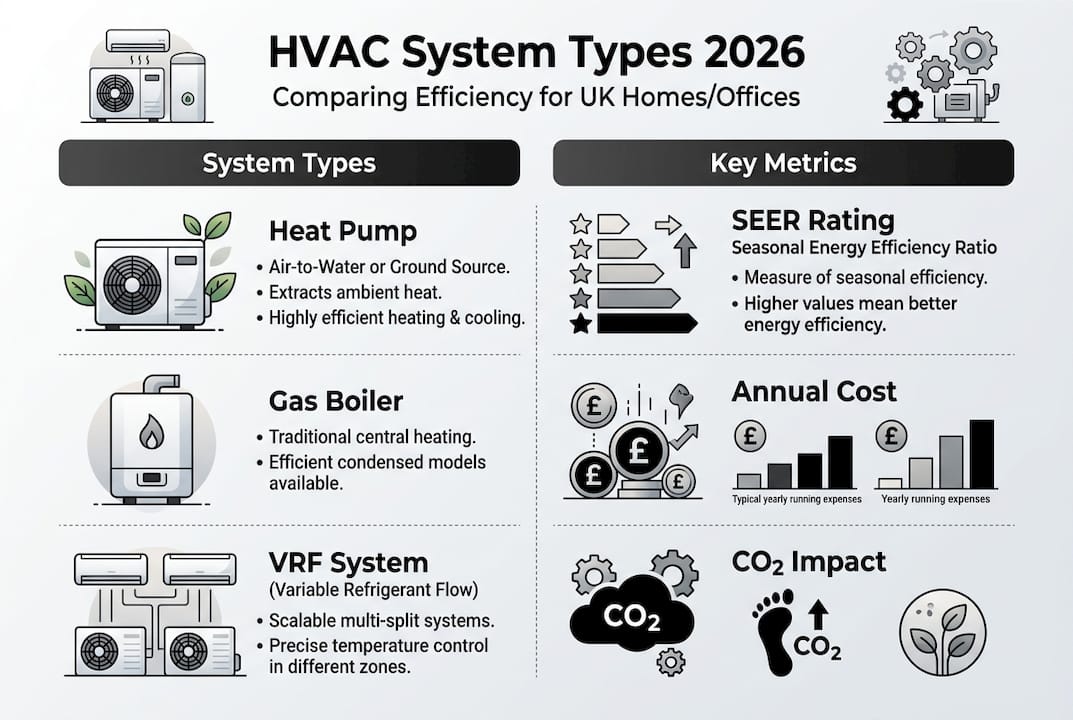
| System | Typical SEER/SCOP | Estimated annual running cost | CO2 impact |
|---|---|---|---|
| Gas boiler | N/A | £900 to £1,400 | High |
| Air-to-air heat pump | SCOP 3.5 to 4.5 | £400 to £700 | Low |
| Standard split AC | SEER 6 to 9 | £300 to £600 (cooling only) | Medium |
| High-efficiency split | SEER 14+ | £180 to £350 (cooling only) | Low |
| VRF system | SEER 16 to 22 | Varies by scale | Very low per zone |
For a thorough look at making a smart purchase, our guide on choosing an energy efficient HVAC system covers the full decision process. You can also read about why energy efficient HVAC matters for the bigger picture, and why upgrade HVAC if you are still on the fence.
For a direct cost comparison between technologies, heat pump vs air conditioner running costs is a useful external reference.
Pro Tip: Always check the SEER and SCOP ratings before buying, not just the purchase price. A cheaper unit with a low SEER rating will cost you more within two or three years of running it.
Choosing the right HVAC system for your UK property
The best system is the one that matches your specific property, not the one with the most features. Use this checklist before making any decision.
- Measure your space. A system that is too small will run constantly and fail early. One that is too large will short-cycle, wasting energy and creating humidity problems.
- Check for existing ductwork. If your property already has ducts, a central system may be cost-effective. Without ducts, prioritise ductless splits or heat pumps for homes, and VRF for multi-zone business needs.
- Assess your insulation. Poor insulation undermines any HVAC system. Draught-proof and insulate first, then size your system.
- Define your zones. Do you need different temperatures in different rooms or floors? Multi-split or VRF systems handle this well.
- Set a realistic budget. Include installation, running costs, and maintenance, not just the unit price.
For residential properties, air-to-air heat pumps offer the best all-season performance and the lowest carbon footprint. For commercial properties, VRF systems provide the precision and scalability that large premises demand. Our guide on commercial HVAC systems for energy efficiency goes into detail for business owners.
If you want independent guidance on heat pump options, best heat pumps guide is a solid starting point.
Common pitfalls to avoid:
- Choosing a system based on upfront cost alone
- Ignoring insulation before installation
- Fitting a residential system in a commercial space
- Skipping zoned controls in multi-room properties
- Buying portable units as a long-term solution
Expert tips and pitfalls to avoid
Even a well-chosen system can underperform if it is installed or managed poorly. Here are the most important lessons from experienced HVAC engineers.
- Insulate before you install. Poor insulation undermines any HVAC system, and specialist tariffs can save £186 or more per year when paired with a heat pump.
- Invest in smart controls. VAV and DCV systems do not just save energy on paper. They deliver real, measurable reductions in bills and emissions. Read more on evaluating ventilation controls.
- Choose R290 refrigerant in new systems where possible. It has a global warming potential of just 3, compared to over 2,000 for older refrigerants, and aligns with upcoming UK F-gas regulations.
- Plan for maintenance from day one. Regular HVAC maintenance keeps systems running at peak efficiency and prevents costly breakdowns.
- Be cautious with portable units. They are cheaper to buy but louder, less efficient, and far less comfortable than a properly installed split system.
“The biggest mistake we see is homeowners buying a system without first addressing insulation. You are essentially trying to fill a leaky bucket.”
Pro Tip: When comparing quotes, ask each installer for the projected annual running cost based on your property size and usage pattern. A higher upfront cost often means significantly lower bills over five years.
Find the right HVAC installation for your property
If you have read this far, you now have a clear picture of which HVAC system type suits your property, your budget, and your efficiency goals. The next step is getting it installed correctly by engineers who know the UK climate and building stock inside out.

At Akita Air Conditioning, we offer domestic air conditioning installation for homeowners across Suffolk, Norfolk, and Essex, with transparent fixed pricing and flexible finance options. For larger premises, our commercial air conditioning installation service covers everything from small offices to multi-site VRF networks. If you want a straightforward starting point, our fixed price air conditioning packages make it easy to get a quality system fitted without any surprises. Speak with one of our qualified engineers today for a tailored quote.
Frequently asked questions
What is the most energy efficient HVAC system for UK homes?
Air-to-air heat pumps are typically the most energy efficient option, achieving SCOP 3.5 to 4.5 and producing up to 70% less CO2 than a gas boiler.
How much does it cost to install an HVAC system in the UK?
Costs vary widely: ductless installs cost £3,000 to £7,000, full ducted systems run from £8,000 to £15,000, and commercial VRF installations range from £12,000 to £50,000 depending on scale.
Will upgrading my HVAC system really reduce my energy bills?
Yes. Upgrading saves 30% energy on average, and the savings compound over time as energy prices continue to rise in the UK.
Can HVAC systems also improve indoor air quality?
Absolutely. HVAC systems ensure indoor air quality through filtration and controlled ventilation, which reduces allergens, pollutants, and excess humidity in your home or workplace.