

Best home climate control systems for UK homeowners 2026
The best home climate control systems for UK homeowners in 2026 combine smart thermostats, zoned heating, and energy-efficient HVAC technology to cut bills and maintain consistent comfort year-round. Whether you have a Victorian terrace, a modern flat, or a detached family home, the right system depends on your property’s insulation, heating infrastructure, and how you actually live in the space.
Here is a quick overview of what the UK market offers:
- Smart thermostats (Google Nest Learning Thermostat, Hive, tado°, Honeywell Evohome, Drayton Wiser): control your boiler remotely, learn your schedule, and reduce wasted heating
- Smart radiator valves (TRVs): enable room-by-room zoning without a full system overhaul
- Air source heat pumps: highly efficient replacements for gas boilers in well-insulated homes
- Hybrid heating systems: pair a heat pump with a gas boiler for flexibility during cold snaps
- Split air conditioning units: provide both cooling and heating, ideal for homes without central heating upgrades
- Combi and system boilers with smart controls: the most common UK setup, significantly improved by adding a smart thermostat
All of these options can reduce energy costs and improve comfort. The challenge is matching the right technology to your specific property.
Table of Contents
- How do smart thermostats and climate control systems actually work?
- What are the real benefits of upgrading to smart climate control?
- Common types of home climate control systems for UK properties
- What does it cost to install smart climate control in the UK?
- How to choose the right climate control system for your UK home
- How Akita approaches energy-efficient climate control for UK homes
- What maintenance do home climate control systems need?
- Which system suits your property type?
- Akita can install the right system for your home
- Key takeaways
How do smart thermostats and climate control systems actually work?
Smart thermostats sit between your boiler (or heat pump) and your heating schedule, replacing the basic timer and dial most UK homes still use. They connect to your home Wi-Fi and let you control heating via a smartphone app, voice commands through Amazon Alexa or Google Assistant, or the device itself.
The key features that separate smart thermostats from standard programmable ones:
- Scheduling: set different temperatures for different times and days
- Geofencing: the thermostat detects when your phone leaves or approaches home and adjusts heating accordingly
- Occupancy detection: some models use motion sensors or door sensors to avoid heating empty rooms
- Learning: the Google Nest Learning Thermostat builds a schedule automatically after observing your adjustments over one to two weeks
- Zoning: paired with smart TRVs, systems like Honeywell Evohome and tado° control individual rooms independently
- OpenTherm integration: compatible boilers can modulate their output (rather than simply switching on and off), though boiler modulation requires OpenTherm compatibility, which is not universal
Smart thermostats reduce heating bills primarily by cutting boiler run-time, not by making the boiler itself more efficient. The savings come from heating your home only when and where it is needed.
Pro Tip: Before buying any smart thermostat, check the manufacturer’s compatibility tool. Nest, tado°, and Hive all offer online checkers. An incompatible boiler can limit features significantly, particularly geofencing and modulation.

What are the real benefits of upgrading to smart climate control?
The headline benefit is lower bills. Smart thermostats typically reduce heating gas consumption in UK homes, especially in households that previously relied on manual controls or heated the home all day. A government-backed trial of an energy-aware smart thermostat found a 5.0% reduction in gas use among participants, even accounting for varying occupancy patterns.
Beyond the numbers, the practical benefits stack up quickly:
- Remote control: turn heating on from the train home rather than leaving it running all day
- Comfort consistency: no more cold mornings or overheated evenings from a badly set timer
- Energy awareness: apps show you exactly how much you are spending and where
- Smart home integration: works with Amazon Alexa, Google Home, and Apple HomeKit
- Reduced carbon footprint: less gas burned means lower emissions, relevant as UK homes face tightening EPC requirements
The savings correlate strongly with behaviour. Homes that already run disciplined schedules see smaller marginal gains. The biggest wins go to households switching from no thermostat control at all, or from heating the home on a fixed timer regardless of occupancy.
Common types of home climate control systems for UK properties
Choosing the right system starts with understanding what is available and what each one suits. The best choice depends on your property’s insulation, hot water demand, and existing radiator infrastructure.
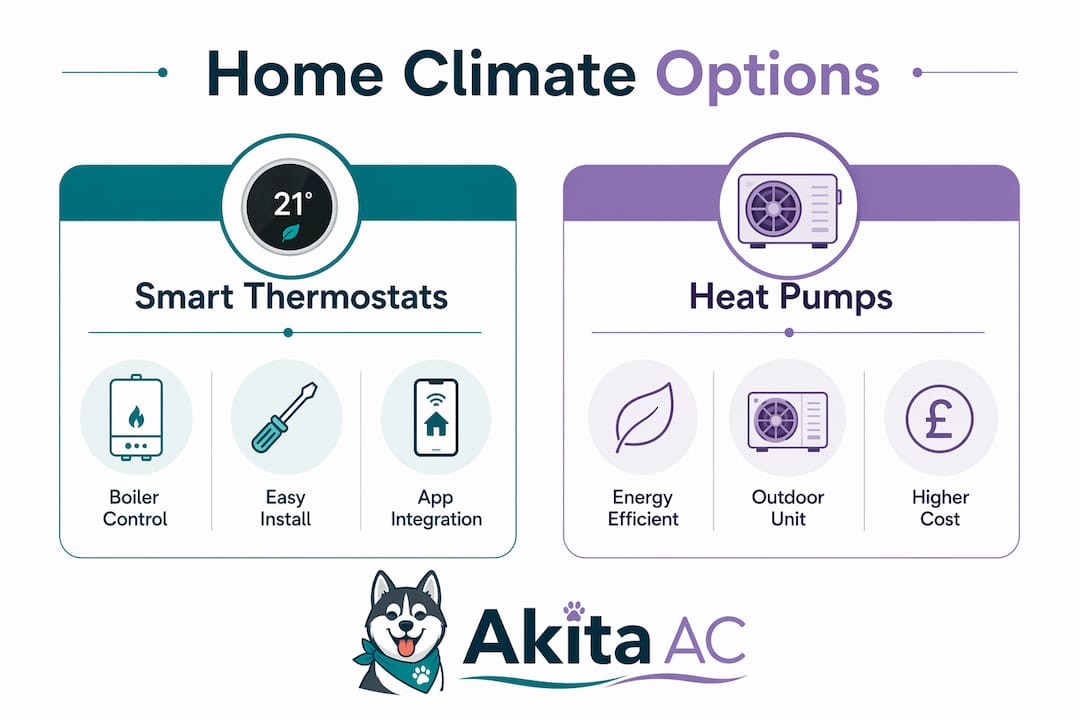
- Combi boilers with smart thermostats: the most common UK setup. Combi boilers suit smaller homes with one bathroom and no separate hot water cylinder. Adding a smart thermostat is the lowest-cost upgrade.
- System boilers with unvented cylinders: better for larger homes with high hot water demand. Compatible with smart controls and heat pumps.
- Air source heat pumps (ASHPs): extract heat from outside air and deliver it at lower temperatures over longer periods. Modern ASHPs provide up to 3–4 units of heat per unit of electricity used, but they need good insulation and ideally underfloor heating or larger radiators.
- Ground source heat pumps: more efficient than air source but require significant outdoor space for ground loops. Higher upfront cost, lower running costs.
- Hybrid heating systems: combine an ASHP with a gas boiler. The heat pump handles mild weather; the boiler takes over when temperatures drop sharply. A practical middle ground for homes not yet ready for full electrification.
- Smart radiator valves (TRVs): replace manual twist valves on individual radiators. Smart TRVs cost around sixty to seventy pounds each and enable room-by-room zoning without replacing the boiler.
- Split air conditioning units: wall-mounted units that heat and cool. Particularly useful for homes adding a home office or a room the central heating does not reach effectively.
Pro Tip: Before committing to a heat pump or hybrid system, commission a professional heat-loss survey. Poorly insulated homes see diminished returns from advanced systems, and insulation upgrades are often a prerequisite for optimal performance.
What does it cost to install smart climate control in the UK?
Smart thermostats are the most accessible entry point. Typical prices run from around one hundred to two hundred fifty pounds for the device, with professional installation adding additional costs. Efficient use can save a notable amount per year on gas heating bills.
Key cost factors to consider:
- Smart thermostat only: £120–£250 device cost, plus £80–£150 installation
- Smart TRVs: around £60–£70 per valve; a full house installation adds £300–£500 on top of the thermostat
- Air source heat pump: typically £8,000–£15,000 installed, before grants. The Boiler Upgrade Scheme offers £7,500 toward ASHP installation, closing a significant portion of the cost gap with a new gas boiler
- Hybrid system: higher than a standalone heat pump due to dual components, but often lower disruption to existing infrastructure
- Split air conditioning unit: varies by capacity and brand; Akita offers fixed-price domestic installation with transparent upfront costs
Running costs depend heavily on how you use the system and your current energy tariff. Efficient use of smart heating controls typically results in annual savings of £70–£140 per year on gas heating bills, with households moving from no thermostat control tending to see higher savings.
How to choose the right climate control system for your UK home
No single system fits every property. A property-specific approach that accounts for heat-loss calculations, existing infrastructure, and your household’s habits is the only reliable way to select the most efficient option.
Key considerations when making your decision:
- Property size and layout: larger homes with multiple zones benefit most from smart TRVs and multi-zone systems like Honeywell Evohome or tado°
- Insulation quality: poorly insulated homes lose heat faster than any system can efficiently replace it; address insulation before upgrading the heating
- Existing heating infrastructure: combi boiler homes have different upgrade paths than those with system boilers or older back boilers
- Hot water demand: high demand households need a cylinder-based system, not a combi
- Future EPC requirements: UK regulations are tightening. Choosing a system that improves your EPC band now avoids costly retrofits later. Guidance on HVAC innovations for businesses is worth reviewing before you commit
- Budget: smart thermostats offer the fastest payback; heat pumps require longer-term thinking
- Cooling needs: if your home overheats in summer, a split air conditioning unit addresses both heating and cooling in one system
The government’s energy efficiency tool lets you enter your property details and receive tailored recommendations, including estimated costs and savings for each improvement.
Pro Tip: Balance upfront cost against long-term efficiency carefully. A smart thermostat pays back within two to three years for most households. A heat pump may take longer but positions your home well for future energy regulations and resale value.
How Akita approaches energy-efficient climate control for UK homes
Akita specialises in installing and maintaining energy-efficient HVAC systems for UK homeowners, with a particular focus on Suffolk, Norfolk, and Essex. The approach is built around matching the right system to each property rather than recommending the same solution to everyone.
What Akita offers:
- Professional installation of split air conditioning systems that provide both heating and cooling
- Transparent, fixed pricing with no hidden costs
- Flexible finance options to spread the cost of installation
- Eco-friendly, high-efficiency systems from leading manufacturers
- Ongoing maintenance memberships and warranty guarantees
- Diagnostics and servicing for existing systems
Akita’s customer testimonials consistently highlight the combination of technical competence and straightforward communication, two qualities that matter when you are making a significant investment in your home’s comfort infrastructure.
What maintenance do home climate control systems need?
Maintenance requirements vary by system type, but all climate control technology benefits from regular attention. Neglected systems lose efficiency and can fail at the worst possible moments.
Smart thermostats need very little: occasional software updates (usually automatic) and a battery check if the device is not hardwired. The real maintenance is reviewing your schedules seasonally to make sure they still reflect how you use the house.
Boilers should be serviced annually by a Gas Safe registered engineer. A service typically costs £80–£120 and covers the heat exchanger, burner, flue, and controls. Skipping annual servicing can void manufacturer warranties and reduce efficiency over time.
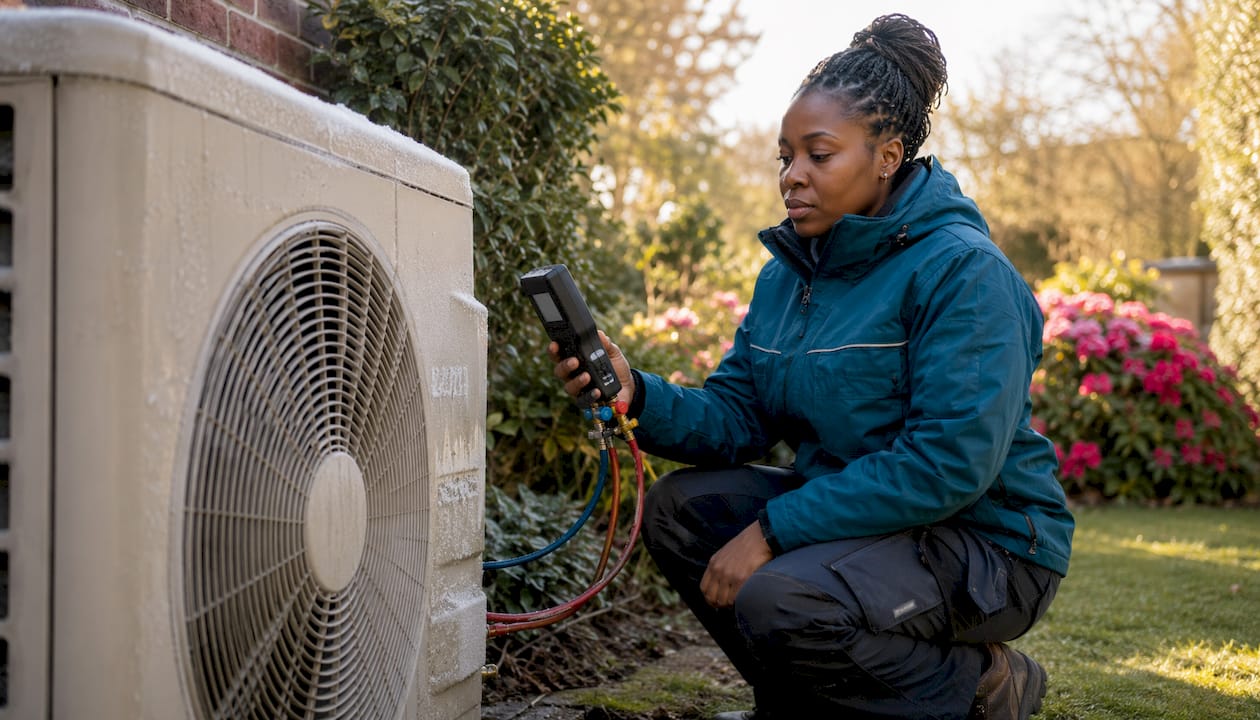
Air source heat pumps require an annual check by a qualified engineer, covering refrigerant levels, filters, and the outdoor unit. Filters on indoor units need cleaning every few months, which is straightforward to do yourself.
Split air conditioning units need filter cleaning every four to six weeks during heavy use, plus an annual professional service covering refrigerant pressure, electrical connections, and coil condition. Akita’s maintenance membership covers this for homeowners who want it handled without thinking about it.
Smart TRVs run on batteries, typically lasting one to two years depending on usage. Most apps will alert you when a valve’s battery is running low.
Which system suits your property type?
Property type shapes your options more than most homeowners realise. A system that works brilliantly in a detached four-bedroom house can be impractical or inefficient in a top-floor flat.
Detached houses have the most flexibility. They suit air source heat pumps (space for the outdoor unit, often better insulation potential), multi-zone smart thermostat systems, and split air conditioning for supplementary cooling. A full Honeywell Evohome or tado° zoning setup makes particular sense here, given the number of rooms that may have different occupancy patterns throughout the day.
Semi-detached and terraced homes are the bread and butter of the UK smart thermostat market. A combi boiler with a smart thermostat and a handful of smart TRVs is usually the most cost-effective upgrade. Heat pumps are possible but require careful assessment of insulation and radiator sizing.
Flats present the most constraints. Leasehold flats often restrict external unit installation, which rules out air source heat pumps and some split air conditioning systems without landlord or management company approval. Smart thermostats work well within existing systems, and energy-efficient cooling tips become particularly relevant during summer when ventilation options are limited.
New-build homes are increasingly delivered with heat pump-ready infrastructure and underfloor heating, making them the easiest candidates for full electrification. Smart controls integrate from day one rather than being retrofitted.
Passive measures matter across all property types. The government’s guidance on managing indoor temperatures recommends shading, night ventilation, and reducing internal heat loads before relying on active cooling. These steps reduce the demand on any climate control system and lower running costs regardless of what technology you install.
Akita can install the right system for your home
Smart thermostats and heat pumps are excellent tools, but they work best when installed correctly and matched to your property from the start. That is where professional installation makes the difference between a system that performs as expected and one that disappoints.

Akita installs energy-efficient air conditioning and climate control systems across Suffolk, Norfolk, and Essex, with fixed pricing, flexible finance, and ongoing support built in. Whether you want a split system that heats and cools a specific room, or a whole-home solution that works alongside your existing boiler, Akita’s team will assess your property and recommend what actually fits.
Visit Akita’s domestic air conditioning page to get a quote or find out which system suits your home.
Key takeaways
Smart thermostats and energy-efficient HVAC systems can cut UK heating bills while improving comfort, but only when matched correctly to the property’s insulation, infrastructure, and usage patterns.
| Point | Details |
|---|---|
| Smart thermostat savings | UK homes typically reduce gas consumption by 5–12%, with the biggest gains in households switching from manual controls. |
| Cost of entry | Smart thermostats cost £120–£250 plus £80–£150 installation; smart TRVs add around £60–£70 per valve. |
| Heat pump grants | The Boiler Upgrade Scheme provides £7,500 toward an air source heat pump, significantly reducing upfront cost. |
| Property type matters | Flats face installation restrictions; detached homes have the most system options including full zoning and heat pumps. |
| Akita’s offering | Akita installs fixed-price, energy-efficient air conditioning systems across Suffolk, Norfolk, and Essex with finance options available. |