

What is high wall aircon? Your home guide
TL;DR:
- High wall air conditioning units eliminate duct energy losses, reducing energy consumption by up to 40%. They offer efficient, zone-specific cooling, quick installation, and quiet operation, making them ideal for renters and homeowners alike. Proper installation and regular maintenance ensure reliable performance and energy savings over a decade.
If your current cooling system forces air through metres of ductwork before it reaches you, you are losing a significant amount of the energy you are paying for. Traditional ducted systems lose over 30% of energy through those ducts alone. High wall aircon sidesteps this problem entirely, and yet many homeowners and renters have never properly considered it. This guide covers exactly what high wall aircon is, how it works, what makes it genuinely worth your attention, and what you need to know before buying or renting one.
Table of Contents
- Key takeaways
- What is high wall aircon?
- Benefits of high wall aircon
- High wall aircon vs other systems
- Installation and maintenance
- My experience with high wall units in UK homes
- Ready to install a high wall aircon?
- FAQ
Key takeaways
| Point | Details |
|---|---|
| No ductwork, less waste | High wall systems avoid duct energy losses, cutting consumption by 25 to 40% versus central systems. |
| Room-by-room control | Zoning lets you cool only occupied rooms, reducing wasted energy throughout your home. |
| Faster, less disruptive install | A professional can typically complete installation within a few hours through a single small wall hole. |
| Quiet enough for bedrooms | Wall-mounted units run quietly, making them suitable for sleeping areas and home offices. |
| Maintenance is non-negotiable | Regular filter cleaning and annual professional servicing protect air quality and system lifespan. |
What is high wall aircon?
A high wall air conditioner, sometimes called a ductless mini-split, is a two-part cooling (and often heating) system. One unit sits inside your room, mounted high on the wall. The other, the compressor, sits outside. The two are connected by a refrigerant line, a power cable, and a condensate drain, all threaded through a single small hole in your exterior wall.
The indoor unit draws warm air from the room across a refrigerant-filled coil, which absorbs the heat. That heat is transferred through the refrigerant to the outdoor compressor, which releases it outside. The cooled air is then distributed back into the room. No ducts involved, and no energy wasted shifting air through metres of pipework.
It is worth understanding how this differs from other common AC types:
- Window units sit entirely within a window frame, venting heat directly outside. They are cheap but noisy, block natural light, and are limited by window size.
- Central ducted systems use a network of ducts to push conditioned air throughout an entire building from one central unit. They suit large properties but carry significant installation complexity and energy losses.
- Portable air conditioners need no installation but are among the least efficient options and often struggle in warmer rooms.
High wall units occupy the middle ground. The outdoor compressor can be positioned up to 50 feet away from the indoor unit, giving considerable flexibility in placement. Most models also include a heat pump function, meaning they can warm your home in winter as well as cool it in summer. That dual-purpose capability makes them particularly practical in the UK climate.
Benefits of high wall aircon
Energy efficiency you can measure
The most significant advantage is efficiency. Because there is no ductwork, high wall systems avoid the 25 to 40% energy losses that ducted systems routinely suffer. Modern units also carry SEER (Seasonal Energy Efficiency Ratio) ratings of between 20 and 30, which translates to 30 to 40% annual energy savings compared to older or less efficient systems. For more context on what those efficiency gains mean in practice, Akita’s guide to upgrading for energy efficiency is worth reading.
The reason these SEER ratings are achievable is inverter technology. Rather than switching on at full power and then shutting off repeatedly (as older units do), an inverter-driven compressor runs continuously at a variable speed, adjusting output to match the room’s actual need. This removes the energy spikes associated with constant cycling.
The main benefits at a glance
- Zoned cooling. You control the temperature independently in each room that has a unit. Independent room temperature control is the primary driver of energy savings for most homeowners, because you stop paying to cool rooms nobody is using.
- Space saving. The indoor unit sits high on the wall and takes up no floor space. It does not obstruct windows or require dedicated floor area.
- Quiet operation. Wall-mounted units run significantly quieter than window units, making them practical in bedrooms, nurseries, and home offices where noise matters.
- Fast installation. A professional can complete a single-room installation in a few hours, with no major building work required.
- Year-round use. Most high wall systems include a reverse-cycle heat pump function, replacing the need for separate heating in many situations.
Pro Tip: If you are renting, check your tenancy agreement before installation. Many landlords in the UK approve high wall aircon because the installation is minimally invasive and genuinely adds value to the property.
High wall aircon vs other systems
Choosing the right air conditioning type depends on your property, your budget, and how you actually live. Here is how high wall aircon compares with the two most common alternatives.
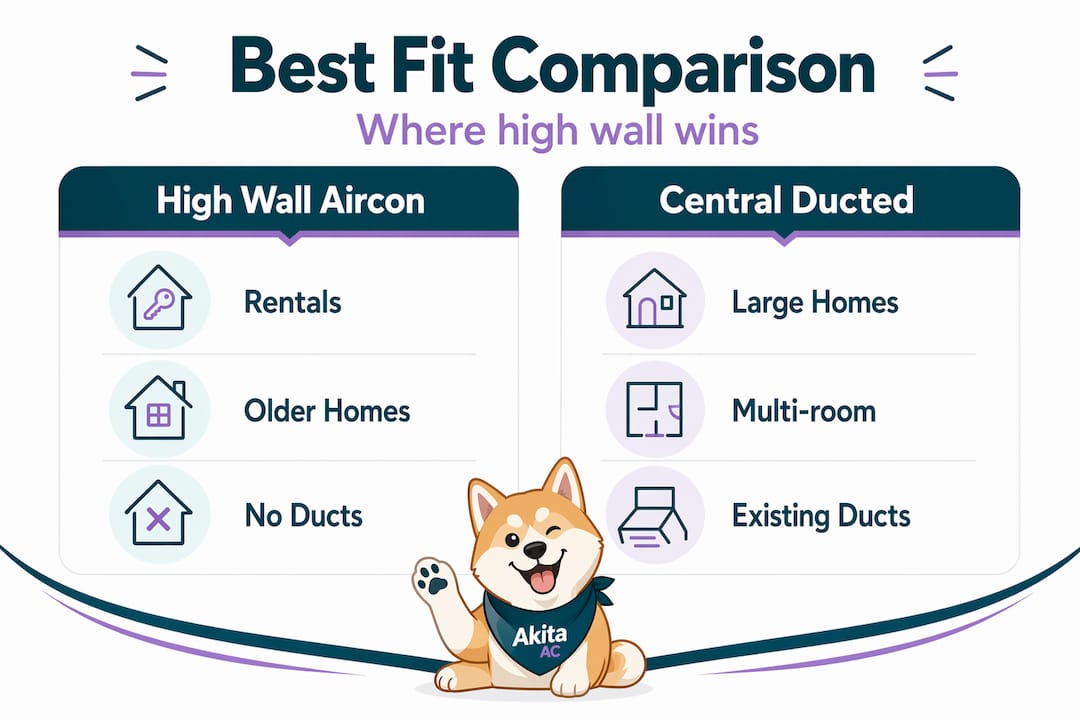
Ducted systems suit large homes well, delivering consistent temperatures across multiple rooms from a single central unit. However, they require significant installation work, particularly in properties without existing ductwork, and they carry those ongoing duct energy losses. For a typical UK semi-detached or terrace house, retrofitting a full ducted system is rarely practical or cost-effective.
Window units are cheap and easy to install, but they are inherently limited. They block a portion of your window, generate considerably more noise, and are far less efficient than modern high wall systems. If you live in a flat or an older property where fitting a window unit seems like the simplest route, a high wall unit is almost always the better long-term decision, even with the slightly higher upfront cost.
| Feature | High wall aircon | Central ducted | Window unit |
|---|---|---|---|
| Energy efficiency | High (SEER 20 to 30) | Moderate (duct losses up to 30%) | Low to moderate |
| Installation complexity | Low | High | Very low |
| Noise level | Low | Low to moderate | High |
| Space required | Wall mount only | Dedicated plant and ductwork | Window space |
| Zoning capability | Yes (per room) | Limited without extra cost | No |
| Suitable for renters | Often yes | Rarely | Yes |
| Upfront cost | Moderate | High | Low |
The situations where high wall aircon is clearly the best fit are apartments, older homes without existing ductwork, home extensions, and any space where you want independent temperature control without major building work.
If you are still comparing models, Akita’s review of the top wall-mounted units for 2026 gives a practical shortlist for UK homeowners.
Installation and maintenance
Getting your system installed
A standard single-room high wall installation follows a straightforward process. The installer first determines the best position for the indoor unit (typically centred on the wall, near the ceiling, with clear airflow across the room). The outdoor compressor is positioned on an external wall, roof, or ground bracket nearby.
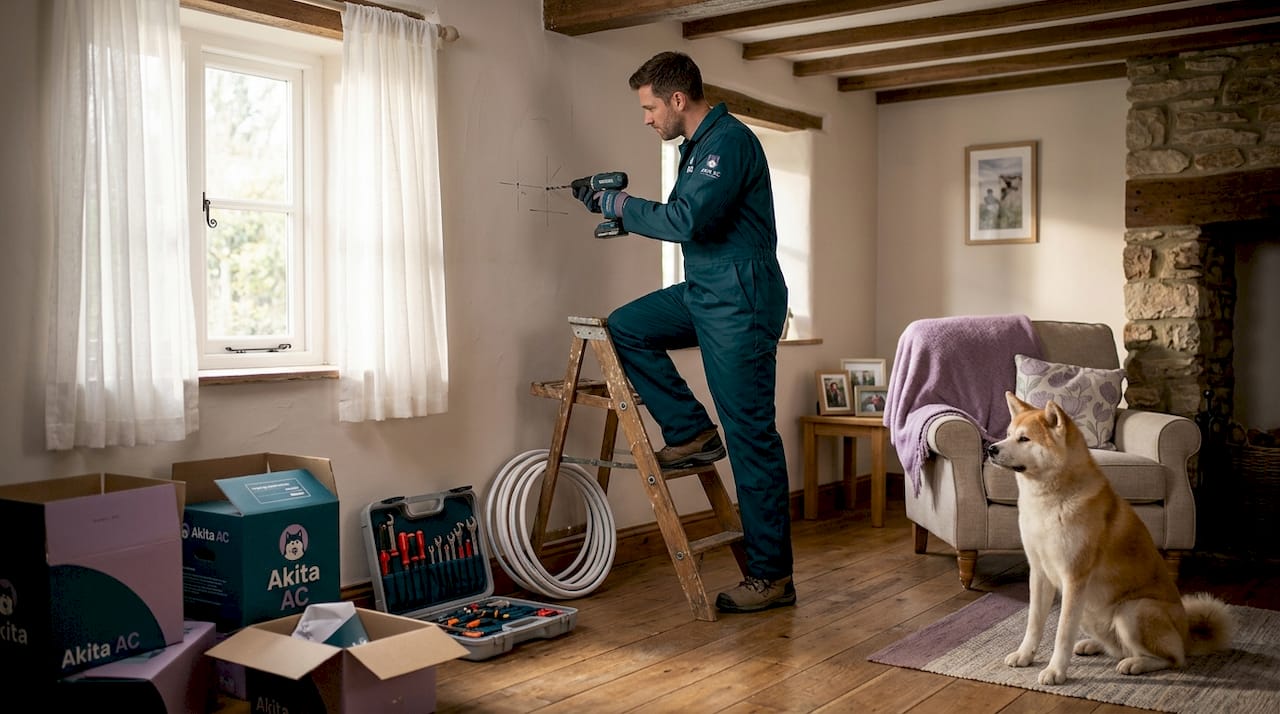
A small hole is drilled through the external wall to route the refrigerant lines, cabling, and drain pipe. Once the units are connected and the refrigerant is charged, the system is commissioned and tested. The entire process typically takes two to four hours for a single room.
One detail that is frequently overlooked: the conduit hole must be sealed perfectly to prevent moisture ingress, pest entry, and air leaks that quietly reduce system efficiency over time. This is one of those details that separates a competent installation from a cheap one.
Pro Tip: Always choose a Gas Safe or F-Gas registered engineer for refrigerant work. In the UK, handling refrigerants without the correct certification is illegal and voids most manufacturer warranties.
Keeping your system in good condition
Maintenance is where many people fall short. The internal heat exchanger accumulates dust and moisture over time. Without regular care, this leads to mould growth and unpleasant odours that affect both air quality and system efficiency.
The basics of high wall aircon maintenance include:
- Cleaning the filters every four to six weeks during periods of regular use. Most indoor units have washable filters that slide out easily.
- Wiping down the indoor unit casing to prevent dust from being drawn back into the system.
- Booking an annual professional service, which includes cleaning the internal heat exchanger, checking refrigerant levels, inspecting electrical connections, and testing overall performance.
Newer models do include auto-dry and self-cleaning functions that reduce moisture retention after the unit shuts off. These features lower the risk of mould, but they do not replace professional servicing entirely. Akita’s air conditioner maintenance checklist covers exactly what to look for at each stage of the year.
My experience with high wall units in UK homes
I have spent years installing and servicing air conditioning systems across Suffolk, Norfolk, and Essex, and my honest view is that high wall aircon is the most practical solution for the vast majority of UK homeowners who want genuine climate control without turning their home into a building site.
The question I hear most often is whether the units are too noisy or too bulky. In my experience, the people who say that have either never seen a modern high wall unit or are thinking of something installed fifteen years ago. Today’s units are slim, relatively unobtrusive, and quiet enough that most people forget they are running.
What I have also found is that the upfront cost concern fades quickly once people see their energy bills after switching. High wall systems with strong efficiency ratings genuinely pay back the installation cost over time, particularly in rooms that previously relied on inefficient portable units or electric heaters.
The one honest caution I would offer is this: poor installation causes more problems than poor equipment. The conduit seal, the refrigerant charge, and the positioning of the outdoor unit all matter more than people realise. Get the installation right, maintain the system annually, and a high wall unit will serve you reliably for well over a decade.
— Akita
Ready to install a high wall aircon?
If you have decided that high wall aircon is right for your home, the next step is getting it installed properly by someone who knows what they are doing.

Akita installs high wall air conditioning systems across Suffolk, Essex, and Norfolk, with fixed-price quotes and no hidden costs. Whether you need a single room cooled or a whole-house solution built around individual units, the team handles everything from survey through to commissioning. Find out more about domestic air conditioning installation and see what is included in each installation package. You can also explore fixed price installation options if you already know the size of unit you need.
FAQ
What is a high wall aircon unit?
A high wall aircon is a ductless air conditioning system where the indoor unit is mounted high on an interior wall, connected to an outdoor compressor by refrigerant lines through a small wall hole. It cools and often heats individual rooms without requiring ductwork.
How does a high wall aircon differ from a split system?
High wall aircon is a type of split system. The term “split” simply means the indoor and outdoor components are separate units. High wall refers specifically to the indoor unit’s position on the wall, distinguishing it from floor-standing or ceiling cassette variants.
How energy efficient are high wall air conditioners?
Modern high wall units carry SEER ratings of 20 to 30, and because they avoid duct energy losses, they typically use 25 to 40% less energy than central ducted systems running the same space.
How often does a high wall aircon need servicing?
Filters should be cleaned every four to six weeks during regular use. A full professional service, covering the heat exchanger, refrigerant check, and electrical inspection, should be carried out annually to maintain efficiency and air quality.
Can renters install high wall aircon?
Many renters can, because installation requires only a small conduit hole and no permanent structural changes. Permission from the landlord is needed, but many agree because it adds value to the property.