

Bedroom air conditioning: quiet, efficient comfort in 5 steps
TL;DR:
- Wall-mounted split systems are the quietest, most efficient, and suitable for permanent bedroom cooling.
- Portable units are easy to install but louder and less energy-efficient, ideal for temporary use.
- Heat pumps offer year-round comfort with high efficiency and potential government grants.
Waking up at 3am, sheets damp, bedroom stuffy and airless. It’s a familiar misery for UK homeowners every summer, and it’s getting worse as temperatures climb. Choosing the right air conditioning for your bedroom isn’t simply about buying the cheapest unit you can find online. You need something quiet enough not to disturb your sleep, efficient enough not to inflate your energy bills, and practical enough to actually fit your room. This article walks you through the main options, the key things to look for, and how to match the right system to your bedroom.
Table of Contents
- Key criteria for selecting bedroom air conditioning
- Wall-mounted split systems: The quiet, efficient favourite
- Portable air conditioning: Pros, cons, and best uses
- Heat pumps: Year-round bedroom comfort in the UK
- Summary comparison: Which option suits your bedroom best?
- Our take: The underrated value of sleep-friendly bedroom cooling
- Ready for quiet, efficient comfort? Get expert help
- Frequently asked questions
Key Takeaways
| Point | Details |
|---|---|
| Prioritise quiet operation | Splits and heat pumps operate quietly, supporting restful sleep compared to louder portable units. |
| Match AC to room size | Ensure the unit’s cooling capacity suits the bedroom’s square metres for best comfort and efficiency. |
| Opt for high efficiency | Look for A++ or better ratings, or consider heat pumps for top energy savings and year-round use. |
| Professional installation matters | F-gas certified installation ensures safe, effective operation and compliance with UK regulations. |
Key criteria for selecting bedroom air conditioning
Before you start browsing units, it helps to understand what actually matters for a bedroom. The priorities here are different from a living room or office. You’re choosing a system that will run while you sleep, so the wrong call can cost you comfort every single night.
Here are the factors that should shape your decision:
- Noise level: This is the big one. Quiet operation and high efficiency are the top priorities in UK bedrooms. Wall-mounted split systems can run as quietly as 19–21 dB(A) indoors, which is roughly the volume of a whisper.
- Energy rating: Look for A++ or A+++ rated systems. These cost significantly less to run and are kinder to the environment. If you’re unsure where to start, our guide to choosing energy efficient AC breaks it down clearly.
- Room size and power output: A unit that’s too small will struggle; one that’s too large will cycle on and off constantly. As a rough guide, a 2.5kW unit suits bedrooms up to around 25m².
- Appearance and installation: Bedrooms are personal spaces. Discreet, wall-mounted units with slim profiles are far less intrusive than bulky floor-standing alternatives.
- Smart features: Look for systems with programmable timers, sleep modes, and app control. These make a real difference to how comfortable your nights actually feel.
For a broader look at energy efficient options available to UK homeowners, it’s worth reading up before committing to a purchase.
Pro Tip: When browsing specifications, look specifically for a ‘sleep mode’ setting. This gradually adjusts temperature through the night and reduces fan speed, keeping noise levels at their lowest while you’re most vulnerable to disturbance.
Wall-mounted split systems: The quiet, efficient favourite
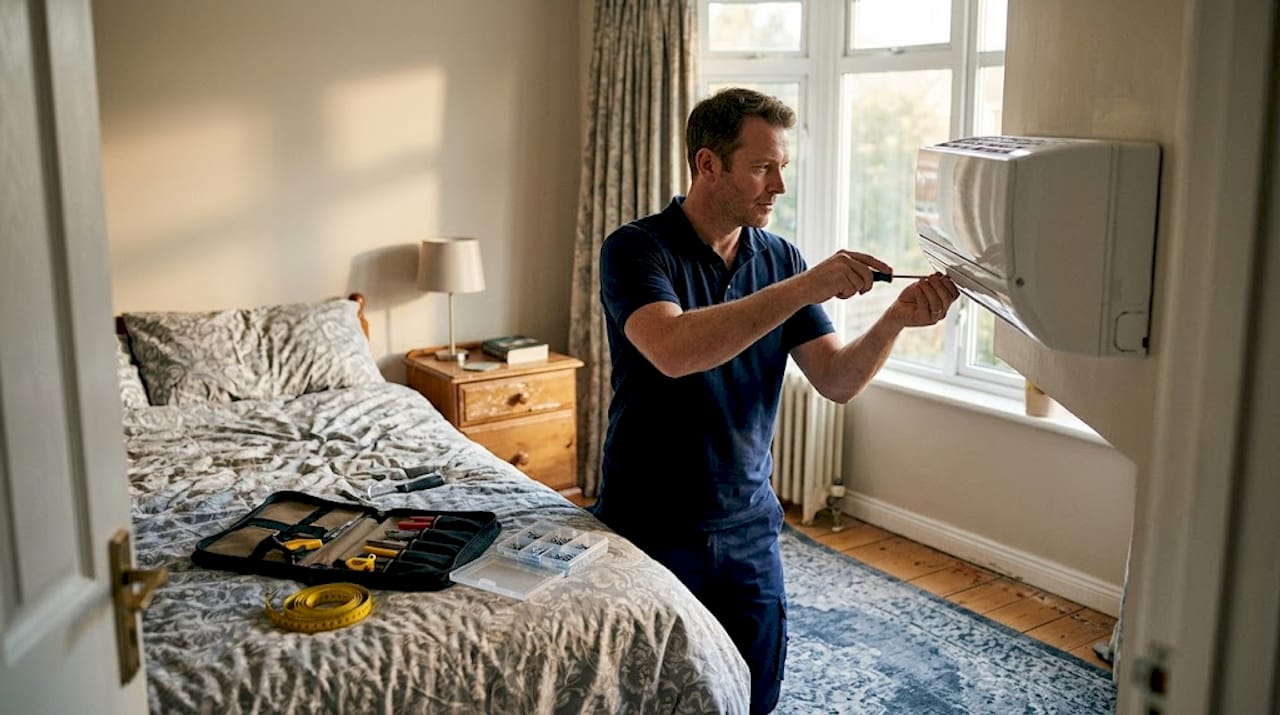
If you ask most HVAC professionals what they’d install in their own bedroom, the answer is almost always a wall-mounted split system. There’s a simple reason: the compressor, which is the noisy part, lives outside. Your bedroom only houses the slim indoor unit, which moves air quietly and efficiently.
Key advantages of wall-mounted splits for bedrooms:
- Near-silent operation: Quietest operation and highest efficiency ratings make splits the benchmark for bedroom comfort, suitable for rooms up to 25m².
- Energy ratings of A++ to A+++: Running costs are a fraction of what you’d pay with a portable unit over the same period.
- Built-in comfort features: Most modern splits include sleep mode, air purification filters, and humidity control. Some even monitor air quality automatically.
- Permanent, tidy installation: Once fitted, there’s no hose trailing to a window, no floor space lost, and no setup required each time you want to use it.
- Professional installation: A qualified F-gas engineer handles the refrigerant pipework and electrical connections. This isn’t a DIY job, but the process is typically completed in a single day with minimal disruption.
For a full overview of the different air conditioning system types available to UK homeowners, it’s useful to understand how splits compare to other formats before making a decision.
The upfront cost of a split system is higher than a portable unit, but the running cost difference adds up quickly. A typical portable unit might cost two to three times more per hour to run than an equivalent split. Over a warm British summer, that gap becomes very noticeable on your electricity bill.
Portable air conditioning: Pros, cons, and best uses
Portable air conditioners have one undeniable advantage: you can buy one online and have it running in your bedroom within 24 hours, no engineer required. That convenience is real. But for bedroom use specifically, portables come with some significant trade-offs worth understanding.
The honest pros and cons:
- Noise: Portable ACs are much louder, less efficient, and only suitable for temporary use or rentals. Most run at 40–50 dB or above, which is comparable to a quiet conversation. For light sleepers, this is a genuine problem.
- Efficiency: Because the hot exhaust hose runs through a window gap, warm air constantly seeps back in. The unit works harder than it should, using more electricity for less cooling effect.
- Space: A portable unit takes up floor space, and the exhaust hose needs to reach a window. In smaller bedrooms, this can feel cramped and awkward.
- Ease of use: No installation needed. Plug in, position the hose, and it works. This makes portables genuinely practical for tenants or anyone in a short-term rental.
- Cost: Lower upfront price, but higher running costs. For anything beyond occasional use, the economics don’t favour portables.
If you’re weighing up your options before buying, our bedroom AC buying tips cover the practical considerations in more detail.
Pro Tip: If you do use a portable unit, fit a draught excluder or foam strip around the window gap where the hose exits. This simple fix reduces warm air re-entry and improves cooling efficiency noticeably.
Heat pumps: Year-round bedroom comfort in the UK
Heat pumps are often discussed in the context of home heating, but they’re equally effective as cooling systems. In fact, a modern air-source heat pump is essentially a reversible air conditioning unit. In summer it cools your bedroom; in winter it heats it. One system, all year round.
| Feature | Split AC only | Air-source heat pump |
|---|---|---|
| Cooling | Yes | Yes |
| Heating | No | Yes |
| Efficiency (COP) | 1–2 | 3–4 |
| Running cost | Moderate | Lower |
| Government grant eligible | No | Yes (Boiler Upgrade Scheme) |
| Carbon footprint | Moderate | Lower |
The efficiency figures here are striking. Heat pumps serve as both AC and heating, with a year-round COP of 3–4, meaning they produce three to four units of heating or cooling energy for every one unit of electricity consumed. Standard electric heaters, by contrast, produce one unit for one unit.
“A heat pump doesn’t just cool your bedroom in summer. It creates a stable, comfortable sleep environment throughout the year, and it does so at a fraction of the carbon cost of traditional heating and cooling systems.”
The UK government’s Boiler Upgrade Scheme currently offers grants to help offset installation costs, making heat pumps more financially accessible than many homeowners realise. If you’re thinking about the importance of efficient cooling for your home long-term, or considering upgrading for efficiency as part of a broader home improvement plan, a heat pump deserves serious consideration.
For detailed heat pump guidance from the Energy Saving Trust, the information is thorough and impartial.
Summary comparison: Which option suits your bedroom best?
With all three main options covered, here’s a direct comparison to help you match the right system to your situation.
| Wall-mounted split | Portable AC | Heat pump | |
|---|---|---|---|
| Noise level | 19–21 dB(A) | 40–50 dB+ | 19–25 dB(A) |
| Energy rating | A++ to A+++ | C to D | A+++ (COP 3–4) |
| Installation | Professional | Self-install | Professional |
| Heating function | No | No | Yes |
| Upfront cost | Moderate | Low | Higher |
| Running cost | Low | High | Lowest |
| Best for | Homeowners | Renters | Future-ready homes |
As splits are ideal for permanent, quiet comfort, portables suit temporary use, and heat pumps offer both high efficiency and dual-purpose use, eligible for government grants.
Best for each situation:
- Homeowners wanting quiet, reliable cooling: Wall-mounted split system
- Renters or short-term solutions: Portable air conditioner
- Those wanting year-round comfort and lower bills: Air-source heat pump
- Energy-conscious homeowners: Heat pump, with grant support available
- Tight budgets, immediate need: Portable, with a plan to upgrade later
For practical ideas on managing summer bedroom cooling during the warmer months, there’s useful reading available to help you plan ahead.
Our take: The underrated value of sleep-friendly bedroom cooling
Most homeowners focus on the upfront price when choosing bedroom air conditioning. We understand that instinct, but it’s the wrong lens. The real cost is measured in sleep quality, energy bills, and how long the system lasts.
We’ve seen it repeatedly: someone buys a cheap portable unit, tolerates the noise for one summer, and then replaces it with a split system anyway. They’ve paid twice. Investing in a quiet, efficient system from the start isn’t an indulgence; it’s the practical choice.
There’s also something worth saying about property value. Homes with well-installed, energy-efficient climate control are increasingly attractive to buyers. A quality split system or heat pump isn’t just comfort; it’s an asset. For those who want to explore expert efficiency upgrades that add genuine long-term value, the evidence is clear: cutting corners on bedroom cooling leads to regret. Invest in comfort where it matters most, and you’ll feel the benefit every single night.
Ready for quiet, efficient comfort? Get expert help
Understanding your options is the first step. Taking action is where the real difference happens.

At Akita Air Conditioning, our F-gas certified engineers handle everything from initial advice through to installation and ongoing care. Whether you’re looking at bedroom AC installation in Essex or want to set up a regular maintenance services plan to keep your system running at peak efficiency, we’re here to help. We offer transparent pricing, flexible finance options, and genuine expertise across Suffolk, Norfolk, and Essex. Get in touch today for tailored advice and start enjoying quieter, cooler nights.
Frequently asked questions
What is the quietest type of air conditioning for bedrooms?
Wall-mounted split systems are the quietest option, with indoor units running as low as 19–21 dB(A) indoors, making them ideal for light sleepers.
Do I need planning permission to install air conditioning in my bedroom?
In most cases, no. Outdoor units for wall-mounted splits typically fall under permitted development rights, meaning no planning permission is usually required for residential installations.
How energy efficient are air conditioning systems for bedrooms?
Modern split systems carry A++ to A+++ ratings, using far less electricity than portables, while heat pumps achieve a COP of 3–4, making them the most efficient option available.
Can I install air conditioning in a rented property?
Portable air conditioners are the most practical choice for renters, as they require no permanent installation and can be moved between properties easily.