

Step-by-step residential air conditioning guide for UK homes
TL;DR:
- Proper planning, certification, and adherence to regulations are essential for a safe and efficient UK residential air conditioning installation. Ignoring these steps can lead to system failures, legal issues, and safety hazards. Working with qualified professionals ensures compliance, optimal performance, and long-term satisfaction.
Few things are more frustrating than a sweltering July afternoon with no reliable way to cool down your home. As UK summers grow longer and hotter, more homeowners are turning to residential air conditioning as a permanent solution rather than a seasonal luxury. But the installation process involves far more than simply mounting a unit on the wall. Regulated steps, certified engineers, and careful planning all sit between you and that first blast of cool air. This guide walks you through the entire process clearly, so you can approach installation with confidence and avoid costly mistakes.
Table of Contents
- What you need before installing residential air conditioning
- Residential air conditioning installation: step-by-step
- Regulatory compliance and safety for UK installations
- Troubleshooting and common mistakes
- The reality behind every residential AC installation
- Take the next step with professional AC installation
- Frequently asked questions
Key Takeaways
| Point | Details |
|---|---|
| Certified installer essential | Using an F-Gas certified engineer is a legal requirement for AC installation in the UK. |
| Step-by-step approach | Survey, plan, install, and commission your home AC system to maximise efficiency and compliance. |
| Regulatory documentation | Always secure proper records for compliance including leak tests and wiring standards. |
| Common pitfalls | Avoid mistakes by ensuring correct sizing, placement, and calling professionals for technical steps. |
| Access expert help | Manufacturer and regional installer networks simplify sourcing qualified AC professionals. |
What you need before installing residential air conditioning
Before diving into installation, understanding the essentials sets a strong foundation.
Getting AC installation right starts well before anyone picks up a drill. The decisions you make at the planning stage directly determine how well your system performs, how much it costs to run, and whether it meets UK legal requirements.
System type and sizing
Choosing the right system is the first critical step. The most popular option for UK homes is the split system, which consists of an indoor unit and an outdoor compressor connected by refrigerant pipework. For homes with multiple rooms requiring cooling, a multi-split system connects several indoor units to one outdoor compressor. Consulting a detailed UK air conditioning system types guide helps you understand which configuration fits your property.
Sizing your system correctly is equally important. An undersized unit will run constantly without adequately cooling the room. An oversized unit will short-cycle, switching on and off too frequently, which wastes energy and reduces the lifespan of the equipment. Sizing is calculated using a heat load assessment, which considers room volume, insulation quality, window area, and orientation.
Essential prerequisites checklist
Before speaking to any installer, gather the following information:
- Floor area and ceiling height of the rooms you want to cool
- Type and age of your home’s insulation
- Location and size of windows, including which direction they face
- Whether your property is a flat, listed building, or sits within a conservation area
- Proximity of external walls or rooftop access for the outdoor unit
- Your electrical consumer unit capacity and available circuits
A solid air conditioning buying guide will help you assess these factors and arrive at your consultation prepared.
Legal requirements at the planning stage
This is where many homeowners are caught off guard. UK law requires that any work involving refrigerants, including connecting pipework and charging the system, must be carried out by an F-Gas certified engineer. It is not a recommendation. It is a legal requirement. Homeowners must verify installer competence and use manufacturer networks to find approved professionals.
| Prerequisite | Why it matters |
|---|---|
| Heat load assessment | Ensures correct system size and efficiency |
| F-Gas certified installer | Legal requirement for refrigerant handling |
| Electrical capacity check | Prevents overloading existing circuits |
| Planning permission check | Required for listed buildings and conservation areas |
| Structural survey of wall | Confirms safe mounting of indoor and outdoor units |
Pro Tip: Contact your local planning authority before any work begins if you live in a flat or a conservation area. External units can fall under permitted development restrictions, and getting caught out after installation can result in a removal order.
Residential air conditioning installation: step-by-step
Once you are prepared, it is time to follow the key installation steps.
A typical UK split-system installation involves several distinct phases. Understanding what happens at each stage allows you to ask better questions, monitor progress, and verify that your installer is doing the job correctly.
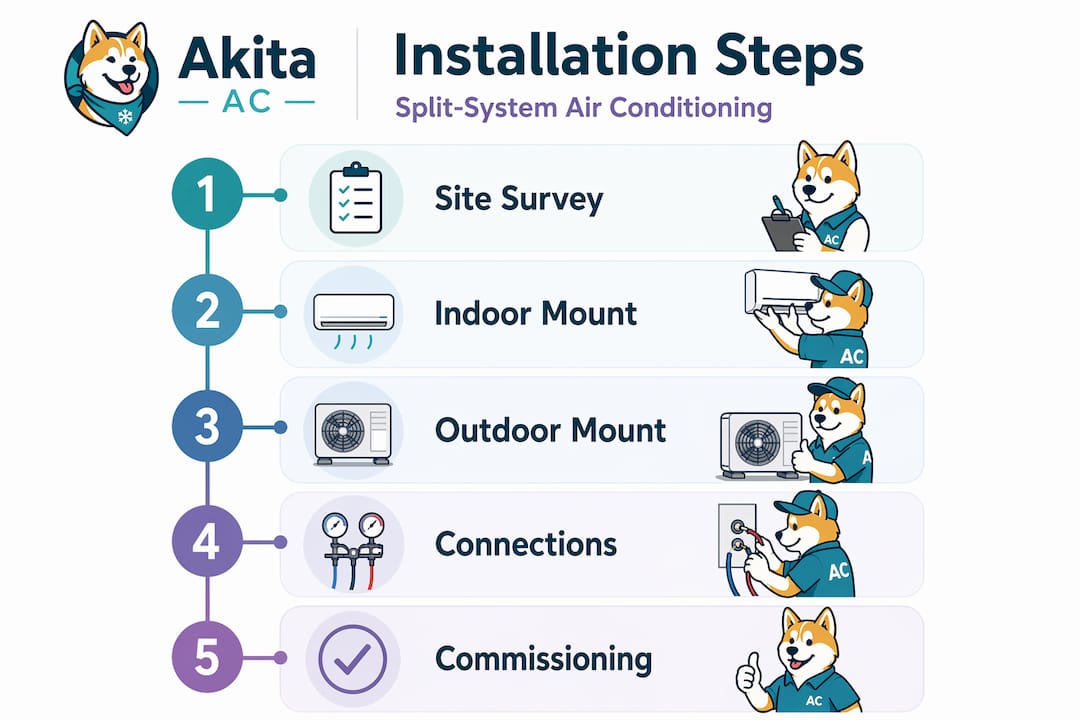
A split system air conditioning setup is the most common residential choice in the UK, and the steps below reflect that configuration.
Step 1: Site survey and system design
A qualified engineer visits your property to assess room dimensions, wall construction, and cable routing options. They confirm the heat load calculation, recommend the correct unit capacity, and agree on locations for both the indoor and outdoor units. This is also when any planning considerations are confirmed.
Step 2: Indoor unit placement and mounting
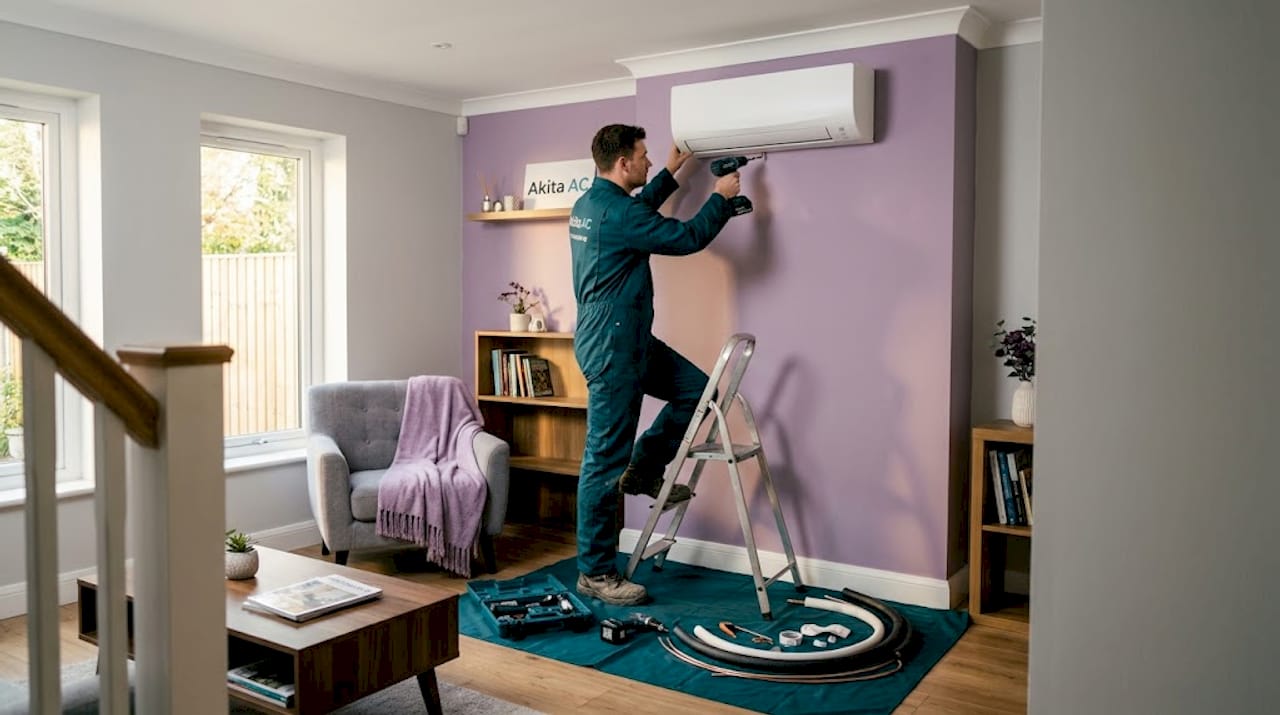
The indoor unit is typically wall-mounted high on an external or internal wall. The engineer drills a core hole through the wall to route refrigerant pipes, drainage, and electrical connections to the outside. The unit is secured to a robust bracket, and the pipe sleeve is fitted.
Step 3: Outdoor unit positioning and mounting
The outdoor compressor must be positioned with adequate clearance for airflow, typically at least 30cm on all sides. It sits on a wall bracket or concrete plinth and must be accessible for future servicing. Noise and visual impact on neighbours should be considered during placement.
Step 4: Pipework and electrical connections
Refrigerant pipes are insulated and routed from the indoor unit through the wall to the outdoor compressor. Electrical connections are made at both ends, and the unit is wired into the consumer unit by a qualified electrician. Note that electrical work must comply with BS 7671, the UK wiring regulations.
Step 5: Commissioning
This is the most technically regulated phase. Regulated installation steps require a certified F-Gas engineer and cannot be skipped or substituted. The commissioning process involves vacuuming the pipework, pressure and leak testing the refrigerant circuit, and then releasing refrigerant into the system under controlled conditions. Only after successful commissioning is the system switched on for operational testing.
| Installation phase | DIY possible? | Certified engineer required? |
|---|---|---|
| Site survey | Yes | No |
| Indoor unit mounting | Yes (basic) | Recommended |
| Outdoor unit positioning | Yes (basic) | Recommended |
| Pipework routing | Partially | For connections |
| Electrical wiring | No | Yes (qualified electrician) |
| Vacuuming and leak testing | No | Yes (F-Gas certified) |
| Refrigerant charging | No | Yes (F-Gas certified) |
Pro Tip: Ask your installer to walk you through the commissioning report after the job is done. It should show vacuum depth readings, leak test results, and the refrigerant charge weight. If they cannot provide this, raise concerns immediately. Learning how to boost air conditioning efficiency starts with a properly commissioned system.
Regulatory compliance and safety for UK installations
With installation steps completed, regulatory compliance becomes critical for safety and legal peace of mind.
UK air conditioning installations are governed by a framework of regulations that protect both the homeowner and the environment. Ignoring these requirements does not simply risk a fine. It can invalidate your home insurance, void the warranty on your equipment, and create genuine safety hazards.
F-Gas compliance
The F-Gas Regulations (EC 517/2014 as retained in UK law post-Brexit) control the use of hydrofluorocarbon (HFC) refrigerants. F-Gas regulatory requirements include mandatory leak checking at defined intervals based on refrigerant charge weight, safe handling documentation, and use of only certified engineers for refrigerant work.
Systems containing more than 3kg of refrigerant must be leak checked at least annually. Larger systems have more frequent requirements. Make sure your installer provides written records of the initial charge weight and leak test results.
Wiring and structural standards
All electrical work must comply with BS 7671, the IET Wiring Regulations. This means the installation should be inspected and tested by a registered electrician, and in many cases a Part P notification to building control is required. Do not allow an installer to skip this step.
The structural standard EN 378 governs the safe installation of refrigerating systems and heat pumps in buildings, covering everything from ventilation requirements to emergency isolation.
Key regulatory checklist for UK homeowners: Confirm your installer holds a current F-Gas certificate. Ask for the certificate number and verify it on the official Refcom register. Ensure all electrical work is certified under Part P. Obtain a commissioning report with refrigerant charge documentation. Check whether planning permission is required for your outdoor unit.
Planning permissions
Most domestic AC installations in England fall under permitted development rights, meaning you do not need formal planning permission. However, this does not apply universally. Flats, listed buildings, and properties within conservation areas are common exceptions. For more detail on UK air conditioning regulations, and for practical costs and compliance tips specific to the Suffolk and Essex region, explore those resources before committing to an installation date.
Safety during the installation process
Refrigerant pipes operate under significant pressure. Electrical connections must be correctly rated and earthed. The outdoor unit must be secured in a way that withstands wind loading. These are not minor details. A poorly installed system is a safety risk, not just an inconvenience.
Troubleshooting and common mistakes
Mistakes can often derail even well-planned installations, so proactive troubleshooting is essential.
Even when you follow the correct process, problems can arise. Knowing the most common pitfalls means you can spot them early and address them before they escalate into expensive repairs.
Common mistakes homeowners make
- Choosing the wrong system size: Based on a rough guess rather than a proper heat load calculation. Both undersizing and oversizing cause performance and efficiency problems.
- Ignoring outdoor unit placement: Placing the compressor in a spot with poor airflow or excessive sun exposure reduces efficiency and increases noise.
- Skipping planning checks: Particularly critical for flats and conservation areas, where external wall constraints and legal requirements can create serious complications after installation.
- Using unqualified installers to cut costs: This leads to illegal refrigerant handling, voided warranties, and systems that fail prematurely.
- Not testing drainage: Condensate drainage must be routed correctly. A blocked or incorrectly pitched drain line causes water damage and mould growth inside your home.
Troubleshooting issues after installation
If your system is making unusual noises, the most common causes are loose mounting brackets, debris in the outdoor unit fan, or refrigerant flow issues. A rattling sound during operation often indicates vibration between the pipework and the wall. A hissing sound may indicate a refrigerant leak, which requires immediate professional attention.
Poor cooling performance after commissioning usually points to one of three issues: an undersized unit, a refrigerant charge that is slightly off, or blocked air filters. Filters should be cleaned every four to six weeks during heavy use, which is a simple task you can do yourself.
When to call a professional immediately
- The system trips your circuit breaker on startup
- You notice ice forming on the refrigerant pipes
- The unit produces a burning smell
- Cooling performance drops suddenly after working well
Pro Tip: Schedule your first professional service visit around twelve months after installation. This allows the engineer to check refrigerant levels, clean internal components, and verify electrical connections, all of which protect your investment. Exploring dedicated AC maintenance tips will help you stay ahead of issues year-round. And if you are still deciding on the best system for your circumstances, comparing UK summer AC solutions can clarify your options.
The reality behind every residential AC installation
Here is something most installation guides do not tell you: the technical steps are rarely the problem. The real risk in most residential AC installations lies in the decisions made before any tools are picked up.
After years of working with UK homeowners across Suffolk, Norfolk, and Essex, we have seen a consistent pattern. Homeowners who invest time in choosing the right installer, confirming credentials, and planning the placement properly almost always end up with a system that works brilliantly for years. Those who rush the process, choose on price alone, or assume they can manage the regulated parts themselves frequently face problems within the first eighteen months.
The uncomfortable truth is that a cheap, quick installation is almost never a bargain. An undersized system runs constantly, driving up electricity bills. A poorly commissioned system loses efficiency within months. And an installation carried out without proper F-Gas certification is technically illegal, which means your insurer may refuse to pay out if something goes wrong.
We would also push back on the idea that the brand of unit matters more than the quality of installation. A mid-range unit installed correctly and commissioned to the manufacturer’s specifications will outperform a premium unit that has been rushed into service by an uncertified engineer. Pre-planning and installer selection are genuinely more important than the model name on the front panel.
If you are ready to move forward with a trustworthy professional, exploring top residential AC installers in your region is a sensible first move.
Take the next step with professional AC installation
Understanding the process is valuable, but having the right team behind you makes all the difference.

At Akita Air Conditioning, we handle every stage of domestic air conditioning installation from initial survey through to commissioning and handover, with full F-Gas compliance and documentation included as standard. Whether you are looking for a straightforward entry-level system or a premium setup, our transparent pricing removes the guesswork. You can get started with a fixed price AC install for a 2.5kW system, or explore the highly regarded Mitsubishi LN series AC install for exceptional efficiency and quiet operation. Serving homeowners across Suffolk, Norfolk, and Essex, we are ready to help you get it right the first time.
Frequently asked questions
Do I need an F-Gas certified engineer for home air conditioning installation in the UK?
Yes, UK law requires certified F-Gas engineers for all refrigerant-related parts of the installation. Connecting and commissioning AC legally requires this certification regardless of system size.
What is the commissioning process for a split-system air conditioner?
Commissioning involves vacuuming the pipework, pressure and leak testing the refrigerant circuit, and releasing refrigerant under certified supervision. The key commissioning stages must be documented and signed off by an F-Gas engineer.
How can I verify a residential air conditioning installer’s credentials?
Use manufacturer networks to find certified professionals, such as the Daikin installer search tool, and independently verify F-Gas registration through the Refcom online register.
What documentation is needed for regulatory compliance?
You need records showing F-Gas leak checks, safe refrigerant handling, and adherence to EN 378 and BS 7671 wiring standards. UK refrigerant compliance documentation must be provided by your installer at handover and retained for the life of the system.