

Master UK air conditioning terminology in 2026
Choosing an air conditioning system for your UK property shouldn’t feel like deciphering a foreign language, yet many homeowners and business owners find themselves overwhelmed by technical jargon. From BTU ratings to SEER values, the terminology surrounding climate control can obscure rather than clarify your options. This confusion often leads to poor purchasing decisions, inefficient installations, and higher energy bills than necessary. Understanding the fundamental vocabulary of air conditioning empowers you to communicate effectively with installers, compare systems accurately, and make informed choices that balance comfort with cost efficiency. This guide demystifies the essential terminology you’ll encounter when researching, installing, or maintaining air conditioning systems across the UK.
Table of Contents
- Common Air Conditioning Terms Explained
- Types Of Air Conditioning Systems And Related Vocabulary
- Understanding Energy Efficiency Terms And Ratings
- Terminology For Maintenance And Troubleshooting
- Discover Expert Air Conditioning Installation Services
Key takeaways
| Point | Details |
|---|---|
| Terminology clarity drives smarter decisions | Understanding air conditioning terms helps you evaluate systems, communicate with professionals, and avoid costly mistakes during installation or maintenance. |
| Efficiency ratings directly impact costs | Terms like SEER, EER, and COP translate into real energy savings, making them crucial for comparing long-term operating expenses. |
| System vocabulary guides selection | Knowing the differences between split systems, VRF, and ducted units enables you to choose the solution best suited to your property type and needs. |
| Maintenance terms ensure longevity | Familiarity with servicing vocabulary helps you understand reports, schedule appropriate care, and maintain optimal system performance. |
Common air conditioning terms explained
Navigating the world of climate control begins with understanding the foundational terminology that professionals use daily. These terms form the basis for every conversation about installation, efficiency, and performance.
HVAC stands for heating, ventilation, and air conditioning, representing the integrated systems that regulate indoor climate. When you research what HVAC means, you discover it encompasses far more than simple cooling, including air quality, humidity control, and year-round comfort management. This umbrella term helps you understand that modern climate control involves coordinated components working together rather than isolated cooling units.
BTU, or British Thermal Unit, measures cooling capacity, indicating how much heat an air conditioner can remove from a space per hour. A higher BTU rating means greater cooling power, but bigger isn’t always better. Oversized units cycle on and off frequently, wasting energy and failing to dehumidify properly, whilst undersized systems struggle to maintain comfortable temperatures during peak summer heat.
SEER (Seasonal Energy Efficiency Ratio) and EER (Energy Efficiency Ratio) quantify how efficiently a system converts electricity into cooling. SEER measures efficiency across an entire cooling season, accounting for varying temperatures, whilst EER represents efficiency at a single outdoor temperature point. Higher numbers indicate better efficiency and lower operating costs, making these metrics essential for comparing different models.
COP, or Coefficient of Performance, expresses the ratio of heating or cooling output to energy input. A COP of 3.0 means the system produces three units of heating or cooling for every unit of electricity consumed. This metric proves particularly valuable when evaluating heat pump performance during colder months.
Refrigerant refers to the chemical compound circulating through your air conditioning system, absorbing heat indoors and releasing it outdoors. Modern systems use environmentally friendly refrigerants like R32, which offer improved efficiency and reduced environmental impact compared to older alternatives. Understanding refrigerant types helps you assess system sustainability and future-proofing.
Pro Tip: When comparing systems, prioritise SEER ratings above 16 for UK climates, as these deliver optimal efficiency without excessive upfront costs, typically recovering the investment through energy savings within five to seven years.
Key terminology distinctions:
- Cooling capacity measures how much heat removal a system provides, expressed in BTUs or kilowatts
- Efficiency ratings indicate how economically a system achieves that capacity, measured through SEER, EER, or COP
- Refrigerant type affects environmental impact, efficiency potential, and long-term system viability
- Load calculation determines the appropriate system size based on room volume, insulation, window area, and occupancy patterns
A clear understanding of terminology improves decision-making and communication with installers, preventing mismatched systems and ensuring your investment delivers expected comfort and efficiency.
Types of air conditioning systems and related vocabulary
Different air conditioning configurations suit different property types and usage patterns, each bringing specific terminology that helps you evaluate suitability and performance expectations.
Split systems consist of an outdoor condensing unit and one or more indoor air handling units, connected by refrigerant lines. These systems dominate UK residential installations due to their flexibility, quiet operation, and room-by-room control. The term “split” simply describes the physical separation of components, allowing outdoor noise and heat rejection away from living spaces.

VRF (Variable Refrigerant Flow) systems represent advanced commercial and large residential solutions, using sophisticated controls to vary refrigerant flow based on precise demand across multiple zones. This technology enables simultaneous heating and cooling in different areas, recovering waste heat from cooling zones to warm others. VRF terminology includes terms like heat recovery, branch selectors, and refrigerant piping networks.
Ducted systems distribute conditioned air through concealed ductwork, delivering consistent temperatures across entire floors or buildings. These systems suit new builds or major renovations where ductwork integration proves feasible. Understanding terms like return air, supply registers, and static pressure helps you assess ducted system design quality.
Portable units offer temporary or supplementary cooling without permanent installation, though they sacrifice efficiency and capacity compared to fixed systems. Terms like exhaust hose, condensate tank, and single-hose versus dual-hose configurations distinguish portable unit capabilities.
| System Type | Best For | Key Advantages | Typical Limitations |
|---|---|---|---|
| Split System | Individual rooms, retrofits | Quiet, efficient, flexible placement | Visible indoor units, multiple outdoor units for whole-home coverage |
| VRF | Commercial, large homes | Simultaneous heating/cooling, energy recovery | Higher upfront cost, complex installation |
| Ducted | New builds, whole-home comfort | Concealed components, uniform temperatures | Requires ceiling/floor space, less zone flexibility |
| Portable | Temporary needs, renters | No installation, movable | Lower efficiency, noise, floor space required |
Inverter technology represents a crucial advancement across all system types, continuously adjusting compressor speed to match demand rather than cycling on and off. This delivers superior efficiency, quieter operation, and more stable temperatures. When evaluating air conditioning system types, inverter-equipped models typically justify their premium through reduced energy consumption.
Zoning terminology describes systems’ ability to control temperatures independently across different areas. Multi-zone systems use individual thermostats and dampers or separate indoor units to customise comfort whilst minimising energy waste in unoccupied spaces.
Airflow specifications, measured in cubic metres per hour or litres per second, indicate how much conditioned air a system circulates. Adequate airflow ensures effective temperature distribution and air quality, whilst insufficient airflow creates hot spots and stuffiness.
Understanding system types supports energy-conscious choices and correct installation, matching technology to your specific property characteristics and usage patterns.
Understanding energy efficiency terms and ratings
Energy efficiency terminology directly translates into operating costs and environmental impact, making these terms among the most financially significant you’ll encounter.
SEER (Seasonal Energy Efficiency Ratio) provides the most comprehensive efficiency measure for UK climates, calculating performance across typical seasonal temperature variations. Current UK regulations require minimum SEER ratings of 5.1 for split systems, but premium models achieve ratings exceeding 8.5, delivering substantial energy savings. A system with SEER 8.0 uses roughly 37% less electricity than one rated 5.1 to deliver identical cooling.
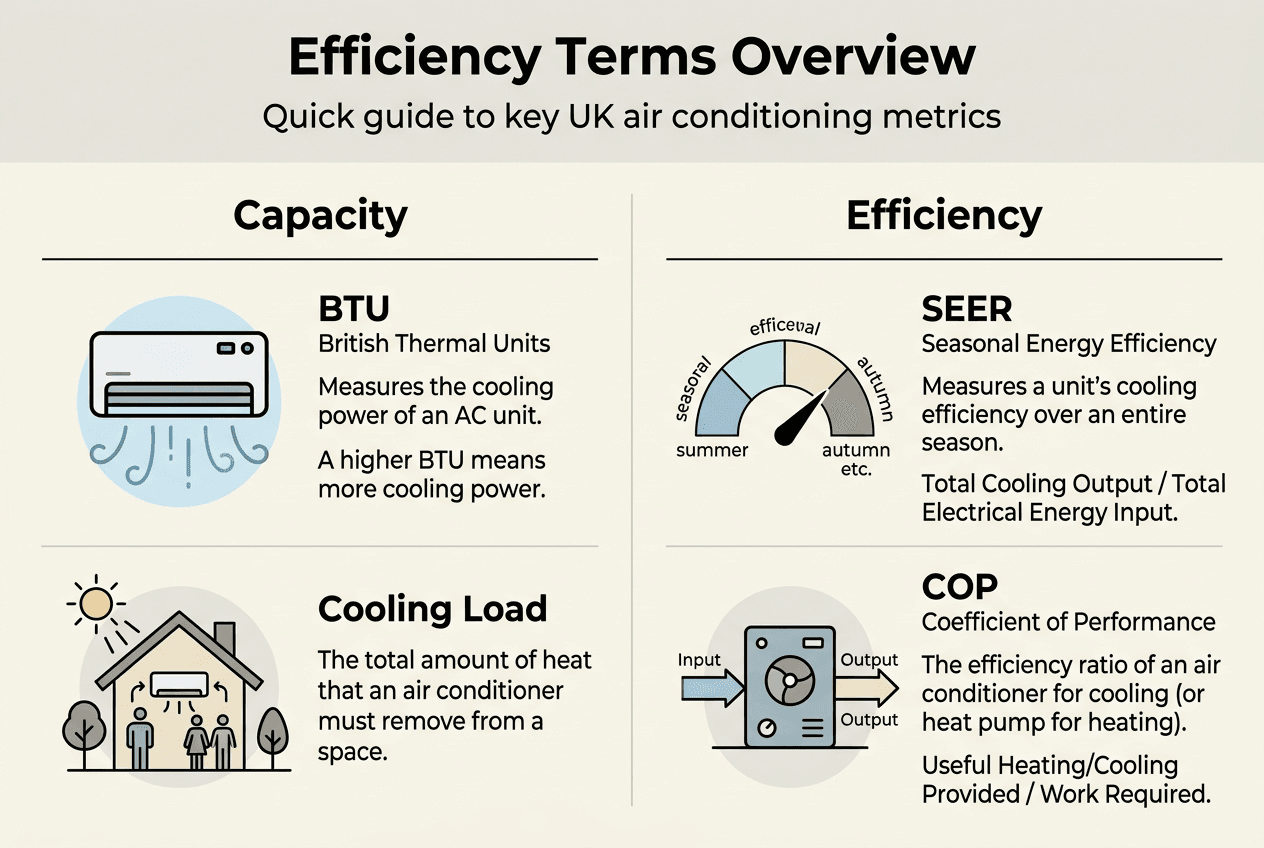
EER (Energy Efficiency Ratio) measures efficiency at a standardised outdoor temperature, typically 35°C. This metric proves valuable for comparing peak performance during the hottest conditions, when systems work hardest and electricity demand peaks. High EER ratings indicate a system maintains efficiency even under thermal stress.
Annual Performance Factor (APF) applies specifically to heat pumps operating in heating mode, accounting for seasonal temperature variations and defrost cycles. APF ratings above 4.0 indicate excellent heating efficiency, meaning the system produces four times more heat energy than the electricity it consumes.
Energy efficiency terms are vital for assessing cost and environmental impact, transforming abstract specifications into concrete financial and sustainability outcomes.
Inverter efficiency deserves special attention, as inverter-driven compressors achieve substantially higher seasonal efficiency than fixed-speed alternatives. Inverter systems modulate output continuously, avoiding the energy spikes associated with constant on/off cycling. This technology typically improves SEER ratings by 20 to 40% compared to non-inverter equivalents.
Standby power consumption, often overlooked, represents electricity used when systems remain powered but inactive. Quality systems minimise standby consumption below 1 watt, whilst poorly designed units may waste 10 watts or more continuously. Over a year, excessive standby power can add £20 to £50 to operating costs unnecessarily.
Part-load efficiency describes performance when systems operate below maximum capacity, which occurs most of the time in real-world conditions. Inverter systems excel at part-load operation, maintaining high efficiency across a wide output range, whilst fixed-speed systems perform optimally only at full capacity.
Key efficiency considerations:
- SEER ratings reflect real-world seasonal performance better than single-point measurements
- Inverter technology delivers superior efficiency across varying loads and conditions
- Standby consumption accumulates costs year-round, even when cooling isn’t needed
- Part-load efficiency matters more than peak efficiency for typical UK usage patterns
Pro Tip: Calculate potential annual savings by comparing SEER ratings directly. A system rated SEER 7.0 versus SEER 5.5 saves approximately 21% on cooling costs annually, which on a £200 yearly cooling bill equals £42 saved every year.
Proper understanding can lead to significant savings and comfort improvements, making efficiency terminology knowledge one of the highest-return investments in your research process.
Terminology for maintenance and troubleshooting
Maintenance vocabulary empowers you to understand service reports, communicate issues effectively, and recognise when professional intervention becomes necessary.
Filters trap airborne particles, preventing dust and debris from entering your living space and clogging system components. Filter terminology includes MERV ratings (Minimum Efficiency Reporting Value), which quantify filtration effectiveness from 1 to 16, with higher numbers capturing smaller particles. Residential systems typically use MERV 8 to 13 filters, balancing air quality with airflow resistance.
Refrigerant leaks represent common issues that severely impact efficiency and cooling capacity. Terms like refrigerant charge, leak detection, and pressure testing describe diagnostic and repair processes. Low refrigerant doesn’t just reduce cooling; it forces the compressor to work harder, increasing wear and energy consumption whilst potentially causing complete system failure.
Compressor issues encompass various mechanical problems affecting the heart of your air conditioning system. Understanding terms like compressor cycling, hard start, and thermal overload helps you interpret technician explanations and recognise warning signs before catastrophic failure occurs.
Thermostat calibration ensures accurate temperature sensing and appropriate system response. Miscalibrated thermostats create comfort issues and efficiency losses, causing systems to over-cool or under-cool spaces. Terms like temperature differential, swing, and anticipator describe thermostat behaviour characteristics.
Condensate drainage removes moisture extracted from indoor air during cooling. Blocked condensate drains cause water damage, humidity problems, and potential system shutdown. Understanding terms like condensate pump, drain pan, and overflow switch helps you maintain proper drainage and avoid water-related issues.
Routine maintenance steps with associated terminology:
- Filter inspection and replacement, checking for blockages, damage, or excessive dirt accumulation that restricts airflow and reduces efficiency
- Coil cleaning, removing dust and debris from evaporator and condenser coils to maintain heat transfer effectiveness and prevent efficiency degradation
- Refrigerant pressure checks, verifying proper charge levels and identifying potential leaks before they cause performance issues or compressor damage
- Electrical connection inspection, tightening terminals and checking for corrosion or damage that could cause failures or safety hazards
- Condensate system verification, ensuring drains flow freely and pumps operate correctly to prevent water damage and humidity control problems
- Thermostat calibration testing, confirming accurate temperature sensing and appropriate system cycling for optimal comfort and efficiency
- Outdoor unit clearance check, removing vegetation, debris, or obstructions that restrict airflow and force the system to work harder
Familiarity with maintenance terms helps prolong system lifespan and maintain efficiency, transforming routine servicing from a mysterious process into an understandable procedure you can monitor and verify.
Diagnostic terminology includes superheat and subcooling, which technicians measure to assess refrigerant charge accuracy. Amperage draw indicates electrical consumption and can reveal motor problems before failure. Static pressure measurements in ducted systems identify restrictions or design flaws affecting performance.
Understanding this HVAC maintenance checklist vocabulary enables productive conversations with service technicians, helping you ask informed questions and make sound decisions about repairs versus replacement.
Discover expert air conditioning installation services
Now that you’ve mastered essential air conditioning terminology, you’re equipped to make informed decisions about system selection and installation. Akita Air Conditioning brings professional expertise to homeowners and businesses across East Anglia, combining technical knowledge with transparent communication to deliver climate control solutions tailored to your specific needs.
Our team specialises in energy-efficient system installations throughout Suffolk, Norfolk, and Essex, helping you navigate terminology and technology to find the perfect balance of comfort, efficiency, and value. Whether you’re exploring split systems for residential comfort or VRF solutions for commercial applications, our qualified installers provide expert guidance from initial consultation through ongoing maintenance.
Discover how professional installation in Ipswich and surrounding areas transforms technical specifications into real-world comfort and energy savings. Contact Akita Air Conditioning today for a personalised consultation and detailed quote tailored to your property’s unique requirements.
FAQ
What does HVAC stand for and why is it important?
HVAC stands for heating, ventilation, and air conditioning, representing the integrated systems that control indoor climate, air quality, and comfort. Understanding what HVAC means helps you recognise that modern climate control involves coordinated components working together rather than isolated cooling units. This integrated approach delivers superior comfort, efficiency, and air quality compared to standalone systems.
How can I tell if an air conditioner is energy efficient?
Look for SEER ratings above 6.0, EER values exceeding 3.0, and inverter technology, which indicates superior efficiency compared to fixed-speed alternatives. Check for energy labels and manufacturer specifications that detail seasonal performance across varying conditions. Energy-efficient cooling systems typically feature inverter compressors, high SEER ratings, and low standby power consumption, translating directly into reduced operating costs.
What maintenance terms should I know for air conditioning care?
Essential terms include filter replacement, which maintains airflow and air quality; refrigerant charge verification, ensuring optimal cooling capacity; and compressor health checks, preventing costly failures. Understanding condensate drainage, coil cleaning, and thermostat calibration helps you recognise proper maintenance procedures and communicate effectively with service technicians. Familiarity with this HVAC maintenance checklist vocabulary enables you to verify that servicing addresses all critical system components.
What is the difference between cooling capacity and efficiency?
Cooling capacity, measured in BTUs or kilowatts, indicates how much heat a system removes per hour, whilst efficiency ratings like SEER describe how economically it achieves that capacity. A high-capacity system isn’t necessarily efficient; it might remove heat quickly but consume excessive electricity doing so. Conversely, an efficient system delivers adequate cooling whilst minimising energy consumption, balancing performance with operating costs for optimal value.