

Understanding aircon warranties: protect your UK cooling system
TL;DR:
- Most UK air conditioning warranties are limited and exclude consumables, damage from improper installation, and routine maintenance issues.
- Maintaining your system with qualified engineers and documenting service history are essential to preserve warranty coverage and prevent costly disputes.
Most homeowners and business owners assume that when something goes wrong with their air conditioning, the warranty will simply cover it. That assumption is one of the most expensive mistakes you can make. Air conditioning warranties in the UK are often narrower than people expect, with specific conditions, exclusions, and obligations that can catch you completely off guard. Understanding exactly what your warranty covers, how long it lasts, and what actions protect or undermine it is the difference between a free repair and a four-figure bill.
Table of Contents
- What does an aircon warranty cover?
- How long do air conditioning warranties last?
- Warranty vs maintenance plans: what’s the difference?
- How to use or claim your aircon warranty
- The truth most people miss about aircon warranties
- Protect your comfort with expert aircon installation and support
- Frequently asked questions
Key Takeaways
| Point | Details |
|---|---|
| Warranty basics | An air conditioning warranty covers key components but usually excludes damage or neglect. |
| Service matters | Regular professional maintenance is essential to keep your warranty valid and your system efficient. |
| Document everything | Always keep records of installation, servicing, and warranty claims to avoid disputes or voided coverage. |
| Know your options | Maintenance plans and extended warranties can offer benefits above basic manufacturer coverage. |
| Professional installation | Using approved engineers for installation and servicing both activates and preserves warranty coverage. |
What does an aircon warranty cover?
With the need for clarity high, let’s explore exactly what most air conditioning warranties offer. A standard air conditioning warranty is a manufacturer’s promise to repair or replace faulty parts if the system fails due to a defect in materials or workmanship. It is not a guarantee against all possible problems.
Typical warranties cover the compressor (the heart of the system), refrigerant circuit components, heat exchangers, and major electrical parts. Some installers, including those offering air conditioning maintenance packages, also include a period of labour coverage, meaning a qualified engineer will attend and repair the fault at no additional cost during the warranty window.
What warranties almost never cover is just as important to understand. Commonly excluded items include:
- Filters, grilles, and consumable components
- Damage caused by improper installation (if carried out by an unqualified person)
- Accidental damage or physical impact
- Electrical surges or water ingress not related to the unit itself
- Faults caused by a failure to carry out routine maintenance
- Misuse or modification of the system
Most manufacturers will void a warranty instantly if the system has been serviced or repaired by an engineer who is not registered or authorised. This is not just small print. It is standard practice across the UK HVAC industry.
UK warranties are typically issued either by the manufacturer or the installing company, sometimes both. Manufacturer warranties cover the equipment itself, while installer warranties cover the quality of the installation work. These can overlap, but they are separate protections. When choosing between top air conditioners for your home or business, it is worth comparing the warranty terms alongside the headline specification, because a more modest unit with stronger warranty coverage may offer better long-term value.
Misunderstanding coverage leads to real financial consequences. Imagine assuming your system’s breakdown is covered, only to discover the fault was caused by a blocked drain that went unchecked for two years. That is a maintenance failure, not a manufacturing defect, and the manufacturer’s warranty will not pay for it.
How long do air conditioning warranties last?
Now that you know what’s usually included, it’s important to understand how long this protection actually lasts. Warranty duration varies considerably, and length does not always equal quality of coverage.
| Warranty type | Typical duration | Notes |
|---|---|---|
| Manufacturer parts warranty | 2 to 5 years | Varies by brand and product range |
| Installer workmanship warranty | 1 to 2 years | Covers installation quality |
| Extended manufacturer warranty | Up to 7 years | Often requires annual servicing |
| Labour coverage | 1 to 2 years | Included by some installers |
The majority of standard manufacturer warranties for residential systems run for two to five years. Commercial systems often follow similar timelines, though residential air conditioning installers may offer extended terms as part of a premium package or to reward customers who commit to a regular servicing contract.
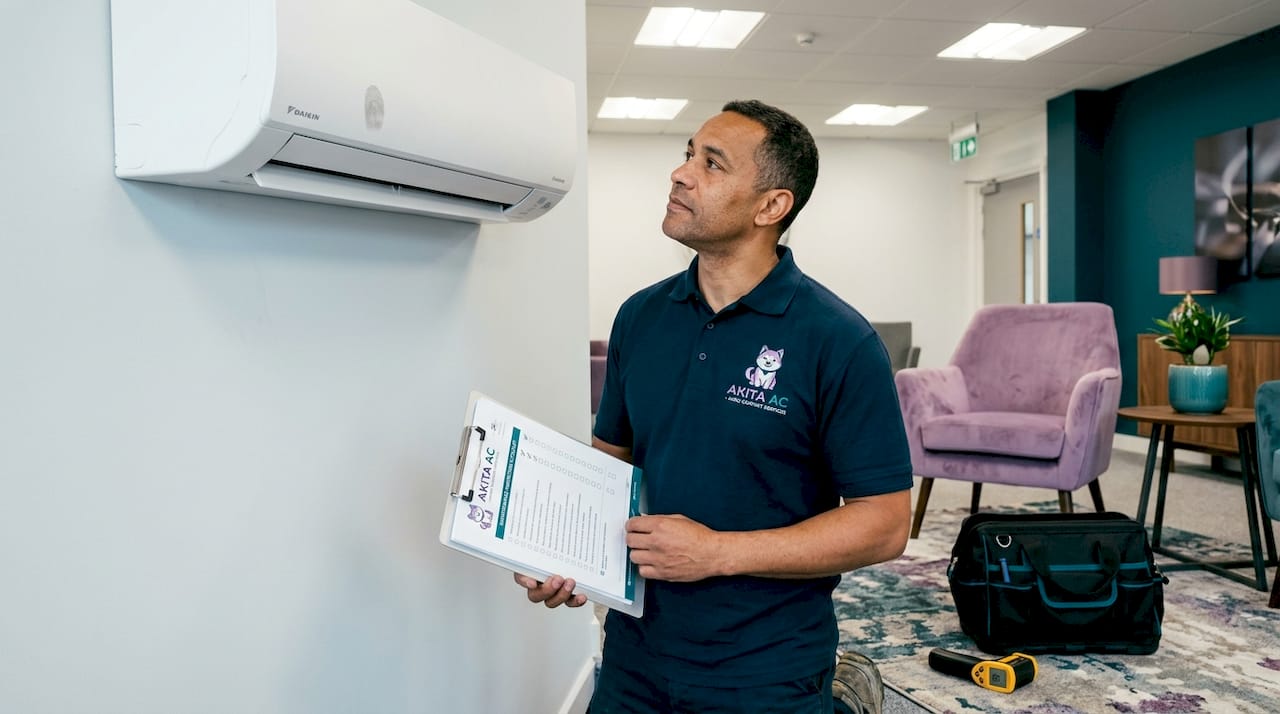
The start date matters enormously. Most warranties begin on the date of installation, not the purchase date. If your unit sat in a warehouse for six months before fitting, your warranty period started from the moment it was commissioned on-site. Business owners who purchase systems for multiple sites need to track each unit’s installation date separately, because a batch purchase does not mean a unified warranty timeline.
Pro Tip: Register your unit with the manufacturer as soon as it is installed. Many brands offer an extended warranty (sometimes an additional one to two years) simply for completing an online registration within 30 days of installation. It takes five minutes and could save hundreds of pounds.
Actions that commonly void or shorten a warranty include:
- Having the system serviced by an unregistered engineer
- Using non-approved replacement parts
- Skipping scheduled annual maintenance
- Tampering with refrigerant circuits without F-Gas certification
- Installing the unit in conditions outside the manufacturer’s specified operating range
For homeowners, the key takeaway is that your warranty is not passive protection. It is a contract with conditions, and you are responsible for meeting them.
Warranty vs maintenance plans: what’s the difference?
Understanding the limits of your warranty makes it crucial to see where maintenance contracts can help keep your system and your warranty in peak shape. These two things are frequently confused, but they serve very different purposes.
A warranty protects you against manufacturing faults and defects. A maintenance plan protects you against the gradual wear, inefficiency, and minor failures that affect every mechanical system over time. One covers what should not happen. The other addresses what inevitably will happen.
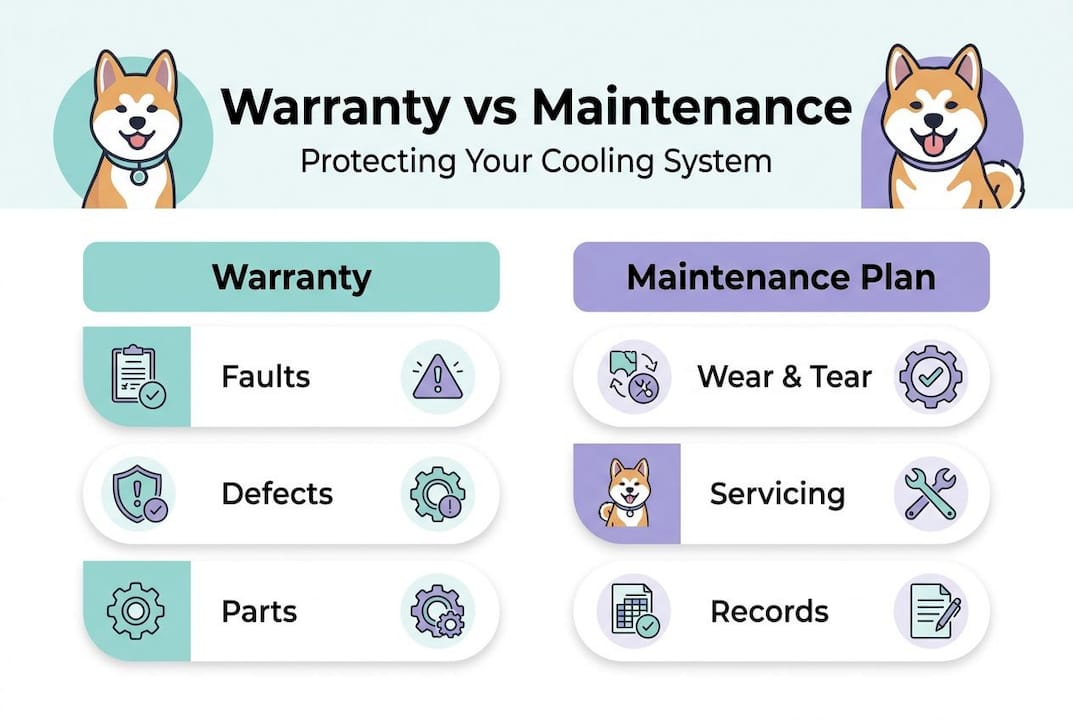
| Feature | Manufacturer warranty | Maintenance plan |
|---|---|---|
| Covers manufacturing defects | Yes | No |
| Covers routine wear and tear | No | Yes |
| Filter cleaning and replacement | No | Often included |
| Annual safety checks | No | Core service |
| Emergency callout support | Rarely | Often included |
| Keeps warranty valid | Required condition | Directly supports |
| Labour costs after warranty period | Not covered | Covered |
Maintenance obligations are not optional if you want to keep your warranty valid. Most manufacturers specify that the system must be serviced at least once per year by an F-Gas certified engineer. Failure to do so gives the manufacturer grounds to reject a warranty claim, even if the fault itself has nothing to do with maintenance. Reviewing an air conditioner maintenance checklist before your annual service helps ensure nothing is missed.
HVAC maintenance plans solve two problems at once. They keep your system running at its best and they provide the documented service history that a manufacturer requires before approving any warranty claim. Without that paperwork, even a legitimate fault can become a disputed one.
Consider the real-world cost of neglect. A system that goes unserviced for three years may develop refrigerant leakage, reduced airflow efficiency, and compressor strain. When it eventually breaks down, the repair bill can run to several hundred pounds. Worse, if the manufacturer’s investigation shows a lack of maintenance contributed to the fault, you may receive nothing from your warranty claim at all.
Pro Tip: Ask your installer to provide a written service record after every visit. Keep these documents together with your original installation certificate, warranty paperwork, and any product registration confirmation. A clear file of evidence protects you if a warranty dispute ever arises.
Advanced approaches such as predictive HVAC maintenance use performance data to flag issues before they become failures, which is particularly valuable for commercial premises where system downtime carries a tangible business cost. Learning how to create an effective HVAC maintenance plan is not just good practice. It is the smartest way to preserve the investment you have made in your system.
How to use or claim your aircon warranty
Since maintaining your warranty is vital, knowing precisely how to claim it can make the process far less stressful. Following a clear process dramatically improves your chances of a successful and timely resolution.
- Identify the fault clearly. Note when the problem started, what symptoms you are seeing (unusual noise, loss of cooling, error codes on the display), and whether anything changed before the issue appeared.
- Check your warranty documents. Confirm that your system is still within the warranty period and that you have met all maintenance obligations. Locate your installation certificate, service records, and product registration.
- Contact the installer first. In most cases, the company that installed your system is your first point of contact. They will either resolve the issue under their workmanship warranty or liaise with the manufacturer on your behalf.
- Request a written fault report. Ask the attending engineer to document the fault in writing. This creates a formal record that supports your claim and prevents disputes about what was found.
- Follow up in writing. If you are not satisfied with the response or the timeline, put your concerns in writing via email. This creates a clear audit trail and demonstrates that you took the matter seriously.
- Escalate if needed. If the installer or manufacturer disputes your claim and you believe it is valid, you can escalate to Trading Standards or seek independent arbitration under the Consumer Rights Act 2015.
Reviewing a residential HVAC maintenance checklist before making a claim is genuinely useful, as it helps confirm that you have fulfilled all routine care obligations and gives you confidence when speaking to the manufacturer. Understanding the benefits of HVAC maintenance is also valuable context, as it illustrates why manufacturers place so much weight on documented service records.
Common mistakes that derail warranty claims include calling an independent engineer before contacting the original installer, attempting DIY repairs, and failing to register the product at point of installation. Each of these can give the manufacturer a reason to decline your claim, even when the underlying fault is clearly a defect.
The truth most people miss about aircon warranties
After exploring the mechanics, it is worth stepping back for an honest assessment. Warranties are valuable. They provide real financial protection and signal that a manufacturer stands behind their product. But treating a warranty as a complete safety net is a mistake we see play out repeatedly.
A warranty is a floor, not a ceiling. It catches the worst-case scenario of early equipment failure, but it does not replace filters, it does not clean evaporator coils, it does not top up refrigerant that has slowly leaked away, and it does not tell you when your system is operating at 60% efficiency rather than 100%. All of those things affect your energy bills and your comfort every single day, yet none of them are warranty issues.
The homeowners and business owners who get the most value from their air conditioning systems are the ones who treat maintenance as the real investment and the warranty as a useful bonus. New technology helps here. Systems with smart diagnostics can flag performance issues early, but only if someone is paying attention. Consider exploring aircon upgrades for efficiency if your current system is ageing, because a newer, more efficient unit with a fresh warranty often works out cheaper over five years than keeping an old system limping along.
The uncomfortable reality is that a warranty dispute is stressful, slow, and sometimes unresolvable without a well-maintained paper trail. The most reliable way to avoid that stress is to make it impossible for anyone to question your maintenance record. That means using qualified engineers, keeping every receipt and service report, and registering your products promptly.
Protect your comfort with expert aircon installation and support
If you want genuine peace of mind from your air conditioning system, it starts with choosing the right installer and the right ongoing support from the very beginning.
At Akita Air Conditioning, we install and service modern, energy-efficient systems for homeowners and businesses across Suffolk, Norfolk, and Essex. Every installation we carry out activates manufacturer warranty terms correctly, and our maintenance memberships are designed to keep your system and your warranty in excellent standing year after year. From first installation through to ongoing servicing, our team of F-Gas certified engineers handles everything, so you are never left wondering whether your coverage is still valid. Get in touch today to discuss your options and find out how we can protect your investment for the long term.
Frequently asked questions
Does regular servicing keep my aircon warranty valid?
Yes, most warranties require proof of regular servicing by authorised professionals to remain valid. Check your specific terms, as the frequency required is usually annual servicing by a qualified engineer.
What happens if I use a non-approved engineer for aircon repairs?
Using an unapproved engineer can void your air conditioning warranty. Manufacturers specify that only F-Gas certified installers are authorised to carry out repairs or maintenance on warranted systems.
Can I extend my aircon warranty after installation?
In many cases, you can purchase extended coverage for your system, but offers vary by manufacturer and installer. Many brands reward annual servicing with extended terms, making HVAC maintenance an easy way to protect your investment further.
Is accidental damage covered by an aircon warranty?
Accidental damage is almost never covered by standard air conditioning warranties. Standard warranty coverage applies to manufacturing defects and component failures, not physical accidents or external damage.
How do I know if my aircon warranty is still valid?
Check your installation or manufacturer paperwork for the warranty start and end dates, or contact the installer for confirmation. Keeping a maintenance checklist log also helps confirm that all conditions for validity have been met.