

What is predictive HVAC maintenance: guide for homeowners
Most homeowners assume that scheduling an annual HVAC service is enough to keep their systems running smoothly. This assumption costs them hundreds of pounds each year in emergency repairs and inflated energy bills. Predictive HVAC maintenance represents a fundamental shift from reactive fixes to proactive care, using sensors and artificial intelligence to identify problems weeks before they cause breakdowns. For property managers overseeing multiple buildings across Suffolk, Norfolk, and Essex, this technology transforms maintenance from a cost centre into a strategic advantage that delivers measurable savings whilst extending equipment lifespan.
Table of Contents
- Key takeaways
- What is predictive HVAC maintenance and how does it work?
- Benefits of predictive HVAC maintenance for homeowners and property managers in East Anglia
- Comparing predictive maintenance to reactive and preventive methods
- Practical steps to implement predictive HVAC maintenance in your home or property portfolio
- Explore Akita AC’s domestic and commercial air conditioning services
- Frequently asked questions about predictive HVAC maintenance
Key Takeaways
| Point | Details |
|---|---|
| Predictive maintenance prevents failures | Sensors and artificial intelligence monitor HVAC systems to identify issues weeks before breakdowns, enabling proactive repairs and reducing emergency calls. |
| Energy costs reduced | By optimising operation and avoiding late fixes, predictive maintenance lowers energy consumption and trims bills. |
| Increased lifespan and reliability | Continuous monitoring helps components operate within design tolerances, extending equipment life and improving reliability. |
| Clear return on investment | Although there is an upfront investment, the ongoing savings from fewer repairs and lower energy use deliver a substantial return. |
What is predictive HVAC maintenance and how does it work?
Predictive HVAC maintenance is a data-driven strategy using sensors and machine learning algorithms to monitor real-time parameters like vibration, temperature, pressure, and current draw. Unlike traditional maintenance that follows fixed schedules, this approach analyses continuous data streams to predict remaining useful life before breakdown occurs. The system learns normal operating patterns for your specific equipment, then alerts you when measurements deviate from baseline performance.
The technology relies on several interconnected components working together. Wireless sensors attach to critical HVAC components like compressors, motors, and heat exchangers. These devices measure multiple parameters simultaneously, transmitting data every few seconds to cloud-based analytics platforms. Machine learning models process this information, comparing current readings against historical patterns and manufacturer specifications. When the system detects anomalies that indicate impending failure, it generates alerts with specific recommendations for intervention.
Common diagnostic methods include vibration analysis, motor current signature analysis, infrared thermography, and ultrasonic detection. Vibration sensors identify bearing wear and imbalance issues weeks before they cause catastrophic failure. Temperature monitoring reveals refrigerant leaks, blocked filters, and heat exchanger degradation. Current draw analysis detects motor winding problems and electrical faults. Combining these measurements creates a comprehensive picture of system health that single-point inspections cannot match.
The sophistication of predictive systems varies considerably. Basic installations monitor three to five critical parameters on high-value equipment. Advanced implementations track dozens of data points across entire HVAC networks, using artificial intelligence to optimise energy consumption whilst predicting maintenance needs. Property managers typically start with essential monitoring on their most critical or failure-prone units, then expand coverage as they validate results and build confidence in the technology.
Integration with existing building automation systems amplifies effectiveness. When predictive maintenance software connects to your building management system, it can automatically adjust operating parameters to compensate for developing issues. If sensors detect a compressor running hotter than normal, the system might reduce load or increase cooling to prevent damage whilst you arrange repairs. This automated response prevents minor problems from escalating into emergency situations that disrupt occupants and drain budgets.
Pro Tip: Starting with vibration and temperature sensors provides essential early warning signals for the most common HVAC failures at minimal cost, typically under £500 per monitored unit including installation and first-year analytics.
The residential HVAC maintenance checklist still applies, but predictive technology tells you exactly when each task needs attention rather than following arbitrary schedules. You service components based on actual condition rather than calendar dates, eliminating unnecessary work whilst catching problems that traditional inspections miss entirely.
Benefits of predictive HVAC maintenance for homeowners and property managers in East Anglia
The financial case for predictive maintenance becomes compelling when you examine actual performance data. Systems equipped with predictive monitoring reduce emergency repairs by 3-9 times, energy bills by 10-30%, and extend equipment life by 25% compared to traditional approaches. For a property manager overseeing twenty commercial units, this translates to avoiding multiple five-figure emergency callouts each year whilst slashing utility costs across the entire portfolio.
Energy savings deserve particular attention given rising electricity prices across the UK. Predictive systems identify efficiency degradation long before it becomes obvious through utility bills. A compressor losing 15% efficiency might add £200 monthly to energy costs without triggering any obvious symptoms. Predictive monitoring catches this gradual decline immediately, allowing you to address the root cause before wasting thousands of pounds. The regular HVAC maintenance benefits multiply when you know precisely which components need attention.
Equipment lifespan extension provides another substantial benefit that traditional maintenance approaches struggle to deliver. HVAC systems fail primarily due to undetected minor issues that cascade into major damage. A small refrigerant leak stresses the compressor, causing premature wear that leads to catastrophic failure years earlier than expected. Predictive monitoring identifies that initial leak within days, allowing simple repairs that prevent the downstream damage cascade. This protection proves particularly valuable for the benefits of HVAC maintenance for UK homeowners who want maximum return from their climate control investment.
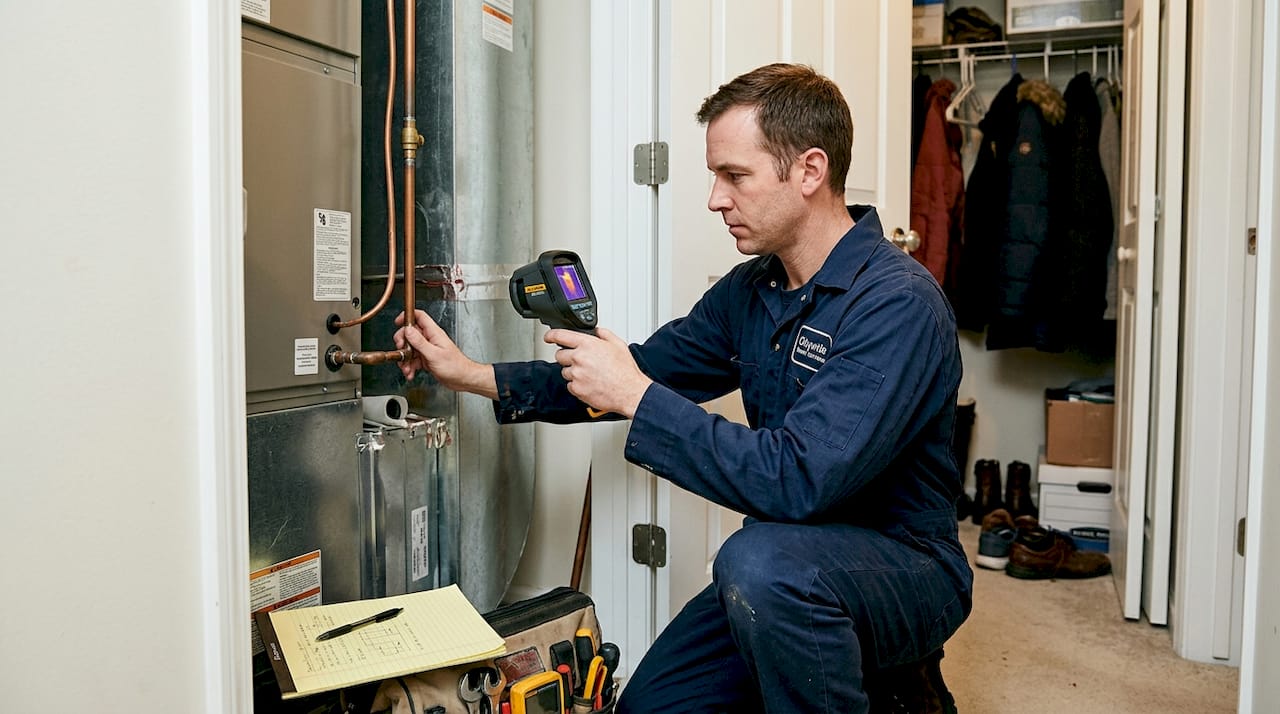
Empirical benchmarks from commercial deployments show 40% less unplanned downtime, 38% lower maintenance costs, and 28% energy reduction in documented case studies. These figures come from real-world implementations across various building types and climates, demonstrating consistent results that transcend individual circumstances. Property managers in East Anglia report particular value during transitional seasons when HVAC systems cycle frequently between heating and cooling modes, creating stress that predictive monitoring helps manage.
| Metric | Traditional maintenance | Predictive maintenance | Improvement |
|---|---|---|---|
| Emergency repairs | 8-12 per year | 1-3 per year | 70-85% reduction |
| Energy costs | Baseline | 10-30% lower | £800-2400 annual savings |
| Equipment lifespan | 12-15 years | 15-19 years | 25% extension |
| Maintenance labour | 100% | 62% | 38% reduction |
| Unplanned downtime | 100% | 60% | 40% reduction |
Return on investment calculations consistently show payback periods between eight and fourteen months for typical installations. A homeowner investing £2000 in predictive monitoring for a comprehensive HVAC system saves approximately £1500 annually through reduced repairs and energy costs, recovering the initial investment within sixteen months. Property managers with multiple buildings achieve even faster payback due to economies of scale in sensor deployment and analytics platforms.
Pro Tip: Focus initial predictive monitoring on your newest or most expensive HVAC equipment where failure would prove most costly, then expand to older units as you validate savings and build operational confidence.
Comparing predictive maintenance to reactive and preventive methods
Understanding the fundamental differences between maintenance approaches clarifies why predictive methods deliver superior results. Reactive maintenance involves fixing equipment after it fails, responding to breakdowns as they occur without any advance planning. This approach minimises upfront investment but maximises long-term costs through emergency callouts, expedited parts, and collateral damage from cascading failures. A compressor that seizes suddenly might damage other system components, turning a £1200 repair into a £4000 replacement.
Preventive maintenance follows fixed schedules, servicing equipment at predetermined intervals regardless of actual condition. You might change filters quarterly and inspect refrigerant levels annually whether needed or not. This approach reduces failures compared to reactive maintenance but wastes 30-40% of work on unnecessary tasks whilst missing developing problems that fall between scheduled inspections. A bearing might begin failing two weeks after your quarterly inspection, leaving it undetected until the next scheduled service three months later when damage has progressed significantly.
Predictive maintenance monitors actual equipment condition continuously, triggering maintenance only when data indicates genuine need. You service components based on measured degradation rather than arbitrary schedules, eliminating wasted effort whilst catching problems at the earliest possible stage. This precision transforms maintenance from a cost centre into a strategic capability that optimises both reliability and expenditure.
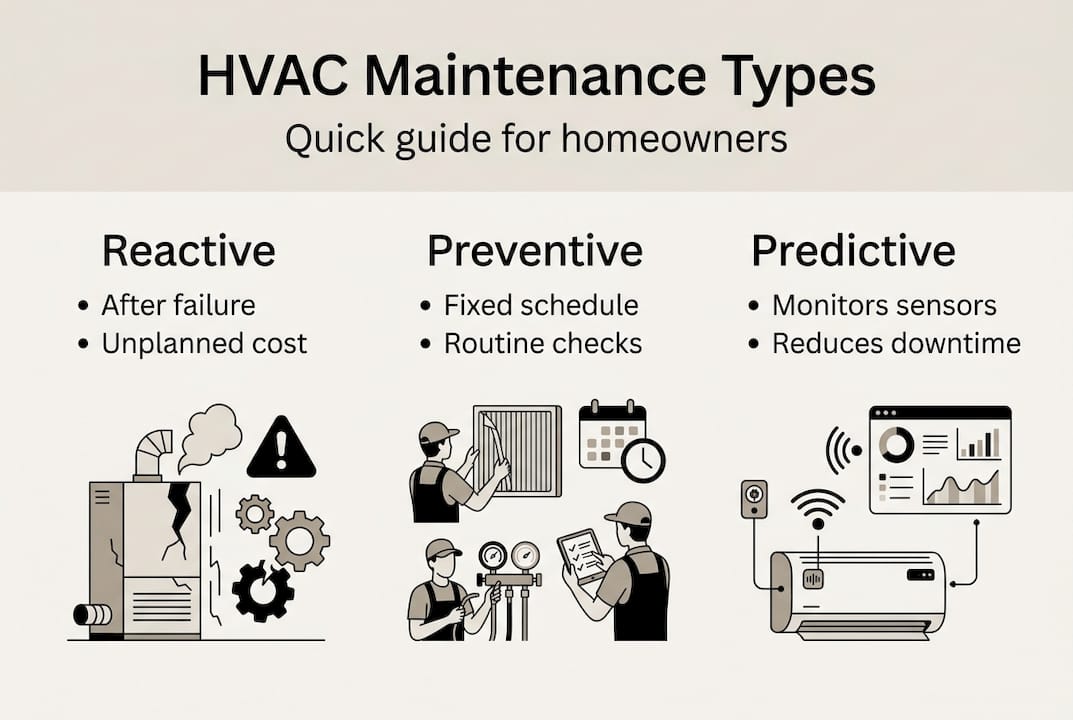
The practical differences become obvious when you examine specific scenarios. Consider a heat exchanger developing a small crack. Reactive maintenance discovers this only after complete failure floods your system with water, requiring emergency repairs during a cold snap when contractor rates triple. Preventive maintenance might catch it during a scheduled inspection if the crack happens to be visible and the inspector looks carefully, but more likely misses it until symptoms become obvious. Predictive monitoring detects the temperature anomaly within days of the crack forming, allowing planned repairs at standard rates before any water damage occurs.
Hybrid approaches combining predictive and preventive maintenance offer practical advantages for many property managers. Critical equipment receives continuous predictive monitoring whilst less essential components follow preventive schedules. This strategy balances investment against risk, concentrating advanced monitoring where it delivers maximum value. An effective HVAC maintenance plan typically incorporates both methods, using predictive technology to optimise preventive schedules rather than replacing them entirely.
| Maintenance type | Timing | Cost profile | Failure prevention | Efficiency |
|---|---|---|---|---|
| Reactive | After failure | Very high | None | Lowest |
| Preventive | Fixed schedule | Medium | Moderate | Medium |
| Predictive | Condition-based | Low | Excellent | Highest |
| Hybrid | Mixed approach | Low-medium | Very good | High |
The choice between approaches depends on equipment criticality, failure consequences, and available resources. Single-family homeowners might implement basic predictive monitoring on their primary HVAC system whilst using preventive maintenance for secondary equipment. Property managers typically deploy comprehensive predictive monitoring across their entire portfolio, given the substantial savings potential and reduced operational complexity compared to managing dozens of preventive schedules.
Marketing strategies for HVAC service providers increasingly emphasise predictive capabilities as a competitive differentiator, similar to how targeted advertising boosts home service leads by highlighting technological advantages. Property managers should evaluate contractors based on their predictive maintenance expertise rather than simply comparing hourly rates.
Practical steps to implement predictive HVAC maintenance in your home or property portfolio
Successful implementation begins with a thorough assessment of your existing HVAC assets. Document each system’s age, capacity, criticality, and maintenance history. Prioritise units that are mission-critical, expensive to replace, or have histories of reliability problems. A property manager might identify ten commercial units where downtime causes immediate tenant complaints and revenue loss, making them ideal candidates for initial predictive monitoring regardless of their age or condition.
Installing minimum viable sensors provides the foundation for effective monitoring without excessive upfront investment. Focus on three essential parameters that predict the majority of common failures. Vibration sensors detect bearing wear, motor imbalance, and mechanical problems. Temperature sensors identify refrigerant issues, heat exchanger problems, and electrical faults. Current draw monitors reveal motor winding degradation and electrical anomalies. These three measurements together predict approximately 80% of HVAC failures weeks before they occur.
Integration with existing building automation or maintenance management software amplifies the value of sensor data. Modern predictive maintenance platforms offer APIs that connect seamlessly with popular building management systems, allowing automated alerts and work order generation. When sensors detect an anomaly, the system automatically creates a maintenance ticket with specific diagnostic information, eliminating manual monitoring and ensuring rapid response. Property managers report that this integration reduces administrative overhead by 60% compared to manual monitoring approaches.
Starting with a pilot project validates results and builds organisational confidence before full-scale deployment. Select three to five representative HVAC units that span different ages, capacities, and usage patterns. Install comprehensive monitoring and track performance for three to six months, documenting avoided failures, energy savings, and maintenance cost reductions. This data provides concrete evidence for expanding the programme whilst identifying implementation challenges in a controlled environment where mistakes have limited consequences.
Budgeting for sensor installation requires understanding both hardware and ongoing analytics costs. Basic wireless sensor packages cost £300-500 per monitored unit including installation. Cloud-based analytics platforms typically charge £15-30 monthly per monitored asset for data processing, machine learning analysis, and alert management. A property manager monitoring twenty HVAC units should budget approximately £8000 for initial deployment plus £4800 annually for analytics services. Case studies show 8-14 month payback through combined energy savings and avoided repair costs.
Pro Tip: Partner with experienced service providers for troubleshooting and integration rather than attempting DIY installation, as proper sensor placement and baseline calibration require HVAC expertise that determines whether your predictive system delivers accurate alerts or generates false alarms.
Training your maintenance team or contractors on interpreting predictive alerts ensures you capture the technology’s full value. Many organisations install sophisticated monitoring but lack the expertise to act on insights effectively. Schedule quarterly reviews with your analytics provider to refine alert thresholds, discuss trending patterns, and optimise maintenance schedules based on accumulated data. This continuous improvement process transforms predictive maintenance from a monitoring tool into a strategic capability that fundamentally changes how you manage HVAC assets.
The HVAC servicing best practices evolve when predictive data guides your decisions. Technicians arrive onsite with specific diagnostic information rather than conducting general inspections, reducing service time by 40% whilst improving repair quality. This efficiency proves particularly valuable for commercial HVAC maintenance workflow optimisation where minimising disruption to occupied spaces creates substantial value beyond simple cost savings.
Explore Akita AC’s domestic and commercial air conditioning services
Implementing predictive HVAC maintenance requires expertise in both traditional climate control systems and modern monitoring technology. Akita AC delivers comprehensive installation and maintenance services across Suffolk, Norfolk, and Essex, supporting homeowners and property managers who want to integrate predictive capabilities with their existing HVAC infrastructure. Our technicians understand how to position sensors for optimal data collection whilst ensuring installations meet manufacturer specifications and warranty requirements.

Our domestic air conditioning installation services include consultation on predictive monitoring options that match your specific equipment and budget. We help homeowners select appropriate sensor packages and analytics platforms, then provide ongoing support as you learn to interpret alerts and optimise maintenance schedules. For property managers overseeing multiple buildings, our commercial air conditioning installation expertise ensures consistent deployment across your entire portfolio with centralised monitoring and reporting.
Regional expertise matters when implementing predictive maintenance across East Anglia’s varied building stock and climate conditions. Our air conditioning installation East Anglia experience spans everything from listed buildings requiring sensitive installations to modern commercial developments demanding integrated building management systems. We understand local building regulations, typical HVAC configurations, and seasonal patterns that affect optimal monitoring strategies.
Frequently asked questions about predictive HVAC maintenance
What is predictive HVAC maintenance?
Predictive HVAC maintenance uses sensors and artificial intelligence to monitor equipment continuously, analysing real-time data to forecast failures before they occur. This approach allows you to schedule repairs based on actual condition rather than arbitrary timelines.
How much does predictive HVAC maintenance cost?
Initial sensor installation typically costs £300-500 per monitored unit, with ongoing analytics services running £15-30 monthly per asset. Most implementations achieve payback within 8-14 months through reduced repairs and energy savings.
Can I add predictive monitoring to my existing HVAC system?
Yes, modern wireless sensors attach to existing equipment without modifications, making retrofits straightforward for systems of any age. The sensors transmit data to cloud platforms that work independently of your current HVAC controls.
What failures can predictive maintenance detect?
Predictive systems identify bearing wear, refrigerant leaks, motor problems, heat exchanger degradation, electrical faults, and efficiency losses weeks before they cause breakdowns. The technology predicts approximately 80% of common HVAC failures with sufficient advance notice for planned repairs.
Do I still need regular HVAC servicing with predictive monitoring?
Yes, but predictive data optimises when and what you service rather than following fixed schedules. Technicians focus on components showing actual degradation whilst skipping unnecessary work on equipment operating normally, reducing overall maintenance costs by 30-40%.