

VRF systems explained: a practical guide for UK homes
A VRF system (variable refrigerant flow) is a multi-zone air conditioning and heating technology that uses an inverter-driven compressor to vary the amount of refrigerant delivered to each indoor unit, giving precise, independent climate control across multiple rooms or zones from a single outdoor unit. You may also see it called VRV — that stands for variable refrigerant volume and is a registered trademark of Daikin, while VRF is the generic industry term used by everyone else.
Three things worth knowing straight away:
- Zoning and efficiency: each indoor unit operates independently, so a meeting room can be cooled while a corridor is heated, and the system only works as hard as the combined load demands.
- Heat recovery capability: the most advanced configurations allow simultaneous heating in one zone and cooling in another, recovering heat that would otherwise be wasted.
- Installer and design quality matter enormously: a poorly designed or commissioned VRF system will underperform a well-installed split system. The technology is only as good as the engineer behind it.
Pro Tip: Before requesting quotes, check that any installer references CIBSE guidance on VRF design and commissioning, and ask specifically which refrigerant the system uses. UK F-gas regulations are tightening, and refrigerant choice affects your long-term running costs.
Table of Contents
- What are VRF systems and how do they actually work?
- What types of VRF system are available?
- What are the real benefits of VRF systems?
- What are the drawbacks and considerations before choosing VRF?
- When should you choose VRF over other HVAC options?
- What does VRF installation involve in the UK, and what does it cost?
- How do you choose a reputable VRF installer in the UK?
- Key takeaways
- The case for getting VRF right, not just getting VRF
- VRF installation in Suffolk, Norfolk, and Essex: how Akita can help
- Useful sources and further reading
What are VRF systems and how do they actually work?
VRF modulates refrigerant flow using inverter compressors, matching output precisely to what each zone needs at any given moment rather than cycling on and off at full power.

Think of a conventional on/off compressor as a light switch: fully on or fully off. An inverter compressor is a dimmer. It ramps up when demand is high and throttles back when zones reach their set temperatures, which is where the efficiency gains come from. The system continuously reads zone conditions and adjusts refrigerant flow accordingly, often within seconds.
The main physical components are:
- Outdoor condensing unit: contains the inverter compressor(s), heat exchanger and controls; acts as condenser or evaporator depending on whether the system is in cooling or heating mode. Outdoor units are designed to serve many indoor units simultaneously through a shared refrigerant network.
- Indoor fan coil units (FCUs): wall-mounted, ceiling cassette, ducted, or floor-standing units installed in each zone; each has its own electronic expansion valve to regulate refrigerant flow locally.
- Refrigerant pipework: copper pipes carrying refrigerant between the outdoor unit and indoor units; a branch selector box (in heat-recovery systems) routes refrigerant to heating or cooling mode per zone.
- Controls and BMS integration: zone thermostats, centralised controllers, and — in commercial installations — building management system (BMS) interfaces that log performance and allow remote adjustment.
The refrigerant travels in a closed loop. When a zone calls for cooling, the indoor unit’s expansion valve opens, refrigerant evaporates and absorbs heat from the room, and that heat is rejected at the outdoor unit. Heating mode reverses the cycle. The inverter compressor adjusts its speed continuously so the system delivers exactly what the combined zone loads require.
What types of VRF system are available?
There are two main configurations, and the choice between them shapes both the installation cost and the long-term energy performance.
- Heat-pump VRF (two-pipe): the entire system operates in either heating or cooling mode at any one time. All indoor units heat simultaneously or all cool simultaneously. This is the simpler, lower-cost option and suits residential properties, small offices, and buildings where zones broadly share the same seasonal need.
- Heat-recovery VRF (three-pipe or enhanced two-pipe): a branch selector box allows individual indoor units to heat or cool independently at the same time. Heat extracted from a cooling zone is redirected to a heating zone rather than rejected outside. Hotels, mixed-use offices, and buildings with south-facing and north-facing zones running opposite loads simultaneously benefit most from this configuration.
- Specialised topologies: some manufacturers offer dedicated outdoor heat recovery units, modular systems for very large buildings, or systems designed to integrate with dedicated outdoor air systems (DOAS) for ventilation. These are common in large commercial retrofits where ductwork is impractical.
For a terraced house or a small flat conversion, a heat-pump VRF covering three or four zones is often the right call. For a hotel where the gym is cooling while guest rooms are heating, the energy recovered through a heat-recovery system can meaningfully reduce running costs over the building’s lifetime.

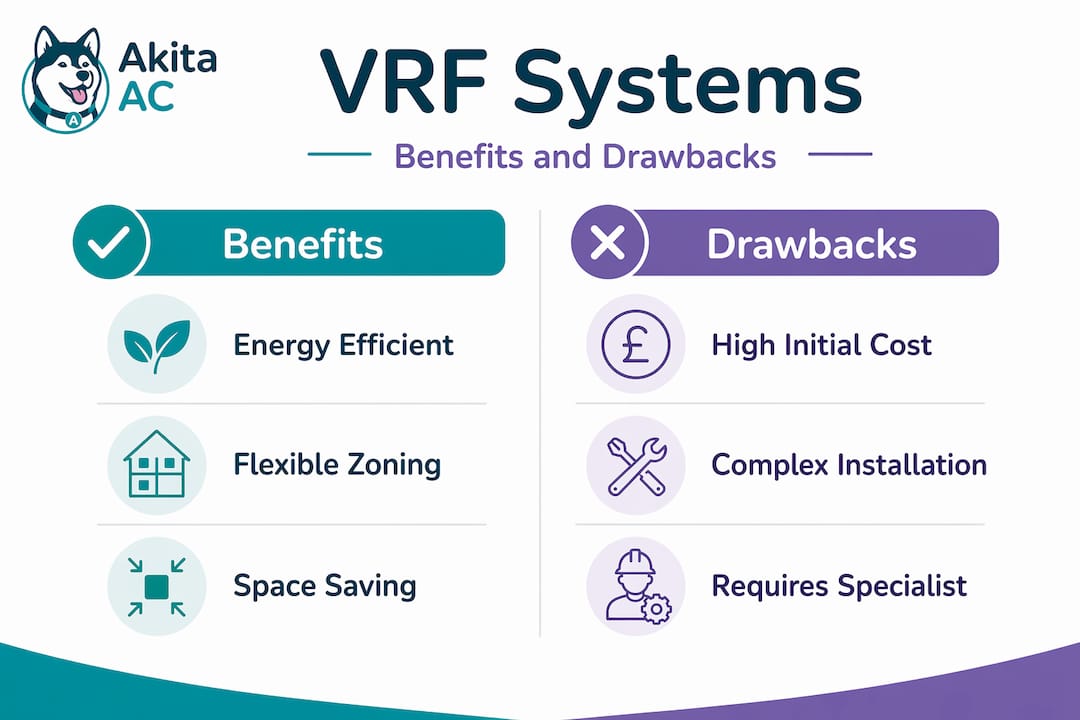
What are the real benefits of VRF systems?
The headline advantage is part-load efficiency combined with granular zoning. Most buildings spend the majority of their operating hours at partial load, not peak demand, and that is precisely where VRF outperforms conventional systems.
Efficiency advantages:
- Inverter modulation avoids the energy spikes of on/off cycling and maintains stable zone temperatures with less electrical input.
- Refrigerant is distributed directly to indoor units, avoiding the distribution losses associated with long duct runs or large chilled-water circuits.
- Pairing VRF with a dedicated outdoor air system (DOAS) handles ventilation separately and efficiently, keeping the VRF circuit focused on sensible heating and cooling loads.
- Energy-efficient HVAC setups that combine VRF with smart controls and occupancy sensors can reduce conditioning energy further.
Comfort and acoustic benefits:
- Indoor units in well-specified VRF systems operate quietly. Ceiling cassettes and wall-mounted units from leading manufacturers typically produce noise levels comparable to a quiet library at normal operating speeds, making them well-suited to bedrooms and meeting rooms. For a closer look at air conditioning noise levels, Akita has a dedicated guide.
- Because each zone has its own set point, occupants in different rooms are not fighting over a shared thermostat.
- No large ductwork means no duct-borne noise transmission between rooms.
Space and installation flexibility:
- Outdoor units are compact relative to the number of zones they serve, and refrigerant pipework is far less bulky than ductwork.
- Systems can be installed in buildings where running large ducts is impractical, including period properties and multi-storey retrofits.
Efficiency callout: VRF systems are recognised by industry bodies for strong part-load performance, particularly in buildings where zones have diverse and shifting loads throughout the day. The efficiency advantage is most pronounced in mixed-use or multi-occupancy buildings rather than single-zone applications.
What are the drawbacks and considerations before choosing VRF?
VRF is not the right answer for every building, and several practical issues deserve honest attention before you commit.
Common drawbacks:
- Higher upfront cost: equipment and installation costs are significantly higher than a comparable number of individual split systems. The payback depends on how intensively the building is used and how diverse the zone loads are.
- Refrigerant leak risk: VRF systems carry a larger refrigerant charge than individual splits, and a leak anywhere in the pipework affects multiple zones. Leak detection systems are not always included as standard.
- Specialist installer requirement: the electronics, piping logic and commissioning process are more complex than for standard splits. A poorly commissioned system will not achieve its rated efficiency and may cause long-term reliability problems.
- Fresh-air integration: VRF conditions recirculated air. Ventilation must be handled separately, typically via a DOAS or mechanical ventilation with heat recovery (MVHR). Omitting this is a common design oversight.
Regulatory and refrigerant considerations:
The UK’s F-gas regulations are tightening, and the refrigerant used in your system is a material lifecycle issue. R410a, which was the dominant refrigerant in VRF systems for many years, is being phased down under UK F-gas rules, with implications for maintenance costs and asset value. Many manufacturers have moved to R32, which has a lower global warming potential (GWP), but R32 is mildly flammable and requires specific installation precautions. When requesting quotes, ask explicitly which refrigerant the system uses and confirm the installer is trained to handle it.
Red flags to watch for in quotes:
- No mention of a detailed refrigerant charge calculation
- Commissioning described as a single-day visit with no leak test or system log
- No leak detection provision in a large system
- Manufacturer selection software used as the sole design tool, with no independent pipe sizing check
When should you choose VRF over other HVAC options?
The right system depends on the building type, the diversity of zone loads, and the available budget. VRF is not universally superior; it wins in specific scenarios.
- VRF vs individual split or multi-split systems: for a single room or two adjacent rooms with similar loads, a standard split or multi-split is simpler, cheaper and easier to maintain. VRF becomes the better option when you have four or more zones with genuinely different load profiles, or when you need heat recovery between zones.
- VRF vs chilled-water or central plant: large buildings with many zones and high cooling loads often favour chilled-water systems, which scale more easily and use lower-GWP water as the distribution medium. VRF is typically more cost-effective for small-to-medium commercial buildings where installing a full chiller plant would be disproportionate.
- VRF vs rooftop units (RTUs): RTUs suit large open-plan spaces such as warehouses and retail sheds where a single zone covers a vast floor area. VRF’s zoning advantage is irrelevant in a single-zone building, and RTUs are often cheaper to install and maintain in that context.
- VRF + DOAS vs central air handling units (AHUs): in medium-sized offices and hotels, VRF handling sensible loads with a separate DOAS for ventilation often delivers better part-load efficiency than a central AHU serving the whole building. The trade-off is two systems to maintain rather than one.
For HVAC zoning in a multi-room home or a small commercial property, VRF sits in a practical sweet spot: more flexible than a multi-split, less complex than a full chilled-water plant.
What does VRF installation involve in the UK, and what does it cost?
There is no single price for a VRF installation because the cost drivers vary considerably from project to project. Understanding what moves the price helps you evaluate quotes critically.
Main cost drivers:
- System type (heat-pump vs heat-recovery adds cost for branch selector boxes and additional pipework)
- Number and type of indoor units (ceiling cassettes cost more than wall-mounted units; ducted units require additional ductwork)
- Refrigerant charge volume (larger charges mean higher material cost and greater F-gas compliance obligations)
- Pipe run length and access difficulty (long runs through existing walls or ceilings add labour significantly)
- DOAS or MVHR requirement (a separate ventilation system adds to total project cost)
- Controls and BMS integration (basic zone controllers are inexpensive; full BMS integration is not)
- Commissioning and handover documentation
Typical UK timeline:
A domestic VRF installation in a residential property typically runs from initial survey to commissioning in a few weeks, depending on equipment lead times and access. Commercial projects with more zones, structural penetrations and BMS integration can take several months from design to handover.
Commissioning checklist — what to expect:
- Full piping evacuation (vacuum test to remove moisture and non-condensables)
- Leak test at system pressure before refrigerant charge
- Refrigerant charge recorded against the calculated design quantity
- Zone-by-zone control check and set-point verification
- Handover documentation including refrigerant log, F-gas compliance record and maintenance schedule
The CIBSE guide to VRF systems sets out design, commissioning and maintenance requirements in detail and warns against relying solely on manufacturer selection software for pipe sizing and system matching. Ask your installer whether they follow CIBSE-level commissioning procedures.
How do you choose a reputable VRF installer in the UK?
The installer is the single biggest variable in whether a VRF system performs as expected. Good equipment poorly installed will disappoint; a well-specified system properly commissioned will deliver for fifteen years or more.
Installer checklist:
- F-gas certification: the installer must hold a valid F-gas certificate covering the refrigerant type in your system. This is a legal requirement in the UK, not an optional credential.
- VRF-specific experience: ask for examples of completed VRF projects of similar scale. General air conditioning experience does not automatically translate to VRF competence.
- Commissioning capability: confirm the installer carries out full system commissioning themselves, not a subcontracted third party with no knowledge of the design.
- References and aftercare: ask for references from VRF projects and confirm what ongoing maintenance and emergency call-out cover is offered.
- Manufacturer authorisation: many VRF manufacturers offer extended warranties only through authorised installers. Check whether the installer is authorised for the brand they are quoting.
Questions to ask when reviewing a quote:
- What refrigerant does the system use, and what is the total charge in kg?
- How is the pipe sizing calculated, and is it done independently of the manufacturer’s selection tool?
- What does commissioning include, and what documentation will be provided at handover?
- What warranty is offered on parts and labour, and who backs it?
- What does the recommended maintenance schedule look like, and what does a service visit cover?
Pro Tip: Request a site survey before accepting any quote. A reputable installer will not price a multi-zone VRF system from a floor plan alone. If a quote arrives without a site visit, treat it as indicative at best.
Key takeaways
VRF systems deliver their efficiency and comfort advantages only when correctly designed, specified with the right refrigerant for UK regulatory compliance, and commissioned by a qualified engineer.
| Point | Details |
|---|---|
| VRF vs VRV | VRV is a Daikin trademark; VRF is the generic term for the same technology. |
| Two main types | Heat-pump (two-pipe) suits residential and single-mode buildings; heat-recovery (three-pipe) suits mixed-use buildings with simultaneous heating and cooling needs. |
| Refrigerant and F-gas risk | R410a is being phased down under UK F-gas rules; specify R32 or a lower-GWP alternative and confirm F-gas compliance at handover. |
| Commissioning is non-negotiable | Insist on full piping evacuation, a pressure leak test, and written handover documentation including a refrigerant log. |
| Akita for UK installs | Akita offers site surveys, fixed-price domestic and commercial VRF-compatible installations, and ongoing maintenance across Suffolk, Norfolk, and Essex. |
The case for getting VRF right, not just getting VRF
VRF technology is genuinely impressive when it is matched to the right building and installed by someone who understands the engineering. The problem is that the marketing around it has outrun the reality of how many installations are actually commissioned to a standard that realises those efficiency claims.
The CIBSE guide on VRF is not light reading, but its central message is simple: manufacturer selection software is a starting point, not a design tool. Pipe sizing, indoor/outdoor matching and refrigerant charge calculations require engineering judgement. Akita’s view is that the buildings where VRF makes the clearest sense are multi-zone residential properties, small-to-medium commercial spaces, and retrofits where ductwork is impractical. In a single-room application or a large open warehouse, the economics rarely stack up against simpler alternatives.
The refrigerant question is one that too many buyers overlook until they receive a maintenance quote five years in. Specifying R32 or a lower-GWP refrigerant from the outset is not just an environmental consideration; it is a financial one, given where UK F-gas regulation is heading. Any installer who cannot give you a clear answer on refrigerant type and total charge at the quoting stage is not ready to commission a system that will serve you well for the next decade.
VRF installation in Suffolk, Norfolk, and Essex: how Akita can help
If you are weighing up a VRF system for a multi-room home or a commercial property in Suffolk, Norfolk, or Essex, Akita offers something that most online research cannot: a proper site survey before any commitment. That means a qualified engineer assessing your building’s zone loads, pipe routing options, and refrigerant requirements, not a quote generated from a floor plan.

Akita provides fixed-price domestic air conditioning installation and commercial air conditioning installation across the region, with flexible finance options and ongoing maintenance plans that keep your system compliant and performing. Every installation includes full commissioning documentation and a refrigerant log, so you are covered for F-gas compliance from day one. Book a site survey or request a quote directly through the Akita website.
Useful sources and further reading
These are the primary references used in this article. Each is worth bookmarking if you are moving towards a specification or installation decision.
- CIBSE Guide to Variable Refrigerant Flow Air Conditioning (2017): the authoritative UK design and commissioning reference. Use it to check whether your installer’s approach meets recognised engineering standards.
- Savills: Are VRF/VRV systems the right choice for the future?: commercial property analysis covering refrigerant phase-down risks and asset value implications. Useful for building managers and commercial landlords.
- Daikin: VRV and VRF explained: manufacturer explanation of the VRV trademark and VRF technology fundamentals.
- US General Services Administration VRF Report: a detailed technical evaluation of VRF performance in federal buildings; useful for understanding system efficiency characteristics and commissioning requirements, though US-market focused.
- Wikipedia: Variable refrigerant flow: a reliable overview of the technology, system types and historical development for readers who want broader context.