

Tips for reducing cooling costs: 10 ways to cut your bills
The fastest wins are free: close south-facing blinds before 10 AM, run a fan instead of switching on the air conditioning, and open windows only after outdoor temperatures drop below indoor levels in the evening. After those immediate steps, the biggest long-term savings come from reducing how much heat enters your home in the first place, not from running cooling equipment harder.
Here is what to do right now:
- Close curtains or blinds on any sun-facing window before the heat builds in the morning
- Switch to a fan for comfort; fans cost a few pence per hour while portable air conditioners can cost substantially more to run
- Keep windows shut while outside air is hotter than inside, then open them at night to flush stored heat
- Set your air conditioning thermostat to the highest comfortable temperature rather than blasting it cold
- Move to the coolest room in the house, typically north-facing and on a lower floor, for sleeping or working
- Turn off lights, chargers, and non-essential electronics — they all generate heat
Table of Contents
- 1. External shading and insulation save the most money
- 2. How to run your cooling system without wasting money
- 3. Maintenance checks that keep your system running efficiently
- 4. Daytime and night-time passive cooling, room by room
- 5. Low- and mid-cost technology upgrades worth considering
- 6. When to call a qualified installer and what to ask
- 7. Estimated costs and realistic savings for common measures
- 8. Your daily and heatwave-day checklist
- Key takeaways
- Why insulation-first is the right approach for summer too
- How Akita can help you cool your home for less
- Useful sources and further reading
1. External shading and insulation save the most money
Passive measures deliver the biggest, most lasting reductions in cooling costs because they stop heat entering the building rather than fighting it once it is already inside.
External shading on a single room can reduce indoor temperatures by more than 6°C. That is a meaningful drop before you have touched a thermostat. Awnings, external roller blinds, and shutters fitted to south- and west-facing windows are the most effective options because they intercept solar radiation before it reaches the glass. Internal curtains help, but they work on heat that has already passed through the window.
Research callout: External shading on a single room can cut indoor temperatures by more than 6°C, making it one of the highest-impact, lowest-running-cost interventions available to UK homeowners.
Reflective or light-coloured blinds fitted close to the glass are the next best option when external shading is not possible. Loose dark curtains are the least effective of the three. For a practical order of operations:
- Today, free: Close existing curtains or blinds on sun-facing windows before 10 AM
- Low cost (£20–£80): Fit reflective or blackout blinds, or apply solar-control window film
- Medium investment (£300–£1,500+): Install external awnings or shutters on the hottest-facing windows
- Longer term: Upgrade loft insulation and draught-proof gaps around doors and windows to reduce heat gain through the building fabric
Loft insulation is usually thought of as a winter measure, but a poorly insulated roof lets radiated heat pour into the top floor on hot days. Draught-proofing gaps around skirting boards, loft hatches, and window frames also prevents warm outside air from seeping in during the day.
Pro Tip: When choosing external shading, prioritise the windows that receive direct afternoon sun — typically south-west-facing in the UK. A single well-placed awning on a living room window often has more impact than fitting reflective film across every window in the house. For guidance on choosing the right type, outdoor shading options vary considerably in cost and performance.
2. How to run your cooling system without wasting money
The single most effective operational rule: set your thermostat to the highest temperature you find genuinely comfortable, typically 24–26°C for daytime, and use a fan to raise perceived comfort rather than lowering the setpoint further. Every degree you drop the thermostat adds meaningfully to running costs.
Thermostat and timer settings:
- Set a comfortable daytime cooling setpoint rather than very low temperatures
- Programme a modest setback for periods when the house is empty
- Use a night mode or schedule to reduce cooling between midnight and 6 AM when outdoor temperatures are lower and passive ventilation can take over
- If your system has a fan-only mode, use it during mild evenings before switching to full cooling
Using fans to reduce AC use:
- A ceiling fan or desk fan creates a wind-chill effect that makes 26°C feel like 22°C, letting you raise the AC setpoint without discomfort
- Fans only cool people, not rooms — turn them off when you leave the space
- Position a fan to draw air across your body, not directly at your face, to avoid dehydration
Smart thermostat behaviours that cut bills:
- Geo-fencing switches the system off automatically when everyone leaves and pre-cools before you return, avoiding the temptation to blast it cold on arrival
- Scheduling around the hottest hours (typically 11 AM–3 PM) means the system works when it is most needed and rests when passive measures can manage
- Integration with window sensors prevents cooling running while windows are open
One practical note: some popular cooling hacks such as placing ice in front of a fan give only brief, localised relief and can raise indoor humidity if conditions are already damp. A well-positioned fan and a correctly set thermostat outperform most viral tricks.
Concentrating cooling in one room is often the most cost-effective approach for UK homes. Choosing the coolest room — north-facing, lower floor, fewer windows — and cooling only that space cuts running costs compared with trying to maintain a comfortable temperature throughout the whole property.
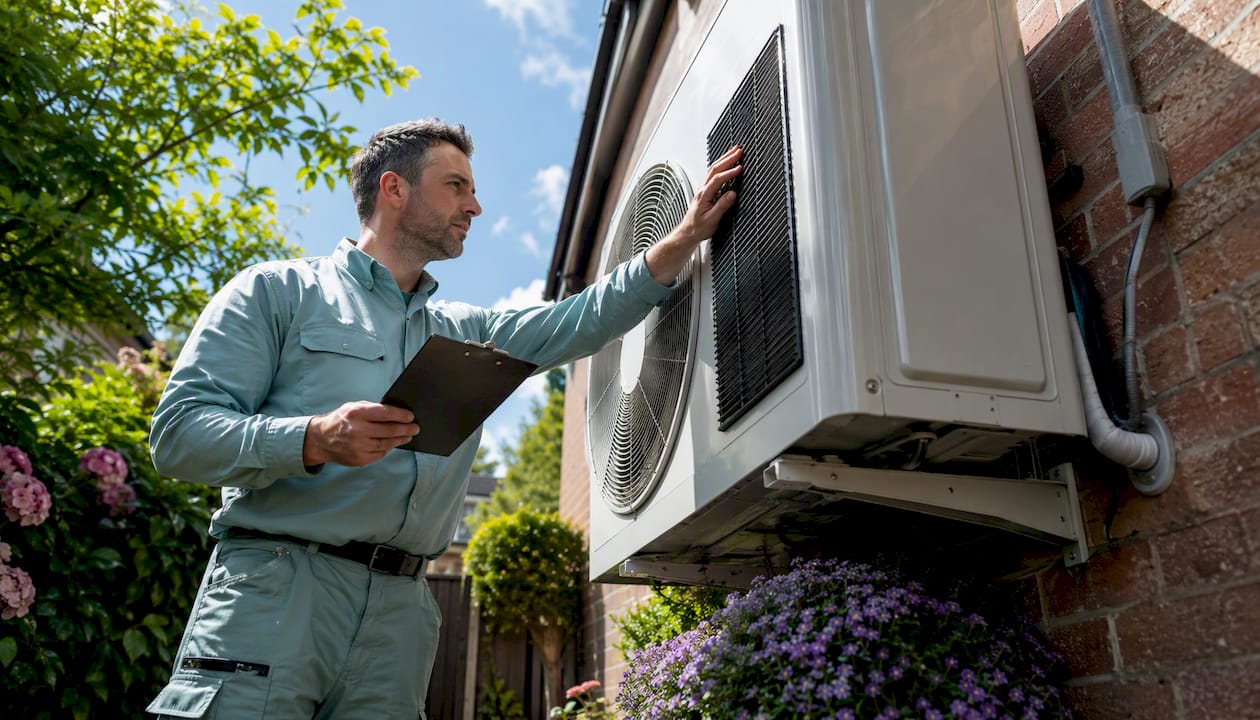
3. Maintenance checks that keep your system running efficiently
Simple maintenance is usually the cheapest way to reduce cooling bills. A dirty filter or blocked outdoor unit forces the system to work harder for the same output, which means higher electricity use and faster wear.
The core principle: regular servicing preserves rated efficiency and prevents the kind of gradual performance decline that homeowners rarely notice until the bill arrives.
What you can do yourself:
- Monthly: Check and clean the indoor unit’s air filter (most split systems have a washable mesh filter behind the front panel)
- Before summer: Clear any debris, leaves, or overgrown plants from around the outdoor unit; it needs at least 30 cm of clear space on all sides
- Seasonally: Wipe down indoor unit vents and check that the condensate drain is clear
- Year-round: Keep internal doors closed to the room being cooled so the system is not working against open-plan heat gain
When to book a professional service:
- Annually, ideally in spring before the first heatwave
- If the system takes noticeably longer to reach the set temperature than it did last year
- If you hear unusual noises, see ice forming on pipework, or notice water leaking from the indoor unit
- If electricity bills have risen without a change in usage patterns
Pro Tip: Before a professional service visit, note down the system’s model number, the last service date if you have it, and any specific symptoms. An engineer can diagnose faster and you are less likely to pay for diagnostic time. Akita’s AC efficiency guide covers the checks worth doing before calling.
4. Daytime and night-time passive cooling, room by room
The ventilation sequence is the most misunderstood part of keeping a home cool. The rule is straightforward: keep windows closed while outside air is hotter than inside, then open them once outdoor temperatures fall below indoor levels, usually after 9–10 PM in a UK summer. Opening windows during the hottest part of the day pushes warm air in, not out.
Room-by-room actions:
- Bedroom: Fit blackout blinds to block morning sun; place a fan at the foot of the bed pointing across the body rather than directly at the face; open the window once outdoor air cools in the evening
- Kitchen: Avoid using the oven between 11 AM and 3 PM on hot days; use a microwave, slow cooker, or cold meals instead; run the extractor fan while cooking to expel heat
- Living room: Close curtains on south- and west-facing windows during the afternoon; turn off the television and other electronics when not in use, as they generate significant background heat
- Loft rooms: These heat up fastest and cool slowest; a Velux window opened at night combined with a staircase window creates a chimney effect that draws hot air out
Cross-ventilation for night cooling:
- Open windows on opposite sides of the house to create a through-draught
- Place a fan in a lower window drawing air in and let warm air escape through an upper window or loft hatch
- Close all windows and blinds again before the temperature rises the next morning
For smart ways to keep your home cool during a heatwave, the GOV.UK beat-the-heat checklist also recommends checking that any mechanical ventilation system is switched to summer mode if that option exists.
5. Low- and mid-cost technology upgrades worth considering
The guiding principle for upgrades: reduce the hours your cooling system runs before spending money on a more powerful system. Controls and passive measures almost always pay back faster than new plant.
Upgrade options by cost and context:
- Reflective window film (£15–£60 per window, DIY): Blocks a significant proportion of solar heat gain without affecting daylight much; best on large south-facing glazing; works year-round
- Programmable or smart thermostat (£50–£250 installed): Pays back through avoided run hours; most effective when the home is empty for predictable periods each day
- Efficient ceiling fan (£80–£300 installed): Raises comfort at higher AC setpoints and can replace AC use entirely on mild days; choose a model with a summer/winter reversible mode
- Evaporative cooler (£100–£400): Effective only in dry conditions; UK summers are often humid enough to reduce their benefit, so check local climate suitability before buying
- Inverter air conditioner: Inverter technology can reduce power consumption by more than 40% compared with older fixed-speed systems; the right choice for rooms used regularly throughout summer
| Upgrade | Typical cost | Best suited to | Payback direction |
|---|---|---|---|
| Reflective window film | £15–£60 per window | Large south-facing windows | Fast (1–3 summers) |
| Smart thermostat installation at moderate cost | Homes with predictable occupancy | 1–3 years | |
| Efficient ceiling fan | £80–£300 installed | Living rooms, bedrooms | 2–4 years |
| Inverter split AC (new install) | — | Regularly used rooms | 5–10 years vs old unit |
| External awning or shutter at a mid-level investment | South/west-facing windows | More than 6°C room temperature reduction |
For single-room installations, a single-split system sized correctly for the room is typically more cost-effective than a portable unit, which vents warm air back into the space if not ducted properly. Sizing matters: an oversized unit short-cycles, which wastes energy and wears components faster.

For a broader look at sustainable cooling options including heat pumps, the choice between a dedicated cooling system and a reversible heat pump often comes down to whether you also need winter heating.
6. When to call a qualified installer and what to ask
Call a professional for new installations, systems that are persistently underperforming after basic maintenance, suspected refrigerant leaks, or any work involving refrigerant handling (which legally requires an F-gas certified engineer in the UK).
Questions to ask before signing anything:
- Is the system correctly sized for the room or zone? Ask for the heat load calculation.
- What SEER or EER rating does the proposed unit achieve?
- Does it use inverter technology?
- What warranty is offered on parts and labour, and who handles warranty claims?
- Does the engineer hold F-gas certification for any refrigerant work?
- What is included in the written quote, and what could change the final price?
Red flags to watch for:
- No written quote provided before work begins
- Pressure to sign or pay a deposit on the same day as the survey
- Vague efficiency claims with no SEER figures to back them up
- Recommendation to upsize significantly without a heat load calculation
Typical timeline and costs:
- Survey and quote: usually free or low-cost; allow 1–2 hours on site
- Standard single-split installation: typically completed in one day
- Annual service: usually 60–90 minutes; budget £80–£150 depending on system type and location
Pro Tip: Ask specifically whether the engineer will check refrigerant charge during a service visit. Low refrigerant is one of the most common causes of poor efficiency, but it is not always included in a basic service unless you ask. An HVAC cost reduction guide can help you understand what a thorough service should cover.
7. Estimated costs and realistic savings for common measures
Savings depend on your current electricity tariff, how often you run cooling equipment, and the condition of your home’s fabric. The figures below are indicative ranges for a typical UK semi-detached or detached home.
| Measure | Typical cost | Expected saving | Notes |
|---|---|---|---|
| Blackout or reflective blinds for moderate cost per window | Reduces solar gain noticeably | Immediate; DIY possible | |
| External awning or shutter at a mid-level investment | More than 6°C room temperature reduction | Highest passive impact | |
| Loft insulation top-up at moderate cost | Reduces heat gain through roof | Also saves on winter heating | |
| Draught-proofing doors and windows at low cost | Prevents warm air infiltration | Low cost, quick payback | |
| Smart thermostat installation at moderate cost | Reduces run hours through scheduling | Best with predictable occupancy | |
| Annual AC service at reasonable cost | Maintains rated efficiency | Prevents costly breakdowns | |
| Inverter AC replacement at higher investment | Over 40% less power than fixed-speed | Largest saving on running costs |
The running-cost gap between fans and air conditioning is worth spelling out clearly. Fans cost a few pence per hour to run; portable air conditioners can cost up to 20 times more. On a long heatwave, that difference accumulates quickly. Using a fan to extend the hours before you need to switch on the AC is one of the most cost-effective strategies available, requiring no upfront spend at all.
For a more detailed breakdown of HVAC cost-saving strategies, prioritise measures with the shortest payback first: draught-proofing and reflective blinds before external shading, and external shading before a full system replacement.
8. Your daily and heatwave-day checklist
Morning (before 9 AM):
- Close all south- and west-facing blinds or curtains before the sun reaches them
- Open windows briefly to flush overnight cool air, then close them as outside temperature rises
- Set the thermostat to a modest cooling setpoint (24–26°C) if using AC
- Switch on ceiling fans or desk fans in occupied rooms
During the day:
- Keep internal doors closed to the room being cooled
- Turn off lights, chargers, and non-essential electronics
- Delay oven use until the evening; use a microwave or cold meals
- Run the washing machine and tumble dryer after 8 PM when the home is cooler
Evening and night:
- Once outdoor temperature drops below indoor temperature (typically after 9–10 PM), open windows on opposite sides of the house
- Place a fan to draw cooler air in through a lower window
- Switch AC to fan-only mode or off entirely if cross-ventilation is sufficient
- Prepare the bedroom: blackout blinds down, fan positioned at the foot of the bed
On a heatwave alert day (Met Office Heat-Health Alert issued):
- Move sleeping arrangements to the coolest, lowest room in the house
- Avoid strenuous activity between 11 AM and 3 PM
- Check that fridges and freezers are working correctly
- Keep a damp cloth or cool water spray to hand for personal cooling
Key takeaways
Reducing home cooling costs comes down to three priorities: stop heat entering the building, run fans before air conditioning, and maintain whatever cooling equipment you have.
| Point | Details |
|---|---|
| Passive measures first | External shading can cut room temperatures by more than 6°C — address solar gain before upgrading equipment. |
| Fans over portable AC | Fans cost a few pence per hour; portable air conditioners can cost substantially more to run. |
| Ventilate at the right time | Keep windows closed while outside air is hotter than inside; open them at night to flush stored heat. |
| Inverter technology saves most | Inverter air conditioners use significantly less power than older fixed-speed systems for the same cooling output. |
| Akita for professional installs | Akita offers home surveys, correctly sized inverter AC installations, and maintenance packages across Suffolk, Norfolk, and Essex. |
Why insulation-first is the right approach for summer too
The conventional framing of home insulation is almost entirely about winter: keep heat in, reduce the boiler bill. That framing misses half the picture. A well-insulated, well-shaded home is harder to heat up in summer just as it is harder to cool down in winter, and the fabric improvements that deliver that result cost roughly the same whether you are motivated by January gas bills or July heatwaves.
Sustainability experts recommend treating insulation as a summer policy first: reduce cooling demand through building improvements before defaulting to more mechanical cooling. The logic is straightforward. A room that gains more than 6°C less heat through a shaded window needs far less active cooling to stay comfortable. That reduced demand means fewer hours of AC running, lower electricity bills, and less strain on the grid during peak summer demand.
A practical example: fitting external shading to a south-west-facing living room window in a typical UK semi-detached home can shift the point at which you feel the need to switch on the AC from early afternoon to late evening, or remove it entirely on all but the hottest days. The shading costs a few hundred pounds. The running-cost saving accumulates every summer thereafter.
The wider point is that UK homes are increasingly overheating in summer as average temperatures rise, and the homes best placed to cope are those with good fabric, not those with the largest air conditioning units. Mechanical cooling is a useful tool, but it works best as a supplement to a well-prepared building, not a substitute for one.
How Akita can help you cool your home for less
Knowing which measures to prioritise is one thing; getting the sizing, installation, and ongoing maintenance right is another. Akita provides home surveys across Suffolk, Norfolk, and Essex that give you a clear picture of whether your existing system is performing as it should, whether a new inverter installation would pay back, and which passive measures are worth tackling first.
A typical survey involves an on-site inspection, a room-by-room sizing check, and a written fixed-price quote with no obligation to proceed. Akita’s services cover inverter split-system installations, smart control upgrades, and annual maintenance packages that keep systems running at rated efficiency year after year. Flexible finance options are available, so the upfront cost of a more efficient system does not have to come all at once.
If you are ready to find out what the right cooling setup looks like for your home, book a home survey with Akita and get a written quote with no pressure to commit on the day.
Useful sources and further reading
The following UK sources were used in this article and are worth bookmarking for further detail:
- GOV.UK Beat the Heat checklist — the official government checklist for identifying overheating risk and reducing it at home
- UK Health Security Agency: how to keep cool in hot weather — practical health-focused guidance on staying safe during heatwaves
- Energy Saving Trust: tips to keep your home cool this summer — running-cost comparisons for fans versus air conditioning and general efficiency advice
- WarmGuide: how to keep your house cool in a heatwave — detailed guidance on ventilation sequencing, shading, and single-room cooling strategies
- Which?: heatwave myths — expert scientists assess which popular cooling hacks actually work
- The Independent: how to keep your house cool without air conditioning — the case for reducing cooling demand through building improvements before installing more AC
- Carrier UK: air conditioner power consumption — technical explanation of inverter technology and efficiency ratings