

Cost-saving HVAC strategies: your 2026 guide
TL;DR:
- Cost-saving HVAC strategies focus on system improvements and behavioral changes to reduce energy expenses while maintaining comfort. Lowering your thermostat by 1°C can cut heating bills by up to 8%, with the best results achieved through routine maintenance, smart controls, and equipment upgrades. Understanding heat pump operation and installing submeters helps identify inefficiencies for sustained long-term savings.
Cost-saving HVAC strategies are the deliberate practices and system improvements that reduce energy consumption and expenses while keeping your home or workplace comfortable. Heating and cooling account for a significant share of energy bills for both homeowners and business operators across the UK. A single degree on your thermostat can cut monthly heating bills by up to 8%. That figure alone shows how much room there is to save before you spend a penny on new equipment. This guide covers the most effective approaches, from no-cost behavioural changes to government-backed upgrades, all grounded in current UK standards and real-world results.
1. Adjust your thermostat settings first
The fastest cost-saving HVAC strategy available to you costs nothing. Reducing indoor temperature by 1°C saves approximately £90 per year in Great Britain. That is a meaningful annual saving from a single setting change.
Recommended indoor temperatures vary by activity. Sedentary spaces such as offices and living rooms perform well at 19–21°C. Active areas like gyms or warehouses can sit lower, at 16–18°C, without affecting comfort. Sleeping areas benefit from 16–18°C as well.
One underused tactic is creating a temperature “dead band” between your heating and cooling setpoints. If your heating switches off at 20°C and your cooling switches on at 22°C, you avoid the two systems fighting each other. That overlap wastes energy every time it happens.
Pro Tip: Avoid setting your cooling system below 24°C in summer. Overcooling is one of the most common and costly HVAC habits in commercial buildings.
2. Use programmable and smart thermostats
Smart thermostats control heating and cooling via mobile apps and automate efficiency based on occupancy patterns. They remove the human error of forgetting to turn the heating down before leaving a building.
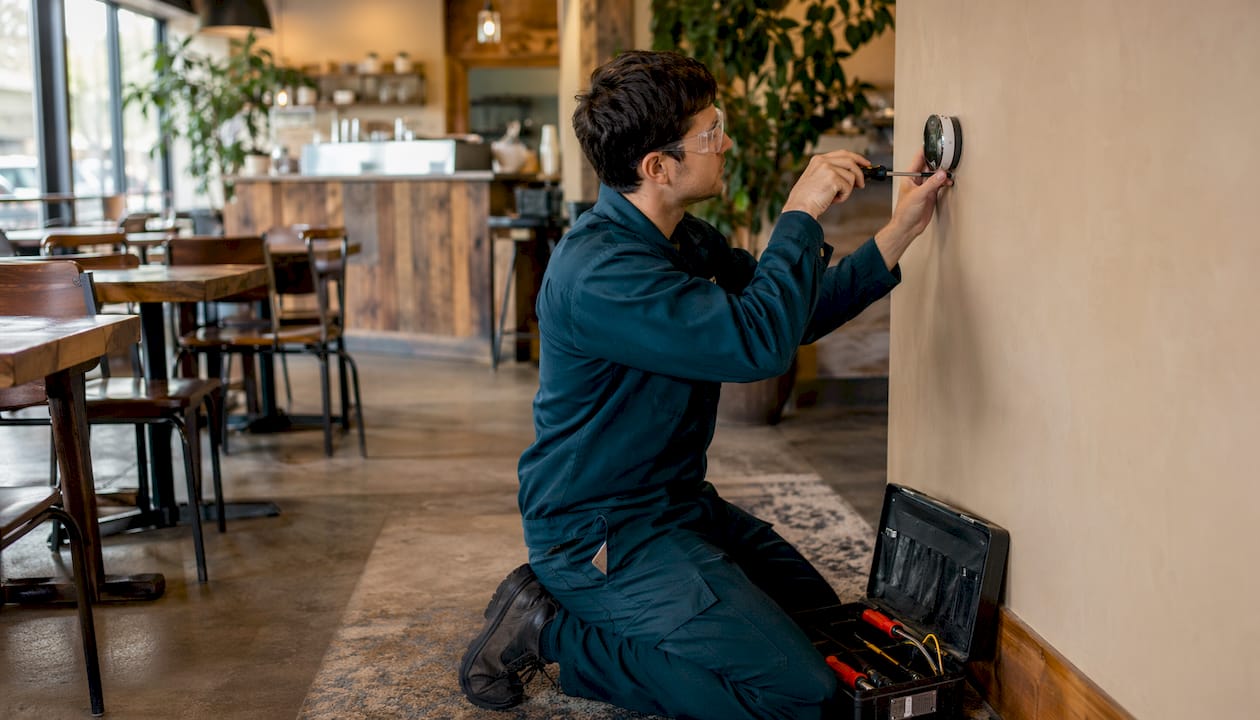
Programmable thermostats let you set different temperatures for different times of day. A business can programme lower temperatures overnight and at weekends without relying on staff to remember. A homeowner can schedule warmth for the hour before waking, then let the system drop back during the working day.
The financial case for smart thermostats is straightforward. They reduce unnecessary HVAC operation, which directly cuts fuel and electricity consumption. For businesses with multiple zones, the savings compound across every room and floor.
Pro Tip: Place your thermostat away from heat sources such as direct sunlight, ovens, or photocopiers. A poorly positioned thermostat reads the room incorrectly and causes the system to work harder than necessary.
3. Maintain filters, units, and radiators regularly
Regular HVAC maintenance including filter replacement, duct cleaning, and boiler thermostat checks reduces running costs and the risk of expensive breakdowns. A blocked filter forces your system to draw more power to move the same volume of air. That extra effort shows up directly on your energy bill.
Air filters in most residential and commercial systems need checking every one to three months. Replace them when they are visibly dirty rather than waiting for a fixed schedule. Dusty evaporator coils and condenser fins reduce heat transfer efficiency and should be cleaned annually.
Bleeding radiators removes trapped air that prevents hot water from circulating properly. A cold patch at the top of a radiator is the clearest sign that bleeding is overdue. This takes under five minutes and costs nothing.
Pro Tip: Keep a simple maintenance log. Recording filter changes, servicing dates, and any unusual noises helps you spot patterns and avoid reactive repairs that cost far more than planned ones.
4. Align HVAC operation with occupancy schedules
Running your HVAC system when a building is empty is one of the most avoidable costs in both homes and commercial properties. Matching system operation to actual occupancy is a core principle of energy-efficient HVAC solutions that many operators overlook.
For businesses, this means programming systems to reduce output 30 minutes before closing and to begin warming or cooling 30 minutes before opening. The building reaches the right temperature by the time people arrive, without running at full capacity overnight.
For homeowners, occupancy-based scheduling is equally straightforward. If the house is empty from 9AM to 5PM on weekdays, there is no reason to heat it to living-room temperature during those hours. A setback of 4–5°C during unoccupied periods produces measurable savings over a full heating season.
5. Upgrade to energy-efficient equipment and motors
Equipment upgrades deliver the largest long-term reductions in HVAC running costs. Older motors, compressors, and fans often operate at fixed speeds regardless of demand. Variable-speed drives (VSDs) adjust motor output to match actual load, which cuts electricity consumption significantly during part-load conditions.
Building Energy Management Systems (BEMS) reduce total energy costs by 10% or more through real-time monitoring and automatic adjustments. A BEMS connects all your HVAC components into a single platform, identifies waste, and responds to changes in occupancy or weather without manual intervention. For commercial buildings, this is one of the highest-return investments available.
The UK government supports eligible upgrades through the Boiler Upgrade Scheme, which offers up to £7,500 for heat pump installation in England and Wales. Insulation improvements attract 0% VAT on materials and installation until april 2027, with potential annual savings of £150–£590 depending on property type. These incentives change the payback calculation considerably.
| Upgrade | Typical annual saving | Key benefit |
|---|---|---|
| Smart thermostat | £90+ | Automated scheduling, no ongoing cost |
| BEMS installation | 10%+ of total energy costs | Real-time control across all zones |
| Heat pump (replacing gas boiler) | Varies by property | Lower running cost, grant-eligible |
| Variable-speed drives on motors | Significant electricity reduction | Matches output to actual demand |
| Insulation improvement | £150–£590 | Reduces heat loss, 0% VAT until 2027 |
Pro Tip: Before committing to any upgrade, request an energy audit. A professional assessment identifies which improvements will deliver the fastest payback for your specific building.
6. Install submeters to find hidden waste
Most energy bills show a single total figure. That number tells you how much you spent but not where the money went. Submetering HVAC electricity or gas lines gives you accurate, system-level data that a standard meter cannot provide.
CIBSE TM39 sets out best-practice guidance for building metering and monitoring. It recommends metering individual systems so that facility managers can isolate inefficiencies that are invisible in aggregate bills. A spike in HVAC electricity use on a Tuesday morning, for example, might reveal a fan running continuously due to a faulty sensor.
Submeters start from as little as £20 for basic units. The data they produce can identify waste that costs many times that amount each month. For commercial operators managing multiple zones or buildings, submetering is not optional. It is the foundation of any serious efficiency programme.
“HVAC distribution losses can add 10–15% to total heating energy consumption, yet they are routinely ignored in standard energy models. Accounting for them through proper metering and CIBSE TM54 operational assessments reveals the true cost of inefficiency and makes targeted corrective action possible.”
7. Understand how heat pumps actually work
Heat pumps work differently from gas boilers, and most homeowners who switch run them incorrectly. A gas boiler heats water quickly to a high temperature and then switches off. A heat pump works best when it maintains a steady temperature continuously rather than cycling on and off.
This “low and slow” approach is counterintuitive for anyone used to gas heating. Turning a heat pump off overnight and then demanding rapid warmth in the morning forces it to work at its least efficient point. Keeping it running at a lower, consistent output costs less overall.
Key behavioural shifts for heat pump users:
- Set a consistent target temperature and leave it. Avoid large adjustments throughout the day.
- Reduce the number of zones where possible. Fewer zones mean simpler, more efficient operation.
- Accept that rooms warm up more gradually. The system is working correctly; it is not broken.
- Use weather compensation controls if your system supports them. These automatically adjust output based on outdoor temperature.
Pro Tip: If you have recently installed a heat pump and your bills seem high, check whether the system is set to a “boost” or “immersion” mode. Running these modes frequently removes most of the efficiency advantage.
Key takeaways
The most effective approach to reducing HVAC costs combines no-cost behavioural changes, routine maintenance, and targeted equipment upgrades, each reinforcing the other.
| Point | Details |
|---|---|
| Thermostat adjustment saves immediately | Lowering temperature by 1°C cuts monthly heating bills by up to 8% with no upfront cost. |
| Maintenance prevents costly inefficiency | Regular filter changes, coil cleaning, and radiator bleeding keep systems running at full efficiency. |
| BEMS delivers measurable commercial savings | Building Energy Management Systems reduce total energy costs by 10% or more in commercial properties. |
| Submetering reveals hidden waste | CIBSE TM39-compliant submetering identifies system-level inefficiencies invisible in standard bills. |
| Heat pumps need different habits | Consistent “low and slow” operation outperforms the on-off approach used with gas boilers. |
What I have learnt from working with HVAC systems across Suffolk, Norfolk, and Essex
The most common mistake I see is homeowners and business operators treating HVAC cost reduction as a one-off project. They adjust a thermostat or replace a filter once, see a modest improvement, and then return to old habits. Sustained savings require sustained attention.
The properties that achieve the best long-term results combine all three layers: behavioural changes first, because they cost nothing; maintenance second, because it protects the investment; and equipment upgrades third, timed to coincide with natural replacement cycles or grant availability. Trying to skip straight to upgrades without addressing behaviour and maintenance is expensive and often disappointing.
For anyone considering a heat pump or BEMS installation, I strongly recommend a professional HVAC commissioning assessment before signing any contract. The assessment reveals whether your building fabric, controls, and distribution system are ready to support the upgrade. Without it, you risk installing efficient equipment into an inefficient building and wondering why the bills barely moved.
The grants available in 2026 are genuinely worth pursuing. The Boiler Upgrade Scheme and 0% VAT on insulation change the financial case for upgrades that might otherwise take a decade to pay back. Act while the incentives exist.
— Akita
Professional HVAC installation and efficiency upgrades from Akita
Akita installs and maintains energy-efficient air conditioning and climate control systems for homeowners and businesses across Suffolk, Norfolk, and Essex. Whether you are replacing an ageing system or fitting air conditioning for the first time, the right installation makes a measurable difference to your running costs from day one.
Akita’s team provides professional consultation to match the right system to your property, budget, and usage patterns. For homeowners, domestic air conditioning installation covers everything from initial survey to aftercare. For business operators, commercial air conditioning installation delivers the efficiency and reliability that working environments demand. Transparent pricing, flexible finance options, and ongoing maintenance support are available across all services.
FAQ
How much can I save by lowering my thermostat by 1°C?
Lowering your thermostat by 1°C cuts monthly heating bills by up to 8% and saves approximately £90 per year in Great Britain. The saving applies immediately with no equipment cost.
What is a BEMS and is it worth the investment?
A Building Energy Management System (BEMS) monitors and controls all HVAC components in real time, reducing total energy costs by 10% or more. It is most cost-effective in commercial buildings with multiple zones or complex heating and cooling requirements.
How often should I replace HVAC air filters?
Check air filters every one to three months and replace them when visibly dirty. Blocked filters force the system to use more energy and accelerate wear on components.
Are there UK government grants available for HVAC upgrades in 2026?
The Boiler Upgrade Scheme offers up to £7,500 for eligible heat pump installations in England and Wales. Insulation improvements also qualify for 0% VAT on materials and installation until april 2027.
Why are my heat pump bills higher than expected?
Heat pumps run most efficiently at a steady, consistent temperature rather than cycling on and off like a gas boiler. If bills are high, check whether boost or immersion modes are running frequently, and switch to a continuous low-output setting instead.