

Sustainable cooling solutions for UK homes and businesses
TL;DR:
- Sustainable cooling solutions aim to reduce energy use and environmental impact through passive, thermally driven, or high-efficiency electrical systems. Combining passive materials like radiative coatings with active systems and selecting low-GWP refrigerants ensures genuine carbon savings and regulatory compliance. Prioritizing building fabric improvements and proper system sizing leads to more effective and sustainable cooling performance.
Sustainable cooling solutions are methods and technologies that reduce energy consumption and environmental harm while maintaining comfortable indoor temperatures. For UK homeowners and business operators, the choice of cooling system now carries real regulatory weight, with SAP 10.3 and NCM frameworks shaping how buildings are assessed for carbon performance. Technologies such as passive radiative cooling, solar-assisted absorption chillers, and heat pumps running on low-GWP refrigerants represent the leading approaches available today. Understanding which option suits your property, budget, and compliance requirements is the difference between a genuinely green upgrade and one that merely looks the part.
What are the main types of sustainable cooling technologies?
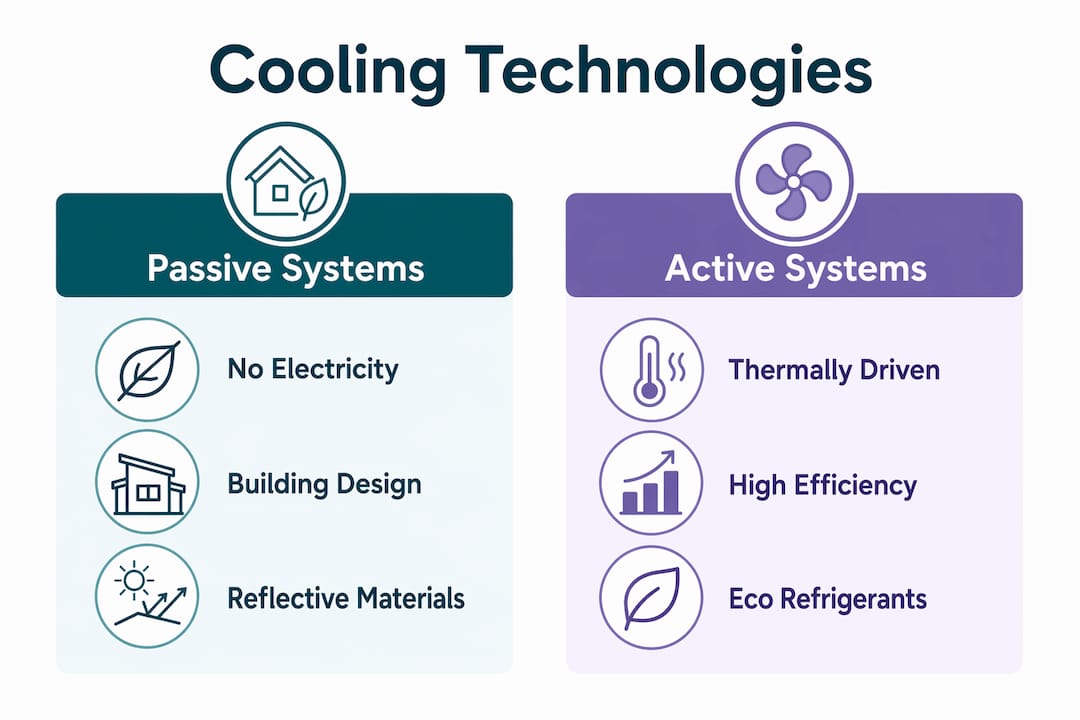
Sustainable cooling divides into three broad categories: passive systems, thermally driven systems, and high-efficiency electrical systems. Each reduces energy use and emissions through a different mechanism, and the right choice depends on your building type, location, and existing infrastructure.
Passive cooling requires no electricity to operate. It works through building design, reflective materials, and radiative cooling films or coatings that reject heat naturally. This category suits new builds and retrofit projects where surface treatments or architectural changes are feasible.
Thermally driven cooling uses heat rather than electricity as its primary energy source. Absorption and sorption chillers powered by solar thermal collectors or industrial waste heat fall into this group. The CharCool project demonstrates modular thermochemical storage systems that enable seasonal storage and flexible renewable cooling, decoupling demand from the electricity grid entirely.
High-efficiency electrical systems include modern heat pumps and inverter-driven air conditioning units using low global warming potential (GWP) refrigerants such as R-32, CO2, or ammonia. Modern heat pumps typically deliver two to four times the efficiency of older heating and cooling systems. That ratio means a well-specified heat pump can cut your cooling-related electricity consumption by more than half compared with a conventional unit.
| Technology | Energy source | Best suited for | Key limitation |
|---|---|---|---|
| Passive radiative cooling | None (zero electricity) | Rooftops, facades, new builds | Requires thermal isolation design |
| Solar absorption chillers | Solar or waste heat | Commercial buildings, large sites | Higher upfront cost |
| Heat pumps (low-GWP) | Electricity (grid or renewables) | Homes and offices | Efficiency varies with climate |
| Sorption chillers | Medium-low heat (80–150 °C) | Industrial or solar-rich sites | Specialist installation needed |
Each approach has a role. Many of the most effective installations combine two or more, for example pairing a radiative cooling roof coating with a high-efficiency heat pump to reduce the load the electrical system must handle.
How does passive radiative cooling work, and why does it matter?
Passive radiative cooling is the process by which a surface emits heat directly into outer space through the atmospheric infrared window, achieving temperatures below ambient air without any energy input. The physics relies on a specific spectral gap: the atmosphere is largely transparent to infrared radiation in the 8 to 13 µm wavelength range, allowing surfaces engineered to emit strongly in that band to shed heat continuously, even under sunlight.
Recent material science has made this practical at scale. A 2026 Nature Communications study reported a natural wood biocomposite achieving 106 W/m² cooling power under strong sunlight, with sub-ambient temperatures of up to 8.8 °C and tensile strength sufficient for structural applications. That combination of cooling performance and mechanical durability addresses the main barrier that previously limited radiative materials to laboratory settings.
For buildings, this translates into roof membranes, facade panels, or applied coatings that reduce the heat load entering the structure. A cooler building fabric means the air conditioning system runs less frequently and at lower intensity, directly cutting energy bills and carbon output. The technology is particularly relevant for flat-roofed commercial properties across Suffolk, Norfolk, and Essex, where summer solar gain is a significant driver of cooling demand.
Pro Tip: Spectral selectivity is the critical design variable. A coating that reflects solar radiation across the 0.3 to 2.5 µm range while emitting strongly in the 8 to 13 µm atmospheric window will outperform a generic white paint by a substantial margin. Always request spectral performance data, not just solar reflectance index (SRI) values, when specifying radiative cooling products.
Durability is equally important. Advances in biocomposites now improve structural strength without degrading cooling performance, making long-term outdoor deployment viable for the first time at a commercial scale.
What role do thermally driven systems play in green cooling?
Thermally driven cooling systems use heat as their primary input rather than electricity, which makes them a natural fit for buildings with access to solar thermal collectors or industrial waste heat. The core technology is the absorption or sorption chiller, which drives a refrigeration cycle using heat instead of a compressor motor.
Solar-driven sorption cooling operates efficiently with medium to low heat sources in the 80 to 150 °C range, making it viable wherever solar thermal or process waste heat is available. A Nature Energy study demonstrated adiabatic temperature changes of 37 K in sorption chillers, producing meaningful cooling with minimal electrical input. That figure matters because it confirms the technology can deliver commercially useful cooling outputs, not just laboratory curiosities.
The economic case is strengthened further by system integration. A Scientific Reports 2026 analysis of ejector-enhanced solar absorption refrigeration found a 12.7% COP improvement and a 9% cost reduction compared with standard absorption configurations. Integrating an ejector stage is a relatively modest engineering change that pays back quickly in operating cost savings.
Key benefits of thermally driven cooling for UK properties include:
- Grid independence. Cooling demand is met by heat rather than electricity, reducing exposure to grid price volatility and peak tariffs.
- Seasonal storage compatibility. The CharCool project’s thermochemical storage approach enables 40 to 50% reductions in system volume and cost compared with conventional thermal storage, making seasonal storage practical for mid-sized commercial sites.
- Renewable integration. Pairing sorption chillers with solar thermal panels creates a system where peak cooling demand and peak solar availability align naturally, reducing the need for battery storage.
- Waste heat utilisation. Factories, data centres, and commercial kitchens generating process heat can redirect that output to drive cooling, turning a cost into a resource.
For residential properties, thermally driven systems are less common due to the scale required, but solar-assisted heat pump hybrids are beginning to bridge that gap in the UK market.
How do refrigerant choices affect the sustainability of cooling systems?
Refrigerant selection is one of the most consequential decisions in specifying an eco-friendly air conditioning system, yet it is frequently reduced to a single GWP number. The reality is more nuanced. An IJERT study on Kigali Amendment compliance highlights that electricity-related indirect emissions typically dominate the total climate impact of a cooling system over its lifetime. A low-GWP refrigerant in an inefficient unit can produce more total warming than a higher-GWP refrigerant in a well-maintained, high-efficiency system.
The Kigali Amendment to the Montreal Protocol commits signatory nations, including the UK, to phasing down hydrofluorocarbons (HFCs) progressively through to 2047. This regulatory trajectory makes refrigerant choice a long-term asset decision. Systems installed today using R-32, CO2, or ammonia will remain compliant and serviceable well beyond the phase-down schedule, whereas older HFC refrigerants face increasing cost and availability constraints.
The three refrigerant options most relevant to UK installations are:
- R-32 has a GWP of 675, significantly lower than the R-410A it replaces, and is now the standard refrigerant in most residential split systems. It is flammable but manageable under current F-Gas handling regulations.
- CO2 (R-744) has a GWP of 1 and performs well in heat pump applications, particularly in colder climates. It requires higher operating pressures, which demands specialist equipment and installation expertise.
- Ammonia (R-717) has a GWP of 0 and is highly efficient, making it the preferred choice for large commercial and industrial refrigeration. Its toxicity limits residential use.
Operational efficiency and leak control are equally critical factors in determining climate impact. A system with a low-GWP refrigerant but a 10% annual leak rate and poor energy efficiency can still carry a significant carbon footprint. UK building energy performance compliance, assessed through SAP 10.3 for dwellings and NCM for commercial buildings, requires accurate carbon accounting that captures both direct refrigerant emissions and indirect electricity-related emissions.
Pro Tip: When comparing systems, ask your installer for the TEWI (Total Equivalent Warming Impact) figure, not just the GWP of the refrigerant. TEWI accounts for both direct refrigerant leakage and indirect emissions from electricity consumption across the system’s expected lifespan. It gives a far more accurate picture of true environmental impact.
What practical steps can you take to implement sustainable cooling?
Moving from interest to installation requires a structured approach. The following steps reflect the decisions that matter most for UK homeowners and business operators.
-
Commission an energy performance assessment. For dwellings, a SAP 10.3 assessment establishes your baseline and models the carbon impact of proposed cooling systems. For commercial properties, NCM methodology applies. Both frameworks require coherent inputs about building fabric, system assumptions, and occupancy schedules to produce reliable outputs. Without this baseline, you cannot accurately compare options or demonstrate compliance.
-
Evaluate heat pump and AC options against efficiency ratings. Look for systems with a high Seasonal Energy Efficiency Ratio (SEER) or Seasonal Coefficient of Performance (SCOP). Akita’s guide to choosing efficient AC covers the key specifications to compare when shortlisting units for UK conditions.
-
Consider passive design measures before specifying active systems. External shading, reflective roof coatings, and improved insulation reduce the cooling load your active system must handle. A smaller, correctly sized active system is more efficient and less expensive to run than an oversized unit compensating for poor building fabric.
-
Check eligibility for UK government incentives. The Boiler Upgrade Scheme currently covers air source heat pumps, and various local authority programmes support energy efficiency upgrades for commercial properties. Incentives change regularly, so verify current eligibility before finalising your specification.
-
Prioritise professional installation and scheduled maintenance. Refrigerant leak rates, airflow performance, and electrical efficiency all degrade without regular servicing. Akita’s advice on boosting AC efficiency outlines the maintenance steps that preserve both performance and sustainability credentials over time.
For properties where natural cooling methods are viable, ceiling fans using energy-efficient fan technology can supplement active cooling and reduce run hours significantly during mild weather.
Key takeaways
The most effective sustainable cooling strategy combines low-GWP refrigerants, high-efficiency electrical systems, and passive design measures, assessed through SAP or NCM frameworks to confirm genuine carbon savings.
| Point | Details |
|---|---|
| Passive radiative cooling | Biocomposite materials now achieve 106 W/m² cooling power with no electricity input, making roof and facade applications viable. |
| Thermally driven systems | Solar sorption chillers reduce grid electricity dependence and can cut system costs by 40 to 50% with seasonal storage integration. |
| Refrigerant selection | Use TEWI rather than GWP alone; indirect emissions from electricity use typically outweigh direct refrigerant leakage over a system’s lifetime. |
| Regulatory compliance | SAP 10.3 and NCM assessments are required for accurate carbon accounting and compliance with UK building energy performance standards. |
| Practical implementation | Passive design measures reduce active cooling load; professional installation and maintenance preserve efficiency and sustainability performance. |
What Akita has observed about sustainable cooling in the UK
The conversation around green cooling technologies has shifted noticeably in the past two years. Clients who previously asked only about running costs are now asking about refrigerant phase-down schedules and SAP compliance. That is a genuine change, and it reflects both rising energy bills and growing awareness of the regulatory direction of travel.
What concerns me is the gap between ambition and specification. Many installations labelled as “eco-friendly” are simply standard systems fitted with a low-GWP refrigerant, with no attention paid to building fabric, system sizing, or maintenance schedules. A poorly sized heat pump running at partial load for extended periods can perform worse than a well-maintained older system. The refrigerant choice is one variable among many.
The technology that genuinely excites me is passive radiative cooling at the building envelope level. The idea that a roof coating can shed heat into space without consuming a single watt is not science fiction anymore. The biocomposite materials now entering the market have the structural properties to survive UK weather conditions, and the cooling power figures from recent field tests are commercially meaningful. Integrating these materials with a correctly specified energy-efficient cooling system creates a compounding effect: the passive layer reduces the load, and the active system handles the remainder at peak efficiency.
The practical advice I give every client is this: start with the building, not the equipment. Reduce what you need to cool before deciding how to cool it. That sequence produces better outcomes, lower costs, and systems that actually deliver on their sustainability promise.
— Akita
How Akita supports your sustainable cooling goals

Akita installs energy-efficient air conditioning and heat pump systems for homes and businesses across Suffolk, Norfolk, and Essex, with fixed-price quotes and no hidden costs. Every installation is specified to your building’s actual cooling load, not a generic estimate, and all systems use current low-GWP refrigerants compliant with UK F-Gas regulations. Whether you are upgrading a single room or specifying cooling for a commercial premises, Akita’s team can advise on system selection, SAP compliance, and available incentives. Explore domestic air conditioning installation options for your home, or review Akita’s commercial cooling services for business properties.
FAQ
What are sustainable cooling solutions?
Sustainable cooling solutions are temperature control technologies that minimise energy consumption and environmental impact, including passive radiative cooling, solar-assisted chillers, and heat pumps using low-GWP refrigerants. They differ from conventional air conditioning by reducing both direct refrigerant emissions and indirect carbon from electricity use.
How much can a heat pump reduce cooling costs?
Modern heat pumps deliver two to four times the efficiency of older cooling systems, meaning energy consumption for the same cooling output can fall by 50% or more. Actual savings depend on the system’s SEER rating, building insulation, and local electricity tariffs.
What is passive radiative cooling and does it work in the UK?
Passive radiative cooling uses specially engineered materials to emit heat through the atmospheric infrared window without electricity, achieving sub-ambient surface temperatures. Field tests confirm cooling power of up to 106 W/m², and the technology is applicable to UK flat roofs and commercial facades where solar gain is a significant issue.
Which refrigerants are considered most eco-friendly?
CO2 (R-744) with a GWP of 1 and ammonia (R-717) with a GWP of 0 are the lowest-impact options, though R-32 (GWP 675) is the most practical choice for standard residential and light commercial split systems in the UK. The Kigali Amendment is progressively phasing out higher-GWP HFCs, making early adoption of these alternatives a sound long-term investment.
Do I need a SAP assessment before installing a sustainable cooling system?
SAP 10.3 is required for new dwellings and certain regulated upgrades to demonstrate compliance with UK building energy performance standards. For commercial properties, the NCM methodology applies. Both assessments help confirm that your chosen system genuinely reduces carbon output rather than simply shifting emissions elsewhere.