

Benefits of energy efficient HVAC for your home
TL;DR:
- Upgrading to a high-efficiency HVAC system significantly reduces energy costs, improves indoor comfort, and lowers environmental impact. Proper sizing, regular maintenance, and available incentives enhance long-term value and equipment lifespan. Investing in energy-efficient HVAC results in measurable savings and property benefits over its extended service life.
Choosing the right HVAC system is one of the most financially significant decisions a homeowner or business operator can make. The benefits of energy efficient HVAC go well beyond saving a few pounds on your utility bill each month. You are looking at improved comfort, better air quality, reduced environmental impact, and equipment that lasts longer with fewer costly breakdowns. This article walks through each of those advantages in concrete terms, so you can weigh them clearly against the upfront investment and make a decision grounded in real numbers rather than marketing promises.
Table of Contents
- Key takeaways
- 1. Lower energy bills: the core benefit of energy efficient HVAC
- 2. Improved indoor comfort and more consistent temperatures
- 3. Better indoor air quality
- 4. Reduced carbon footprint and environmental responsibility
- 5. Longer equipment lifespan and lower maintenance costs
- 6. Higher property value and market appeal
- 7. Financial comparison: weighing up the decision
- My honest take on upfront cost versus long-term value
- Ready to upgrade? Here is how Akita can help
- FAQ
Key takeaways
| Point | Details |
|---|---|
| Significant bill reductions | Upgrading to an efficient system can cut heating and cooling costs by 20 to 50% annually. |
| Comfort goes beyond temperature | Variable-speed motors and zoned controls deliver steadier temperatures and better air quality. |
| Environmental impact is measurable | HVAC accounts for over half of household energy use, so efficiency upgrades directly lower emissions. |
| Maintenance protects your investment | Neglected systems lose efficiency fast; regular servicing recovers performance and prevents expensive repairs. |
| Incentives improve the financial case | Tax credits, rebates, and utility schemes can cover a meaningful portion of upgrade costs. |
1. Lower energy bills: the core benefit of energy efficient HVAC
This is where most people start, and rightly so. Heating and cooling account for 43% of a typical home’s utility bill, making your HVAC system the single largest energy consumer under your roof. Switching to a high-efficiency model can reduce those costs by 20 to 50% per year, which for many households translates to several hundred pounds saved annually.
What makes modern systems so much more efficient? It comes down to how they modulate output. Older units run at full power until the target temperature is reached, then switch off completely. High-efficiency systems adjust their output continuously, running at lower speeds for longer periods. This uses less energy and keeps temperatures far more stable.
Pro Tip: Combining your HVAC upgrade with home weatherisation, proper insulation and draught-proofing, allows a smaller, less expensive system to do the same job. Weatherising your home first reduces the capacity you need and improves efficiency further.
Tax credits and utility rebates are also part of the financial picture. Many local energy suppliers and government schemes offer incentives for upgrading to qualifying high-efficiency equipment. These can significantly reduce the net cost of installation, sometimes covering 10 to 30% of the total outlay. Always evaluate total cost of ownership rather than the sticker price alone.
2. Improved indoor comfort and more consistent temperatures
Energy efficient HVAC advantages are not purely financial. The comfort difference between an old single-speed system and a modern variable-speed unit is immediately noticeable. Rather than blasting cold or warm air in cycles, variable-speed motors and zoned systems maintain a steady temperature throughout your home or building with far less fluctuation.
Zoned systems are particularly valuable in larger properties or commercial spaces. Instead of conditioning every room identically, you direct cooling or heating exactly where it is needed. This eliminates the situation where one room is sweltering while another is freezing, which is a common complaint in properties with older, single-zone setups.
The benefits for occupant wellbeing go further than temperature:
- Humidity control: High-efficiency systems manage indoor humidity more precisely, which matters enormously for comfort during summer months in the UK.
- Noise levels: Modern units run at lower fan speeds most of the time, making them noticeably quieter than older equipment running at full blast.
- Smarter scheduling: Smart thermostats allow you to programme temperatures around your actual schedule, cutting waste during empty periods without sacrificing comfort on your return.
3. Better indoor air quality
The link between HVAC efficiency and air quality is one that tends to surprise people. A well-designed, high-efficiency system does not just condition air. It filters, ventilates, and circulates it more effectively than a system that short-cycles or runs intermittently.
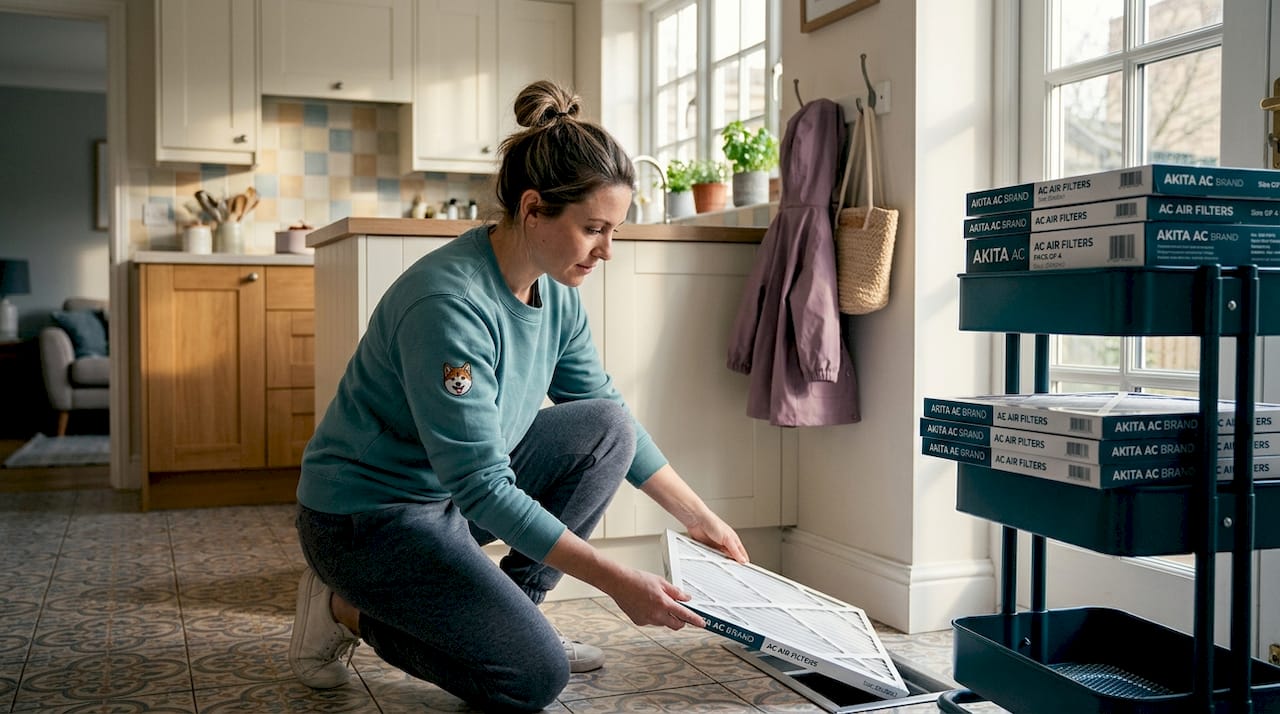
Modern high-efficiency units typically include advanced filtration that captures fine particles, dust, and allergens more reliably. For anyone with asthma, hay fever, or other respiratory sensitivities, this is a material quality-of-life improvement. Consistent air movement also prevents the stagnant pockets of air where moisture builds up and mould becomes a risk.
In commercial settings, air quality directly affects staff productivity and customer experience. A poorly ventilated office is not just uncomfortable. Research consistently shows it impairs cognitive performance. Upgrading to a system designed for proper ventilation rates is an investment in the people inside your building, not just the building itself.
4. Reduced carbon footprint and environmental responsibility
HVAC systems account for over 50% of household energy consumption. That single figure explains why HVAC efficiency is central to any serious effort to reduce a property’s carbon footprint. Every unit of energy your system does not consume is a direct reduction in the emissions generated to produce it.
For homeowners, this aligns with personal values around sustainability. For businesses, it increasingly matters in a commercial context as well. Corporate sustainability reporting, planning obligations, and supply chain requirements are all pushing organisations to account for their energy consumption in measurable ways. Upgrading to a high-efficiency HVAC system is one of the most tangible steps available.
Reducing your building’s energy consumption through HVAC upgrades is not a marginal environmental gesture. For most properties, it is the single highest-impact change available short of generating your own renewable energy.
Pro Tip: Before any upgrade, commission a professional energy audit for your home or business premises. This identifies where heat is being lost, which systems are underperforming, and where the highest-value improvements lie. It prevents you from investing in a new system only to find that poor insulation negates most of the gain.
Modern refrigerants used in high-efficiency systems also have significantly lower global warming potential than older refrigerants, adding another layer of environmental benefit to the upgrade decision.
5. Longer equipment lifespan and lower maintenance costs
One of the less-discussed energy efficient HVAC advantages is what efficiency does to the equipment itself. A properly sized, high-efficiency system works less hard to achieve the same result. That reduced mechanical stress translates directly into longer service life and fewer breakdowns.
Proper sizing using Manual J load calculations is critical here. An oversized system short-cycles, meaning it reaches the target temperature too quickly, switches off, then fires up again repeatedly. This constant stopping and starting generates far more mechanical wear than a correctly sized system running steadily. An undersized system, meanwhile, runs continuously under strain. Neither scenario is good for longevity.
A neglected cooling unit can lose 5 to 15% efficiency annually, and this decline compounds year on year. The good news is that professional maintenance tune-ups restore 15 to 25% efficiency, recovering performance that would otherwise be lost to dirty coils, blocked filters, and worn components.
Practical habits that protect your investment include:
- Annual servicing: Schedule a professional check each year before the season of peak demand.
- Filter changes: Replace or clean filters every one to three months depending on usage and environment.
- Monitoring: Many modern high-efficiency systems include diagnostic alerts that flag problems before they become expensive failures.
For a detailed look at what good maintenance involves, Akita’s guide to HVAC servicing best practices is a practical reference.
6. Higher property value and market appeal
Energy efficiency is increasingly visible in property transactions. Energy Performance Certificates in the UK directly reflect how efficiently a property’s heating and cooling systems operate, and buyers and tenants are paying closer attention to running costs than they did a decade ago.
A property with a high-efficiency HVAC system and a strong EPC rating commands attention in both the sales and rental markets. For commercial landlords, energy performance is becoming a compliance matter as much as a market differentiator, with minimum EPC standards rising progressively.
Installing modern, efficient climate control is therefore not simply a cost-saving measure for your own occupation. It is a property improvement that holds tangible resale and rental value, particularly as energy costs remain elevated.
7. Financial comparison: weighing up the decision
Understanding the individual benefits is one thing. Seeing them side by side helps clarify where the real value lies for your specific situation.
| Benefit | Traditional HVAC | Energy efficient HVAC |
|---|---|---|
| Annual energy cost | Higher, fixed output | 20 to 50% lower |
| Comfort consistency | Variable, cyclical | Steady, zoned control |
| Air quality | Basic filtration | Advanced filtration and ventilation |
| Maintenance frequency | More frequent repairs | Fewer breakdowns, predictable servicing |
| Environmental impact | Higher emissions | Significantly reduced footprint |
| Equipment lifespan | Shorter due to stress | Longer with correct sizing |
Despite higher upfront costs, total ownership cost over the system’s lifetime is typically lower for high-efficiency equipment once energy savings, fewer repairs, and available incentives are factored in. The break-even point varies by property type, usage patterns, and local energy tariffs, but for most UK homeowners and businesses running systems for ten years or more, the maths favours the upgrade.
For a detailed cost breakdown specific to the UK context, Akita’s analysis of HVAC lifecycle costs is worth reading before you commit to any purchasing decision.
Building size, insulation quality, and occupancy patterns all influence which system specification makes sense. This is why a bespoke assessment from a qualified installer is worth more than any general guide, including this one.
My honest take on upfront cost versus long-term value
In my experience working with homeowners and businesses across Suffolk, Norfolk, and Essex, the biggest mistake people make is treating the installation quote as the total cost of the decision. It is not even close to the full picture.
I have seen clients decline a well-specified high-efficiency system to save £500 upfront, then spend that amount and more on energy bills within eighteen months. The savings from efficient HVAC are not theoretical. They show up on every utility statement, month after month, for the life of the system.
What I have also learned is that the system itself is only part of the equation. A high-efficiency unit installed in a poorly insulated building, sized incorrectly, or left without annual servicing will underperform significantly. The preparation matters as much as the equipment.
The clients who get the best outcomes are those who think about the whole picture: the building envelope, the correct load calculation, the maintenance plan, and the available incentives. When those elements align, the financial case for upgrading becomes straightforward, and the comfort improvement is something people notice every single day.
— Akita
Ready to upgrade? Here is how Akita can help
If you have been weighing up the benefits of energy-efficient air conditioning for your home or business, Akita makes the next step straightforward. We specialise in installing modern, high-efficiency systems across Suffolk, Essex, and Norfolk, with transparent fixed pricing and bespoke assessments for every property.
Whether you are a homeowner looking to reduce bills and improve comfort, or a business operator seeking to lower your energy footprint and meet sustainability targets, our team provides expert guidance from first contact through to installation and ongoing support. Our domestic air conditioning installations and commercial HVAC solutions are tailored to the specific demands of your property. Contact Akita today for a no-obligation quote and find out exactly what a modern, efficient system would save you.
FAQ
How much can I save with an energy efficient HVAC system?
Most homeowners see heating and cooling costs fall by 20 to 50% after upgrading. The exact saving depends on your current system’s age, your property’s insulation, and local energy tariffs.
Does energy efficient HVAC actually improve air quality?
Yes. Modern high-efficiency systems use advanced filtration and better ventilation rates, which reduce airborne particles, allergens, and humidity levels compared to older equipment.
Are there financial incentives for upgrading HVAC in the UK?
Tax credits, utility rebates, and government schemes can cover a significant portion of upgrade costs. It is worth checking current offers from your energy supplier and relevant government programmes before purchasing.
How long does an energy efficient HVAC system last?
With correct sizing and regular annual servicing, a modern high-efficiency system typically lasts 15 to 20 years. Poorly maintained or incorrectly sized systems often fail well before that threshold.
Is the upfront cost of energy efficient HVAC worth it?
For most homeowners and businesses using their system for ten or more years, the answer is yes. Lower energy bills, fewer repairs, and available incentives mean total ownership cost is typically lower than a cheaper, less efficient alternative.