

40–60% less power: 3 step rule for dry vs cool mode on AC
Cool mode lowers your room to a set temperature by running the compressor at full strength; dry mode targets humidity instead, running the compressor and fan low so it wrings moisture from the air with barely any temperature drop. Use cool mode on genuinely hot days. Use dry mode when the air feels sticky but the thermometer is not the problem, or overnight when you want quiet, gentle comfort.
TL;DR:
- Dry mode consumes roughly 40 to 60 percent of the energy used by cool mode because the compressor runs at low capacity, making it more cost-effective on humid days.
- Cool mode is best used for genuinely hot conditions or when both temperature and humidity are high, delivering faster cooling and precise control with higher energy consumption.
- Using a hygrometer to monitor room humidity and temperature helps decide whether dry or cool mode will provide the most comfort, especially overnight or during muggy weather.
- Dry mode offers limited cooling power and is ineffective in hot rooms, often leaving the air clammy if the heat load exceeds its modest capacity.
- Routine maintenance, such as cleaning filters and checking for ice or airflow issues, is crucial before escalating to professional repairs for persistent problems.
Table of Contents
- Air conditioner dry mode vs cool mode: how cool mode actually cools
- How does dry mode work, and what does it actually remove?
- When should you use cool mode instead of dry mode?
- Weighing the trade-offs: comfort, health and running costs
- What does dry mode cost compared with cool mode?
- When should you call a professional instead of switching modes?
- What routine do installers actually recommend?
- Sources
- FAQ
Air conditioner dry mode vs cool mode: how cool mode actually cools
Cool mode does one job: chase the temperature you set on the thermostat. The compressor runs to meet that setpoint, cycling harder when the gap between room temperature and target is large, and easing off as you get close.
The mechanics behind it are the same refrigeration cycle every air conditioner relies on. Refrigerant evaporates inside the indoor coil, absorbing heat from the air passing over it, then travels outside where the condenser releases that heat into the outdoor environment. Run the cycle enough times and the room drops steadily towards your setpoint.
Fan speed usually sits higher in cool mode than in dry mode, because faster airflow across a cold coil moves more cooled air into the room per minute. That is what gives cool mode its speed advantage: more air, more contact with a very cold coil, faster results.
What you control day to day is simple:
- Setpoint: the target temperature the compressor works towards.
- Fan speed: higher settings cool a room faster but use more energy and can feel draughty.
- Swing or louvre direction: spreads cooled air more evenly around the room.
Dehumidification happens here too, as a byproduct of cooling. Moisture condenses on that same cold coil and drains away, so a room cooled hard in summer usually feels drier as well as cooler. It just is not the primary goal of the mode.
How does dry mode work, and what does it actually remove?
Dry mode flips the priority. Instead of chasing a temperature, it chases moisture, and it does that by slowing everything down rather than speeding it up.
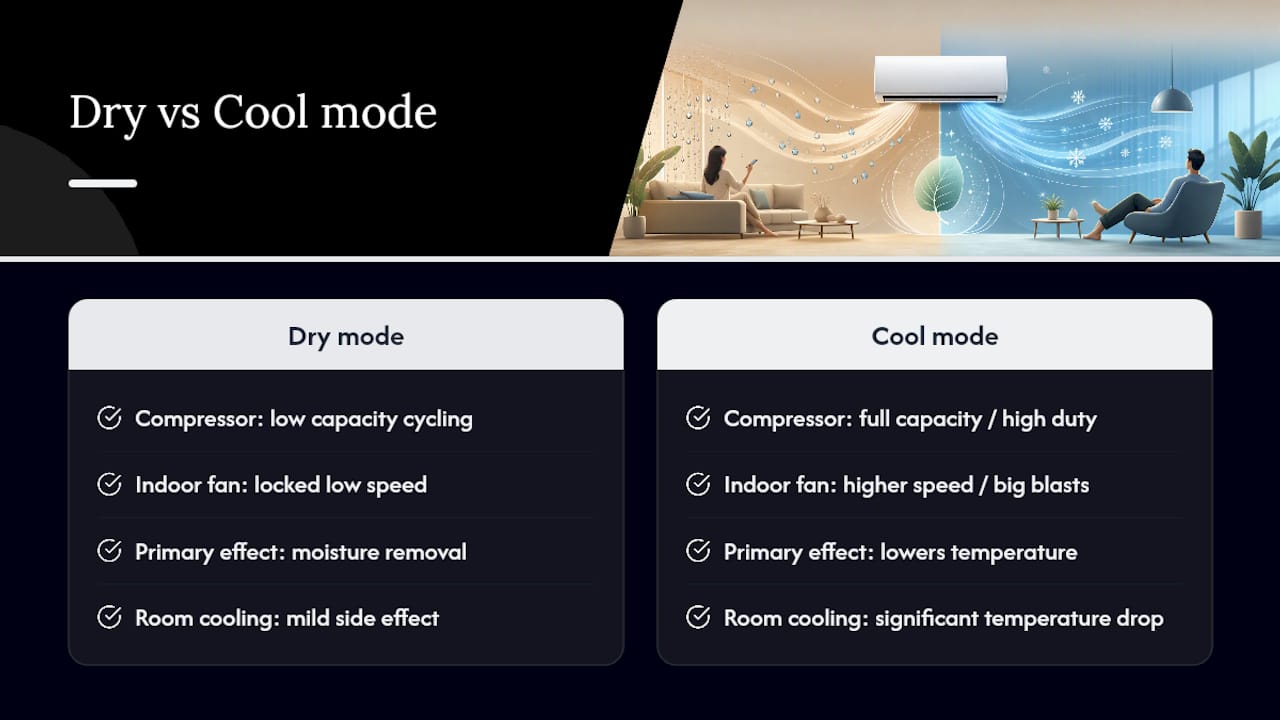
The compressor cycles at low capacity and the indoor fan locks to a low speed, which sounds counterintuitive if you associate air conditioning with big fans and cold blasts. But slower airflow means air spends longer in contact with the cold coil on each pass, which lets more moisture condense out before that air gets pushed back into the room. Think of it as a squeegee working over glass rather than a hose blasting it clean: less volume, more contact time, better moisture removal per pass.
That extended contact time is precisely why dry mode does not chill a room the way cool mode does. The compressor is not working hard enough to drive temperatures down significantly. You get a mild cooling effect as a side benefit, but the real output is drier air.
Dry mode typically draws roughly 40 to 60% of the electricity that cool mode uses under mild, humid conditions, because the compressor is running at reduced capacity rather than full tilt.
Most residential units have a real limitation worth knowing about: there is usually no independent humidity setpoint. A handful of premium systems include humidity-aware or “auto dry” controls that adapt automatically, but on a basic unit, dry mode just runs its low-speed cycle and you judge the result by feel, or better, by a hygrometer reading.
When should you use cool mode instead of dry mode?
The clearest signal is temperature. If the room is genuinely hot, dry mode will disappoint you, because its compressor never runs hard enough to fight serious heat. Cool mode is the right call when temperature and humidity are both elevated, or when you need fast relief and do not have time to wait for a gentler setting to catch up.
Reach for cool mode once the temperature climbs past that range, or when both heat and humidity are working against you at the same time.
A three-step check makes the decision almost automatic:
- Check relative humidity with a hygrometer, a small, cheap gadget that takes the guesswork out entirely.
- Check the room temperature against how it actually feels, not just the number on the thermostat.
- Choose the mode, then monitor. If dry mode isn’t cutting through the muggy feel within 20 to 30 minutes, switch to cool.
A few everyday scenarios make this concrete. Coming home to a house that baked in the sun all afternoon calls for cool mode, no contest. A muggy evening after a rainstorm, where the air feels heavy but the temperature is not extreme, is a textbook dry mode moment. Right after a shower or while cooking, dry mode clears the clamminess fast without over chilling the kitchen or bathroom. Overnight, many people prefer dry mode because it is quieter and less prone to the “too cold, then too warm” cycle that a thermostat-driven cool mode can produce.
Pro Tip: Keep a £15 to £20 hygrometer on a shelf in your main living space. Glancing at it before you touch the thermostat turns mode selection from a guess into a five-second decision.
Weighing the trade-offs: comfort, health and running costs
Each mode has a clear strength and a clear weakness, and knowing both stops you reaching for the wrong one out of habit.
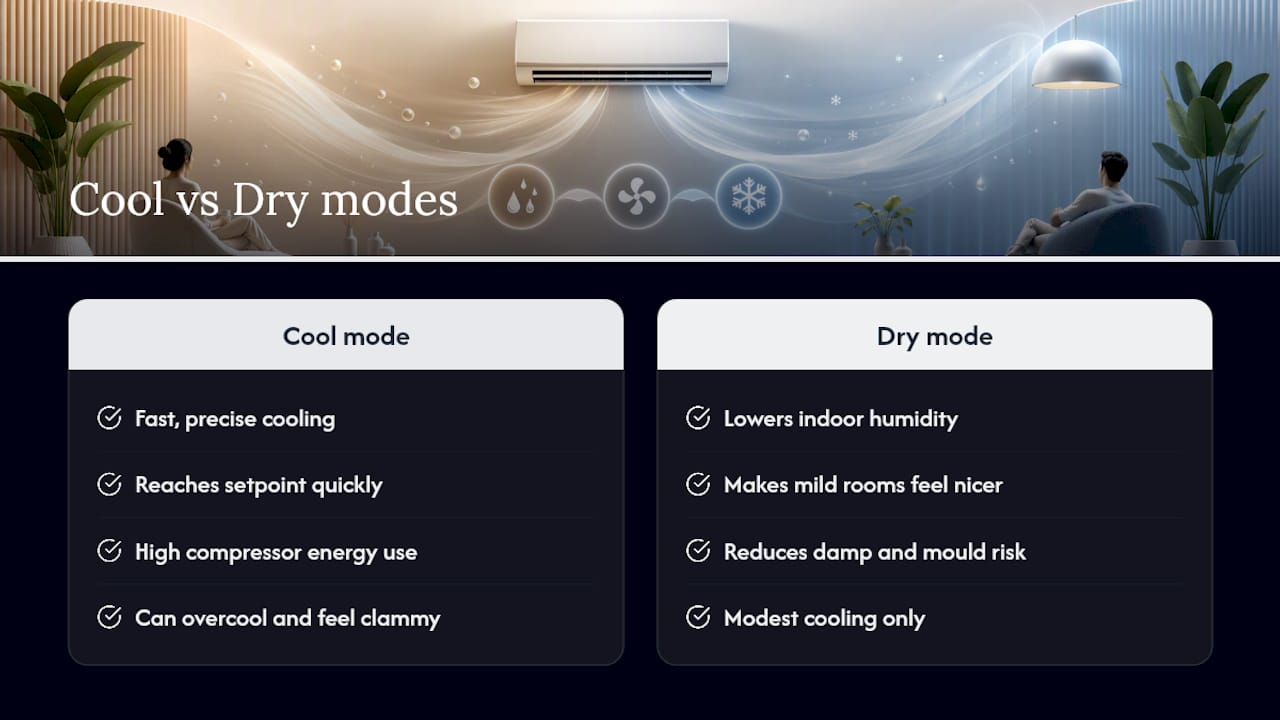
Cool mode’s advantages are speed and control. It gets a hot room comfortable quickly and gives you a precise, repeatable target temperature. Its downside is energy use. A hard-working compressor draws considerably more power than a gently cycling one, and if the setpoint is too aggressive, you end up overcooling a room, which wastes energy and can leave the air feeling clammy despite being cold, since cooling and dehumidifying are not always perfectly matched.
Dry mode’s advantages show up in perceived comfort and in reducing the conditions that let mould develop. Lower humidity makes a mild room feel noticeably more pleasant even without a big temperature change, and keeping indoor humidity down helps limit damp and mould growth over time. Its downside is that in a genuinely hot room, it feels ineffective. The modest cooling it produces cannot handle a heavy heat load, so running it in a stuffy, sun-baked room just leaves you dry and still uncomfortable.
There is a subtler risk too. If dry mode never quite solves your humidity problem no matter how long you run it, that can point to something bigger than mode choice, such as poor insulation, a leaky building envelope, or a genuinely oversized moisture load the way you’d see in a converted loft or basement. In that situation, a dedicated dehumidifier running alongside your AC often solves the problem faster than either mode alone.
What does dry mode cost compared with cool mode?
Running costs tell the real story of why people reach for dry mode on borderline days. Compressor runtime is the single biggest driver of an air conditioner’s electricity use, and small changes in how hard that compressor works translate into outsized swings in your bill.
Since dry mode keeps the compressor at reduced capacity, its draw sits at roughly 40 to 60% of cool mode’s energy use under mild conditions, based on manufacturer and industry estimates. Over an eight-hour overnight run, that gap adds up week after week, particularly across a humid summer.
A few habits stretch that saving further:
- Raise the cool mode setpoint by even 1 to 2°C rather than chasing an aggressively low target.
- Switch to dry mode on days when humidity, not heat, is the real complaint.
- Keep filters clean; a clogged filter forces the compressor to work harder in either mode.
- Close doors and windows while running either setting, so you are not conditioning outdoor air.
None of this requires new equipment, just paying attention to which problem you are actually trying to solve before you press a button.
When should you call a professional instead of switching modes?
Before assuming a mode is faulty, run a few basic checks yourself. Confirm the filter is clean, all vents are open and unobstructed, and there is no visible ice on the indoor coil. Listen for unusual compressor noise, since grinding or clicking that was not there before often signals a mechanical issue rather than a settings problem.
Certain symptoms are worth escalating rather than troubleshooting further:
- Persistently poor dehumidification even with clean filters and correct settings.
- A visibly frozen evaporator coil.
- Warm air blowing from vents while the unit is set to cool mode.
A dirty or restricted coil is a common, quiet culprit. When airflow is blocked, the coil cannot hold a temperature below the dew point, so both cooling and dehumidification suffer at once, which is exactly why routine servicing pays off on both fronts.
Pro Tip: If dry mode used to work fine and suddenly doesn’t, check the filter first. It is the cause behind more “broken” AC calls than any other single fault.
What routine do installers actually recommend?
Most installers settle into the same simple pattern once they’ve serviced enough homes through a full summer: start on cool mode to bring a hot room down to a comfortable baseline, then switch to dry mode to hold that comfort overnight or through a muggy afternoon, rather than leaving the compressor working hard the whole time.
The habit that separates people who are happy with their system from people who fight it constantly is measurement. Buy a hygrometer, glance at it before adjusting anything, and let the reading, not habit, decide the mode.
Sources
- How does an air conditioner work | PhysicsExplained
- AC Dry Mode Explained: What It Does & When to Use It | HVAC Base
- Air Conditioner Cool Mode Versus Dry Mode: What to Use - Pick Comfort
If you’d rather have a professional assess which system and settings suit your home, Akita’s domestic air conditioning installation team covers Suffolk, Norfolk and Essex, with fixed-price options such as the 2.5kW installation package for homeowners ready to upgrade to a system with proper humidity control built in.
FAQ
Is it okay to use dry mode all day?
Yes, in mild and humid conditions dry mode is generally safe to run for extended periods, since the compressor operates at low capacity rather than working hard continuously. It becomes ineffective, not unsafe, once the room is genuinely hot, because its modest cooling cannot handle a heavy heat load.
Should I put my AC on cool or dry mode?
Choose cool mode when the room is hot or when both temperature and humidity feel high; choose dry mode when the air feels sticky but the temperature itself is tolerable.
Is it okay to sleep with AC on dry mode?
Yes, many homeowners prefer dry mode overnight because the low fan speed runs quieter and avoids the harsh temperature swings that a thermostat-driven cool mode can produce. It suits bedrooms that feel humid rather than genuinely hot.
What are the disadvantages of AC dry mode?
Dry mode’s main drawback is limited cooling power, so it feels ineffective in a truly hot room and can leave the air feeling clammy if the heat load is too high. Most standard units also lack an independent humidity setpoint, so you cannot target a specific humidity level directly.