

How dehumidifiers work: a practical guide for UK homes
A dehumidifier removes water vapour from the air by one of two methods: cooling the air below its dew point so moisture condenses onto cold coils (refrigeration or compressor units), or passing the air through a hygroscopic desiccant material that adsorbs the moisture and then releases it as condensate (desiccant or adsorption units). For most UK homes, the target indoor relative humidity is typically maintained within a moderate range considered comfortable and safe. Compressor units are the more energy-efficient choice when room temperatures stay above roughly 15°C; desiccant units remain effective down to around 1°C, which makes them the sensible pick for unheated garages, cellars, and conservatories through a British winter.
Key takeaways
Dehumidifiers remove moisture by condensation (compressor units, best above 15°C) or adsorption (desiccant units, effective down to 1°C); choosing the right type for your room temperature is the single most important decision.
| Point | Details |
|---|---|
| Choose by temperature | Use a compressor unit above 15°C; use a desiccant unit in cold spaces down to around 1°C. |
| Target indoor RH | Aim for 40–60% relative humidity; above 60–65% encourages mould and dust mites. |
| Size up, not down | Rate capacity in litres/day and allow for real-world conditions being cooler than test conditions. |
| Maintain monthly | Clean filters, empty tanks, and wipe sensor areas to prevent humidistat drift and maintain extraction rates. |
| Know the limits | Persistent mould, rising damp, or water ingress after rain need a professional survey, not a larger appliance. |
Table of Contents
- How do dehumidifiers work? The physics behind moisture removal
- Which type of dehumidifier suits your home?
- How a compressor dehumidifier works: the refrigeration cycle
- How desiccant and other dehumidifiers work
- How to size and use a dehumidifier effectively
- Routine maintenance and common faults
- When a dehumidifier is not enough: signs you need professional help
- Akita’s perspective: what most homeowners get wrong
- Sources
How do dehumidifiers work? The physics behind moisture removal
Relative humidity (RH) is the percentage of water vapour the air holds compared to the maximum it could hold at that temperature. Warm air holds more moisture than cold air, which is why a room that feels fine in summer can drip with condensation in winter once the walls cool down. The dew point is the temperature at which the air becomes saturated and water starts to form on surfaces.
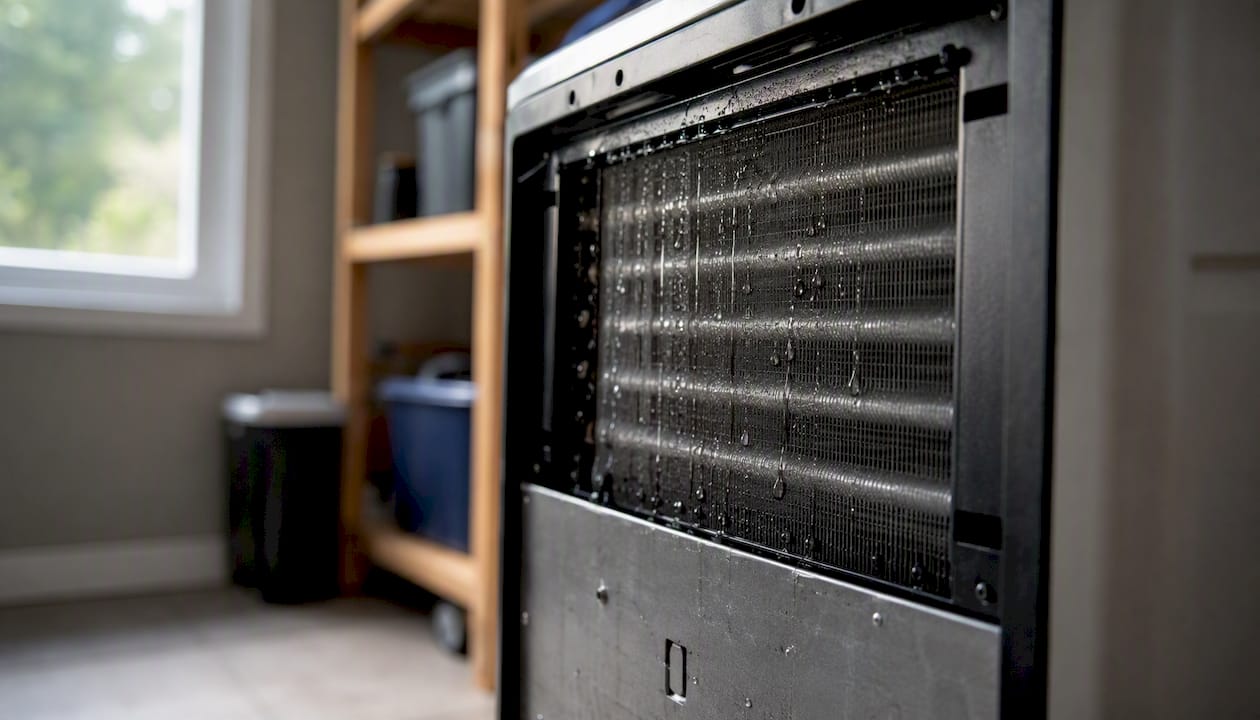
That condensation process is exactly what a compressor dehumidifier exploits. The unit chills a metal coil below the dew point of the incoming air, water droplets form on the coil, drain away, and the now-drier air is reheated slightly before being returned to the room. In simple terms: air in → cool coil → water collected → drier air reheated and returned.
Why does this matter for health and building fabric? Sustained high indoor relative humidity encourages dust mite populations, mould growth on walls and window frames, and can accelerate timber decay. NICE guidance NG149 is clear that identifying and removing the moisture source is the primary strategy; mechanical dehumidification is a secondary, targeted intervention for situations where ventilation alone is insufficient. The Manchester University NHS Foundation Trust patient leaflet on damp and mould reinforces this: fix leaks, improve ventilation with trickle vents or extractor fans, and avoid moisture-producing activities before reaching for an appliance.
Key reasons indoor humidity rises in UK homes:
- Cooking, showering, and drying laundry indoors
- Poor or blocked ventilation (blocked trickle vents, absent extractor fans)
- Cold external walls causing warm moist air to condense
- Structural defects: leaking roofs, failed pointing, rising damp
Pro Tip: Ventilation tackles moisture at source; a dehumidifier manages what remains. Pairing a bathroom extractor fan with a dehumidifier in a damp bedroom is more effective than either alone. See bathroom ventilation fan types explained for guidance on choosing the right extractor.
Which type of dehumidifier suits your home?
There are four main technologies. Understanding the working principle of each helps you avoid buying the wrong one for your space.
| Type | How it removes moisture | Best environments | Advantages | Downsides |
|---|---|---|---|---|
| Compressor (refrigeration) | Cools air below dew point; water condenses on evaporator coil | Heated rooms above 15°C | Energy-efficient in warm conditions; high extraction rates | Loses efficiency in cold; coils can ice up; noisier |
| Desiccant (adsorption) | Rotating hygroscopic wheel adsorbs moisture; regeneration heat expels it | Cold spaces, garages, cellars, down to ~1°C | Temperature-independent; quieter; warmer output air | Higher energy per litre in warm rooms; warm exhaust can be unwanted in summer |
| Thermoelectric (Peltier) | Small solid-state heat pump creates a cold surface | Very small spaces, low humidity | Silent; no moving parts | Very low extraction rate; impractical for serious damp |
| Whole-house / HVAC-integrated | Dehumidification built into ducted ventilation or heat pump system | Whole properties; commercial | Consistent whole-building control; no portable units needed | High installation cost; requires professional design |
Dantherm Group’s industry guidance frames the choice around three variables: room temperature, the target RH you need to reach, and life-cycle running costs rather than purchase price alone.
The 15°C rule: if the room you want to dehumidify regularly drops below 15°C, a compressor unit will spend a significant portion of its running time in defrost mode rather than extracting moisture. A desiccant unit, which remains effective down to around 1°C, is the practical choice for unheated British spaces.
For a deeper look at dehumidification methods for UK homes, Akita’s overview covers appliance-based options alongside integrated HVAC approaches.
How a compressor dehumidifier works: the refrigeration cycle
The refrigeration cycle is the same thermodynamic loop used in a fridge or air conditioning unit. Here is how it runs in a dehumidifier, step by step.
- Fan draws moist room air across the evaporator coil. The evaporator contains refrigerant at low pressure, which makes the coil surface cold, typically well below the dew point of the incoming air.
- Moisture condenses on the cold coil. Water droplets form and run down into a collection tank or drain. The air leaving the evaporator is now drier but also cold.
- The refrigerant absorbs heat and moves to the compressor. The compressor raises the refrigerant’s pressure and temperature, turning it into a hot, high-pressure gas.
- Hot refrigerant passes through the condenser coil. The condenser sits downstream of the evaporator in the airflow. The drier air from step 2 passes over it, picks up heat, and is returned to the room slightly warmer than it entered. This is why a compressor dehumidifier raises room temperature marginally.
- The expansion device drops the refrigerant pressure. The refrigerant cools rapidly and returns to the evaporator, completing the loop.
A thermodynamic analysis of household dehumidifiers confirms that extraction capacity rises with higher room temperature and humidity, and that traditional on/off compressor cycling causes latent-heat losses: when the compressor stops, water on the evaporator can re-evaporate back into the room air. Inverter-driven compressors running at variable frequency avoid this by maintaining a continuous, lower-speed cycle.
Key components at a glance
- Compressor: pressurises the refrigerant; the main energy consumer and the source of most operational noise
- Evaporator coil: the cold surface where condensation forms; sits in the incoming airflow
- Condenser coil: the warm surface that reheats the outgoing air; sits downstream
- Expansion device (valve or capillary tube): drops refrigerant pressure to create the cold side of the cycle
- Humidistat: the sensor that tells the unit when to run; measures RH and switches the compressor on and off to maintain the target setting
Defrost cycles and low-temperature behaviour
When room temperature falls below roughly 15°C, moisture can freeze on the evaporator rather than draining away. The unit detects this and runs a defrost cycle, pausing extraction while the coil warms up.
How desiccant and other dehumidifiers work
The rotating desiccant wheel
A desiccant dehumidifier contains a slowly rotating wheel coated in a hygroscopic material, typically silica gel or zeolite. Room air passes through one segment of the wheel; the desiccant adsorbs moisture from the air as it passes through. A separate, smaller stream of air is heated internally and passed through a different segment of the wheel, driving the captured moisture out as warm, humid regeneration air, which either vents to a collection tank or exhausts to the outside via ducting.
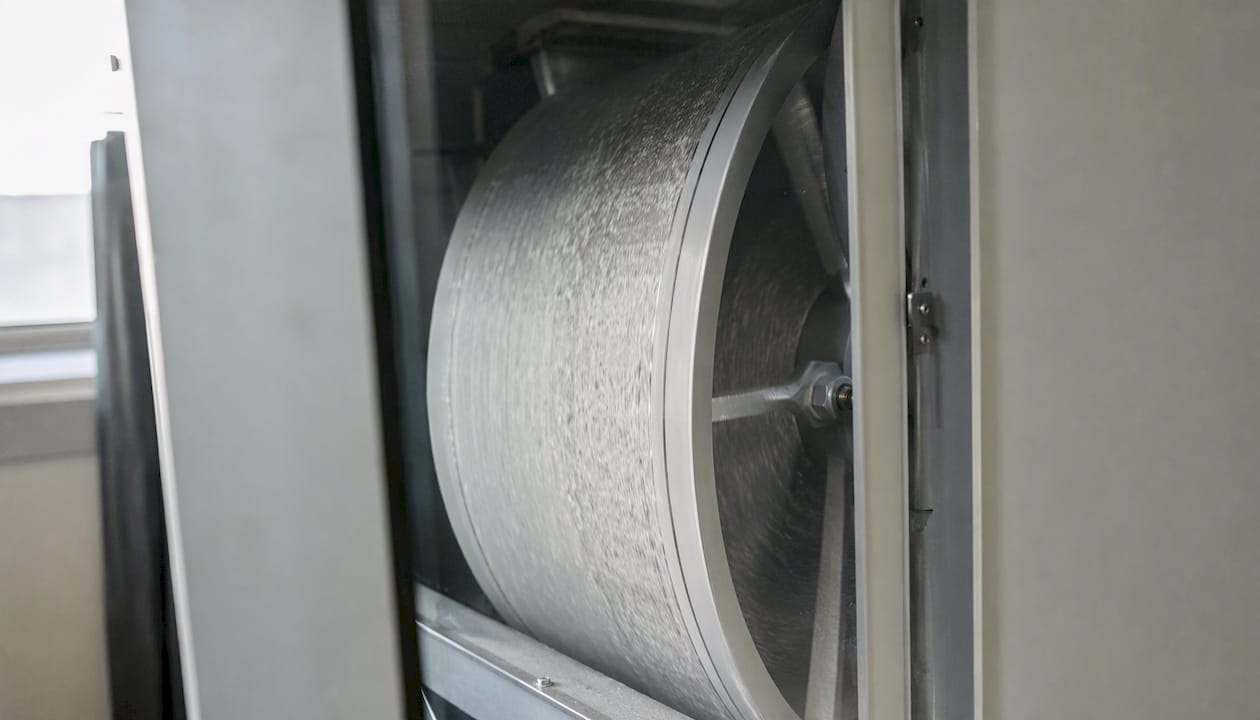
The result: the main airstream leaves drier and slightly warmer. Because the process is chemical adsorption rather than condensation, it does not depend on chilling air below a dew point. A desiccant unit remains effective at temperatures as low as 1°C, which is why they are the standard choice for cold stores, unheated garages, and boat interiors.
Pros and cons in practice:
- Temperature-independent extraction: consistent performance year-round in cold UK spaces
- Quieter operation: no compressor, just a fan and a small motor turning the wheel
- Warmer output air: useful in a cold garage; less welcome in a bedroom in July
- Higher energy per litre extracted in warm conditions: in a heated living room, a compressor unit will usually cost less to run per litre of water removed
- Life-cycle cost analysis often reverses the upfront price comparison: desiccant units can be cheaper per litre in cold conditions due to consistent extraction, while high-efficiency compressor units pay back faster in warm rooms
Pro Tip: If you are using a desiccant unit in an unheated space in winter, the warm output air is a bonus: it raises the ambient temperature slightly and speeds drying. In a bedroom during summer, that same warm exhaust makes the room stuffy. Position the unit near a slightly open window or switch to a compressor unit for warm-weather bedroom use.
Thermoelectric (Peltier) units
These use a solid-state Peltier module to create a cold surface without a compressor. They are silent and have no moving parts beyond a fan, but their extraction rate is very low. A Peltier unit is adequate for a small wardrobe or a gun safe; it is not a practical solution for a damp bedroom or a wet cellar.
Whole-house and HVAC-integrated systems
Ducted heat pump systems and mechanical ventilation with heat recovery (MVHR) can manage whole-building humidity without portable appliances. The dehumidification function is built into the system’s refrigeration or heat-exchange cycle. Running costs spread across the whole property, and there are no tanks to empty. The trade-off is installation complexity and cost, which means professional design and fitting are necessary. For homeowners considering this route, Akita’s guidance on HVAC systems and indoor air quality explains how integrated approaches compare to portable units.
How to size and use a dehumidifier effectively
Capacity: litres per day
Real-world extraction in a cool UK room will be lower, so size up rather than down.
Rough guidance for UK homes:
- Small bedroom (up to 15 m²), mild condensation: 10–12 litres/day
- Medium living room or kitchen (15–30 m²), moderate damp: 16–20 litres/day
- Utility room or laundry space: 20–25 litres/day; desiccant preferred if unheated
- Unheated cellar or garage: 20–25 litres/day desiccant, or accept lower real-world output from a compressor unit
Placement checklist
- Position the unit centrally in the room, away from walls and furniture, with at least 30 cm clearance on all sides for airflow
- Keep internal doors closed during operation so the unit works on a defined air volume
- In open-plan spaces, target the dampest zone and move the unit as conditions improve
- Never place a compressor unit in a room colder than its minimum operating temperature (check the manual; typically 5°C)
- Keep the unit level; condensate drains rely on gravity
Drainage options
Condensate drains into a tank, via a gravity outlet, or through a condensate pump. For occasional use, a tank with a float switch (which stops the unit when full) is fine. For continuous operation in a cellar or utility room, a gravity drain hose running to a floor drain is simpler and avoids the unit stopping unattended. Where the drain point is above the unit, a condensate pump pushes water upward to a sink or waste pipe.
Controls and settings
In automatic mode, the unit runs until it reaches the target and then cycles on and off to maintain it. Continuous mode runs the fan constantly regardless of RH, which is useful during an initial drying-out period after a leak or flood. Higher fan speeds extract faster but generate more noise; medium speed overnight is a reasonable compromise in a bedroom. For more on humidity control in HVAC systems, including humidistat integration, Akita’s guide covers the technical detail.
Routine maintenance and common faults
Keeping a dehumidifier running well takes about 15 minutes a month. Neglect it and extraction rates drop, energy use rises, and the humidistat may start cycling incorrectly.
Monthly maintenance checklist:
- Clean or rinse the air filter (most units have a washable foam or mesh filter at the intake grille); a clogged filter cuts airflow and extraction rate sharply
- Empty and rinse the collection tank; biofilm builds up quickly in warm, wet conditions
- Check the drain hose for kinks or blockages if using gravity drainage
- Wipe the intake and discharge grilles clear of dust and fluff
- Inspect the evaporator and condenser coils for visible dust build-up; a soft brush or low-pressure air can clear surface deposits
Troubleshooting quick checks:
- No water collected: check that RH in the room is actually above the humidistat target; if the room is already dry, the unit is working correctly. Also check the filter is not blocked.
- Poor drying despite running: room temperature may be too low for a compressor unit; check the operating temperature range. Alternatively, the room is too large for the unit’s capacity.
- Frost or ice on the coils: normal in cold conditions; the defrost cycle should clear it. If icing persists at normal room temperatures, the refrigerant charge may be low — this requires a qualified engineer.
- Unusual noise: rattling often means a loose panel or debris in the fan; a grinding or hissing sound from the compressor area warrants professional inspection.
HowStuffWorks notes that some humidistats use simple resistance-based sensors that drift as dust accumulates on them, causing the unit to cycle incorrectly or run continuously. Cleaning the sensor area when you clean the filter usually resolves this. If the humidistat continues to misread after cleaning, the sensor may need replacement.
When to call a qualified engineer: compressor faults, refrigerant leaks (indicated by a sudden drop in extraction with no other explanation), and any electrical fault — burning smell, tripped circuit breaker, or damaged cable — should not be investigated by the homeowner. Refrigerant handling is a regulated activity in the UK and must be carried out by an F-Gas certified technician.
When a dehumidifier is not enough: signs you need professional help
A dehumidifier manages airborne moisture. It cannot fix the source of water entering a building, and running one continuously against an unresolved structural problem is expensive and ineffective.
Red flags that need a professional damp survey, not an appliance:
- Tide marks or staining on lower walls (rising damp)
- Persistent mould that returns within weeks of cleaning, despite controlled indoor RH
- Visible water ingress after rain: wet patches on ceilings, walls, or around window frames
- Efflorescence (white salt deposits) on masonry
- Rotting timber, lifting floor coverings, or peeling plaster at skirting level
- A musty smell that persists even when the dehumidifier reads the target RH
NICE guidance NG149 is explicit: source removal and ventilation come first. The Manchester University NHS Foundation Trust guidance adds that prompt repair of water damage and improving ventilation are the primary interventions; dehumidifiers are recommended as an adjunct where ventilation cannot fully control moisture. Relying on an appliance while a roof leak or failed damp-proof course continues is not a solution.
Before a contractor visits, collect:
- Photographs of affected areas with timestamps
- A humidity log (most modern dehumidifiers display and log RH; a standalone hygrometer costs under £15)
- Notes on when symptoms worsen (after rain, in winter only, after cooking)
- Any previous repair history for the property
A professional damp survey will typically check external defects (guttering, pointing, render), internal ventilation provision, subfloor conditions, and the damp-proof course. For properties where ventilation is the primary gap, ventilation systems in healthy buildings explains how whole-building approaches address what portable appliances cannot.
Akita’s perspective: what most homeowners get wrong
The single most common mistake Akita sees in UK homes is a compressor dehumidifier placed in an unheated cellar or garage and left to run through winter. The unit spends a large portion of its time in defrost mode, the tank fills slowly if at all, and the homeowner concludes that dehumidifiers simply do not work. They do work — just not that one, in that space, at that temperature. A desiccant unit in the same cellar would extract consistently regardless of whether it is 3°C or 13°C outside.
The second mistake is treating a dehumidifier as a permanent fix for a structural problem. An appliance that runs continuously to keep mould at bay is masking a defect that will worsen and cost more to repair the longer it is left.
One practical tip that makes a genuine difference: after any water leak or flood, close all internal doors, set the dehumidifier to continuous mode, and run it at medium fan speed for 24–48 hours before switching to automatic. The sustained airflow through a defined space accelerates drying significantly compared to running on automatic from the start, where the unit may cycle off before the building fabric has dried out.
Sources
- Indoor air quality at home (NICE guidance NG149) — resources
- Desiccant vs Compressor Dehumidifier UK 2026 — Which Do You Need?
- Adsorption or condensation? Choosing the right dehumidifier for your needs — Dantherm Group
- International Refrigeration and Air Conditioning Conference paper — analysis of household dehumidifier working process
- RMCH Patient leaflet - Damp & mould in the home (Manchester University NHS Foundation Trust)
- How dehumidifiers work | HowStuffWorks
If you are considering a whole-house humidity control solution or an air conditioning system with integrated dehumidification, Akita installs and maintains climate control systems across Suffolk, Norfolk, and Essex.  Find out more about domestic air conditioning installation or get in touch for a no-obligation quote.