

The role of ventilation systems in healthy buildings
TL;DR:
- Proper ventilation removes indoor pollutants and is essential for occupant health and energy efficiency. Mechanical systems like MVHR are required in airtight buildings to meet UK regulations and improve air quality. Regular maintenance and proper system design ensure healthy indoor environments and compliance.
Ventilation is defined as the controlled exchange of stale indoor air with fresh outdoor air to remove pollutants, excess moisture, and carbon dioxide. The role of ventilation systems goes far beyond comfort. Poor indoor air quality causes respiratory illness, fatigue, and reduced concentration, making effective ventilation a health necessity rather than a luxury. UK Building Regulations, specifically Approved Document F, mandate mechanical ventilation in airtight homes to protect occupants and meet legal standards. Whether you own a home or manage a commercial property, understanding how ventilation works is the first step to protecting the people inside it.
What are the different types of ventilation systems?
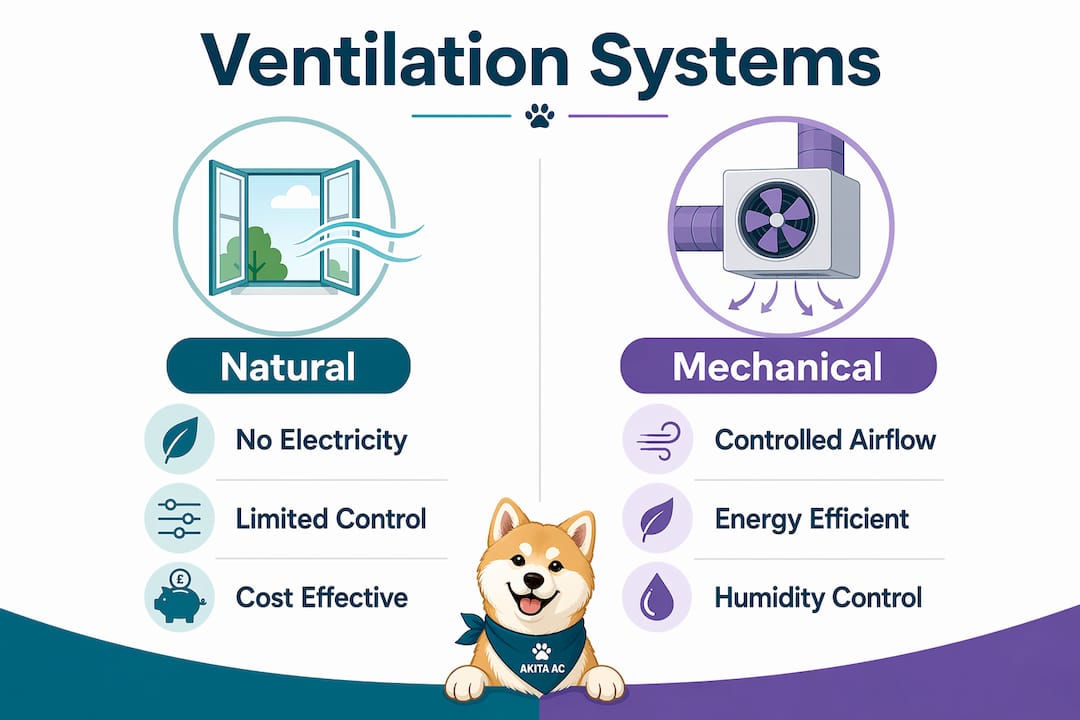
Ventilation systems fall into two broad categories: natural and mechanical. Natural ventilation relies on windows, trickle vents, and passive stack effects to move air through a building. It costs little to install but depends entirely on wind pressure and temperature differences, making it unreliable in airtight modern buildings.
Mechanical systems offer controlled, consistent airflow regardless of weather conditions. UK Building Regulations recognise four main system types:
- System 1: Intermittent extract fans in kitchens and bathrooms, combined with background trickle vents.
- System 2: Passive stack ventilation with humidity-controlled inlets.
- System 3: Continuous Mechanical Extract Ventilation (MEV or dMEV), which runs at a low background rate and boosts when needed.
- System 4: Mechanical Ventilation with Heat Recovery (MVHR), which simultaneously supplies fresh air and extracts stale air while recovering heat from the outgoing stream.
Airtight modern buildings trap pollutants that natural ventilation cannot shift, making mechanical systems necessary rather than optional. Retrofitting insulation or upgrading windows without upgrading ventilation creates a sealed box where carbon dioxide and moisture accumulate unchecked.
Pro Tip: If you are upgrading insulation or replacing windows, always review your ventilation strategy at the same time. Improving airtightness without improving airflow creates worse indoor conditions, not better ones.

The choice between System 3 and System 4 depends on your building’s airtightness, budget, and energy goals. MVHR is the preferred option for most energy-efficient homes because it delivers both fresh air and heat recovery in a single unit.
How do ventilation systems improve indoor air quality and health?
Good ventilation removes the pollutants that accumulate in occupied buildings every hour of every day. Carbon dioxide from breathing, volatile organic compounds (VOCs) from furniture and cleaning products, moisture from cooking and showering, and fine particulate matter all build up when air is not exchanged regularly. A well-designed system dilutes and removes these contaminants before they reach harmful concentrations.
The health consequences of poor air quality are well documented. Research confirms that poor air quality reduces cognitive function, concentration, and decision-making. In commercial settings, this translates directly into lower productivity and higher absenteeism. For homeowners, it means disrupted sleep, persistent headaches, and worsened asthma or allergy symptoms.
“Proper ventilation correlates with increased occupant alertness, productivity, and reduced absenteeism in commercial settings. Poor air quality reduces cognitive function, concentration, and decision-making, making ventilation a business performance issue as much as a health one.”
Humidity control is one of the most underappreciated ventilation system benefits. When moisture is not extracted efficiently, it condenses on cold surfaces and feeds mould growth. Mould spores worsen respiratory conditions and can cause structural damage to walls and ceilings over time. A continuous extract system running at background rate prevents this cycle from starting.
Air cleaning units reduce airborne contaminants but cannot lower CO₂ levels or control humidity. This means air purifiers are a supplement to ventilation, never a replacement. Ventilation also controls airborne pathogens and odours in a way that no filter-based device can match, because it physically removes contaminated air from the space.
For practical tips on improving home ventilation alongside other building improvements, small changes to how you use windows and vents can make a meaningful difference while you plan a longer-term system upgrade.
What are the UK regulatory requirements for ventilation?
UK Building Regulations set clear, legally binding standards for ventilation in new and significantly renovated buildings. Approved Document F is the primary reference document, and it applies to both residential and commercial properties.
The critical threshold is air permeability. Buildings with air permeability ≤5 m³/h·m² at 50 Pa require continuous mechanical ventilation, either System 3 or System 4. This threshold is now routinely reached in new builds and in older properties that have undergone significant insulation upgrades.
The four system types and their selection criteria are:
- System 1: Suitable for dwellings with background ventilators and intermittent fans. Appropriate for less airtight buildings.
- System 2: Passive stack ventilation. Suitable where natural pressure differences are reliable.
- System 3 (MEV/dMEV): Continuous extract. Required for airtight dwellings where supply air enters through background ventilators.
- System 4 (MVHR): Continuous supply and extract with heat recovery. Required or strongly preferred for the most airtight homes.
| Requirement | Detail |
|---|---|
| Airtightness trigger | ≤5 m³/h·m² at 50 Pa requires mechanical ventilation |
| Commissioning | Airflow rates must be physically measured and adjusted |
| Home User Guide | Must be provided to occupants on completion |
| Maintenance obligation | Filter replacement and vent cleaning are owner responsibilities |
Pro Tip: Ask your installer for the commissioning report as a matter of course. This document proves the system was set up correctly and is your evidence of compliance if questions arise later.
Commissioning is not optional. Mechanical ventilation systems often fail or underperform without proper commissioning, which involves physically measuring airflow rates and adjusting configurations to match the design specification. A system that has not been commissioned may look functional but deliver a fraction of the required airflow.
How does maintenance affect ventilation system performance?
A ventilation system that is not maintained degrades steadily until it fails to protect occupants at all. The consequences are not abstract: blocked filters, dirty fans, and sealed vents lead directly to damp, mould, and poor air quality.
Replacing filters annually and keeping trickle vents unblocked prevents condensation, damp, and mould that cause respiratory illness. This is the minimum maintenance standard for any mechanical system. MVHR units also require duct inspection and heat exchanger cleaning on a schedule set by the manufacturer.
The most common homeowner mistake is blocking trickle vents to retain heat in winter. Blocked trickle vents cause harmful humidity buildup and mould problems. The short-term heat saving is real but small. The long-term cost in remediation, health impact, and structural repair is far greater.
Key maintenance tasks for mechanical ventilation systems include:
- Replacing or cleaning filters every 6–12 months, depending on the manufacturer’s guidance.
- Cleaning extractor fan grilles and MVHR intake and exhaust terminals.
- Checking that all trickle vents are open and unobstructed, including in winter.
- Arranging a professional service inspection every two to three years.
- Keeping the Home User Guide accessible so all occupants understand how the system operates.
Pro Tip: Set a calendar reminder for filter replacement when the system is first installed. Filters that are overdue by even a few months can reduce airflow significantly and push the system into a performance range that no longer meets regulatory standards.
What energy efficiency benefits do ventilation systems provide?
Ventilation and energy efficiency are not in conflict. The right system delivers both fresh air and meaningful energy savings, particularly when paired with good insulation.
MVHR units recover up to 90% of heat from outgoing air, transferring it to incoming fresh air before it enters the living space. This dramatically reduces the heating load compared to a simple extract fan that vents warm air directly outside. For a well-insulated home, MVHR can make a measurable difference to annual heating bills.
Fabric insulation must be installed alongside proper ventilation to avoid moisture trapping, mould, and structural damage. Insulation without ventilation creates a damp, unhealthy building. Ventilation without insulation wastes energy. The two work together, and a building that has both performs better on every measure.
| System type | Approximate installation cost | Heat recovery |
|---|---|---|
| Decentralised units (dMEV) | £400–£1,200 | None |
| Positive Input Ventilation (PIV) | £800–£2,000 | None |
| MVHR | £3,000–£8,000+ | Up to 90% |
The upfront cost of MVHR is higher, but the long-term energy saving and the health benefit justify the investment for most airtight properties. For energy-efficient HVAC options that complement your ventilation strategy, the key is matching the system to your building’s actual airtightness level rather than choosing on price alone.
Key takeaways
Proper ventilation is the single most important factor in maintaining healthy, energy-efficient indoor environments, and no other technology can replace it.
| Point | Details |
|---|---|
| Ventilation removes pollutants | It extracts CO₂, VOCs, moisture, and particulates that accumulate in occupied buildings. |
| Airtight buildings need mechanical systems | Buildings at ≤5 m³/h·m² air permeability require System 3 or 4 under Approved Document F. |
| MVHR recovers up to 90% of heat | It is the most energy-efficient option for airtight homes and supports Part F compliance. |
| Maintenance is non-negotiable | Annual filter replacement and open trickle vents are the minimum standard to prevent mould and damp. |
| Insulation and ventilation work together | Upgrading one without the other creates either energy waste or unhealthy indoor conditions. |
Ventilation is not an optional extra
Akita has worked with homeowners and businesses across Suffolk, Norfolk, and Essex for years, and the same misunderstanding comes up repeatedly. People treat ventilation as something to sort out after the “real” work is done. They insulate, they upgrade windows, they install a new heating system, and then they wonder why they have condensation on the walls in january.
The truth is that ventilation is the foundation everything else sits on. A building that breathes correctly is healthier, cheaper to heat, and far less likely to develop the damp and mould problems that cost thousands to fix. The buildings that perform best are the ones where ventilation was planned from the start, not bolted on at the end.
The regulatory picture has also shifted. Approved Document F now sets clear thresholds, and the commissioning requirements mean that a system that has not been properly set up is not just ineffective. It is non-compliant. For commercial property owners, that carries real legal and reputational risk.
My honest advice: if you have upgraded your building’s insulation or airtightness in the last five years and have not reviewed your ventilation, do it now. The relationship between HVAC ventilation and air quality is direct and measurable. Getting it right is not complicated, but it does require the right system, correctly commissioned, and properly maintained.
— Akita
How Akita can help with your ventilation and air quality needs
Akita installs and maintains air conditioning and climate control systems for homes and businesses across Suffolk, Norfolk, and Essex, with a focus on energy-efficient solutions that meet current UK regulations.

Whether you need a domestic air conditioning installation with integrated ventilation options or a commercial air conditioning solution designed to improve air quality across a larger site, Akita’s team can assess your property and recommend the right approach. All installations include commissioning to Approved Document F standards, and Akita provides transparent, fixed pricing with flexible finance options. Contact Akita to discuss what your property needs and get a clear quote without obligation.
FAQ
What is the role of ventilation systems in buildings?
Ventilation systems replace stale indoor air with fresh outdoor air, removing carbon dioxide, moisture, VOCs, and airborne pathogens. This protects occupant health, prevents mould, and supports energy-efficient building performance.
When is mechanical ventilation required under UK Building Regulations?
Mechanical ventilation is required when a dwelling’s air permeability is ≤5 m³/h·m² at 50 Pa, as set out in Approved Document F. At this level of airtightness, natural ventilation cannot maintain safe indoor air quality.
Can an air purifier replace a ventilation system?
No. Air cleaning units reduce airborne particles but cannot lower CO₂ levels or control humidity. Ventilation physically removes contaminated air from a space, which no filter-based device can replicate.
How often should a mechanical ventilation system be serviced?
Filters should be replaced every 6–12 months, and grilles and terminals should be cleaned regularly. A professional inspection every two to three years keeps the system performing to its designed specification.
What is MVHR and why is it recommended for airtight homes?
MVHR (Mechanical Ventilation with Heat Recovery) simultaneously supplies fresh air and extracts stale air, recovering up to 90% of heat from the outgoing stream. It is the most energy-efficient ventilation option for airtight buildings and supports compliance with Approved Document F.