

Why humidity control matters for your UK home
TL;DR:
- Maintaining indoor humidity between 40% and 60% helps protect health, prevent property damage, and improve comfort.
- Controlling moisture reduces mould growth, limits dust mites, and prevents structural damage in homes.
Humidity control is the regulation of indoor moisture levels to protect health, maintain comfort, and prevent property damage. The optimal indoor relative humidity sits between 40% and 60%. Drop below that range and your skin dries out, your airways become irritated, and timber contracts. Exceed it and mould grows, dust mites multiply, and your walls start to suffer. For UK homeowners and renters, understanding why humidity control matters is the first step towards a healthier, more energy-efficient home.
Why humidity control starts with your health
The most direct reason to manage indoor moisture is what uncontrolled humidity does to your body. High humidity creates the conditions mould and dust mites need to thrive. Both are well-established triggers for asthma, rhinitis, and other respiratory conditions.
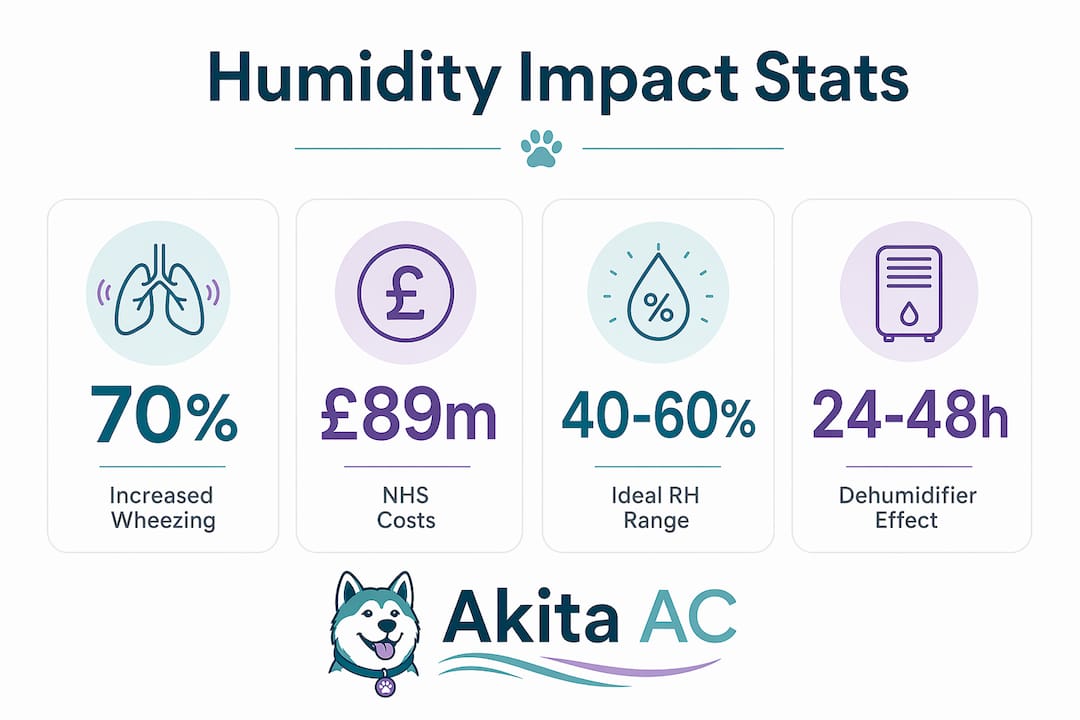
The numbers are striking. Children in mouldy rooms are 70% more likely to experience wheezing, and the UK NHS spends £895 million every year treating health problems linked to damp housing. That figure alone shows how far the consequences of poor humidity management reach beyond individual discomfort.
Dust mites thrive above 50% RH and are a leading asthma trigger in UK homes. Keeping bedroom humidity below 50% reduces allergen levels without any chemical treatment. That is a meaningful benefit for anyone managing allergies or asthma in the family.
Low humidity causes its own problems. When indoor air drops below 40% relative humidity, mucous membranes dry out, skin becomes itchy, and the body’s natural defences against airborne viruses weaken. This is particularly common in winter, when central heating runs continuously and strips moisture from the air.
“Damp and mould are not just cosmetic problems. They are a public health issue, legally classified as a Category 1 hazard under the UK Housing Health and Safety Rating System. Awaab’s Law now requires landlords to act quickly when mould hazards are reported in rented homes.”
Sleep quality also connects directly to humidity. A bedroom that is too humid feels stuffy and warm, disrupting sleep. One that is too dry irritates the throat and nasal passages. Keeping humidity in the 40–60% band supports deeper, more restful sleep for the whole household.
How does humidity damage your home?
Poor moisture management does not just affect people. It attacks the building itself, often in ways that are expensive to reverse.
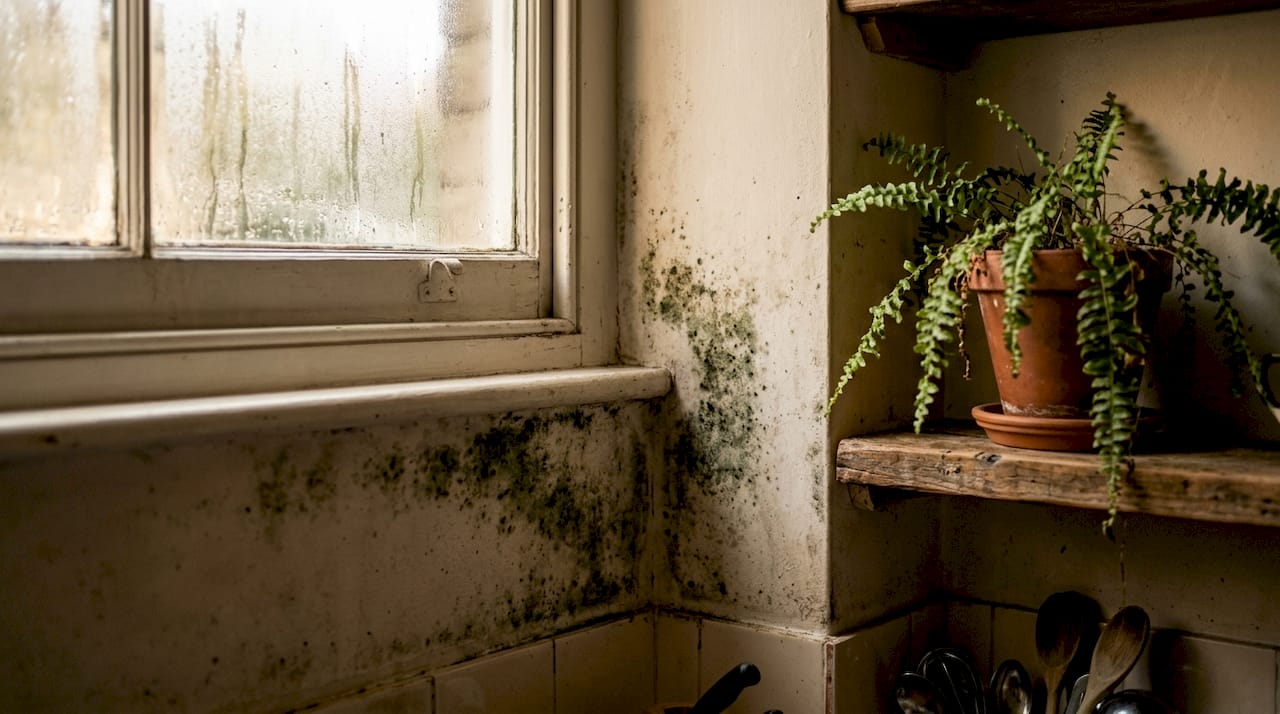
High humidity causes condensation on cold surfaces: window frames, external walls, and corners behind furniture. Over time, that condensation feeds mould growth, which stains plaster, degrades paintwork, and can penetrate deep into masonry. Timber is particularly vulnerable. Skirting boards, floorboards, and door frames swell and warp when moisture levels stay elevated for weeks.
The damage profile looks like this:
- Mould growth on walls and ceilings, leading to structural deterioration and costly remediation
- Timber swelling causing doors and windows to stick, and floorboards to lift or creak
- Plaster damage from repeated wetting and drying cycles, leading to crumbling and cracking
- Corrosion of metal fixings, radiator brackets, and pipework in poorly ventilated rooms
- Paintwork failure where moisture trapped behind emulsion causes bubbling and peeling
Low humidity creates the opposite problem. Timber shrinks and gaps appear between floorboards. Plaster can crack as it dries out. Furniture joints loosen. These are slower processes, but they accumulate over years of neglect.
| Humidity level | Primary risk | Typical signs |
|---|---|---|
| Below 40% RH | Dryness and shrinkage | Cracked plaster, gaps in flooring, dry skin |
| 40–60% RH | Balanced and safe | No condensation, comfortable air |
| Above 60% RH | Mould and structural damage | Condensation, mould spots, timber swelling |
The importance of humidity management becomes clear when you consider repair costs. Mould remediation, replastering, and timber replacement are all avoidable with consistent moisture control.
Practical ways to control humidity at home
The most effective approach starts with reducing moisture at source before reaching for any equipment. Ventilation and source control are the first steps, and they cost nothing.
- Use extractor fans every time you cook or shower, and leave them running for 15 minutes after you finish.
- Avoid drying laundry on radiators. A single load of wet washing releases around 2 litres of moisture into the air. Use a tumble dryer vented outside, or dry clothes outdoors when possible.
- Open windows for cross-ventilation in the morning, even in winter. Ten minutes of fresh air exchanges stale, humid air for drier outdoor air.
- Keep furniture away from external walls. This allows air to circulate and prevents cold spots where condensation forms.
- Monitor humidity with a hygrometer. These small, inexpensive devices give you an accurate reading of relative humidity in any room. Without one, you are guessing.
When habits alone are not enough, a dehumidifier is the most direct corrective tool. Dehumidifiers can reduce indoor humidity within 24–48 hours, though dust mite populations take several weeks of sustained low humidity to decline significantly. Set the target to 50% and let the unit run in the most affected rooms first.
In winter, the problem often reverses. Central heating dries the air below 40% RH, making a humidifier useful. Set it to maintain 45–50% and check the reading with your hygrometer rather than running it continuously.
Pro Tip: Place your hygrometer in the bedroom first. Sleep environments are where humidity imbalances cause the most direct health impact, and they are often the last room homeowners check.
Thermostat settings also influence humidity. Lowering your heating by 1–2°C reduces indoor humidity noticeably in well-insulated homes, cuts energy bills, and reduces condensation risk. Pairing this with a smart thermostat that allows precise scheduling gives you consistent control without constant manual adjustment.
How do humidity control systems work?
Air conditioning and HVAC systems manage humidity as part of their core function, not as an add-on. When a system cools air, it draws warm, moist air across a cold evaporator coil. Moisture condenses on the coil and drains away. The result is cooler, drier air returned to the room.
This process is why a well-sized air conditioning unit is one of the most effective humidity control systems available for UK homes. An undersized unit runs continuously without reaching the target temperature, and an oversized unit short-cycles, switching off before it has had time to dehumidify properly. Correct sizing is the single most important factor in getting both temperature and humidity right.
HVAC systems improve indoor air quality by combining filtration, temperature regulation, and moisture removal in one process. Modern units with inverter technology adjust their output continuously, which means they dehumidify more consistently than older on/off systems.
Energy efficiency and humidity control are directly linked. Humid air feels warmer than dry air at the same temperature. When humidity is high, you turn the thermostat up. When it is managed correctly, you feel comfortable at a lower temperature setting, and your energy bills reflect that. Energy-efficient cooling becomes far easier when the system is also removing excess moisture.
Pro Tip: Replace your air conditioning filter every 3–6 months. A blocked filter reduces airflow across the evaporator coil, cutting the system’s ability to dehumidify and forcing it to work harder.
Maintenance matters as much as installation. A system with a clean filter, clear drainage, and correctly charged refrigerant dehumidifies efficiently. Neglect any of those and performance drops, humidity creeps up, and energy consumption rises.
Key takeaways
Humidity control is the single most cost-effective measure UK homeowners can take to protect health, comfort, and property simultaneously.
| Point | Details |
|---|---|
| Target 40–60% RH | This range prevents mould, dust mites, dryness, and structural damage in UK homes. |
| Health risks are significant | Mouldy rooms increase children’s wheezing risk by 70%; NHS spends £895m yearly on damp-related illness. |
| Source control comes first | Extractor fans, ventilation, and avoiding indoor drying reduce moisture before equipment is needed. |
| Air conditioning dehumidifies | A correctly sized AC unit removes moisture as it cools, making it a dual-purpose humidity control system. |
| Monitor with a hygrometer | Without a reading, you cannot know whether your efforts are working or where problems are developing. |
Akita’s view: the problem hiding in plain sight
Most homeowners I speak to notice the symptoms before they identify the cause. A persistent cough through winter. A musty smell in the spare room. Paint peeling in the bathroom corner. These are humidity problems, but they rarely get labelled as such.
The UK climate makes this worse. Mild, damp winters mean outdoor moisture levels are already high for much of the year. Homes that are well-insulated but poorly ventilated trap that moisture inside. The result is a slow build-up that feels normal until the mould appears or the plaster starts to crumble.
What I have found, working with homeowners across Suffolk, Norfolk, and Essex, is that the fix is almost always simpler than people expect. Better ventilation habits, a hygrometer to track progress, and a properly maintained air conditioning system cover the vast majority of cases. The mistake is waiting until there is visible damage before acting.
Humidity management is not a one-season task. Summer brings high outdoor humidity. Winter brings dry heating air. Both extremes need attention, and the homes that stay comfortable year-round are the ones where the occupants check their readings regularly and adjust accordingly.
— Akita
Akita’s domestic air conditioning for year-round humidity control

Akita installs air conditioning systems across Suffolk, Norfolk, and Essex that manage both temperature and humidity in one unit. A correctly sized system removes excess moisture as it cools in summer and works alongside your heating in winter to keep air from becoming too dry. Every installation includes guidance on settings that keep relative humidity in the 40–60% range your home needs.
Akita’s domestic air conditioning installations are priced transparently, with flexible finance options available. If you want a system that handles humidity, comfort, and energy efficiency together, Akita’s team can advise on the right unit for your home’s size and layout. Get in touch for a no-obligation quote.
FAQ
What is the ideal indoor humidity level for a UK home?
The ideal indoor relative humidity is 40–60%. Below 40% causes dryness and irritation; above 60% encourages mould growth and dust mite activity.
How quickly does a dehumidifier reduce indoor humidity?
A dehumidifier can lower indoor humidity within 24–48 hours. Dust mite populations take several weeks of sustained low humidity to decline meaningfully.
Does air conditioning help with humidity control?
Yes. Air conditioning removes moisture from the air as it cools, making it an effective humidity control system for UK homes when correctly sized and maintained.
Is mould a legal issue for UK renters?
Mould is classified as a Category 1 hazard under the UK Housing Health and Safety Rating System. Awaab’s Law requires landlords in England to address mould hazards promptly when reported by tenants.
Can I control humidity without buying equipment?
Yes. Ventilation and source control — using extractor fans, opening windows, and avoiding indoor laundry drying — reduce moisture significantly at no cost before any equipment is needed.