

What is humidity control in HVAC systems?
TL;DR:
- Humidity control in HVAC actively manages indoor moisture levels to enhance comfort, protect building materials, and reduce energy use within the optimal 30% to 60% RH range. It involves dehumidification and humidification through dedicated components that work together, such as cooling coils, humidistats, and steam or evaporative humidifiers, to maintain proper moisture balance. Properly managed humidity lowers energy costs, prevents mould and structural damage, and creates healthier indoor environments by addressing both excessive and insufficient moisture conditions.
Humidity control in HVAC is defined as the active regulation of indoor moisture levels to maintain occupant comfort, protect building materials, and reduce energy consumption. Most HVAC professionals refer to this as moisture management or humidity regulation, and it sits at the heart of any well-designed climate control system. ASHRAE standards define the optimal indoor relative humidity (RH) range as 30% to 60%, a band that prevents mould growth, respiratory irritation, and structural damage simultaneously. Whether you manage a Suffolk farmhouse or a commercial office in Norwich, getting this balance right determines how comfortable, healthy, and cost-effective your building actually is.
What is humidity control in HVAC and how does it work?
Humidity control in HVAC is the process of adding or removing moisture from circulating air using dedicated components built into or connected to your existing climate system. The industry term for the full process is psychrometric control, though most installers and facility managers simply call it humidity regulation.
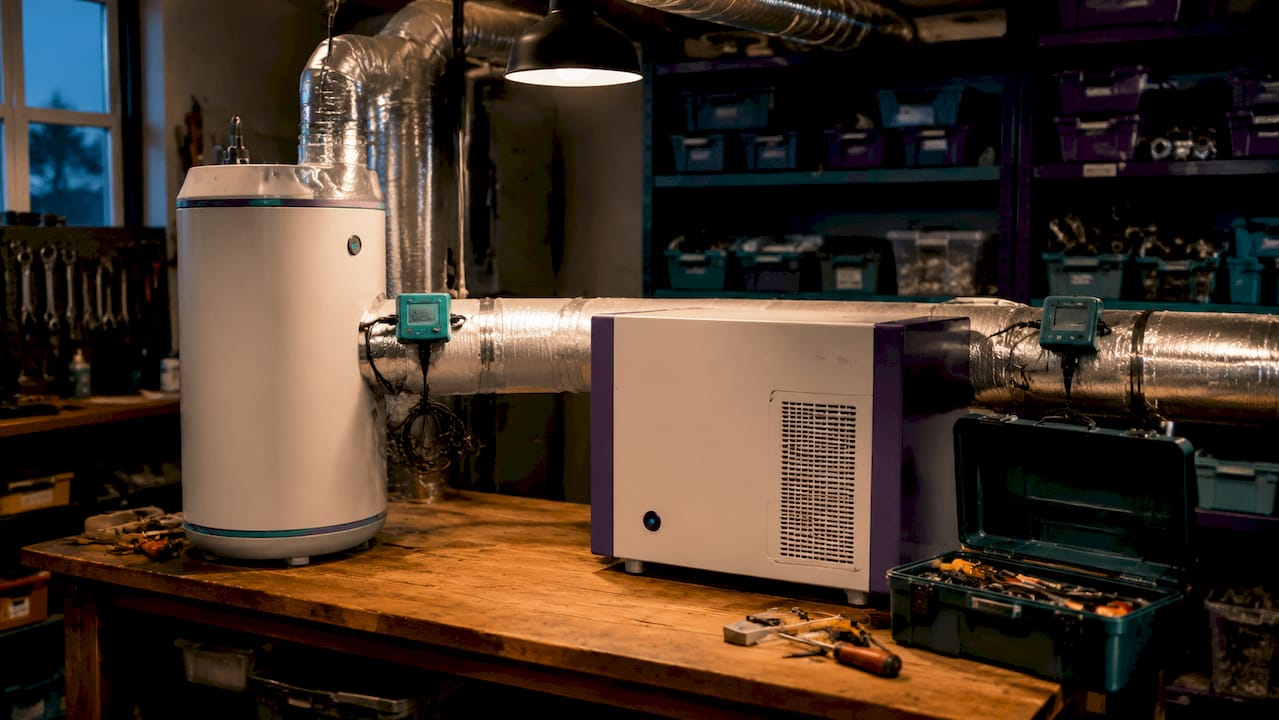
The two core operations are dehumidification and humidification. Dehumidification happens when warm, moist air passes over chilled cooling coils inside an air handling unit. The coils drop the air temperature below its dew point, causing water vapour to condense and drain away. Humidification works in reverse: steam generators or evaporative pads introduce controlled moisture into the airstream when indoor air becomes too dry.
Key components that regulate moisture
Several components work together to keep humidity within the target range:
- Humidistats and sensors: These devices measure RH continuously and signal the system to add or remove moisture. Modern units connect to building management systems for remote monitoring.
- Cooling coils: The primary dehumidification tool in most residential and commercial systems. Coil temperature determines how much moisture is removed per cycle.
- Steam humidifiers: Used in commercial settings and larger homes, these inject precise amounts of steam directly into ductwork supply plenums.
- Evaporative humidifiers: More common in residential retrofits, these pass air over a water-saturated pad to raise RH without electricity-intensive heating.
- Reheat systems: Without reheat functionality, achieving low humidity targets risks overcooling the space, wasting energy and leaving occupants cold even in summer.
Pro Tip: If your air conditioning runs for very short cycles in summer, it is likely removing very little moisture. Longer run times at moderate fan speeds are far more effective at dehumidification than short, high-intensity blasts.
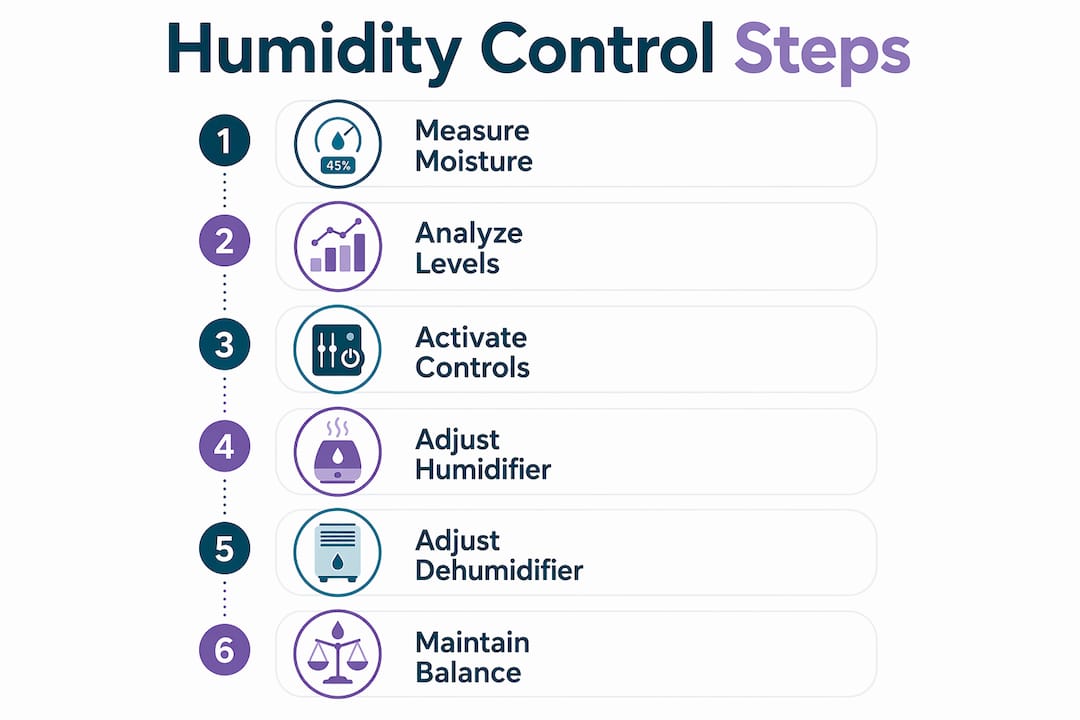
Humidity control systems integrate into existing ductwork using humidistats to trigger the correct response automatically, and proper installation typically delivers a payback period of 3 to 12 months through energy savings and reduced maintenance.
Why does humidity control matter for health and buildings?
Poor humidity management is not a minor inconvenience. 85% of building moisture problems are directly linked to inadequate humidity control, resulting in mould, wood rot, and paint failure. That statistic means the vast majority of damp-related repair bills are preventable with the right HVAC setup.
The effects split clearly into two categories depending on whether humidity is too high or too low.
When humidity is too high (above 60% RH):
- Mould and mildew colonise wall cavities, ceiling tiles, and soft furnishings within 24 to 48 hours of sustained high moisture.
- Dust mite populations increase significantly, worsening asthma and allergy symptoms for occupants.
- Timber swells, paint blisters, and plaster deteriorates, leading to costly structural repairs.
- Electronic equipment in offices and server rooms becomes vulnerable to corrosion and short circuits.
When humidity is too low (below 30% RH):
- Respiratory passages dry out, increasing susceptibility to colds and airborne viruses.
- Static electricity builds up, damaging sensitive electronics and causing discomfort.
- Timber flooring and furniture crack and warp as moisture is drawn out of the material.
- Occupants feel colder than the thermostat reading suggests, prompting unnecessary heating increases.
“Temperature and humidity must be managed together. Aggressive moisture removal can be just as harmful as excess humidity, particularly when it causes condensation on cold surfaces or creates static conditions that damage equipment.” ASHRAE
The relationship between temperature and moisture is governed by dew point physics. As air cools, its capacity to hold moisture decreases. This is why a room can feel perfectly comfortable at 21°C and 50% RH but oppressively damp at the same temperature if RH climbs to 70%. Understanding this relationship is what separates a well-designed HVAC system from one that simply moves air around.
How does humidity control reduce energy costs?
Effective humidity management directly reduces what your HVAC system spends to maintain comfort. Humidity control can cut total HVAC energy consumption by 15% to 20% by allowing higher thermostat settings in summer without any reduction in perceived comfort. That is a meaningful saving on annual energy bills for both homes and commercial premises.
The mechanism is straightforward. When indoor humidity is properly controlled, the air feels cooler at the same temperature. A well-dehumidified room at 24°C feels equivalent to a humid room at 21°C. You can raise the thermostat by two or three degrees and occupants notice no difference, but your system works considerably less hard.
| Scenario | Humidity level | Thermostat setting | Perceived comfort |
|---|---|---|---|
| Poor humidity control | 70% RH | 20°C | Clammy, uncomfortable |
| Good humidity control | 45% RH | 24°C | Cool, comfortable |
| Over-dehumidified | 20% RH | 22°C | Dry, irritating |
The table above illustrates why chasing the lowest possible humidity is counterproductive. Every 1°C reduction in target dew point increases system capital and operational costs by 8% to 12%. Precision beyond what occupants actually need simply wastes money.
Pro Tip: For commercial premises in Suffolk and Norfolk, consider a building management system that logs RH alongside temperature data. Reviewing seasonal patterns often reveals that dehumidification is running unnecessarily in spring and autumn, adding cost with no comfort benefit.
The energy efficiency gains from proper humidity regulation compound over time. Systems that do not overcool to achieve dehumidification also experience less mechanical wear, reducing servicing frequency and extending equipment lifespan.
How to choose the right humidity control solution
Selecting the correct approach depends on your building type, existing HVAC equipment, and the precision your occupants or processes require. There is no single answer that fits a Victorian terraced house in Ipswich and a commercial kitchen in Colchester equally well.
Defining humidity control objectives and tolerances alongside architectural moisture loads is the critical first step. Ignoring the building’s own moisture behaviour leads to oversized equipment that performs poorly at partial load, which is the most common operating condition in UK buildings outside of peak summer.
Options for residential properties
- Whole-house humidifiers: Fitted to the supply or return plenum of an existing forced-air system. Bypass models are low cost and low maintenance; fan-powered models offer greater output for larger homes.
- Standalone dehumidifiers: Suitable for problem areas like basements or conservatories, but they do not integrate with the main HVAC system and require manual emptying unless plumbed to a drain.
- Split system upgrades: Modern split air conditioning units from manufacturers such as Mitsubishi Electric include built-in humidity sensing and can be configured to prioritise dehumidification independently of temperature targets.
Options for commercial premises
- Dedicated outdoor air systems (DOAS): These handle ventilation and humidity control separately from the main cooling and heating plant, giving far greater precision and improving indoor air quality across large open-plan spaces.
- Desiccant dehumidifiers: Used in environments where very low humidity is required, such as food storage or pharmaceutical facilities. They remove moisture chemically rather than through cooling.
- Variable refrigerant flow (VRF) systems: Allow zone-by-zone humidity management across multi-room commercial buildings, with HVAC zoning providing granular control where occupancy patterns vary.
ASHRAE standards require uniform humidity distribution and non-wetting delivery. Systems that allow humidity to fluctuate widely or that wet surfaces during humidification cause compliance failures and material damage even when average RH readings appear acceptable. Professional assessment before installation prevents these costly design errors.
Key takeaways
Effective humidity control in HVAC requires balancing dehumidification, humidification, and system design to maintain 30% to 60% RH, delivering comfort, energy savings, and building protection simultaneously.
| Point | Details |
|---|---|
| Target RH range | Maintain indoor relative humidity between 30% and 60% to prevent mould, static, and respiratory issues. |
| Energy savings potential | Proper humidity management reduces total HVAC energy use by 15% to 20% by allowing higher thermostat settings. |
| Reheat prevents overcooling | Systems without reheat functionality risk overcooling spaces while dehumidifying, wasting energy and reducing comfort. |
| Design before installation | Architectural moisture loads must be assessed before specifying equipment to avoid oversized, inefficient systems. |
| Precision has a cost | Each degree of additional dew point precision adds 8% to 12% to system costs; target only what occupants need. |
Akita’s view on what most people get wrong about humidity
The most persistent misconception we encounter is that a standard air conditioning unit fully controls humidity. It does not. A typical split system cools air and removes some moisture as a byproduct, but it is not designed to hit a specific RH target. On mild days when the cooling load is low, the system may barely run at all, leaving humidity unchecked. This is exactly when mould risk is highest in UK buildings: cool, damp spring and autumn days when nobody thinks to switch on the air conditioning.
The second mistake is overcooling to compensate. Turning the thermostat down to force longer run times does remove more moisture, but it also makes rooms uncomfortably cold, drives up energy bills, and puts unnecessary strain on the compressor. We have seen commercial clients in Essex running systems at 18°C in September simply because nobody had explained that a dedicated dehumidification mode or a standalone unit would solve the problem at a fraction of the cost.
What actually works is designing the system around the building’s real moisture behaviour from the start. That means accounting for occupancy patterns, ventilation rates, and the building fabric itself before specifying any equipment. A well-sized system running at moderate capacity for longer periods will always outperform an oversized unit cycling on and off. The HVAC retrofitting process is the right moment to address humidity properly rather than bolting on a fix later.
The goal is a stable, comfortable environment where humidity barely registers as a concern because the system handles it quietly in the background. That is what good design delivers.
— Akita
Upgrade your humidity control with Akita

Akita installs and maintains modern air conditioning systems across Suffolk, Norfolk, and Essex, with humidity management built into every specification from the outset. Whether you need a domestic air conditioning installation that keeps your home comfortable year-round or a commercial air conditioning system with precise humidity regulation for your business premises, Akita’s team handles the full process from survey to commissioning. Every installation includes a full assessment of your building’s moisture loads, so you get a system sized correctly for your actual needs rather than a generic off-the-shelf solution. Contact Akita for a no-obligation consultation and fixed-price quote.
FAQ
What is the ideal indoor humidity level for a home?
The ideal indoor relative humidity for a home is between 30% and 60%, as defined by ASHRAE. Staying within this range prevents mould growth, dust mite proliferation, and the respiratory irritation caused by excessively dry air.
Can a standard air conditioning unit control humidity?
A standard air conditioning unit removes some moisture as a byproduct of cooling, but it is not designed to hit a specific humidity target. Dedicated humidistats, dehumidifiers, or humidity-enabled HVAC systems are needed for reliable moisture regulation.
How much energy can humidity control save?
Effective humidity management can reduce total HVAC energy consumption by 15% to 20% by allowing thermostat settings to be raised in summer without any loss of perceived comfort.
Where should humidity control equipment be installed?
Humidifiers are typically fitted to the supply or return plenum of a forced-air system, while dehumidification components are integrated into the air handling unit. Placement depends on system type, building layout, and the humidity targets required.
How often should humidity control systems be serviced?
Humidity control components, including humidistats, sensors, and humidifier pads or steam cylinders, should be inspected annually as part of a standard HVAC maintenance visit to maintain accuracy and prevent scale or microbial build-up.