

What is dehumidification: a guide for UK homes
TL;DR:
- Dehumidification removes excess indoor water vapour to prevent mould and dampness in UK homes.
- Choosing between compressor and desiccant models depends on room temperature, with compressor units more efficient above 15°C and desiccants better in colder spaces.
Dehumidification is the process of removing excess water vapour from indoor air to reduce condensation, mould growth, and general dampness. In practical terms, it means your windows stop streaming with moisture every morning, your walls dry out, and that background musty smell disappears. For most UK homes, the target to aim for is a moderate relative humidity (RH). Dropping below a low threshold risks dry, irritated airways and cracked woodwork, so more is not always better.
Consider a dehumidifier if you notice any of these:
- Persistent condensation on windows or cold walls
- A musty or earthy smell in a room
- Visible mould spots, particularly in corners or on ceilings
- Laundry that takes days to dry indoors
- Wallpaper lifting or paint bubbling near external walls
Table of Contents
- How does dehumidification work?
- Which type of dehumidifier should you choose?
- What are the real benefits of dehumidification?
- How do you measure indoor humidity?
- When should you dehumidify rather than just open a window?
- How to use a dehumidifier effectively
- When should you call a professional?
- Glossary of key terms
- Key takeaways
- The part most guides skip
- Persistent damp? Akita can assess and install the right solution
- Useful sources
How does dehumidification work?
Two physical approaches do the job, and understanding the difference saves you buying the wrong machine.
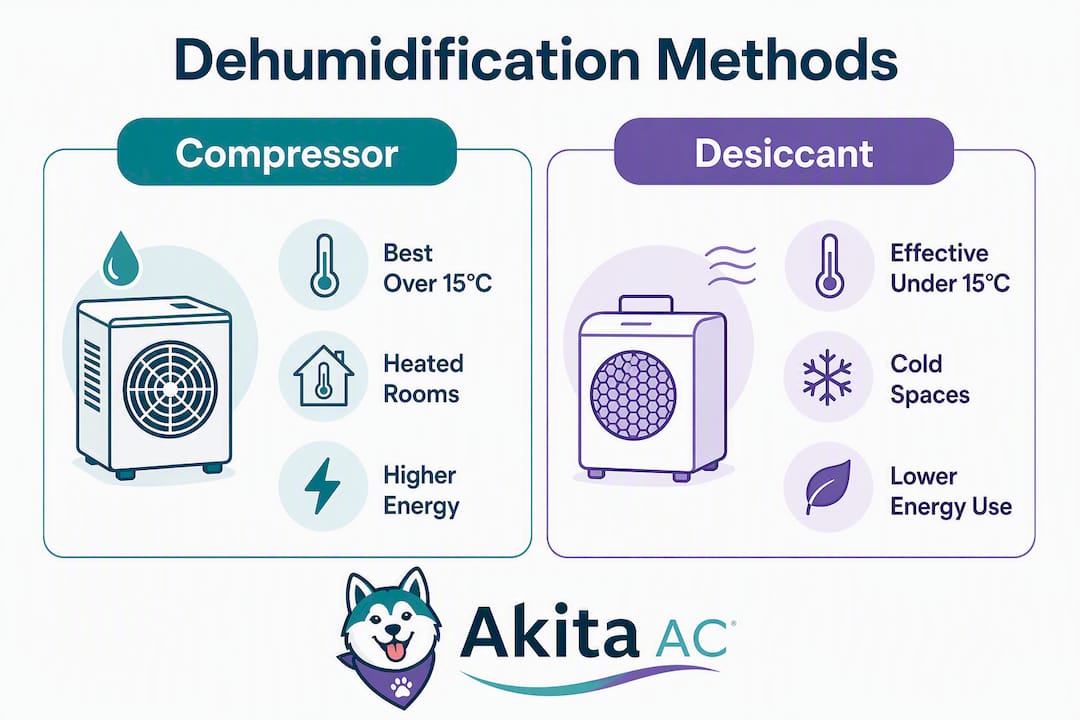
Condensation (compressor) method: The unit draws warm room air across a refrigerated coil. The coil chills the air below its dew point, water vapour condenses into liquid, and the now-drier air is reheated slightly before returning to the room. The collected water drips into a tank or drains away continuously. Think of it like a cold glass of water on a humid day: the moisture in the air condenses on the cold surface.
Sorption (desiccant) method: Instead of cooling, the unit passes air through a slowly rotating wheel coated in a moisture-absorbing material, typically silica gel or zeolite. The material captures water vapour chemically, then a separate heated airstream regenerates the wheel by driving the moisture out and exhausting it. No refrigerant, no compressor, no dew-point dependency.
The underlying physics is straightforward: warm air holds more water vapour than cold air. Cooling air or exposing it to a desiccant both reduce its capacity to hold moisture, forcing that moisture out.
“Compressor models are more energy-efficient in warmer rooms (above about 15°C); desiccant units work effectively down to around 1°C.” — UKAirQuality
Pro Tip: Use the 15°C rule as your starting point. If the room you want to treat stays above 15°C year-round (a heated bedroom or living room), a compressor unit will cost less to run. If it regularly drops below that (a garage, cellar, or unheated conservatory), a desiccant unit is the reliable choice.
Which type of dehumidifier should you choose?
The four main categories cover almost every domestic situation in the UK.
- Compressor (refrigerant) dehumidifiers: The most common type for heated living spaces. Efficient above 15°C, good extraction rates, and widely available. They enter defrost cycles in cold rooms, which wastes energy and reduces output.
- Desiccant dehumidifiers: Quieter, lighter, and effective down to around 1°C. They use more electricity per litre extracted in warm conditions but are the right tool for cold, unheated spaces.
- Thermoelectric (Peltier) dehumidifiers: Very quiet and compact, but low extraction rates (typically under 300 ml per day). Suited only to small, warm spaces such as wardrobes or caravans.
- Whole-house / HVAC-integrated systems: Ducted or inline units that treat the whole building. Often paired with mechanical ventilation with heat recovery (MVHR) or an air conditioning system. Best installed by a qualified engineer.
| Type | Best temperature | Typical use-case | Energy note |
|---|---|---|---|
| Compressor | Above 15°C | Heated bedrooms, living rooms, laundry rooms | Most efficient in warm conditions |
| Desiccant | Down to ~1°C | Garages, cellars, conservatories, loft spaces | Higher running cost in warm rooms |
| Thermoelectric | Above 15°C | Wardrobes, small enclosed spaces | Very low extraction; not for whole rooms |
| Whole-house / HVAC | Any (system-dependent) | New builds, large homes, commercial premises | Highest upfront cost; lowest per-room running cost |
Pro Tip: A compressor unit left running in a cold garage will spend much of its time defrosting rather than extracting moisture. That is not a fault — it is the wrong machine for the job. Swap to a desiccant unit and the problem disappears.

What are the real benefits of dehumidification?
The headline benefits are mould prevention, reduced allergy triggers, protection of furnishings, and a modest improvement in heating efficiency.
Indoor air quality experts recommend keeping RH at 50–55% to inhibit both dust mite populations and mould spore germination. Dust mites thrive above 60% RH; mould colonies establish themselves on surfaces where RH at the wall surface exceeds 70–80%. Keeping the room air drier keeps both in check.
Approximately one in four UK homes has a damp problem, driven by the climate, older housing stock, and everyday moisture from cooking, bathing, and breathing.
Beyond health, the practical gains are real:
- Condensation on windows and cold walls reduces significantly
- Indoor laundry dries faster, cutting the time clothes hang in living spaces
- Wooden floors, furniture, and books are less prone to warping, swelling, or mildew
- Musty odours disappear once RH drops to a healthy range
On energy, drier air requires less energy to heat than damp air, so a dehumidifier can offset some of its own running costs in a persistently damp home. That said, a dehumidifier does not replace proper insulation or fix a cold bridge. It manages airborne moisture; it does not add heat or repair the building fabric.
How do you measure indoor humidity?
A hygrometer is the tool you need. Digital hygrometers cost as little as £8–£15 from most hardware retailers and give an instant RH reading. Place one in each problem room, away from windows and exterior walls, at roughly head height.
| RH range | What it means for your home |
|---|---|
| Below 45% | Too dry — risk of dry skin, irritated airways, cracking wood |
| 50–55% | Comfortable and healthy for most people; ideal target for UK homes |
| 56–59% | Elevated — monitor closely, especially in winter |
| Above 60% | High risk of condensation, mould, and dust mite activity |
A few practical checks:
- Morning window test: Condensation on single-glazed or older double-glazed windows on a cold morning is a reliable sign that overnight RH is too high.
- Seasonal expectations: UK winters push indoor RH up naturally as cold air infiltrates and residents seal up the house. Check readings in October and again in February.
- Set your dehumidifier’s humidistat to 50–55% RH and let it cycle on and off automatically rather than running continuously.
Pro Tip: Take readings at different times of day. RH peaks overnight and after cooking or showering. A single midday reading can look fine while the overnight average is well above 60%.
When should you dehumidify rather than just open a window?
Ventilation is the right first step when outdoor air is drier than indoor air — typically on a dry summer day. Open windows, run extractor fans, and let fresh air do the work. Dehumidification becomes the reliable solution during damp UK winters, when outside air is often just as humid as inside. Opening a window in January rarely helps; it may make things worse.
A simple decision guide:
- Ventilate when it is dry outside and the problem is stuffy, stale air.
- Heat when condensation appears on cold surfaces because the room is simply too cold relative to the dew point of the air.
- Dehumidify when RH stays above 55% despite adequate heating and ventilation, or when the space cannot be ventilated easily (a cellar, a laundry room, a sealed conservatory).
- Call a professional when moisture is coming through the structure, not just from the air.
A dehumidifier treats the symptom of excess airborne moisture. If water is entering through the walls, floor, or roof, the source must be fixed first — a dehumidifier running in a room with penetrating damp is fighting a losing battle.
Watch for these structural red flags, where a dehumidifier alone will not solve the problem:
- Tide marks or staining on lower walls (rising damp)
- Damp patches that appear after heavy rain on external walls (penetrating damp)
- Efflorescence (white salt deposits) on brickwork or plaster
- Persistent mould that returns within weeks of cleaning, despite correct RH
Understanding how moisture enters home walls helps you distinguish between a ventilation or dehumidification fix and a structural one.
How to use a dehumidifier effectively
Placement and sizing:
- Position the unit centrally in the room, away from walls and furniture, so air can circulate freely around it.
- Match the unit’s rated extraction capacity (litres per day) to the room size. A 10–12 litre/day unit suits most UK bedrooms and living rooms; a 20+ litre/day unit is better for a large open-plan space or a damp cellar.
- Keep internal doors closed so the unit treats one defined space rather than the whole house.
Drain options:
- Tank emptying: Most portable units have a 2–4 litre tank. Empty it daily in damp conditions — a full tank triggers an automatic shutoff.
- Continuous drain: Many units have a small hose outlet. Route this to a drain or sink for hands-free operation, especially useful in cellars or utility rooms.
Maintenance checklist:
- Clean or rinse the air filter every two to four weeks. A clogged filter reduces airflow and extraction rate.
- Wipe the water tank with a mild disinfectant solution monthly to prevent bacterial or mould growth inside the unit.
- If a compressor unit enters frequent defrost cycles, check the room temperature. Below 15°C, consider switching to a desiccant model.
- Store the unit upright; laying a compressor unit on its side can damage the refrigerant circuit.
Energy habits: Set the humidistat to 50–55% RH so the unit cycles off when the target is reached. Running it continuously at maximum extraction wastes electricity and can over-dry the room. Combining dehumidification with efficient HVAC operation keeps running costs manageable.
Pro Tip: In winter, run the dehumidifier during the day when the heating is on. Warm air holds more moisture, so the unit extracts more per hour and uses its energy more productively than in a cold, unheated room overnight.
When should you call a professional?
Some moisture problems go beyond what a portable dehumidifier can manage. Contact an HVAC specialist or damp surveyor if you see:
- Mould that returns within a few weeks of cleaning, despite maintaining correct RH
- Visible water penetration through walls, floors, or around window frames
- Wallpaper or plaster bubbling away from the wall surface
- Recurring condensation on internal walls (not just windows) despite adequate heating
- A property where multiple rooms show high RH simultaneously, suggesting a systemic ventilation failure
A professional assessment will examine the building fabric, check ventilation rates, review the heating balance, and identify whether a whole-house solution such as MVHR or an HVAC-integrated dehumidifier is appropriate. CIBSE technical guidance covers the engineering principles behind both condensing and desiccant systems for those who want the technical detail.
Landlords in England have a legal duty under the Homes (Fitness for Human Habitation) Act 2018 to address serious damp and mould. If you are a tenant experiencing persistent mould, report it in writing to your landlord and keep records.
For serious water damage or post-flood remediation, hiring a dehumidifier is a practical short-term measure while structural repairs are arranged. Rental units with high extraction rates are available from specialist providers.
Glossary of key terms
- Relative humidity (RH): The percentage of water vapour in the air relative to the maximum it could hold at that temperature. 100% RH means the air is fully saturated.
- Dew point: The temperature at which air becomes saturated and water vapour begins to condense into liquid. When a surface is colder than the dew point of the surrounding air, condensation forms on it.
- Condensate: The liquid water collected by a dehumidifier after moisture has been removed from the air.
- Desiccant: A moisture-absorbing material (commonly silica gel or zeolite) used in desiccant dehumidifiers to capture water vapour without refrigeration.
- Compressor: The component in a refrigerant dehumidifier that pressurises the refrigerant, enabling the cooling coil to chill incoming air below its dew point.
- Hygrometer: An instrument that measures relative humidity. Digital hygrometers are inexpensive and accurate enough for domestic use.
- Defrost cycle: A process in compressor dehumidifiers where the unit temporarily heats its coil to melt ice that has formed when operating in cold conditions. Frequent defrost cycles in a cold room indicate the wrong machine type.
- Latent heat: The energy absorbed or released when water changes state (liquid to vapour or back). Dehumidifiers release latent heat back into the room as they condense moisture, providing a small warming effect.
- MVHR (Mechanical Ventilation with Heat Recovery): A whole-house ventilation system that extracts stale, moist air and supplies fresh air while recovering most of the heat from the outgoing air.
- Penetrating damp: Moisture entering a building through defects in the external fabric (cracks, failed pointing, damaged roofing). A dehumidifier does not fix this.
Key takeaways
Dehumidification works by removing water vapour from indoor air, and choosing the right method — compressor above 15°C, desiccant below — is the single most important decision for UK homeowners.
| Point | Details |
|---|---|
| Target RH for UK homes | Aim for 50–55% RH; below this risks over-drying, above 60% risks mould and dust mites. |
| Compressor vs desiccant | Use a compressor unit above 15°C for efficiency; switch to desiccant for cold garages, cellars, or conservatories. |
| Dehumidify vs ventilate | Ventilate when outdoor air is dry; dehumidify in damp UK winters when outside air is equally humid. |
| Structural damp is different | A dehumidifier treats airborne moisture only; penetrating or rising damp requires fabric repairs, not just a machine. |
| Akita for whole-house solutions | For persistent damp, HVAC integration, or whole-house humidity control, Akita provides professional assessment and installation across Suffolk, Norfolk, and Essex. |
The part most guides skip
Most dehumidifier articles treat the purchase decision as the hard part. In practice, the harder question is whether a dehumidifier is the right tool at all.
The UK housing stock is old, draughty in some places and over-sealed in others, and the climate keeps RH elevated for months at a time. A portable dehumidifier handles the symptom well when the moisture source is internal — cooking, bathing, breathing, drying laundry. But a significant proportion of damp complaints in older UK properties come from the fabric: cold bridges, failed cavity wall insulation, inadequate subfloor ventilation, or simply a house that has been sealed up so tightly that moisture has nowhere to go.
Running a dehumidifier in that situation is not wrong, but it is incomplete. The machine will work harder, cost more to run, and the problem will return the moment you switch it off. The honest advice is to measure first (a hygrometer costs less than a takeaway), identify where the moisture is coming from, and then decide whether a portable unit, improved ventilation, or a professional assessment is the right next step. Pairing a dehumidifier with better indoor air quality management and, where needed, structural repairs is what actually resolves the problem long-term.
Persistent damp? Akita can assess and install the right solution
When a portable dehumidifier is not enough, the next step is a system that treats the whole building rather than one room at a time. Whole-house humidity control, integrated with your heating and ventilation, removes moisture at source and maintains consistent RH without daily tank-emptying or guessing which room to treat next.

Akita installs and maintains air conditioning and climate control systems across Suffolk, Norfolk, and Essex, including solutions that combine humidity control with efficient heating and cooling. If you are dealing with persistent condensation, recurring mould, or a property where multiple rooms stay damp despite your best efforts, an on-site assessment is the fastest way to get a clear answer. Book a domestic installation assessment or get a fixed-price installation quote directly from Akita.
Useful sources
- Module 261: Condensing and desiccant dehumidifiers — CIBSE Journal: Engineering-level overview of both dehumidification techniques, typical applications, and integration considerations.
- Desiccant vs Compressor Dehumidifier UK — UKAirQuality: Practical UK-focused comparison of the two main types, including the 15°C decision threshold.
- Do I Need a Dehumidifier? A Practical UK Guide — UKAirQuality: Consumer guidance on when a dehumidifier is the right solution and RH targets for UK homes.
- What does a dehumidifier do? — NRLA: Landlord-focused guidance on dehumidification, ventilation, and tenant health obligations.