

Energy-efficient cooling guide for UK homes
TL;DR:
- Sealing air leaks and improving insulation provide the highest savings before installing cooling systems, saving up to 40%. Passive cooling methods like strategic window opening, shading, and fans effectively reduce indoor temperatures without energy-intensive devices. Upgrading to modern, energy-efficient cooling units and optimizing thermostat settings further enhances comfort and reduces costs during the UK summer months.
An energy-efficient cooling guide gives homeowners and renters a clear method to cut energy bills while keeping indoor temperatures comfortable throughout summer. The most effective approach follows a strict hierarchy: seal air leaks first, apply passive cooling second, and optimise mechanical systems last. Skipping straight to air conditioning without addressing insulation or ventilation is the single most common and costly mistake UK households make. Applied correctly, this layered strategy delivers 20 to 40% savings on cooling energy, with some homes achieving reductions of up to 90% through combined improvements.
How to find and fix air leaks for energy-efficient cooling
Air sealing and insulation are the foundation of any energy-efficient HVAC strategy. No cooling system, however modern, can compensate for a home that leaks conditioned air through gaps around windows, doors, loft hatches, and pipework penetrations. Fixing these leaks reduces the volume of hot air entering your home and the cool air escaping it, which directly lowers how hard your cooling system must work.
The most common leak locations in UK homes include:
- Gaps around skirting boards and floorboards
- Poorly sealed window frames and door surrounds
- Loft hatch edges and recessed light fittings
- Pipework and cable entry points through walls and ceilings
- Letterboxes and extractor fan surrounds
You can check for leaks yourself using a lit incense stick or a damp hand on a breezy day. Hold it near suspected gaps and watch for movement or feel for a draught. For a more precise assessment, a thermal imaging camera reveals temperature differentials invisible to the naked eye. Many energy assessors in Suffolk, Norfolk, and Essex offer this service as part of a home survey.
Pro Tip: Draught-proofing strips for doors and windows cost under £20 per room and typically pay back within a single summer through reduced cooling costs.

Once leaks are sealed, insulation becomes the next priority. Loft insulation is the highest-impact upgrade for most UK homes because heat rises and a poorly insulated roof allows significant solar gain. Cavity wall insulation and solid wall insulation both reduce the rate at which outdoor heat transfers indoors. The energy savings from sealing and insulating are immediate and apply regardless of which cooling system you use, making them the most cost-effective first step.
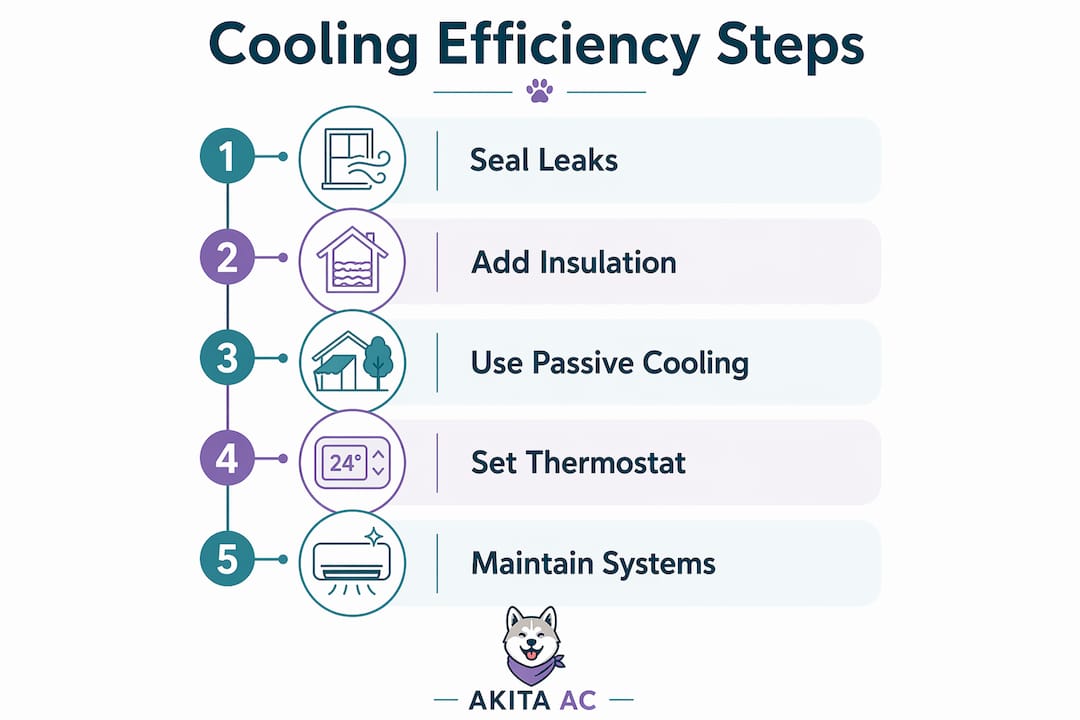
What are the best passive cooling methods for your home?
Passive cooling uses natural airflow, shading, and fans to reduce indoor temperatures without relying on mechanical refrigeration. Done well, it can make a home genuinely comfortable on all but the hottest days, and it costs almost nothing to run.
Follow these steps to get the most from passive cooling:
- Open windows strategically. Open windows on opposite sides of the house in the early morning and late evening when outdoor air is cooler than indoor air. Close them during the hottest part of the day, typically between 11 a.m. and 4 p.m., to trap the cooler air inside.
- Use cross-ventilation. Position a fan in a lower window on the shaded side of the house to draw cool air in, and open a window on the opposite side to let warm air escape upward and out.
- Set ceiling fans correctly. Ceiling fans should rotate counter-clockwise in summer to push air directly downward. This creates a wind-chill effect on skin, making a room feel several degrees cooler without actually lowering the air temperature.
- Block direct sunlight. Close blinds, shutters, or curtains on south and west-facing windows before the sun reaches them. Reflective window film reduces solar heat gain by up to 70% on single-glazed windows.
- Consider a whole-house fan. These units pull air through the house and exhaust it into the loft. Whole-house fans use 10 to 15 times less electricity than a standard air conditioner for comparable cooling when outdoor temperatures are low enough, making them a strong option for night cooling in the UK climate.
One critical point most guides overlook: fans cool people, not rooms. The wind-chill effect only works when air moves over skin. Running a ceiling fan in an empty room wastes electricity without any cooling benefit. Turn fans off when you leave the room.
Pro Tip: Fitting external roller shutters or external awnings on south-facing windows blocks heat before it enters the glass, which is far more effective than internal blinds that absorb and re-radiate heat into the room.
How should you set your thermostat to save energy?
Thermostat settings are one of the simplest and most impactful levers in any cost-effective cooling method. The recommended setting when you are at home is 25.5°C, rising to 29.5°C when the property is unoccupied. Each degree you raise the thermostat above 22°C saves approximately 3% on cooling energy. That adds up quickly over a summer.
Smart thermostats take this further by learning your daily routine and adjusting temperatures automatically. Devices such as the Nest Learning Thermostat or Hive Active Heating adapt to your schedule, pre-cool the home before you arrive, and avoid running the system when no one is present. Smart thermostats save 10 to 23% on cooling energy compared to manually controlled systems. That saving compounds when combined with the insulation and passive cooling improvements covered earlier.
Timing matters beyond just temperature settings. Peak energy demand runs from 4 p.m. to 9 p.m., and running your air conditioning at full capacity during this window costs more per unit of electricity on time-of-use tariffs. Pre-cooling your home to a comfortable temperature before 4 p.m. and then raising the thermostat slightly during peak hours reduces both your bill and the strain on the regional grid.
Practical habits that reinforce smart thermostat settings:
- Never set the thermostat lower than your target temperature to cool faster. Air conditioners work at a fixed rate regardless of the set point.
- Use the fan-only mode on your AC unit during mild evenings rather than running full refrigeration.
- Pair thermostat automation with optimised AC settings to avoid the system fighting against open windows or internal heat sources.
Which cooling systems offer the best energy efficiency?
Modern cooling systems use 30 to 50% less energy than units that are 10 to 15 years old. If your air conditioning unit predates 2012, replacing it is likely to pay back within three to five years through energy savings alone. The question is which system suits your home and climate.
| System type | Best suited for | Efficiency advantage | Key limitation |
|---|---|---|---|
| Inverter split system | Most UK homes | Variable-speed compressor reduces energy waste | Upfront installation cost |
| Mini-split multi-zone | Larger homes, room-by-room control | No ductwork losses; high seasonal efficiency | Higher equipment cost |
| Evaporative cooler | Arid, low-humidity climates | Uses 75% less electricity than traditional AC | Ineffective above 50 to 60% humidity |
| Air source heat pump | Year-round heating and cooling | Delivers 3 units of heat per unit of electricity | Performance drops in very cold weather |
| Geothermal heat pump | Homes with suitable land | Extremely low running costs | Very high installation cost |
For most UK homeowners, a modern inverter-driven split system or a multi-zone mini-split represents the best balance of efficiency, comfort, and cost. These systems carry ENERGY STAR or SEER2 ratings that indicate seasonal efficiency. Look for a Seasonal Energy Efficiency Ratio (SEER) of 16 or above when comparing units. Explore energy-efficient HVAC alternatives if you want a detailed breakdown of newer technologies including variable refrigerant flow systems.
Pro Tip: Always size your cooling system correctly for the room. An oversized unit short-cycles, switching on and off repeatedly without completing a full dehumidification cycle, leaving the air feeling clammy even when it is cool.
Regular maintenance keeps any system running at its rated efficiency. Cleaning filters and clearing debris around outdoor units prevents the performance degradation that silently inflates your energy bills. For a full list of upgrade options, the must-have AC upgrades guide covers both hardware and maintenance priorities.
What mistakes reduce cooling efficiency the most?
The most damaging errors in home cooling are not dramatic failures. They are small, repeated habits that compound over an entire summer.
- Using AC as the first response to heat. Treating AC as a last resort after passive methods have been tried maximises savings and reduces wear on equipment. Most UK summer days can be managed with fans and ventilation alone.
- Running fans in empty rooms. Fans consume between 15 and 75 watts continuously. Running them in unoccupied rooms adds to your bill without cooling anyone.
- Ignoring internal heat sources. Incandescent and halogen bulbs generate significant heat. Switching to LED bulbs reduces both electricity consumption and the heat load your cooling system must overcome.
- Neglecting filter maintenance. A clogged filter forces the system to work harder, reducing airflow and efficiency. Filters should be checked monthly during heavy use periods.
- Running appliances during peak hours. Ovens, tumble dryers, and dishwashers all add heat and draw electricity during the 4 p.m. to 9 p.m. peak window. Limiting appliance use during this period reduces both your bill and the indoor heat load.
- Setting the thermostat too low. Dropping the thermostat to 18°C does not cool the room faster. It simply runs the system longer and wastes energy.
Key takeaways
Effective home cooling starts with sealing air leaks and improving insulation before any mechanical system is considered, because structural improvements deliver the highest savings per pound spent.
| Point | Details |
|---|---|
| Seal before you cool | Air sealing and insulation deliver 20 to 40% savings regardless of which cooling system you use. |
| Fans cool people, not rooms | Turn ceiling fans off when leaving a room to avoid wasting electricity with no benefit. |
| Smart thermostat settings | Setting 25.5°C when home and 29.5°C when away, combined with a smart thermostat, saves 10 to 23% on cooling. |
| Upgrade ageing systems | Cooling units over 10 to 15 years old use 30 to 50% more energy than modern equivalents. |
| Avoid peak hours | Shifting cooling activity away from 4 p.m. to 9 p.m. reduces costs on time-of-use tariffs. |
What Akita has learned from fitting cooling systems across East Anglia
After working with homeowners across Suffolk, Norfolk, and Essex, the pattern Akita sees most often is this: people invest in a new air conditioning unit and then wonder why their bills have not dropped as much as expected. Almost always, the answer is that the building envelope was never addressed. The system is working correctly. The house is simply leaking the cool air straight back out.
The homes that achieve the biggest reductions in running costs are not necessarily the ones with the most expensive equipment. They are the ones where the owner took the time to draught-proof, check loft insulation, and fit decent window coverings before the new system was even switched on. A well-sealed semi-detached house in Ipswich with a mid-range inverter split system will outperform a draughty detached property with a premium unit every time.
The other thing worth saying plainly: the UK climate does not demand the same cooling intensity as southern Europe or the United States. For many homes here, a combination of good insulation, ceiling fans, and a single well-sized split system is genuinely sufficient. The goal is not to replicate a hotel lobby. It is to stay comfortable on the 15 to 20 days per year when temperatures make that difficult without some mechanical help. Start small, measure the difference, and add capacity only if you need it.
— Akita
Ready to upgrade your home cooling with Akita?
If you have worked through the insulation and passive cooling steps and you are ready to add a modern, energy-efficient system, Akita installs and maintains air conditioning across Suffolk, Essex, and Norfolk.
Akita specialises in domestic air conditioning installation for homes of all sizes, from single-room split systems to whole-home multi-zone setups. Every installation is sized correctly for the space, fitted by qualified engineers, and backed by warranty and ongoing maintenance options. Transparent fixed pricing and flexible finance mean there are no surprises. If you want a professional assessment of what your home actually needs before committing to any equipment, Akita is the right starting point.
FAQ
How much can I save with energy-efficient cooling?
Air sealing and insulation alone deliver 20 to 40% savings on cooling energy, with some homes achieving up to 90% through combined improvements. Adding a smart thermostat saves a further 10 to 23%.
What temperature should I set my thermostat in summer?
Set your thermostat to 25.5°C when you are at home and raise it to 29.5°C when the property is empty. Each degree above 22°C saves approximately 3% on cooling costs.
Do ceiling fans actually cool a room?
Ceiling fans cool people through the wind-chill effect, not the room itself. They must rotate counter-clockwise in summer to push air downward, and should be switched off when the room is unoccupied.
When is it worth replacing an old air conditioning unit?
If your unit is more than 10 to 15 years old, modern systems use 30 to 50% less energy for the same output. Replacement typically pays back within three to five years through reduced running costs.
Are evaporative coolers a good option in the UK?
Evaporative coolers use 75% less electricity than traditional air conditioning but become ineffective when outdoor humidity exceeds 50 to 60%. Given the UK’s often humid summers, they are best suited to drier inland areas and are not a reliable primary cooling solution for most British homes.