

Why transparent pricing in HVAC matters for you
TL;DR:
- Transparent pricing in HVAC builds customer trust before any service begins by providing clear, upfront costs. It reduces decision anxiety, shortens sales cycles, and decreases disputes by itemizing scope, costs, and options. Embracing openness attracts better-qualified leads, enhances customer loyalty, and improves operational efficiency for contractors.
Transparent pricing in HVAC services is the single most effective way to build trust before a contractor ever sets foot in your home or business. In an industry historically defined by in-home quotes and vague estimates, the shift towards clear, upfront cost disclosure is reshaping how homeowners and business decision-makers choose their providers. HVAC contractors adopting upfront pricing report that customers now assume companies hiding prices are either outdated or untrustworthy. The standard industry term for this practice is “price transparency,” and understanding why it matters gives you a measurable advantage when comparing HVAC services and budgeting accurately.
Why transparent pricing in HVAC matters for buyer psychology
The way a price is presented changes the decision you make, not just the number itself. Research on the EU Omnibus Pricing Directive confirms that displaying regulated reference prices reduces impulsive purchase intentions by making buyers more informed and less susceptible to misleading price anchors. In practical terms, this means a homeowner shown a clear, itemised HVAC quote is far less likely to be swayed by an inflated “original price” designed to make a discount look attractive.
HVAC bids have long relied on vague scope descriptions that leave room for price escalation after the work begins. This ambiguity creates a psychological state of suspicion rather than confidence. Harvard Business School research shows that pricing clarity triggers psychological safety, increasing a buyer’s willingness to commit and spend. When you know exactly what you are paying for, the decision shifts from anxiety to confidence.
The framing effect is particularly powerful in HVAC, where costs can range from a few hundred pounds for a service visit to tens of thousands for a full commercial installation. Without clear pricing, buyers default to worst-case assumptions. Transparent pricing removes that cognitive friction and replaces it with a straightforward comparison.
- Clear pricing removes the psychological pull of inflated anchor prices common in vague HVAC bids.
- Buyers shown authentic reference prices make more considered, less impulsive decisions.
- Psychological safety from price clarity increases purchase confidence and speeds up commitment.
Pro Tip: When reviewing any HVAC quote, ask for a line-by-line breakdown covering equipment, installation labour, warranties, and any call-out fees. If a contractor cannot provide this, treat it as a warning sign.
What are the operational benefits of transparent HVAC pricing?
Price transparency is not only good for buyers. It delivers measurable operational improvements for contractors and their customers alike. Hidden fees damage brand trust, generate negative reviews, increase support call volumes, and reduce customer retention. Industries that have moved to transparent pricing models consistently report better satisfaction scores and fewer post-service disputes.

For HVAC contractors, the commercial case is equally strong. Businesses report up to 40% higher conversion rates and shorter sales cycles when they publish pricing openly. That figure reflects a fundamental shift: when customers can self-select based on clear price boundaries, the leads who do make contact are already pre-qualified and serious. This reduces the time spent on site visits that never convert.
Transparent pricing also shifts negotiation to the pre-sale phase, specifying scope and cost before any labour begins. This single change reduces the most common source of contractor-customer disputes: unexpected charges after the job is done.
| Outcome | Impact of transparent pricing |
|---|---|
| Lead quality | Pre-qualifies customers, reducing wasted site visits |
| Conversion rate | Up to 40% higher when pricing is published openly |
| Dispute frequency | Reduced by fixing scope and cost before work starts |
| Customer retention | Improved through trust built at first contact |
| Support call volume | Lower, as pricing questions are answered upfront |
Pro Tip: If you are a business decision-maker procuring HVAC services, request a written scope-of-work document alongside any quote. This protects you from scope creep and gives you a clear basis for comparison across providers.
Opaque pricing vs transparent pricing: what is the real difference?
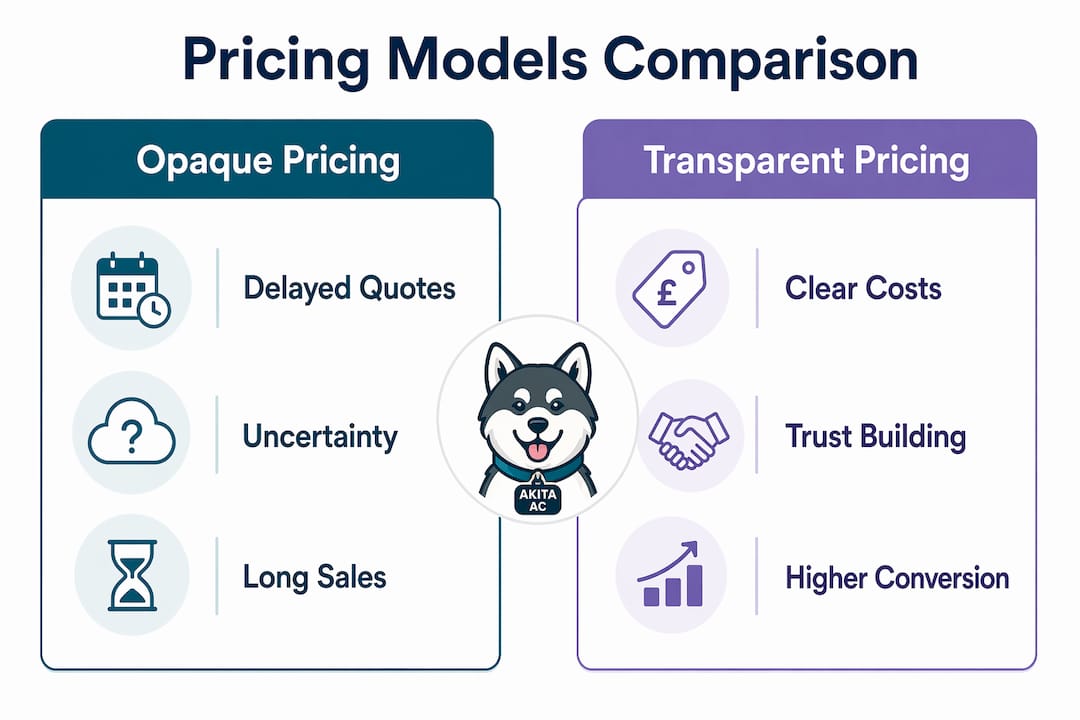
The traditional HVAC pricing model defers detailed quotes until after an in-home visit, allowing scope and pricing to be negotiated late in the process. This approach was standard practice for decades, partly because HVAC installations genuinely vary by property. However, the model has a significant flaw: it creates an information imbalance that consistently favours the contractor over the customer.
Opaque pricing fuels suspicion, extends sales cycles, and loses business to competitors who are willing to be upfront. A customer who cannot find a price online will often move on before making contact. Younger homeowners especially expect online access to pricing and quickly dismiss companies that do not provide it. This is not a preference. It is a baseline expectation shaped by years of digital consumer behaviour across every other service category.
Transparent pricing, by contrast, creates immediacy. A customer who sees a clear price range or a fixed-price package online can make a decision in minutes rather than days. This empowers the buyer and differentiates the contractor from competitors still relying on opaque in-home quote processes.
| Pricing model | Customer experience | Business outcome |
|---|---|---|
| Opaque, quote-on-visit | Uncertainty, delays, suspicion | Longer sales cycles, higher dispute rates |
| Transparent, upfront | Confidence, speed, informed choice | Better leads, faster conversions, fewer complaints |
The shift is not about discounting or racing to the lowest price. Transparency functions as a pre-qualification tool, attracting customers who are ready to buy at a fair price and filtering out those who are simply shopping for the cheapest option regardless of quality.
How to use transparent pricing to choose and budget for HVAC services
Transparent pricing gives you a practical framework for making smarter HVAC decisions, whether you are a homeowner replacing a domestic unit or a facilities manager procuring a multi-site commercial installation. The key is knowing what to look for and what questions to ask before you commit.
Start by seeking out providers who display pricing online with clear package structures. Offering good, better, and best tiers is a recognised best practice because it lets you compare features and value rather than just headline cost. A provider showing three clearly defined packages is giving you genuine choice. A provider showing only a “call for a quote” button is asking you to invest time before they reveal anything.
Understanding what each price component covers is equally important. A well-structured HVAC quote should itemise equipment costs, installation labour, warranty terms, and any ongoing service or maintenance fees. Reviewing how HVAC choices affect your energy bills alongside upfront pricing gives you a complete picture of total cost of ownership, not just the day-one spend.
- Look for providers displaying fixed or banded pricing online before you make contact.
- Check that quotes separate equipment, labour, warranty, and ongoing service costs.
- Use tiered package options to compare value across specification levels, not just price.
- Ask about add-on pricing and change management processes to avoid surprises mid-project.
- Review questions to ask HVAC installers before signing any agreement to confirm scope is fully defined.
Clear communication of scope boundaries and add-on pricing protects both parties. Reputable contractors build contingency buffers into transparent pricing structures so that genuine surprises are covered without renegotiating the entire contract. This is the mark of a professional operation.
Key takeaways
Transparent HVAC pricing builds trust, pre-qualifies buyers, and delivers measurably better outcomes for both customers and contractors.
| Point | Details |
|---|---|
| Trust is built before contact | Customers who see clear pricing online arrive pre-qualified and ready to commit. |
| Psychology favours clarity | Transparent pricing removes anxiety and replaces it with purchase confidence. |
| Opaque pricing costs business | Hidden fees generate disputes, negative reviews, and lost leads to transparent competitors. |
| Tiered packages improve decisions | Good, better, best structures let buyers compare value rather than just headline cost. |
| Scope clarity protects both parties | Itemised quotes with defined add-on processes prevent disputes and protect contractor margins. |
Why price transparency changed how we think about HVAC sales
From where Akita stands, the conversation about price transparency in HVAC is not really about pricing at all. It is about respect. For too long, the industry treated the quote process as a negotiation tactic rather than a service. Customers were asked to invest time in a site visit before they had any idea whether the cost was within their budget. That model served contractors, not customers.
What we have seen shift is the expectation that a professional service should behave like any other considered purchase. You would not buy a car without knowing the price range. You would not book a hotel without seeing the rate. HVAC should be no different. The contractors who recognised this early are now reaping the rewards in shorter sales cycles, better reviews, and customers who return because the experience was straightforward from the start.
The deeper point is that transparency is not a vulnerability. Some contractors worry that publishing prices invites competitors to undercut them or gives customers ammunition to negotiate. The evidence points the opposite direction. Customers who find your pricing online and still make contact are not looking for a discount. They are looking for confirmation that you are the right choice. That is a far stronger starting position than a cold enquiry from someone who has no idea what to expect.
The energy efficiency benefits of modern HVAC systems are compelling on their own. Pairing them with a buying experience built on clear, honest pricing makes the decision genuinely easy. That is the standard Akita holds itself to, and it is the standard every customer deserves.
— Akita
See Akita’s fixed-price HVAC installations for yourself
Akita provides fixed-price air conditioning installation for both homes and businesses across Suffolk, Norfolk, and Essex, with detailed upfront quotes so you know exactly what you are committing to before any work begins.
Whether you are looking for domestic air conditioning installation or a full commercial HVAC solution, Akita’s pricing is clear, itemised, and available before you pick up the phone. No hidden fees, no post-visit surprises. Just straightforward pricing that lets you plan your budget with confidence. Get in touch with Akita today to receive your fixed-price quote.
FAQ
What does transparent pricing mean in HVAC?
Transparent pricing in HVAC means all costs, including equipment, installation labour, warranties, and service fees, are disclosed clearly before any work begins. It removes the traditional reliance on post-visit negotiation and gives customers a complete picture upfront.
Why do HVAC companies hide their prices?
Many HVAC companies defer pricing until after an in-home visit because installation costs genuinely vary by property size and specification. However, this approach creates an information imbalance that erodes trust and extends the sales cycle unnecessarily.
Does transparent pricing mean the cheapest price?
Transparent pricing is not about being the lowest cost provider. It functions as a pre-qualification tool, attracting customers who are ready to buy at a fair price and filtering out those focused solely on cost rather than quality or value.
How can I tell if an HVAC quote is genuinely transparent?
A genuinely transparent HVAC quote itemises equipment, labour, warranty terms, and any add-on or call-out fees separately. If a quote presents only a single total figure without a breakdown, ask for a line-by-line version before signing.
Does publishing prices online hurt HVAC contractors?
The evidence suggests the opposite. Businesses that publish pricing online report up to 40% higher conversion rates and shorter sales cycles, because the customers who make contact are already pre-qualified and serious about proceeding.