

What is ducted air conditioning? A clear guide
TL;DR:
- Ducted air conditioning provides centralized, discreet climate control for large homes and commercial spaces by using concealed ductwork. It offers energy-efficient, multi-zone cooling and heating, significantly reducing visible equipment and enhancing interior aesthetics. Proper installation, regular maintenance, and zoning optimize comfort, efficiency, and overall property value.
If you’ve ever walked into a building with perfectly even temperatures in every room and no visible wall units anywhere, you’ve experienced ducted air conditioning at work. Understanding what is ducted air conditioning matters if you’re managing a large home, running a commercial premises, or simply tired of cooling one room while the rest of the building swelters. This guide covers the core components, how the system operates, the real benefits, what installation involves in the UK, and how ducted compares to the alternatives, so you can make a genuinely informed decision.
Table of Contents
- Key takeaways
- How ducted air conditioning works
- Benefits of ducted air conditioning
- Installation: what to expect
- Ducted vs split system air conditioning
- Getting the most from your ducted system
- My honest take on ducted AC in the UK
- Ready to install ducted air conditioning?
- FAQ
Key takeaways
| Point | Details |
|---|---|
| Centralised airflow system | A single indoor unit distributes conditioned air through concealed ducts to every room in the property. |
| Zoning saves energy | Independent temperature zones let you heat or cool only occupied areas, reducing running costs significantly. |
| Discreet by design | All ductwork is hidden in ceiling voids or roof spaces, leaving interiors free from visible equipment. |
| Installation needs planning | UK properties, especially older or listed buildings, may require planning permission before installation begins. |
| Heat pump integration cuts emissions | Ducted systems paired with heat pump technology can reduce carbon emissions by around 40% versus gas heating. |
How ducted air conditioning works
A ducted air conditioning system is a centralised HVAC setup where one indoor unit distributes conditioned air evenly through a concealed network of ducts across multiple rooms or zones. That single unit sits out of sight, typically in a roof space, ceiling void, or dedicated plant room, while a matching outdoor condenser unit handles heat exchange outside the building.
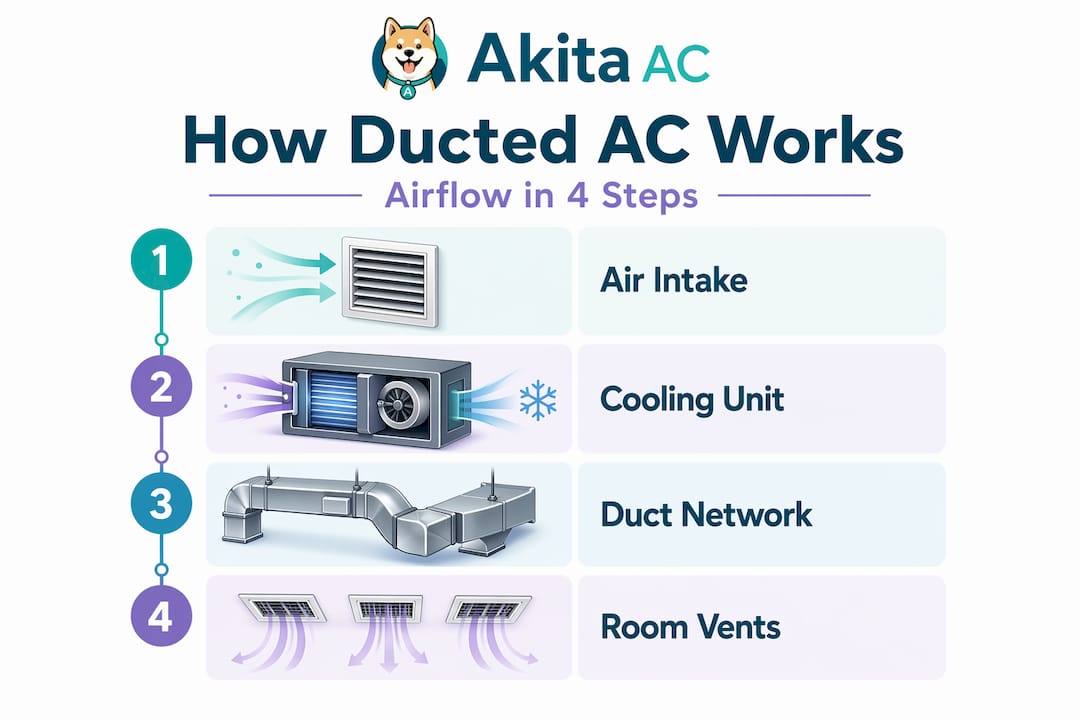
Air is drawn from inside the property into the central unit, where it passes over refrigerant coils that either cool or heat it depending on the mode selected. The conditioned air is then pushed through insulated ducts that run through the ceiling or floor structure, exiting through small vents or grilles in each room. Return air grilles pull stale air back to the central unit, completing a continuous circulation loop.
Zoning and temperature control
One of the defining features of a ducted system is zoning. Rather than conditioning the entire building at a single temperature, zoning allows you to divide the property into independent areas, each with its own temperature setting and on/off control. A boardroom can be kept cooler than a reception area. Bedrooms can be turned off during the day while the kitchen and living space remain active. This is precisely why zoning is considered a major selling point for large properties.
This contrasts sharply with a wall-mounted split system, which conditions only the room it serves. With splits, covering a whole property means installing a separate unit in every room, which adds visual clutter, multiple points of maintenance, and separate running costs for each unit.
- Centralised unit location: roof space, ceiling void, or dedicated plant room
- Air distribution: insulated ducts running through structural voids to ceiling vents
- Return air: grilles in ceilings or walls draw stale air back for reconditioning
- Zoning controls: programmable panels or smart app controls for each zone
- Outdoor unit: a single condenser, typically wall or ground mounted outside
Pro Tip: When planning zones, group rooms by usage patterns rather than by floor level. An office that is empty after 5pm should be its own zone so it can be switched off independently without affecting the rest of the building.
Benefits of ducted air conditioning
The ducted air conditioning benefits go well beyond simple temperature control. For larger homes and commercial properties, the advantages are both practical and financial.
Whole-property coverage is the most obvious advantage. One system, one outdoor unit, one thermostat interface. Every room receives conditioned air without the visual and acoustic compromise of individual wall units in each space.
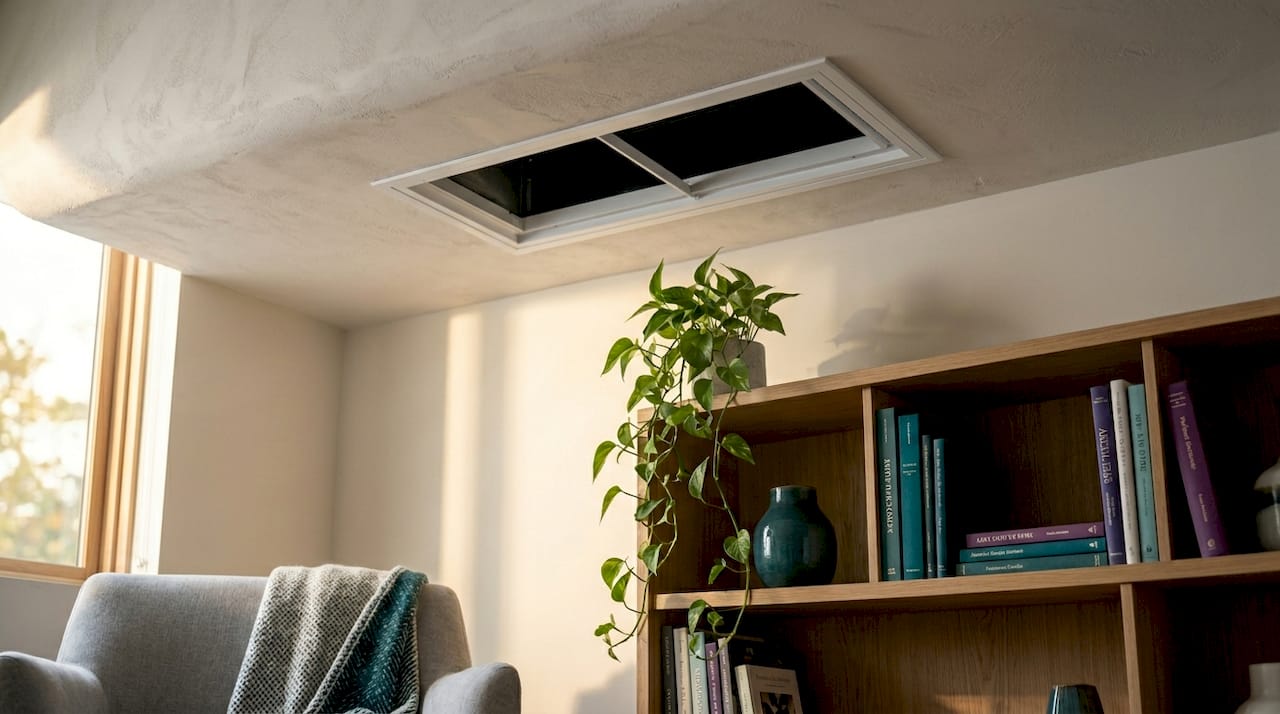
Discretion is a major reason why architects and interior designers favour ducted systems. The ductwork and indoor unit are entirely concealed. Only small, unobtrusive vents are visible at ceiling level, preserving the aesthetic of any room.
Energy efficiency has improved substantially with modern ducted designs. Heat pump-based ducted systems maintain consistent operation at a steady low level rather than cycling on and off aggressively, which reduces both energy consumption and wear on components. Systems integrated with heat pump technology have been shown to cut household carbon emissions by approximately 40% compared to traditional gas heating, making them a genuinely environmentally responsible choice.
Additional advantages worth considering:
- Air filtration: Central units can incorporate high-grade filters that remove dust, allergens, and particulates from the circulated air, improving indoor air quality across the whole property
- Noise levels: Because the main mechanical unit is remote, rooms are quieter than with wall-mounted splits, which have an audible fan unit in the living space
- Property value: A discreetly installed ducted system is viewed as a premium feature that can positively influence property valuations
- Scalability: Systems can often be expanded with additional zones as a business grows or a home is extended
For anyone comparing the advantages of ducted air conditioning against older systems, the efficiency and comfort gains from modern designs are considerable.
Installation: what to expect
Understanding the ducted air conditioning installation process helps you plan realistically, both for timeline and budget.
Typical installation steps
Installation starts with a site survey to assess the property layout, ceiling void depth, insulation levels, and the best routing for ductwork. A qualified engineer will calculate the required system capacity, design the zone layout, and specify the correct unit size. Physical installation involves placing the indoor air handling unit, running insulated ductwork through voids and roof spaces, fitting the outdoor condenser, and connecting the control wiring and refrigerant lines. Commissioning and testing complete the process.
For a standard property with straightforward ceiling access, installation typically takes two to four days. Larger commercial properties or buildings with complex layouts take longer.
Cost factors in the UK
Cost ranges vary by property type, system specification, and installation complexity. The table below gives a general overview of factors that drive price.
| Factor | Impact on cost |
|---|---|
| Property size | Larger properties need more ductwork, zones, and higher-capacity units |
| System type | Reverse cycle systems cost roughly 10 to 15% more than cooling-only |
| Existing ductwork | Retrofitting into a property with no existing voids adds significant labour |
| Listed or conservation buildings | May require planning permission, adding time and administrative cost |
| Smart controls | AI and IoT-enabled zoning systems carry a premium but deliver long-term savings |
In the UK, whole-house ducted systems are less common than in Australia or the US, which means fewer contractors and occasionally higher installation costs due to limited competition and specialist skills. Always use a qualified F-Gas registered engineer.
Pro Tip: Get your survey done in autumn or winter when demand for air conditioning installation is lower. You will often secure better pricing and faster scheduling than during the summer rush.
For a detailed walkthrough of what the process involves, Akita’s residential installation guide covers the regulatory and practical steps specific to UK homeowners.
Ducted vs split system air conditioning
Choosing between ducted and split systems comes down to property size, budget, and your priorities for aesthetics and control. The comparison between ducted and split systems is one of the most common questions Akita encounters.
| Feature | Ducted system | Split system |
|---|---|---|
| Coverage | Whole property via single system | Single room per unit |
| Aesthetics | Fully concealed, vents only | Visible wall-mounted indoor unit |
| Installation cost | Higher upfront | Lower per unit, but multiples needed |
| Zoning capability | Built-in multi-zone control | Separate unit per room acts as its own zone |
| Noise (indoors) | Very quiet, unit is remote | Audible fan unit in room |
| Best suited for | Large homes, offices, commercial | Single rooms, small flats, additions |
| Maintenance | Centralised servicing | Each unit maintained separately |
For a three-bedroom home or a small commercial office, a split system may offer a more cost-effective route. For a four-bedroom property or larger, or any space where aesthetics are a priority, ducted systems offer a more coherent and comfortable solution. You can explore the full types of air conditioning systems available in the UK to see where ducted fits within the broader options.
Getting the most from your ducted system
Owning a ducted system is an investment. Treating it as a fit-and-forget installation means leaving efficiency and comfort on the table.
- Schedule annual servicing. Filters, coils, and drain lines need professional inspection at least once a year. A blocked filter can reduce airflow by 15% or more without any obvious warning sign. Akita’s maintenance checklist details what this should cover.
- Use zoning actively. Turn off zones in unoccupied rooms and set back temperatures in less-used areas. This alone can produce meaningful reductions in running costs over a full year.
- Avoid temperature swings. Counterintuitively, keeping a low set temperature running continuously is more efficient for heat pump systems than switching off entirely when you leave. Avoiding large swings reduces energy consumption and wear.
- Invest in smart controls. AI and IoT-enabled systems optimise energy use based on occupancy patterns and external weather conditions. These systems extend equipment lifespan and reduce running costs compared to older fixed-speed controllers.
- Check duct integrity periodically. Ductwork joints can work loose over time. Leaking ducts push conditioned air into voids rather than rooms, wasting energy. Have ducts inspected if you notice reduced airflow in specific zones.
Pro Tip: If your system has a humidity control feature, use it. UK summers with high humidity can feel uncomfortable even at moderate temperatures. Reducing humidity by just a few percentage points makes the indoor environment noticeably more pleasant without lowering the temperature further.
My honest take on ducted AC in the UK
From our experience working with homeowners and commercial clients across Suffolk, Norfolk, and Essex, the biggest misconception about ducted air conditioning is that it is only worth it for large, purpose-built properties. I’ve seen it installed elegantly in 1930s semi-detached homes and converted barn offices where people assumed it simply wasn’t viable.
What surprises most clients is how quiet the finished installation is. They expected something intrusive. What they got was a system they barely notice is running, except that every room feels exactly as it should.
I’ve also seen the energy efficiency argument dismissed before installation and then enthusiastically endorsed afterwards. When you pair a modern ducted system with heat pump technology and proper zoning, the running costs genuinely reflect the efficiency claims. The old image of ducted AC as an expensive, energy-hungry luxury belongs to a previous era of fixed-speed compressors and no zoning.
My honest advice: if you’re in a property with three or more rooms that all need conditioning, and aesthetics matter to you, ducted is worth the higher upfront cost. The comfort consistency and the absence of wall units in every room are differences you will notice every single day.
— Akita
Ready to install ducted air conditioning?
Akita specialises in domestic ducted air conditioning installation across Suffolk, Essex, and Norfolk, as well as full commercial air conditioning solutions for offices, retail spaces, and industrial premises. Every installation is carried out by qualified F-Gas registered engineers with fixed-price, transparent quotations so you know exactly what you are committing to before work begins.

Whether you are exploring ducted systems for the first time or ready to book a site survey, Akita’s team is available to advise without obligation. With flexible finance options and ongoing maintenance membership available, making the move to a fully conditioned property is more straightforward than most clients expect. Contact Akita for a no-obligation consultation and fixed-price quote.
FAQ
What is a ducted air conditioning system?
A ducted air conditioning system uses a single centralised indoor unit to distribute conditioned air through a network of concealed ducts to multiple rooms or zones. It offers whole-property climate control without visible wall-mounted equipment.
How does ducted air conditioning differ from a split system?
A split system conditions one room per unit via a visible wall-mounted indoor unit, while a ducted system serves an entire property through concealed ductwork. Ducted systems offer superior aesthetics and multi-zone control but carry a higher upfront installation cost.
Is ducted air conditioning energy efficient?
Modern ducted systems, particularly those using heat pump technology, are highly efficient. They maintain a consistent low-level operation that avoids energy-wasting temperature swings, and studies indicate they can reduce household carbon emissions by approximately 40% compared to gas-based heating.
Do I need planning permission to install ducted AC in the UK?
In most standard UK properties, planning permission is not required for air conditioning installation. However, listed buildings and properties in conservation areas may require prior approval, so it is worth checking with your local planning authority before proceeding.
How long does ducted air conditioning installation take?
For a standard residential property, installation typically takes two to four days. Larger commercial properties or buildings with complex layouts or restricted ceiling access will require a longer installation period.