

Smart HVAC systems for buildings: the 2026 UK guide
TL;DR:
- Smart HVAC systems use sensors and automation to manage indoor climates efficiently based on real-time data.
- Ongoing management and active tuning are crucial for maintaining energy savings and system performance.
What makes a smart HVAC system genuinely intelligent?
Smart HVAC systems for buildings are heating, ventilation, and air conditioning solutions that use sensors, real-time data, and automated controls to manage indoor climate efficiently, rather than running on fixed schedules regardless of what is actually happening inside the building. The difference sounds simple. In practice, it changes everything about how a building consumes energy.
Where a conventional system heats or cools to a fixed setpoint on a timer, a smart system reads occupancy, CO₂ levels, external temperature, and humidity, then adjusts output accordingly. HVAC 4.0 describes this as delivering comfort, economy, and sustainability through intelligent control, and that framing captures it well. The system is always asking whether it needs to do more, or whether it can do less.
Core characteristics of a smart HVAC system include:
- Intelligent zone control: microprocessor-based controllers manage individual zones based on occupancy status or activity level, not building-wide averages
- Real-time monitoring: sensors track temperature, humidity, CO₂, and air quality continuously, feeding data to a central building management system (BMS)
- Remote management: facility managers can adjust setpoints, review performance data, and respond to faults from any location
- Adaptive scheduling: optimum start mechanisms calculate when heating or cooling needs to begin to reach target conditions by occupancy start, accounting for external temperature
- Integration with building systems: lighting, access control, and HVAC work from shared occupancy signals rather than independently
- Compliance-ready reporting: sub-metering and energy data logging support obligations under UK regulations
HVAC accounts for a significant portion of commercial building energy use. Getting that portion under intelligent control is not a marginal gain. Akita Air Conditioning specialises in exactly this: designing and installing smart climate control systems for commercial buildings across Suffolk, Norfolk, and Essex, with a focus on energy performance and long-term reliability.
Table of Contents
- How HVAC technology evolved from thermostats to smart systems
- What core features do smart HVAC systems deliver for commercial buildings?
- What integration challenges do smart HVAC systems face, and how are they solved?
- UK regulations and standards that shape smart HVAC design in commercial buildings
- How ongoing management keeps smart HVAC systems performing in UK buildings
- Akita’s commercial HVAC installations: built for smart buildings
- Key takeaways
How HVAC technology evolved from thermostats to smart systems
Understanding where smart building HVAC came from helps explain why the current generation of systems behaves so differently from what most older buildings still have installed.
Traditional HVAC: fixed and reactive
Early commercial HVAC relied on pneumatic controls and simple on/off thermostats. A boiler fired when a room dropped below a setpoint; a chiller ran until a supply air temperature was reached. There was no concept of occupancy, no feedback loop beyond temperature, and no way to coordinate across zones. Energy waste was structural, built into the design.
The shift to digital controls
The 1980s and 1990s brought direct digital control (DDC) systems, which replaced pneumatic actuators with electronic sensors and programmable logic controllers. This allowed time-based scheduling for the first time, meaning a building could at least stop heating empty offices overnight. Building management systems emerged as a central interface, though early versions were proprietary and difficult to integrate across manufacturers.
Key milestones in the evolution of building HVAC technology:
- 1970s: Pneumatic controls dominate; energy crises drive first interest in efficiency
- 1980s: DDC systems introduced; electronic sensors replace pneumatic actuators
- 1990s: BMS platforms emerge; time-based scheduling becomes standard
- Early 2000s: BACnet protocol published as open standard, enabling multi-vendor integration
- 2010s: IoT sensors become affordable; wireless connectivity enters commercial buildings
- 2015 onwards: Cloud-based analytics, machine learning fault detection, and demand-response integration become viable for mid-market buildings
- 2020s: UK regulatory pressure through Approved Document L and net-zero targets accelerates adoption of automated HVAC solutions
The IoT shift was particularly significant. Cheap, wireless sensors made it economical to monitor individual rooms rather than just plant rooms, and cloud connectivity meant analytics could run without expensive on-site servers. A building that previously had one temperature sensor per floor can now have dozens, each feeding real data into a system that actually responds to it.
What core features do smart HVAC systems deliver for commercial buildings?
The features that matter most to building managers are not the ones that look impressive in a brochure. They are the ones that reduce energy bills, prevent complaints, and keep the system running without constant manual intervention.
Occupancy-driven climate control
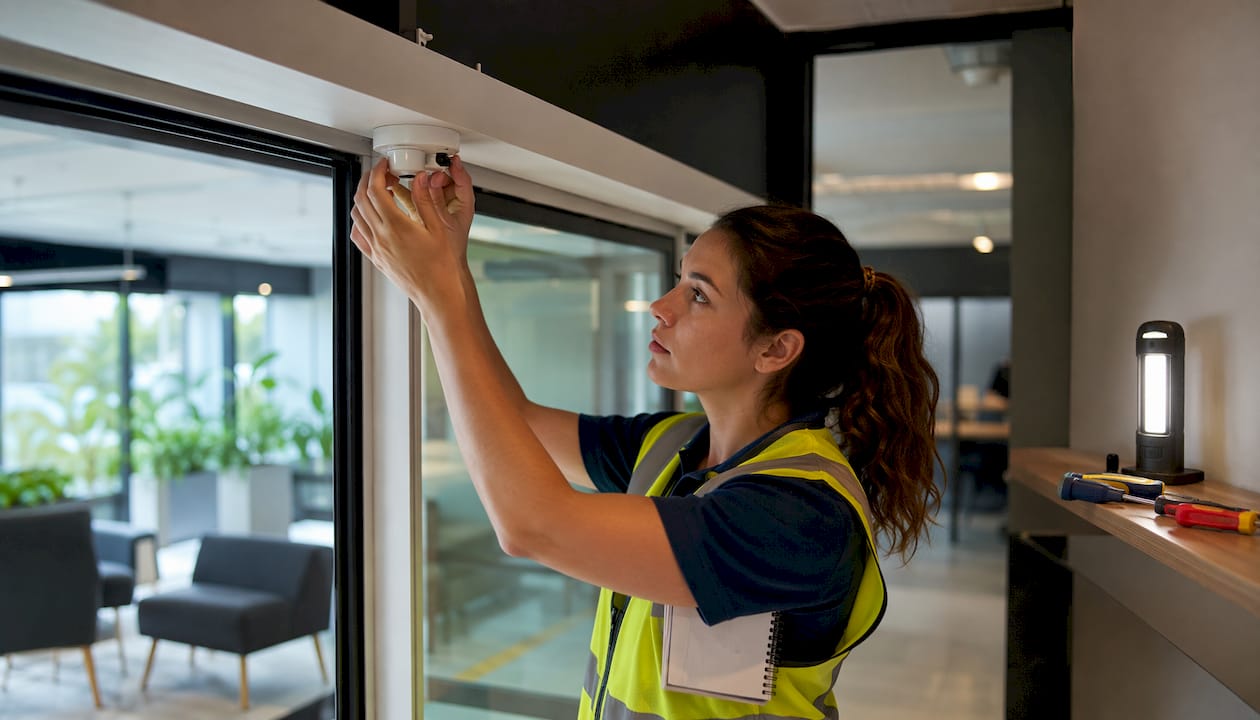
The most impactful feature is also the most straightforward: the system only conditions spaces that are in use. Presence detectors and CO₂ sensors signal occupancy to the BMS, which adjusts airflow, heating, and cooling accordingly. Occupancy-driven HVAC and lighting coordination maximises energy savings by linking sensor signals directly to building controls, avoiding the waste of conditioning empty meeting rooms or corridors.
Adaptive comfort bands
CIBSE Guide H makes a point that is often overlooked in system design: overly narrow temperature and humidity control bands increase energy costs and plant wear. Smart systems enable wider, adaptive comfort ranges that maintain occupant satisfaction with less cycling and lower energy consumption. Chasing a ±0.5°C band runs plant harder than necessary; a ±1.5°C adaptive band achieves the same perceived comfort at significantly lower cost.
Energy efficiency and cost reduction
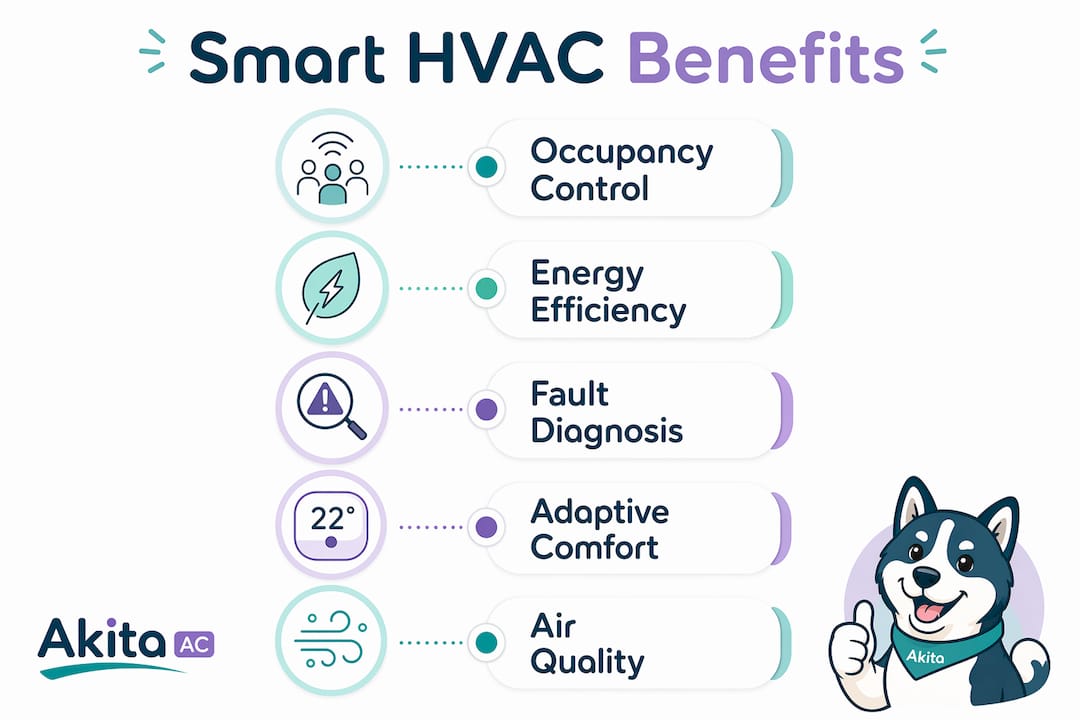
A BMS sequences chillers, adjusts ventilation rates using CO₂ sensing, and manages heating based on occupancy schedules, all of which reduce unnecessary runtime. The energy efficient HVAC systems that deliver the best returns are those where the BMS actively manages plant sequencing rather than leaving individual units to run independently.
Key features that drive measurable savings:
- CO₂-based demand-controlled ventilation: fresh air supply matches actual occupancy rather than design maximums
- Weather compensation: boiler flow temperatures reduce automatically as external temperatures rise
- Optimum start/stop: the system calculates the latest possible start time to reach comfort conditions by occupancy, avoiding unnecessary pre-heating
- Sub-metering: energy consumption is tracked by zone or system, making waste visible and auditable
Fault detection and diagnostics
Advanced BMS platforms flag faults automatically, from a stuck valve to an underperforming chiller, before they become costly failures. Fault detection and diagnostics in smart systems identify issues that would otherwise go unnoticed for weeks, draining energy and degrading comfort. This moves maintenance from reactive to genuinely predictive.
Indoor air quality
CO₂ and particulate sensors give building managers real data on air quality rather than assumptions based on design occupancy. In post-pandemic commercial buildings, this has become a tenant expectation as much as a regulatory consideration.
What integration challenges do smart HVAC systems face, and how are they solved?
Integrating a smart HVAC system into an existing commercial building is rarely straightforward. The technical challenges are real, but each has a well-established solution.
Protocol fragmentation
Older buildings often contain equipment from multiple manufacturers using incompatible communication protocols. A chiller from one supplier, air handling units from another, and a legacy BMS from a third can make integration feel like translating between three different languages simultaneously.
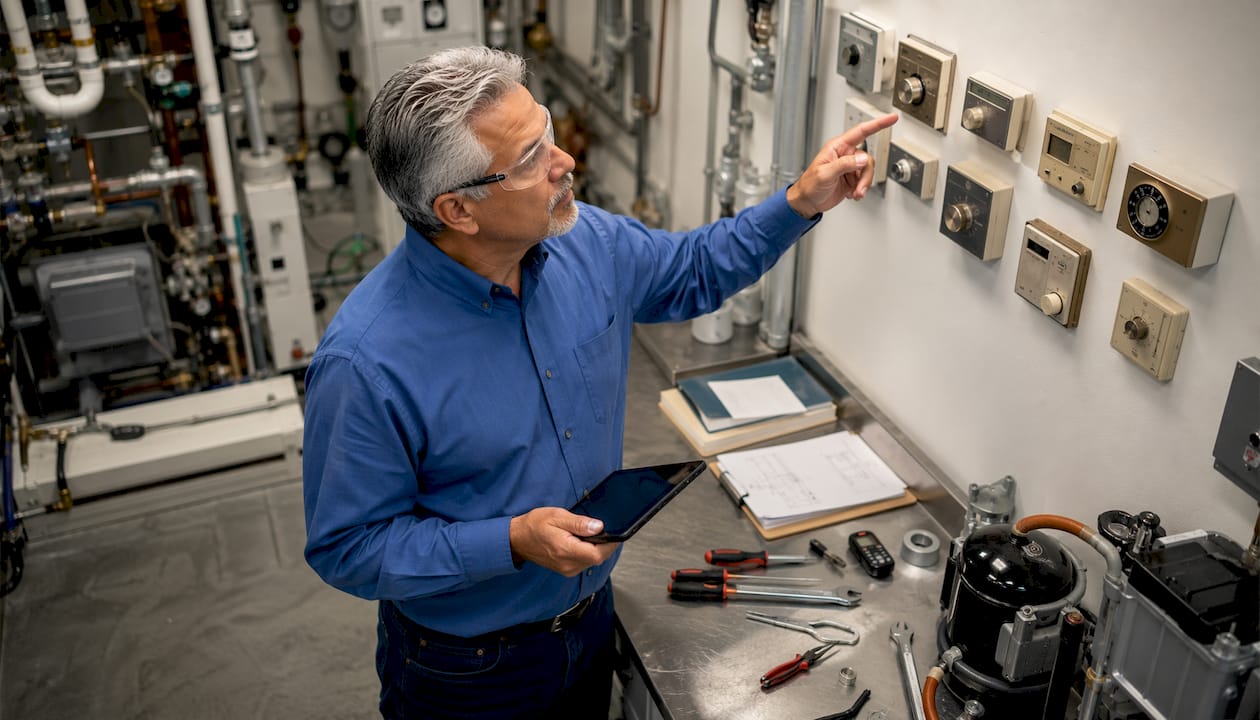
The solution is open standards. BACnet/IP is the dominant open-protocol standard for UK commercial building management integration, allowing devices to communicate over the building’s IT network. For modern IoT-enabled peripherals and sub-meters, Modbus TCP is increasingly preferred over older Modbus RTU variants, leveraging existing Ethernet infrastructure and simplifying wiring considerably.
Common integration challenges and their solutions:
- Legacy equipment: use protocol gateways to translate between proprietary and open standards; BACnet/IP gateways are widely available for most major plant manufacturers
- Cybersecurity: BACnet/IP traffic requires a dedicated VLAN to separate building controls from general IT networks; this is not optional in any serious installation
- Commissioning complexity: smart systems require careful tuning of control sequences after installation; factory defaults rarely reflect actual building behaviour
- Interoperability testing: specify open-protocol compliance at tender stage and require witnessed commissioning to verify device communication before handover
Security and network separation
Building controls on a shared network are a genuine vulnerability. The standard approach is to place all BMS and HVAC devices on a dedicated VLAN with firewall rules restricting access to authorised management terminals. This does not add significant cost but is frequently omitted in budget-driven installations, creating problems that are expensive to fix retrospectively.
Commissioning and tuning
A smart system that has been installed but not properly commissioned behaves like a conventional one. Control sequences need to be set up to reflect actual occupancy patterns, zone sizes, and plant characteristics. This takes time and expertise, and it is where many installations fall short.
Pro Tip: When specifying a smart HVAC installation, require the contractor to demonstrate adaptive setpoint control and occupancy-based mode switching during witnessed commissioning. A system that cannot demonstrate these functions at handover will not deliver the energy savings modelled at design stage.
UK regulations and standards that shape smart HVAC design in commercial buildings
The regulatory context for smart HVAC in UK commercial buildings has tightened considerably, and facility managers who treat compliance as a box-ticking exercise tend to end up with systems that underperform on both energy and cost.
Approved Document L
Approved Document L requires non-domestic buildings to consider high-efficiency alternatives and smart automation to limit fuel and power use. Before construction of a new building begins, the person carrying out the work must analyse the technical, environmental, and economic feasibility of using high-efficiency alternative systems, including heat pumps, cogeneration, and building automation controls. This is not a recommendation; it is a statutory requirement.
For major renovations, the same feasibility analysis applies. The Building Regulations do not mandate that smart systems are installed, but they do require that the case for them is formally assessed and documented.
CIBSE guidance
CIBSE Guide B0 makes clear that building energy efficiency depends on integrated design that balances smart HVAC control with building fabric performance. Over-specifying HVAC without addressing fabric can produce cost penalties that outweigh the benefits of intelligent controls. Smart systems work best when the building envelope is already performing well; they are not a substitute for insulation or glazing upgrades.
CIBSE Guide H addresses control system design specifically, covering adaptive comfort bands, optimum start logic, and the importance of commissioning. It remains the primary technical reference for specifying building control systems in the UK.
Sub-metering and energy reporting
The Energy Technology List (ETL) scheme, administered by the Department for Energy Security and Net Zero, encourages purchase of HVAC building controls that automatically minimise energy consumption. ETL-listed products must meet EN ISO 52120-1:2022 Class A system requirements, which include occupancy-based control, optimum start, and weather compensation.
Practical compliance requirements for UK commercial buildings:
- Document the feasibility analysis for high-efficiency alternative systems before building work starts
- Specify BMS with sub-metering capability to support energy reporting obligations
- Ensure control systems meet EN ISO 52120-1:2022 Class A where ETL compliance is required
- Retain commissioning records and control sequence documentation for building control body inspection
- For commercial HVAC best practices, align maintenance schedules with regulatory reporting periods to keep audit trails current
How ongoing management keeps smart HVAC systems performing in UK buildings
Installation is the beginning, not the end. The most common reason smart HVAC systems fail to deliver their projected energy savings is not a technical fault; it is the absence of active management after commissioning.
Building Management Systems require two-way communication with operators for ongoing tuning and maintenance to sustain optimal performance. Neglecting the human element is the main cause of smart HVAC underperformance, and it is a problem that affects buildings of all sizes.
What active management actually looks like
A well-managed smart HVAC system is reviewed regularly, not just when something breaks. Occupancy patterns change, tenants move, and building use shifts over time. Control sequences that were accurate at commissioning can become misaligned within months if nobody checks them. Seasonal retuning, at minimum twice a year, keeps setpoints and schedules reflecting actual building behaviour.
Fault detection alerts from the BMS need to be acted on promptly. An advanced BMS can flag a stuck valve or a chiller running outside its efficiency curve, but that alert only has value if someone investigates it. Buildings with a named responsible person for BMS management consistently outperform those where alerts are routed to a generic inbox.
Scheduling and occupancy alignment
One of the highest-return adjustments available to any building manager is reviewing HVAC schedules against actual occupancy. Many buildings run conditioning for two hours before and after occupied periods, a legacy of conservative commissioning. Tightening these windows, supported by occupancy sensor data, can reduce runtime without any occupant impact.
Smart HVAC systems only deliver their full potential when building operators treat them as active tools rather than set-and-forget infrastructure. The technology handles the automation; the expertise lies in knowing when to intervene, retune, and adapt the system to how the building is actually being used.
Maintenance and fault response
Predictive maintenance, driven by BMS fault detection and diagnostics, reduces both reactive call-outs and planned downtime. Filters, coils, and actuators that are monitored continuously show degradation patterns before they cause failures. For eco-friendly HVAC maintenance, this means fewer emergency interventions and a longer useful life for plant equipment.
Continuous commissioning, the practice of regularly reviewing and adjusting control sequences against measured performance, supports both regulatory compliance and return on investment. Buildings that adopt it typically sustain energy savings over time rather than seeing performance drift back towards pre-installation baselines. For practical guidance on HVAC servicing schedules that align with these principles, Akita’s published resources cover the specifics in detail.
Akita’s commercial HVAC installations: built for smart buildings
If you are managing a commercial building in Suffolk, Norfolk, or Essex and the gap between your current HVAC setup and what a properly integrated smart system could deliver is becoming harder to ignore, Akita is the practical next step.

Akita specialises in commercial air conditioning installation for businesses that need energy-efficient, intelligently controlled climate systems, not just a replacement unit on the wall. Every installation is designed around the building’s actual occupancy patterns and energy targets, with smart controls specified from the outset rather than bolted on as an afterthought. Transparent, fixed pricing means you know the cost before work begins, and Akita’s ongoing servicing keeps systems performing at the level they were commissioned to achieve. Get in touch with Akita to discuss a smart HVAC installation for your building.
Key takeaways
Smart HVAC systems for buildings deliver their full energy and comfort benefits only when intelligent controls, open-protocol integration, and active ongoing management work together within a compliant UK regulatory framework.
| Point | Details |
|---|---|
| HVAC dominates building energy use | HVAC accounts for a substantial share of commercial building energy consumption, making intelligent control a highly impactful efficiency measure. |
| UK regulations require feasibility analysis | Approved Document L mandates a documented assessment of high-efficiency alternative systems, including building automation controls, before new non-domestic building work begins. |
| Open protocols solve integration | BACnet/IP and Modbus TCP enable multi-vendor integration; BACnet/IP requires a dedicated VLAN for security in any serious installation. |
| Active management sustains savings | Neglecting ongoing tuning and operator engagement is the primary cause of smart HVAC underperformance after commissioning. |
| Akita for commercial installations | Akita designs and installs smart commercial HVAC systems across Suffolk, Norfolk, and Essex, with fixed pricing and ongoing servicing support. |