

The role of refrigerants in cooling: a UK guide
TL;DR:
- Refrigerants are essential for cooling systems because they transfer heat by changing phases between liquid and vapor. The choice of refrigerant, such as R32, affects efficiency, safety, and environmental impact, with regulations phasing out high-GWP options. Proper installation, servicing, and disposal are crucial for legal compliance and minimizing environmental harm.
A refrigerant is the working fluid that makes cooling possible — it moves heat from inside a building to the outside by repeatedly changing phase between liquid and vapour. Without it, your air conditioning unit is just a fan. The most common refrigerants in UK systems right now are R32, R410A, and R134a, each with different properties that affect efficiency, safety, and environmental impact. Get the refrigerant right and you get comfortable indoor temperatures, controlled humidity, and lower running costs. Get it wrong and you face regulatory penalties, premature equipment failure, or a system that simply cannot keep up.
- R32 — now the dominant choice for new domestic split systems in the UK
- R410A — still widely found in existing installations, though being phased down
- R134a — common in chillers and automotive applications, but under pressure from lower-GWP alternatives
Table of Contents
- How refrigerants make cooling happen
- How refrigerant types have changed over time
- What makes a refrigerant suitable for a given application?
- Common refrigerants in UK cooling systems compared
- Environmental impact and what UK law requires of you
- Refrigerant safety, leak detection, and end-of-life disposal
- How to choose the right refrigerant or system
- What a professional installation and service actually covers
- Key takeaways
- The refrigerant decisions that actually matter
- Akita’s refrigerant and cooling services for UK homes and businesses
- Useful sources and further reading
How refrigerants make cooling happen
Refrigerants enable heat transfer by absorbing latent heat during evaporation and releasing it during condensation. That phase-change mechanism is what separates a refrigerant from ordinary fluids — water can carry heat, but it cannot absorb the enormous quantities of energy that a refrigerant can when it boils at low pressure inside an evaporator coil.
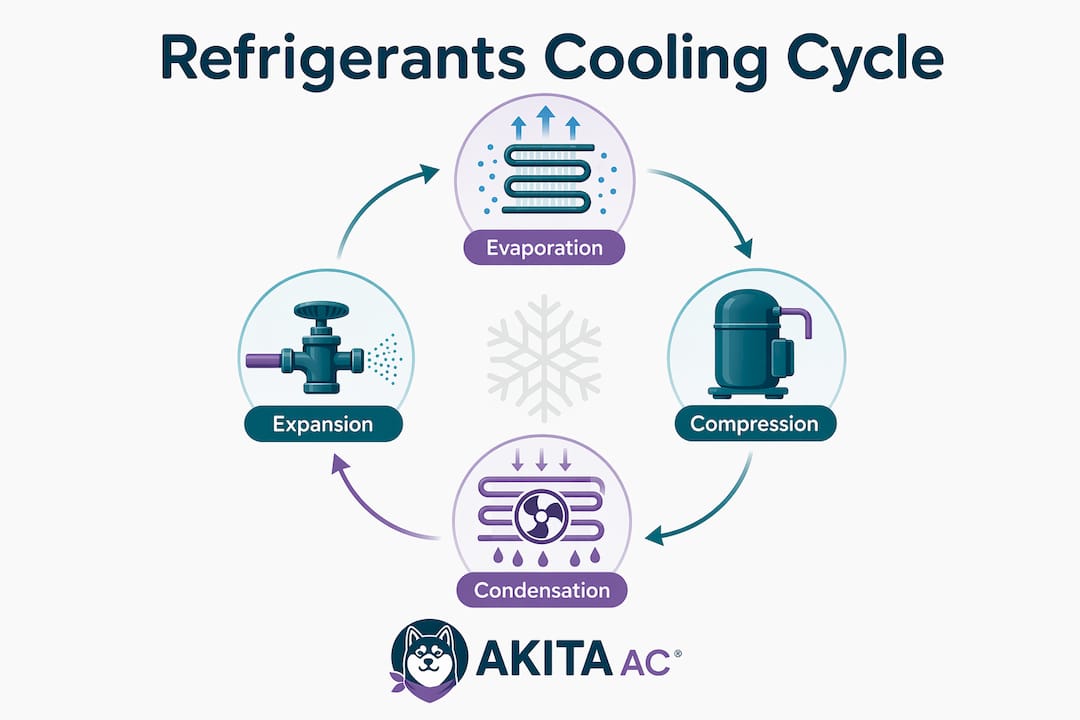
Here is how the vapour-compression cycle works, step by step:
- Evaporation — The refrigerant enters the evaporator coil as a low-pressure liquid. Warm indoor air passes over the coil; the refrigerant absorbs that heat and boils into a vapour. The air leaving the coil is now cooler and drier.
- Compression — The compressor draws in the low-pressure vapour and compresses it, raising both pressure and temperature significantly.
- Condensation — The hot, high-pressure vapour moves to the condenser coil (usually the outdoor unit). Here it releases its heat to the outside air and condenses back into a liquid.
- Expansion — The liquid refrigerant passes through an expansion valve, which drops its pressure sharply. This prepares it to absorb heat again and the cycle repeats.
The key distinction is between latent heat and sensible heat. Sensible heat is what you feel when something warms up — a thermometer would register it. Latent heat is the energy absorbed or released during a phase change, with no temperature rise. Because refrigerants exploit latent heat, they can shift far more thermal energy per kilogram than a simple fluid carrying sensible heat alone. That is why a relatively small charge of refrigerant can cool an entire room.
Pro Tip: If your indoor unit is blowing warm air or you spot ice forming on the evaporator coil, those are classic signs of a refrigerant problem — either a low charge from a leak or a restriction in the system. Neither is a DIY fix. Call a certified technician; working on refrigerant circuits without F-gas certification is illegal in the UK. You can find a checklist of common AC fault symptoms to help you describe the problem accurately before you call.
How refrigerant types have changed over time
The history of refrigerants is essentially a series of regulatory corrections — each generation replaced because of an environmental problem the previous one caused.
- CFCs (chlorofluorocarbons) — R11, R12. Excellent thermodynamic properties but devastating to the ozone layer. Phased out under the Montreal Protocol from the late 1980s onwards. No longer available for servicing in the UK.
- HCFCs (hydrochlorofluorocarbons) — R22 was the workhorse of commercial air conditioning for decades. Lower ozone depletion potential than CFCs, but still damaging. Banned from use in servicing in the UK since 2015.
- HFCs (hydrofluorocarbons) — R410A, R134a, R407C. Zero ozone depletion potential, which made them the obvious CFC/HCFC replacement. The problem: very high global warming potential (GWP). Now subject to the UK HFC phasedown, with tighter restrictions proposed from 2027 through to 2050.
- HFOs (hydrofluoroolefins) — R1234yf, R1234ze. Near-zero GWP and zero ODP. Mildly flammable (A2L safety class), which requires updated service tools and risk assessments. Increasingly specified for new equipment.
- Natural refrigerants — Ammonia (R717), CO2 (R744), propane (R290). Zero or near-zero GWP, no ODP, but each brings specific safety or engineering challenges (toxicity, very high pressure, or flammability) that limit where they can be used.
For homeowners and building managers, the practical implication is straightforward: if your system uses R22, it cannot legally be serviced with that refrigerant any more and replacement is the only option. If it uses R410A, servicing is still possible but the phasedown means supply will tighten and costs will rise. Systems specified today should use R32, an HFO, or a natural refrigerant where the application allows.
Worth knowing: You cannot simply swap one refrigerant for another in an existing system. Different refrigerants operate at different pressures, require different lubricating oils, and have different capacity characteristics. Retrofitting is rarely straightforward and is often impractical — more on that in the selection section below.
What makes a refrigerant suitable for a given application?
Choosing a refrigerant is never about a single property. Designers and specifiers weigh a cluster of thermodynamic and practical factors simultaneously.
Thermophysical properties:
- Boiling point and operating pressure — The refrigerant must boil at the evaporating temperature the application requires. R744 (CO2) boils at -78.5°C at atmospheric pressure, which means it operates at very high pressures in typical AC applications — manageable in industrial plant rooms, less so in domestic settings.
- Latent heat of vapourisation — Higher latent heat means more cooling effect per kilogram of refrigerant circulated, which generally allows smaller pipework and charge sizes.
- Critical temperature and pressure — Above the critical point, a refrigerant cannot condense into a liquid regardless of pressure. For heat pumps operating in warm climates or high-temperature applications, this matters considerably.
- Efficiency — The right refrigerant for a specific temperature range can deliver around 10% better efficiency than a poor match, which compounds significantly over a system’s lifetime.
Practical and safety properties:
- Toxicity and flammability (ASHRAE safety groups) — ASHRAE classifies refrigerants on a two-part scale. The letter indicates toxicity (A = lower, B = higher) and the number indicates flammability (1 = non-flammable, 2L = mildly flammable, 2 = flammable, 3 = highly flammable). R32 is A2L — low toxicity, mildly flammable. Ammonia is B2L — toxic and mildly flammable. These classifications directly affect ventilation requirements, detector specifications, and the tools technicians must use.
- Lubricant compatibility — Refrigerants must be compatible with the compressor oil. Switching refrigerant types often means flushing and replacing the oil, which adds cost and complexity.
- Availability and cost — As the phasedown tightens, high-GWP HFCs will become scarcer and more expensive. Specifying a refrigerant with a secure supply chain is a genuine long-term consideration.
The trade-offs are real. R290 (propane) has excellent thermodynamic properties and near-zero GWP, but its flammability limits charge sizes, typically to 150g in domestic equipment under current standards. R717 (ammonia) is highly efficient and has zero GWP, but its toxicity means it is confined to industrial plant rooms with specialist ventilation and detection systems. There is no single best refrigerant — only the best refrigerant for a specific application, charge size, and operating environment.
Common refrigerants in UK cooling systems compared
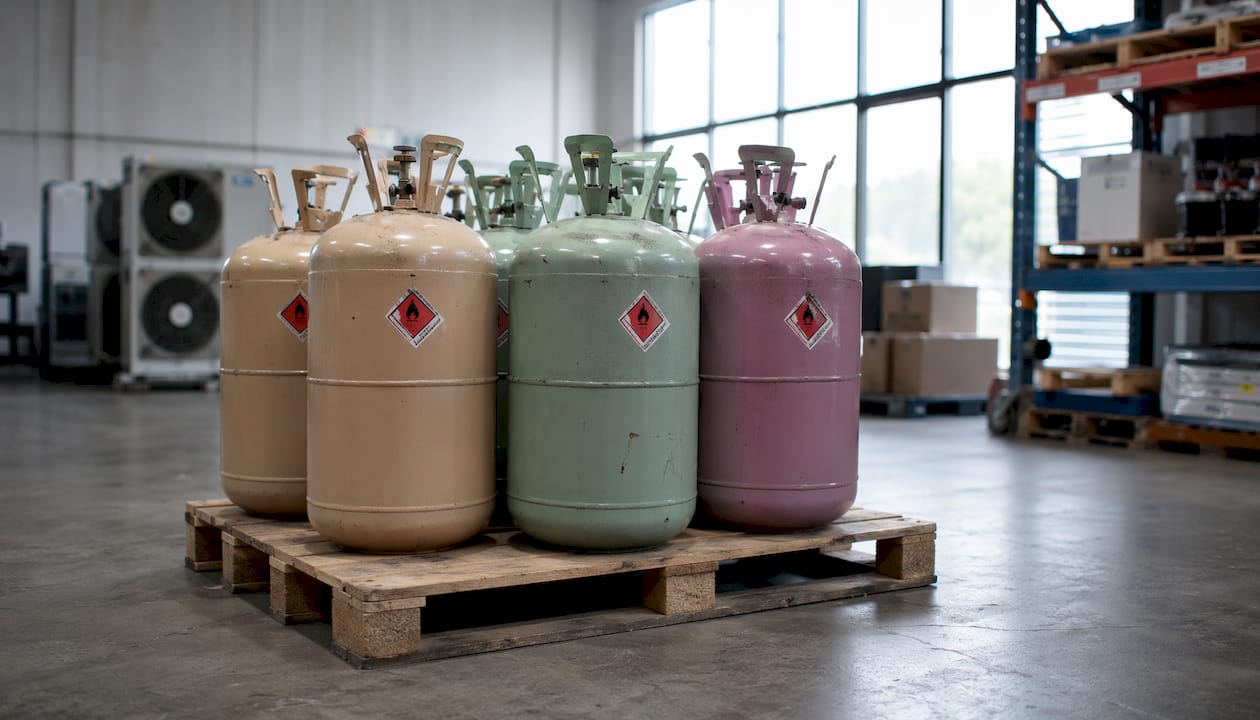
The table below covers the refrigerants most likely to appear in UK residential, commercial, and industrial cooling equipment.
| Refrigerant | Typical applications | GWP | ODP | ASHRAE safety group | Pressure / efficiency notes | UK availability / phase-down status |
|---|---|---|---|---|---|---|
| R32 | Domestic and light-commercial split systems | 675 | — | A2L | Moderate-high pressure; good efficiency | Widely available; dominant for new installs |
| R410A | Existing split and multi-split systems | 2,088 | — | A1 | High pressure; good efficiency | Available for servicing; phasedown reducing supply |
| R134a | Chillers, automotive, refrigeration | 1,430 | — | A1 | Moderate pressure; lower efficiency in some ranges | Available; being replaced in new chiller designs |
| R1234yf | Automotive AC; emerging in small commercial | ~4 | — | A2L | Similar pressure to R134a; slightly lower capacity | Growing availability; preferred for new automotive |
| R1234ze | Large chillers; commercial AC | ~7 | — | A2L | Lower pressure than R134a; mild capacity reduction | Increasing in new chiller specifications |
| R717 (ammonia) | Industrial chillers, cold storage, large process cooling | — | — | B2L | High efficiency at scale; toxic — requires specialist plant rooms | Specialist supply; not for general commercial AC |
| R744 (CO2) | Supermarket refrigeration, heat pumps, industrial | 1 | — | A1 | Very high pressure (transcritical); excellent for heat recovery | Growing in commercial refrigeration and heat pumps |
| R290 (propane) | Domestic refrigerators, small splits, heat pumps | 3 | — | A3 | Excellent thermodynamic properties; charge limited by flammability | Available; charge-size restrictions apply |
A few practical points the table cannot fully convey:
- R32 has become the refrigerant of choice for most new domestic split systems in the UK. With a GWP of 675 it is a meaningful step down from R410A’s 2,088, and its efficiency in small systems is well proven.
- R134a carries a GWP of approximately 1,430 and is being replaced in new chiller designs by R1234ze, which has a GWP of around 7 but is A2L, requiring updated service procedures.
- R717 and R744 are the workhorses of industrial refrigeration. Ammonia’s zero GWP and high efficiency make it attractive at scale, but its toxicity means it stays in restricted-access plant rooms. CO2 operates at very high pressures but is increasingly used in supermarket refrigeration and heat pump applications where its heat-recovery potential is valuable.
- R290 suits small domestic appliances and some heat pumps well, but the 150g charge limit under current standards constrains its use in larger systems.
Environmental impact and what UK law requires of you
Refrigeration, air conditioning, and heat pumps accounted for 79.5% of F-gas emissions in the UK in 2020. That figure explains why the regulatory framework around refrigerants is as demanding as it is.
Understanding the environmental metrics:
- GWP (Global Warming Potential) — How much warming a kilogram of refrigerant causes relative to CO2 over 100 years. R410A at 2,088 is over 2,000 times more potent than CO2 by mass.
- ODP (Ozone Depletion Potential) — All modern refrigerants in common use have zero ODP; this was resolved by the Montreal Protocol. It remains relevant only when assessing legacy equipment.
- TEWI (Total Equivalent Warming Impact) — The metric that actually matters for lifecycle decisions. TEWI combines direct emissions from refrigerant leakage over the system’s life with indirect emissions from the electricity the system consumes. A low-GWP refrigerant in an inefficient system can have a worse TEWI than a higher-GWP refrigerant in a highly efficient one.
Statistic: Refrigeration, air conditioning, and heat pumps represented 79.5% of F-gas emissions in the UK in 2020 — the single largest source by a substantial margin.
Your legal obligations under UK F-gas rules:
- Technicians must hold relevant F-gas certifications to work on equipment containing F gases. Using an uncertified engineer is illegal and invalidates insurance.
- Owners are legally responsible for arranging periodic leak checks — the frequency depends on the refrigerant charge size.
- Records of refrigerant quantities, service activities, and leak checks must be maintained and kept available for inspection.
- Certain high-GWP refrigerants face restrictions on use in new equipment, and the HFC phasedown will tighten availability further from 2027, with additional steps planned through to 2050.
- Recovery of refrigerant before decommissioning is mandatory — venting to atmosphere is a criminal offence.
Pro Tip: When specifying new equipment, ask your installer for the TEWI figure alongside the SEER (Seasonal Energy Efficiency Ratio) rating. A system with an excellent SEER rating and a low-GWP refrigerant will almost always deliver the best lifecycle environmental performance. Choosing on GWP alone, without considering energy efficiency, can lead to a worse outcome overall. Akita’s guide to eco-friendly HVAC maintenance covers how regular servicing keeps both metrics in good shape.
Refrigerant safety, leak detection, and end-of-life disposal
Refrigerant safety depends entirely on what type you are dealing with. R32 and R410A are non-toxic but R32 is mildly flammable; ammonia is acutely toxic; CO2 can displace oxygen in confined spaces at high concentrations. Correct procedures are not optional.
Detecting a leak:
- Electronic leak detectors and refrigerant sniffers — the standard tool for certified technicians
- Fixed detection systems — required in plant rooms containing toxic or high-charge refrigerants such as ammonia
- Visual inspection — oil staining around joints and fittings is a common indicator
- Performance monitoring — unexplained loss of cooling capacity or rising suction pressure can signal a slow leak
- UV dye — sometimes injected into the system to make leak points visible under ultraviolet light
If you suspect a leak:
- Isolate the electrical supply to the unit if it is safe to do so
- Ventilate the area immediately — open doors and windows
- Keep people away from the affected space, particularly in enclosed areas
- Do not attempt to repair the leak yourself — call a certified technician
- Do not use naked flames near the unit if you suspect a flammable refrigerant
End-of-life handling:
Refrigerant must be recovered by a certified engineer using appropriate recovery equipment before any system is decommissioned or scrapped. Recovered refrigerant can be reclaimed and reused, or destroyed through licensed facilities. Venting refrigerant to atmosphere is illegal under UK F-gas rules and carries significant penalties. Always use a certified reclamation service — your installer should be able to arrange this as part of any replacement project.

A2L refrigerants such as R32 and R1234yf add a further consideration: service tools including vacuum pumps, gauges, and recovery units must be explicitly rated for mildly flammable refrigerants. Using non-rated equipment is a genuine safety hazard, not a technicality.
How to choose the right refrigerant or system
Choose for total lifecycle performance — energy use, safety classification, TEWI, and future refrigerant availability — not GWP alone. A system that scores well on GWP but poorly on efficiency will cost more to run and may have a worse environmental impact over its lifetime.
Here is a practical checklist of questions to put to any installer or supplier:
- What refrigerant does this system use, and what is its GWP and ASHRAE safety group?
- What is the system’s SEER or SCOP rating, and can you provide a TEWI estimate?
- What is the refrigerant charge size, and what leak-check frequency will that trigger under UK F-gas rules?
- Is this refrigerant subject to the HFC phasedown, and how will that affect servicing costs over the next 10 years?
- Is the system compatible with lower-GWP alternatives if regulations tighten further?
- Are your engineers F-gas certified, and do they carry tools rated for A2L refrigerants if applicable?
- What does the warranty cover, and is a service plan available?
Quick decision heuristics by scenario:
- Small domestic split system — R32 is the standard choice for new installations. It offers a meaningful GWP reduction versus R410A with no practical performance penalty for typical home use. Check that the installer’s tools are rated for A2L gases.
- Commercial chiller replacement — R1234ze is increasingly specified for new large chillers, replacing R134a. Expect a slightly larger footprint and confirm the engineer has experience with A2L systems.
- Heat pump installation — R32 dominates the domestic heat pump market. For larger commercial heat pumps, R290 or R744 may be worth considering depending on charge-size constraints and plant-room access.
Pro Tip: Retrofitting an older R22 or R410A system to accept a modern low-GWP refrigerant is rarely the right answer. Pressure differences, lubricant incompatibility, and capacity mismatches usually mean that replacing the system outright is more economical and safer over a five-to-ten-year horizon than attempting a conversion. If a supplier is pushing a retrofit as a cheap fix, ask them to put the TEWI and total cost of ownership figures in writing. Akita’s guide to choosing energy-efficient AC walks through the replacement vs retrofit decision in more detail.
What a professional installation and service actually covers
A professional service is not just a top-up of refrigerant. A qualified installer covers system survey, refrigerant identification, leak testing, repair or replacement recommendations, safe recovery and lawful disposal, plus certification and record updates — all in a single visit.
Here is what a thorough service typically involves:
- System survey and documentation — Identifying the refrigerant type, charge size, and recording system details for the F-gas log.
- Visual inspection — Checking pipework, joints, and fittings for signs of oil staining, corrosion, or physical damage.
- Pressure testing — Verifying operating pressures against manufacturer specifications to identify undercharge, overcharge, or restriction.
- Electronic leak detection — Systematic check of all joints, valves, and connections using a calibrated leak detector.
- Filter and oil checks — Inspecting filters and, where accessible, checking compressor oil condition.
- Performance verification — Measuring supply and return air temperatures, airflow, and electrical draw to confirm the system is operating within specification.
- Safe recovery — If refrigerant needs to be removed, recovering it into certified cylinders using rated equipment.
- Documentation and certification — Updating the F-gas record, issuing a service certificate, and noting any recommended follow-up actions.
What you should receive after a professional service:
- A signed F-gas service record with refrigerant quantities logged
- A service certificate confirming the engineer’s certification number
- Written recommendations for any repairs or replacements identified
- Confirmation of the next scheduled leak-check date
- Warranty documentation updated where applicable
F-gas certification is the non-negotiable baseline for any technician handling refrigerants in the UK. Beyond that, manufacturer approval programmes — such as those run by Mitsubishi Electric, Daikin, and similar brands — indicate that an engineer has been trained specifically on that equipment, which matters for warranty validity and system longevity. When A2L refrigerants are involved, confirm that the engineer’s tools carry the appropriate flammable-gas rating before work begins.
Key takeaways
Refrigerants are the working fluid at the heart of every cooling system — and in the UK, choosing, servicing, and disposing of them correctly is both a technical and a legal obligation.
| Point | Details |
|---|---|
| Refrigerants work by phase change | They absorb heat by evaporating at low pressure and release it by condensing at high pressure — this is what makes cooling possible. |
| R32 dominates new UK installs | With a GWP of 675, R32 is now the standard for domestic splits; R410A (GWP 2,088) is being phased down and will become costlier to service. |
| TEWI beats GWP as a decision metric | Total lifecycle impact combines refrigerant leakage and energy use — a low-GWP refrigerant in an inefficient system can perform worse than a higher-GWP one in an efficient system. |
| UK F-gas law is strict | Only F-gas certified technicians may handle refrigerants; owners must arrange leak checks and maintain records or face legal penalties. |
| Akita covers the full service cycle | From system survey and certified installation to leak detection, safe recovery, and F-gas record updates across Suffolk, Norfolk, and Essex. |
The refrigerant decisions that actually matter
Most of the debate around refrigerants focuses on GWP numbers, and understandably so — the regulatory pressure is real and the phasedown timeline is tightening. But in practice, the homeowners and building managers who end up with the best outcomes are the ones who ask a slightly different question: not “what is the GWP?” but “what will this system cost me to run and maintain over the next decade, and will I still be able to service it?”
That shift in framing matters. A system charged with R32 and running at a SEER of 7 will almost always beat a system charged with R1234yf running at a SEER of 4, both on bills and on total carbon impact. The refrigerant is one variable in a larger equation that includes equipment quality, installation standard, and service frequency.
The other thing worth saying plainly: the barrier to adopting modern low-GWP refrigerants is rarely cost — it is usually a lack of clear guidance on safety standards and what the regulations actually require. Once that knowledge gap closes, the transition to A2L and natural refrigerants becomes straightforward. Planned replacement, regular leak checks, and a certified engineer who carries the right tools — that combination handles the vast majority of refrigerant risk before it becomes a problem.
Akita’s refrigerant and cooling services for UK homes and businesses
If you need certified refrigerant work done properly, Akita covers the full cycle — from initial system survey and refrigerant identification through to certified installation, leak detection and repair, safe recovery, and F-gas record updates. Every engineer holds F-gas certification and carries tools rated for A2L refrigerants where required.

For homeowners in Suffolk, Norfolk, and Essex, Akita offers domestic air conditioning installation with modern, low-GWP systems specified to your property’s needs — including fixed-price options for straightforward single-split installations. For business owners and property managers, the commercial installation service covers everything from initial specification through to ongoing maintenance contracts, with full F-gas documentation provided as standard.
To book a survey or request a quote, visit Akita’s website or call the team directly. The survey is the right starting point whether you are replacing an ageing R410A system, specifying a new installation, or simply not sure what refrigerant your current equipment contains.
Useful sources and further reading
These are the primary sources worth consulting for deeper technical or legal detail on refrigerants in the UK context.
- UK F-gas guidance for users, producers and traders — GOV.UK — The definitive reference for legal obligations: technician certification requirements, leak-check frequencies, record-keeping duties, and restrictions on specific refrigerants. Consult this first for compliance questions.
- F-gas Regulation in Great Britain: Reform of the HFC phasedown — Defra consultation — Sets out the proposed tightening of the HFC phasedown from 2027 to 2050. Essential reading for anyone specifying equipment that will still be in service in ten years.
- Guidance on Minimising Greenhouse Gas Emissions from Refrigeration, Air-conditioning and Heat Pump Systems — DEFRA/archived UK guidance — Practical technical guidance on refrigerant selection, secondary refrigerant systems, and efficiency optimisation. Useful for building services engineers and specifiers.
- TG 21/2022 Refrigerants in use in Building Services — The CIBSE/BSRIA technical guidance document covering refrigerant properties, TEWI methodology, and application guidance for building services. The standard reference for UK building services professionals.
- Refrigerant: it really is time to change — ACR Journal — Industry commentary on the practical realities of transitioning to A2L and low-GWP refrigerants, including tooling requirements and technician experience. Worth reading for anyone managing a fleet of HVAC equipment through the phasedown.