

How to troubleshoot air conditioning faults at home
TL;DR:
- Troubleshooting air conditioning faults involves checking filters, thermostats, and power supply issues before considering refrigerant problems. Recognizing early warning signs like strange noises, rising energy bills, or leaks helps prevent costly repairs and safety hazards. Only certified professionals can handle refrigerant work, and regular maintenance keeps systems running reliably.
Knowing how to troubleshoot air conditioning faults is the difference between a cool home and an expensive emergency call-out. Most faults trace back to a handful of causes: blocked filters, thermostat errors, power supply issues, or debris around the outdoor unit. Early warning signs such as reduced cooling, strange noises, and rising energy bills tell you something is wrong before the system fails completely. This guide walks you through the systematic checks you can carry out yourself, and makes clear when UK law requires a certified engineer.
How to troubleshoot air conditioning faults: tools, safety, and preparation
Before touching any part of your system, gather the right tools and take basic safety precautions. Working on an air conditioning unit without isolating the power first is the single most common cause of DIY injury.
What you will need
- A flat-head and cross-head screwdriver
- A soft brush or vacuum with a brush attachment
- A torch for inspecting dark internal spaces
- Replacement air filters compatible with your unit model
- A multimeter if you plan to check electrical continuity
- A bucket and mild detergent for cleaning drain trays
Safety first
Switch off the unit at the wall isolator and at the main consumer unit before opening any panels. Never attempt to access refrigerant lines or compressor components yourself. UK law requires F-Gas certification to handle refrigerants legally. Any homeowner who tops up or tampers with refrigerant commits an offence and risks serious environmental harm.
Pro Tip: Take a photo of any wiring or component layout before you remove anything. It takes seconds and saves considerable confusion when reassembling.
Check your unit’s manual for the model-specific isolation procedure. Split systems have both an indoor air handler and an outdoor condenser, and both need to be off before you start. Understanding this basic layout helps you follow each diagnostic step with confidence.
| Component | What to check | DIY or professional? |
|---|---|---|
| Air filter | Dirt, blockage, damage | DIY |
| Thermostat | Settings, battery, calibration | DIY |
| Condensate drain | Blockage, standing water | DIY (minor) |
| Refrigerant lines | Frost, hissing, leaks | Professional only |
| Electrical wiring | Burnt smell, tripped breakers | Professional only |
Step-by-step checks for filters, thermostat, power, and airflow
Most basic cooling problems stem from airflow restrictions such as dirty filters or outdoor debris, not refrigerant leaks. Start with the simplest checks before assuming the worst.
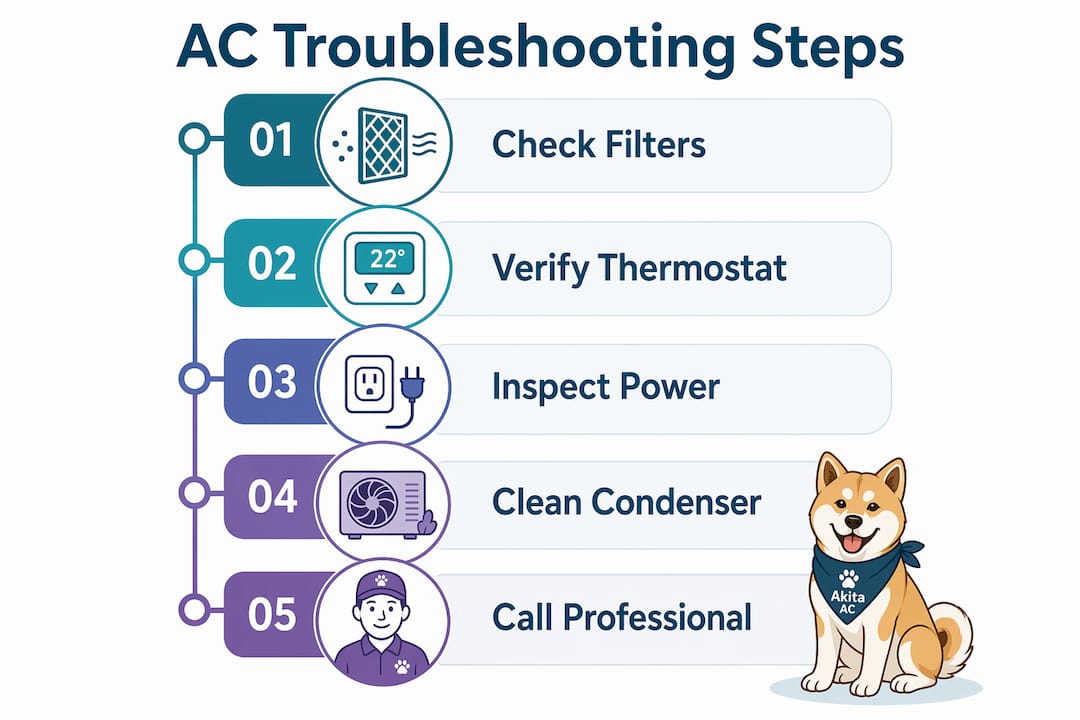
1. Inspect and clean the air filter
A clogged filter is the leading cause of poor performance. Dirty filters left beyond 1–3 months restrict airflow, cause the evaporator coil to ice over, and push energy bills higher. Remove the filter panel, hold the filter up to a light source, and replace it if you cannot see light through it. Washable filters should be rinsed with lukewarm water and left to dry fully before reinsertion. For a full filter replacement schedule, check the manufacturer’s guidance alongside general HVAC recommendations.

2. Verify thermostat settings
Set the thermostat at least 5°C below the current room temperature and confirm the mode is set to cooling, not fan-only or heating. Replace the batteries in wireless thermostats even if the display appears active. A flat battery causes erratic behaviour that mimics a serious fault.
3. Check the power supply
- Confirm the wall isolator switch is in the on position
- Check the consumer unit for a tripped breaker on the AC circuit
- Reset a tripped breaker once only. If it trips again immediately, stop and call an engineer
- Check any external fused spur near the outdoor unit
4. Inspect the outdoor condenser unit
Clear any leaves, grass clippings, or debris from around the condenser. The unit needs at least 60cm of clear space on all sides for adequate airflow. Gently rinse the condenser fins with a garden hose on a low-pressure setting if they are visibly clogged with dirt. Never use a pressure washer, as this bends the delicate aluminium fins and reduces efficiency.
Pro Tip: Schedule your outdoor unit clean in spring, before the first hot spell. Catching debris early prevents the compressor from working harder than it needs to.
For a broader look at common HVAC problems and their causes, Akita’s homeowner guide covers the full range of typical faults in plain language.
Warning signs of refrigerant leaks, electrical faults, frozen coils, and unusual noises
Some fault symptoms point to problems that go beyond DIY repair. Recognising these signs early prevents expensive damage and keeps your household safe.
Signs that need professional attention
- Hissing or bubbling sounds from the indoor unit or refrigerant lines indicate a refrigerant leak. Refrigerant under pressure escapes through cracks and produces a distinctive hiss.
- Ice on the indoor unit or refrigerant pipes signals either a blocked filter restricting airflow or a refrigerant shortage. Both cause the evaporator coil to drop below freezing.
- Burning or electrical smells from the indoor unit suggest overheating components or damaged wiring.
- Rattling or banging noises often mean a loose fan blade, a failing motor bearing, or debris inside the unit casing.
- Clicking that continues after start-up points to a faulty relay or capacitor.
Repeated circuit breaker trips indicate a serious electrical fault or compressor failure. Resetting the breaker repeatedly risks a fire and permanent damage to the compressor. Switch the system off and leave it off until an engineer inspects it.
Continuing to run a system that shows signs of refrigerant loss, electrical faults, or repeated breaker trips does not just risk expensive repair bills. It creates a genuine safety hazard for everyone in the property. The correct response is to isolate the system and call a certified engineer.
Unusual noises are one of the most reliable early warning signs of AC malfunction. A system that ran quietly last summer and now rattles, hisses, or clicks is telling you something has changed internally.
How to clear condensate drains and deal with water leaks and musty odours
Water leaking from the indoor unit is one of the most common calls Akita receives from homeowners. The cause is almost always a blocked condensate drain.
How condensate drains work
Air conditioning removes humidity from the air as it cools. That moisture collects in a drain tray beneath the indoor unit and flows out through a condensate pipe. When algae, dust, or debris block the pipe, water backs up and overflows into the room.
Clearing a minor blockage
- Locate the condensate drain outlet, usually a small pipe exiting through an external wall
- Use a wet-and-dry vacuum to suction the blockage from the outlet end
- Pour a small amount of diluted white vinegar into the drain tray to break down algae build-up
- Check the drain tray itself for cracks or misalignment that could cause leaks independently of the pipe
Pro Tip: Pour a cup of diluted white vinegar into the condensate tray every three months. It prevents algae growth before a blockage forms, rather than clearing one after the fact.
Musty or mouldy odours from the unit typically indicate mould growth caused by dirty filters or blocked condensate drains. Replacing the filter and clearing the drain resolves most odour complaints. If the smell persists after both tasks are complete, mould may have spread to the internal coil or ductwork, which requires professional cleaning. For guidance on keeping your system in good condition year-round, Akita’s maintenance checklist covers every seasonal task in detail.
When to call a professional: legal limits and complex repairs
Some repairs are not a matter of skill. They are a matter of law.
What UK regulations require
UK law mandates F-Gas certification for any engineer handling refrigerants. This covers topping up, recovering, or recharging the refrigerant in a sealed system. A homeowner who attempts this work commits a legal offence, regardless of intent. Always ask to see an engineer’s F-Gas registration before allowing work on refrigerant lines.
Faults that require a professional
- Any suspected refrigerant leak or loss of charge
- Repeated electrical breaker trips or burning smells
- Compressor failure or unusual compressor noise
- Frozen evaporator coils that do not clear after filter cleaning
- Water leaks that persist after drain clearing
- Any fault on a system still under warranty, as DIY work typically voids cover
Professional AC servicing in the UK typically costs between £80 and £150 per visit. That figure covers a full inspection, coil cleaning, refrigerant check, and electrical safety assessment. Annual servicing in spring is the most cost-effective timing, catching minor faults before the summer demand peak. For a clear picture of installation and service costs, Akita publishes transparent pricing for domestic properties across Suffolk, Norfolk, and Essex.
Verifying an engineer’s credentials takes two minutes. The F-Gas register is publicly searchable, and any reputable company will provide their registration number without hesitation.
Key takeaways
Effective air conditioning fault diagnosis starts with airflow and power checks, not refrigerant assumptions. Tackle the simple causes first, recognise the warning signs that require professional help, and schedule annual servicing in spring to prevent faults before they develop.
| Point | Details |
|---|---|
| Start with filters and airflow | Most cooling faults trace to blocked filters or outdoor debris, not refrigerant loss. |
| Check power before assuming failure | A tripped breaker or flat thermostat battery causes symptoms that mimic serious faults. |
| Never reset a breaker repeatedly | Repeated trips signal electrical or compressor failure and create a fire risk. |
| Refrigerant work is legally restricted | Only F-Gas-certified engineers may handle refrigerants under UK law. |
| Annual spring servicing prevents breakdowns | A professional check before summer costs £80–£150 and catches faults early. |
What I have learnt from watching homeowners troubleshoot their own systems
The most common mistake I see is homeowners skipping the filter check entirely and calling an engineer convinced they have a refrigerant leak. Nine times out of ten, a filter that has not been touched in six months is the culprit. Cleaning it takes five minutes and costs nothing. The service call costs considerably more.
The second mistake is resetting a tripped breaker two or three times before calling for help. Every reset on a faulty circuit risks permanent compressor damage. The breaker is tripping because the system is drawing too much current. Forcing it back on does not fix that. It makes the eventual repair bill larger.
What actually works is a simple monthly habit: glance at the filter, listen for any new sounds, and check that the outdoor unit is clear. These three checks take under ten minutes and catch the majority of developing faults before they become expensive. Pair that with a professional service every spring, and most systems run reliably for well over a decade.
The homeowners who get the best value from their air conditioning are not the ones who never call an engineer. They are the ones who know exactly which tasks they can handle and which ones require certified expertise. That boundary is not complicated once you understand it.
— Akita
Akita’s professional AC services for UK homeowners

Akita supports homeowners across Suffolk, Norfolk, and Essex with fixed-price installations, certified fault diagnosis, and annual servicing carried out by F-Gas-registered engineers. Whether your system needs a first-time installation or a thorough inspection after a fault, Akita’s team provides transparent quotes with no hidden charges. For homeowners ready to act on a fault or plan a new installation, the domestic air conditioning service page covers the full range of options, including finance. If you want to understand what a new system costs before committing, the AC installation cost guide gives clear figures for typical UK properties.
FAQ
Why is my air conditioner running but not cooling?
The most likely cause is a blocked air filter restricting airflow to the evaporator coil. Check and replace the filter first, then inspect the outdoor condenser unit for debris.
How often should I clean my AC filter?
Clean or replace your air filter every 1–3 months. Leaving it longer causes airflow restriction, coil icing, and higher energy bills.
Can I top up my AC refrigerant myself?
No. UK law requires F-Gas certification to handle refrigerants. Attempting this yourself is illegal and environmentally harmful.
What does a hissing sound from my AC unit mean?
A hissing sound typically indicates a refrigerant leak under pressure. Switch the system off and contact an F-Gas-certified engineer.
How much does a professional AC service cost in the UK?
Professional air conditioning servicing typically costs between £80 and £150 per visit, with annual spring servicing recommended to prevent summer breakdowns.