

Role of air conditioning in tenant satisfaction
TL;DR:
- Tenant satisfaction with air conditioning depends heavily on perceived control and proper maintenance, not just system presence. Even well-functioning units can cause discomfort if tenants lack adjustment options or if the system is poorly maintained, leading to uneven cooling and frustration. Using smart systems, maintaining records, and understanding legal protections enhance tenants’ ability to advocate for improved comfort.
Having an air conditioning unit in your rental property sounds like the end of the story. You have AC, the landlord ticked the box, so comfort is sorted. But the role of air conditioning in tenant satisfaction is far more nuanced than that. Research consistently shows that tenants can feel genuinely uncomfortable even when the thermostat reads a perfectly reasonable temperature. Understanding what actually drives your satisfaction as a renter, from how much control you have over the system to whether it is properly maintained, puts you in a much stronger position to advocate for yourself.
Table of Contents
- Key takeaways
- The role of AC in real tenant satisfaction
- Why maintenance quality changes everything
- Smart technology and the comfort difference
- Legal standards and your rights as a renter
- Practical steps to improve your situation
- My perspective on what really drives tenant comfort
- Upgrade your comfort with professional AC support
- FAQ
Key takeaways
| Point | Details |
|---|---|
| AC presence alone is not enough | Measured conditions can be within recommended ranges and tenants still report dissatisfaction. |
| Perceived control matters greatly | Your ability to adjust the system yourself has a direct impact on how comfortable you feel. |
| Maintenance quality shapes experience | Regular preventive maintenance links directly to higher satisfaction with cooling performance. |
| Smart systems reduce discomfort peaks | Adaptive HVAC technology cuts the brief but memorable moments of overheating that damage satisfaction. |
| Know your rights as a renter | Legal frameworks in multiple regions place clear obligations on landlords to maintain adequate cooling. |
The role of AC in real tenant satisfaction
The gap between “the air conditioning is on” and “I feel comfortable” is wider than most people expect. Researchers use two specific measures to assess this: the Predicted Mean Vote (PMV), which estimates how a group of people will rate a thermal environment, and the Predicted Percentage Dissatisfied (PPD), which estimates the proportion likely to feel uncomfortable. These tools give building managers objective data. The problem is that objective data and subjective experience do not always agree.
A study assessing a green building facility in Riyadh found that only 36% of occupants reported satisfaction with thermal comfort, despite the average temperature sitting at a reasonable 23 °C and humidity levels within recommended ranges. The PMV was close to neutral, meaning the system was technically doing its job. Yet nearly two thirds of occupants were still unhappy. That finding should shift how you think about your own rental experience.
“Subjective thermal comfort depends heavily on perceived control and individual adaptability, not just on meeting temperature or humidity targets.” (Bridging the gap between perception and measurement)
What this means in practice is that two tenants in identical flats, with identical AC systems running at identical temperatures, can have completely different experiences. Your personal thermal preferences, your activity level, whether you grew up in a warmer or cooler climate, and crucially how much you can adjust the system yourself all feed into your sense of comfort. Adaptive comfort theory recognises that people tolerate a wider range of temperatures when they feel in control of their environment. If your landlord has locked the thermostat or set the system to a fixed schedule you cannot override, that loss of agency alone reduces your satisfaction.
Why maintenance quality changes everything
A system that was installed well but never serviced is a system in slow decline. For tenants, the practical consequences show up as uneven cooling, unusual noises, higher energy bills, and eventually a unit that simply stops working when you need it most.
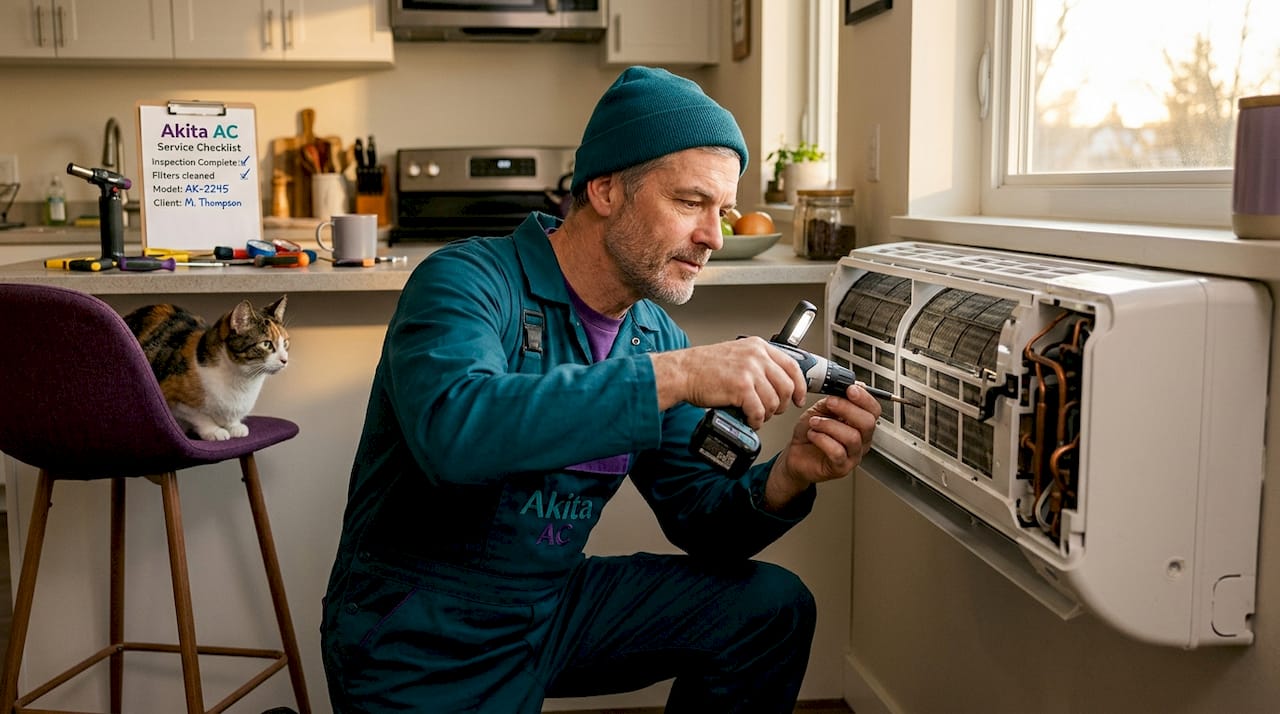
A survey of tenants in managed complexes found that 60% were satisfied with AC supply but only 55% were satisfied with maintenance work. That five percentage point gap matters because it tells you that supply and maintenance are experienced as separate things. Having an AC unit is not the same as having a well-maintained one. The same research showed that preventive maintenance practices correlate strongly with positive tenant responses, which is a compelling argument for asking your landlord about their maintenance schedule before you sign a lease.
The most common maintenance failures that lead to tenant complaints are:
- Blocked or dirty filters reducing airflow and increasing energy consumption
- Refrigerant levels that have dropped, causing the system to cool poorly under load
- Drainage blockages leading to water leaks or humidity problems
- Worn fan components creating noise that disrupts sleep
- Faulty thermostats that cause the system to cycle on and off unpredictably
Each of these issues is preventable with routine servicing. Regular HVAC maintenance reduces energy waste and extends system lifespan, which benefits tenants through lower bills and more reliable comfort.
Pro Tip: Before reporting a cooling problem, take a note of the room temperature at different times of day and keep a brief log. Specific data gives your landlord far less room to dismiss the complaint as vague.
Smart technology and the comfort difference
Not all air conditioning systems are created equal, and the gap between a basic unit and a smart adaptive system is measurable in tenant satisfaction terms.
Smart HVAC systems use IoT sensors to continuously monitor temperature, humidity, and occupancy. Rather than simply switching on at a set time and running at a fixed output, they respond to real conditions inside your home. Adaptive HVAC buildings show lower mean PPD values and higher occupant satisfaction scores compared to conventionally controlled systems.
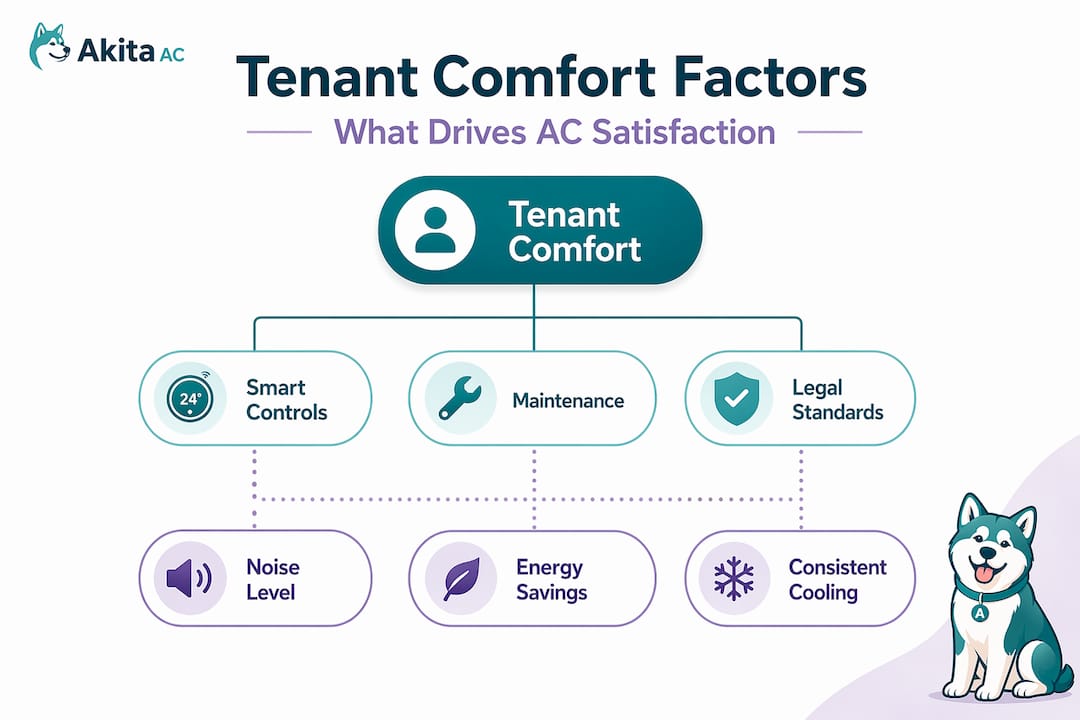
The practical benefit for you as a tenant is consistency. Conventional systems tend to overshoot and undershoot. The room gets too cold, the system switches off, the temperature climbs back up, and the cycle repeats. That cycling is not just inefficient. Tenant dissatisfaction often arises from brief discomfort peaks rather than average temperature failure. You might not notice that your flat averaged 22 °C over a week, but you will absolutely notice the twenty minutes every afternoon when it climbs to 27 °C before the unit kicks back in.
Key features to look for or ask about in rental properties:
- Programmable scheduling so the system cools your home before you return from work
- Individual zone controls if the property is large enough to have distinct rooms with different heat loads
- Remote access via a smartphone app so you can adjust settings without being present
- Humidity monitoring because high humidity at moderate temperatures still feels uncomfortably warm
The energy efficiency angle matters to you directly. Smart systems reduce energy consumption significantly, and if your tenancy agreement passes utility costs to you, a more efficient system means lower bills for the same level of comfort.
Legal standards and your rights as a renter
The legal picture around cooling in rental properties is developing quickly, particularly in regions experiencing more frequent and intense heatwaves. Understanding where the law currently sits helps you frame conversations with your landlord much more effectively.
| Jurisdiction | Legal standard | Tenant remedy |
|---|---|---|
| New York City | Landlords must maintain max 78 °F indoors; AC provision on request by 2030 | Complaint to Housing Preservation and Development |
| California | SB 655 treats excessive heat as a habitability violation | Rent withholding and repair-and-deduct actions |
| UK (general) | Implied duty of habitability; no single national cooling standard | Environmental Health referral; Housing Health and Safety Rating System |
| EU member states | Varies by country; increasingly linked to energy performance certificates | National tenancy tribunal or housing authority |
The UK position is worth noting for renters here. While there is no single statutory temperature threshold for cooling in the way there is for heating, the Housing Health and Safety Rating System (HHSRS) includes excess heat as a category of hazard. If your home regularly reaches temperatures that affect your health during summer, your local Environmental Health team can assess whether the property meets habitability standards.
The broader lesson from places like California and New York is that framing your cooling needs with specific temperature targets rather than vague descriptions of feeling warm produces better outcomes. “The bedroom reached 32 °C at 2 pm on Tuesday” is a complaint that demands a response. “It feels a bit hot sometimes” is easy to dismiss.
Practical steps to improve your situation
You have more influence over your cooling comfort than you might think, even as a tenant without ownership of the property. The key is being specific, proactive, and organised.
Here is where most tenants go wrong: they wait until the system fails completely before saying anything. By that point, summer is already miserable. The smarter approach is to get ahead of problems before peak season arrives.
- Review your tenancy agreement to confirm whether AC maintenance is your responsibility or your landlord’s, and which system components are covered
- Report issues in writing rather than verbally, so there is a clear record with timestamps
- Request a copy of the last service record for the AC unit. A landlord who cannot provide one probably has not had the system serviced recently
- Ask about HVAC maintenance schedules before you agree to a new tenancy rather than discovering the gap afterwards
- Document temperature readings during any periods you consider uncomfortably warm, ideally at multiple times of day and in multiple rooms
If you want to go further and request a smart thermostat or an upgraded system, framing it as a mutual benefit works better than framing it as a demand. Energy-efficient systems reduce running costs and maintenance callouts for landlords. If you can make that case clearly, you are more likely to get a positive response.
Pro Tip: When asking for AC upgrades, reference energy savings from modern HVAC to show your landlord the financial case. A well-maintained, efficient system costs less to run and reduces the risk of expensive emergency repairs.
My perspective on what really drives tenant comfort
In my experience working with residential clients across Suffolk, Norfolk, and Essex, the most common source of frustration is not that the AC does not exist. It is that the AC exists but nobody has looked after it.
I have seen tenants swelter through summer in properties where the unit had not been serviced in three or four years. The system was technically present. It was technically running. But clogged filters, low refrigerant, and an erratic thermostat combined to produce a living environment that felt barely better than no cooling at all. When I ask tenants to describe what bothers them most, the answer is rarely “the temperature was too high on average.” It is almost always about those specific moments: lying awake at midnight in a room that will not cool down, or coming home from work to find the flat stifling.
What I have learned is that perceived control is genuinely undervalued in these conversations. Tenants who can adjust their own system, even by a degree or two, report higher satisfaction than tenants in technically better-conditioned spaces where the controls are locked. That is not a minor psychological quirk. It is a consistent, documented pattern that landlords and property managers would do well to take seriously.
My honest advice is this: do not accept vague reassurances. Ask for service records. Document problems with data. Know that the law is increasingly on your side when it comes to cooling standards, and use that knowledge confidently but constructively.
— Akita
Upgrade your comfort with professional AC support
If your rental’s air conditioning is underperforming or your landlord is exploring options for a proper system upgrade, professional installation and maintenance makes a measurable difference to daily comfort.
Akita specialises in domestic air conditioning installation across Suffolk, Norfolk, and Essex, with energy-efficient systems designed for residential properties of every size. Whether you are a tenant pushing for a better setup or a landlord looking to improve your property’s appeal and meet habitability standards, Akita offers fixed-price installation, ongoing maintenance plans, and smart system options that take the guesswork out of indoor climate control. Get in touch to find out which solution fits your property.
FAQ
Does air conditioning always guarantee tenant comfort?
No. Research shows that tenants can report dissatisfaction even when temperature and humidity are within recommended ranges, because perceived control and individual preferences also shape comfort.
How often should AC in a rental property be serviced?
Most systems benefit from annual servicing, ideally before summer. Regular maintenance prevents the most common causes of tenant complaints, including poor airflow, uneven cooling, and unexpected breakdowns.
Can a tenant legally complain about inadequate cooling in the UK?
Yes. Excess heat is assessed under the Housing Health and Safety Rating System as a potential hazard. Tenants can refer serious cases to their local Environmental Health team if a landlord fails to act.
What makes smart AC better for tenant satisfaction?
Smart systems maintain more consistent conditions by responding to real-time temperature and occupancy data, reducing the short but uncomfortable spikes that conventional systems frequently cause.
How should I report a cooling problem to my landlord?
Put the complaint in writing, include specific room temperature readings and the times they were recorded, and reference any relevant clauses in your tenancy agreement. Specific, documented requests resolve faster than vague descriptions of discomfort.