

HVAC tips for business owners: 2026 practical guide
TL;DR:
- Commercial HVAC management significantly impacts energy costs and air quality in businesses. Regular preventive maintenance, thermostat control, and proper documentation help optimize system performance and compliance. Implementing these practices reduces failures, extends equipment lifespan, and ensures legal and warranty protection.
Commercial HVAC management is the single biggest controllable factor in a business’s energy bill and indoor air quality. The best hvac tips for business owners centre on three pillars: preventive maintenance, thermostat control, and documented service records. Commercial systems without preventive maintenance consume 15–25% more energy and fail 40% earlier than maintained equivalents. ASHRAE standards, EPA 608 refrigerant regulations, and tools like OxMaint give businesses the framework to move from reactive repairs to planned, cost-effective climate control.
1. Schedule preventive maintenance twice a year, minimum
The industry standard for commercial buildings calls for professional HVAC inspections every spring and autumn. Spring checks prepare cooling systems before peak summer demand. Autumn checks ready heating before the coldest months arrive.
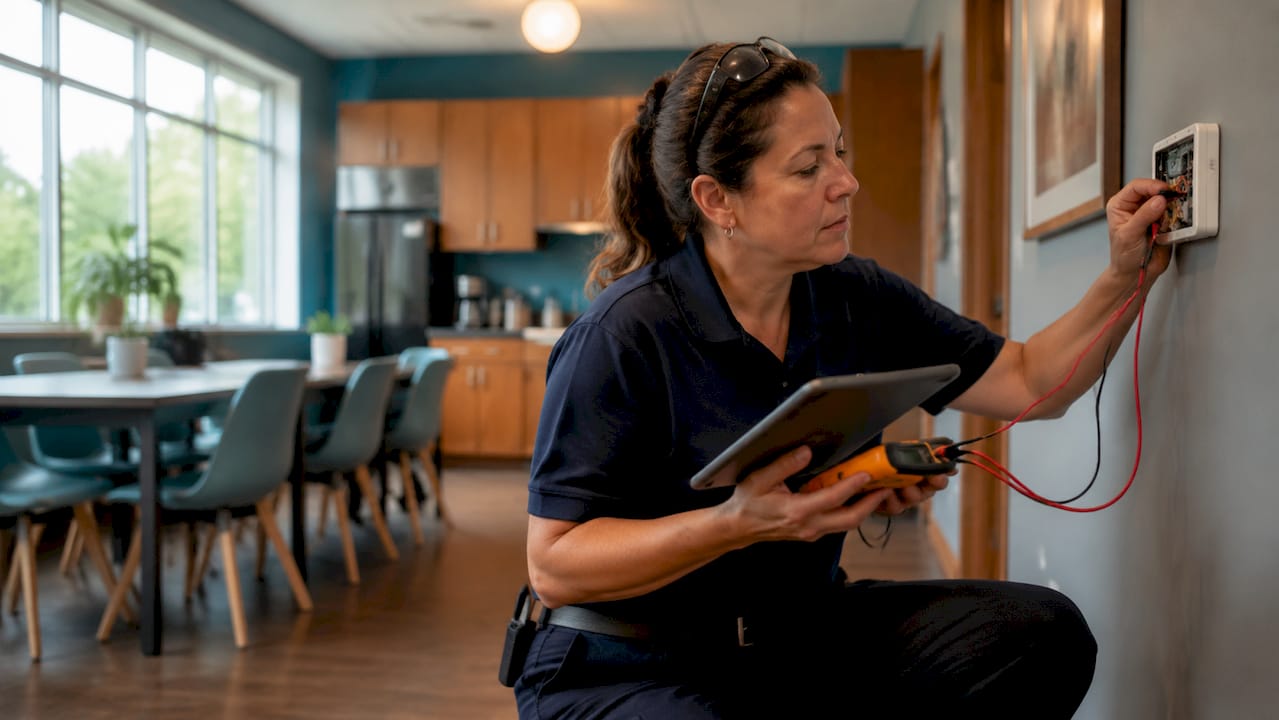
Each visit should cover coil cleaning, refrigerant level checks, belt inspections, and filter replacements. Dirty coils force the compressor to work harder, driving up electricity consumption. A refrigerant leak left unchecked will eventually cause a full system failure at the worst possible time.
For high-risk environments such as server rooms, food preparation areas, or care facilities, quarterly or even monthly checks are appropriate. The occupancy risk and the cost of downtime should drive your maintenance frequency decision, not budget convenience.
Pro Tip: Treat a maintenance agreement like business insurance. The priority response clauses alone, typically 4–24 hour call-out windows during peak seasons, are worth the contract fee when your system fails on the hottest day of July.
2. Use thermostat scheduling to cut energy costs by 10%
Adjusting your thermostat by 7–10°F for 8 hours daily reduces heating and cooling costs by roughly 10%. That figure applies whether you use a programmable thermostat or a building management system (BMS). The key is consistency.
Set temperatures to drop or rise during unoccupied hours, overnight, and at weekends. A typical office building sits empty for 16 hours a day. Running full heating or cooling through those hours is pure waste.
Modern programmable thermostats from manufacturers such as Honeywell and Ecobee allow zone-by-zone scheduling. Zones let you cool a busy server room independently from an empty boardroom, which compounds the savings further.
3. Optimise controls and seal ducts for fast ROI
Optimising existing controls and schedules delivers full return on investment within 1–3 years without expensive hardware upgrades. This is one of the most overlooked HVAC cost-saving strategies available to business owners.
Start with your economiser. A faulty economiser damper that stays closed prevents free cooling from outside air, forcing the refrigeration circuit to run unnecessarily. Fixing a stuck damper costs very little but can save thousands annually.
Duct sealing is equally high-value. Leaky ductwork in a typical commercial building wastes 20–30% of conditioned air before it reaches the occupied space. Mastic sealant or foil tape applied to accessible joints is a low-cost intervention with immediate results.
- Check economiser dampers for correct operation each service visit
- Seal accessible duct joints with mastic or foil tape
- Tighten temperature setpoints to match actual occupancy schedules
- Disable heating and cooling in unoccupied zones automatically
- Review BMS logic annually to remove outdated override settings
Pro Tip: A digital asset management system that tracks serial numbers, installation dates, and service history transforms reactive repairs into predictive maintenance. Tools like Xenia or OxMaint centralise this data and flag upcoming service needs automatically.
4. Upgrade filtration and meet ASHRAE 62.1 ventilation standards
Poor ventilation increases sick days, tenant complaints, and occupant health issues in commercial buildings. The ASHRAE 62.1 standard sets minimum outdoor air supply rates for different occupancy types. Meeting it is not optional for most commercial premises in the UK.
Filter upgrades are the fastest way to improve indoor air quality. Moving from a basic G4 panel filter to an F7 or F9 bag filter captures finer particles including dust, pollen, and airborne pathogens. Higher-grade filters do increase static pressure, so confirm your fan can handle the additional resistance before upgrading.
Ventilation commissioning is a quality assurance step most businesses skip. Commissioning verifies that air volumes, temperatures, and pressures match design specifications. A system that was correctly designed but poorly commissioned can still deliver poor air quality and uneven comfort across floors.
- Replace filters on schedule, not just when they look dirty
- Upgrade to F7 or F9 filtration where occupancy density is high
- Commission ventilation systems after any significant modification
- Monitor CO2 levels as a proxy for ventilation adequacy
- Balance supply and extract air volumes to prevent pressure imbalances
5. Understand your compliance obligations
Documented maintenance per ASHRAE Standard 180 and IMC code is a regulatory requirement, not merely best practice. Auditors examine service records, not just system condition. A well-maintained system with no paperwork fails a compliance audit just as surely as a neglected one.
EPA 608 in the US and F-Gas regulations in the UK require refrigerant handling logs for every service visit involving refrigerant recovery or recharge. These logs must be retained and produced on request. Failure to maintain them carries financial penalties.
Warranty coverage is equally at risk. Equipment warranties on commercial HVAC systems typically require a documented service history aligned with ASHRAE 180. Missing records can void manufacturer coverage on a system worth tens of thousands of pounds.
Building owners often mistake HVAC maintenance for optional expenditure, overlooking the legal and insurance risks of undocumented upkeep. One missed service record can void a warranty or trigger a compliance penalty that far exceeds the cost of the maintenance itself.
6. Structure your service agreement strategically
A commercial preventive maintenance agreement is a strategic business decision, not a transactional purchase. The right agreement converts unpredictable repair bills into a fixed, budgetable cost. It also secures priority response times when your system fails during a heatwave or cold snap.
When evaluating agreements, look for these features:
- Defined response times: 4–24 hours for emergency call-outs during peak seasons
- Included scope: Confirm whether coil cleaning, refrigerant checks, and filter replacements are included or billed separately
- Documentation provision: The contractor should supply written service reports after every visit
- Replacement planning: Good agreements include forward-looking asset condition reports to help you budget for replacements
A structured maintenance programme also supports insurance claims. Insurers increasingly require evidence of regular upkeep before settling claims related to HVAC failures.
7. Identify early warning signs before failures occur
Five degradation mechanisms cause over 93% of unplanned HVAC failures. These are refrigerant faults, heat transfer fouling, mechanical wear, electrical degradation, and controls failure. Monitoring for early signs of each prevents costly emergency breakdowns.
Approach temperature monitoring is the most powerful predictive tool for chiller-based systems. Approach temperature is the difference between the leaving chilled water temperature and the refrigerant evaporating temperature. A rising approach temperature signals fouling or refrigerant loss, typically three months before a full failure occurs.
For simpler split systems and packaged units, these daily and weekly checks catch problems early:
- Check supply air temperature against setpoint. A deviation of more than 2°C warrants investigation.
- Monitor filter pressure drop using a differential pressure gauge or BMS alert. A blocked filter starves the system of airflow.
- Listen for unusual noise from fan motors and compressors. Bearing wear announces itself before it causes failure.
- Inspect condensate drain trays monthly. Blocked drains cause water damage and mould growth inside air handling units.
- Log discharge air temperatures weekly. Consistent records make anomalies obvious.
Pro Tip: Integrate your HVAC monitoring with a BMS or a digital maintenance platform. Automated alerts triggered by temperature deviations or pressure anomalies let you raise a work order before a fault becomes a failure.
8. Train staff on basic HVAC awareness
Staff behaviour directly affects HVAC performance. Employees who block air vents with furniture, prop open fire doors, or override thermostat settings undermine even the best-maintained system. A 30-minute induction covering HVAC basics pays dividends across the life of the building.
Cover three points in any staff briefing. First, explain why thermostat overrides waste money and create comfort complaints elsewhere in the building. Second, show staff where air supply and return grilles are located so they avoid blocking them. Third, explain the reporting process for unusual smells, noises, or temperature complaints so faults reach the facilities team quickly.
Facilities managers at organisations like the NHS and major retail chains build HVAC awareness into their onboarding programmes. The principle scales down to any size of business. A well-informed team is a free layer of building monitoring.
9. Plan for seasonal HVAC checklists
A seasonal HVAC checklist removes the risk of forgetting critical tasks. Spring and autumn are the two most important service windows, but each season has its own priorities. Following a seasonal servicing approach keeps your system ready for whatever the British weather delivers.
Spring checklist priorities: Test cooling mode, clean condenser coils, check refrigerant charge, inspect outdoor units for winter debris, and verify economiser operation.
Autumn checklist priorities: Test heating mode, inspect heat exchangers, check gas connections where applicable, clean indoor coils, and verify controls scheduling for shorter daylight hours.
Keeping a digital log of each completed checklist item creates the documented service history that ASHRAE 180, warranty providers, and insurers all require.
Key takeaways
Effective commercial HVAC management requires preventive maintenance, documented compliance, and proactive monitoring to reduce costs, extend equipment life, and protect indoor air quality.
| Point | Details |
|---|---|
| Preventive maintenance frequency | Schedule professional inspections every spring and autumn as a minimum; increase to quarterly for high-risk sites. |
| Thermostat scheduling savings | Adjusting temperature by 7–10°F for 8 hours daily cuts energy costs by roughly 10%. |
| Controls and duct optimisation | Fixing economisers and sealing ducts delivers full ROI within 1–3 years at low capital cost. |
| Compliance documentation | ASHRAE 180 and F-Gas records are legal requirements; missing paperwork can void warranties and trigger penalties. |
| Early warning monitoring | Approach temperature and filter pressure drop monitoring can predict failures months in advance. |
Akita’s view on getting HVAC management right
Most business owners I speak with treat HVAC maintenance as a cost to defer. That thinking is understandable when cash flow is tight, but it consistently produces the worst financial outcome. A skipped service that voids a warranty on a £15,000 rooftop unit is not a saving. It is a liability.
The businesses that manage HVAC well share one habit: they document everything. Service records, filter change dates, refrigerant logs, and fault histories. That documentation is not bureaucracy. It is the evidence base that supports warranty claims, satisfies compliance audits, and tells you when a unit is approaching end of life before it fails on a Friday afternoon.
I have also seen businesses invest in expensive new equipment when their existing system simply needed controls tuning and duct sealing. The energy saving potential in most commercial buildings is substantial and largely untapped. Start with what you have before committing capital to replacement.
The combination of a structured maintenance agreement, a seasonal checklist, and basic staff awareness covers the vast majority of what goes wrong in commercial HVAC. Technology like BMS integration and digital asset tracking adds a further layer, but the fundamentals come first. Get those right and the system largely looks after itself.
— Akita
How Akita supports commercial HVAC for businesses
Running a commercial building in Suffolk, Essex, or Norfolk means your HVAC system faces real seasonal pressure. Akita provides commercial air conditioning installation and maintenance with fixed-price transparency and expert engineers who understand the compliance and efficiency demands facing business owners today.
Akita’s commercial maintenance agreements include documented service reports, priority response times, and forward-looking asset condition assessments. Whether you need a new system installed or a structured maintenance programme for an existing one, Akita delivers the expertise and paperwork trail your business needs. Contact Akita to discuss a maintenance agreement or installation quote for your commercial premises.
FAQ
How often should a commercial HVAC system be serviced?
The industry standard is a minimum of twice yearly, in spring and autumn. High-risk environments such as server rooms or care facilities require quarterly or monthly inspections.
What is the fastest way to reduce commercial HVAC energy costs?
Thermostat scheduling and controls optimisation deliver the fastest results. Adjusting temperature setpoints by 7–10°F during unoccupied hours reduces energy costs by roughly 10% with no hardware investment.
Is HVAC maintenance documentation legally required for UK businesses?
Yes. F-Gas regulations require refrigerant handling logs for any system containing fluorinated gases. ASHRAE Standard 180 documentation is also required for compliance audits and is typically mandated by equipment warranties.
What are the most common causes of commercial HVAC failure?
Five degradation mechanisms cause over 93% of unplanned failures: refrigerant faults, heat transfer fouling, mechanical wear, electrical degradation, and controls failure. Structured preventive maintenance addresses all five.
How do I know if my HVAC system needs replacing rather than repairing?
A forward-looking asset condition report from a qualified engineer is the most reliable guide. As a rule of thumb, if repair costs exceed 50% of replacement value and the unit is over 15 years old, replacement is usually the better financial decision.