

HVAC load calculation explained for homeowners
TL;DR:
- Proper HVAC load calculation is essential to avoid costly oversizing or undersizing that affects comfort and efficiency. Manual J and N provide accurate, room-specific assessments by considering sensible and latent loads, insulation, and air infiltration, unlike rough rules of thumb. Contractors using these standards ensure reliable performance, energy savings, and longer equipment lifespan, making detailed load analysis a vital step before installation.
Most people assume that a bigger air conditioning system will keep them more comfortable. It is one of the most costly misconceptions in the industry. Understanding what is HVAC load calculation is the single most important thing you can do before investing in any heating or cooling system. Get it right and you have a comfortable, efficient property for years. Get it wrong and you are paying over the odds on energy bills while living in a home that is never quite right.
Table of Contents
- Key takeaways
- What is HVAC load calculation?
- Why rule-of-thumb sizing causes real problems
- How the calculation is actually performed
- From calculation to equipment: the full process
- Quick reference: sizing methods compared
- My perspective on why this gets ignored
- Get accurate HVAC sizing from Akita
- FAQ
Key takeaways
| Point | Details |
|---|---|
| Load calculation defines system size | It determines exactly how many BTUs your property needs, preventing costly oversizing or undersizing. |
| Manual J and Manual N are the gold standards | These industry methods replace inaccurate rule-of-thumb sizing that carries 40-60% error rates. |
| Sensible and latent loads both matter | Temperature control alone is not enough; humidity loads must be calculated separately for proper comfort. |
| The process goes beyond one calculation | Manual J, Manual S, and Manual D must be completed in sequence for the best system performance. |
| Accurate data inputs are non-negotiable | Insulation levels, window orientation, and air leakage figures all directly affect the final result. |
What is HVAC load calculation?
HVAC load calculation is the engineering process used to determine the precise heating and cooling capacity a building requires to maintain comfortable conditions throughout the year. The result is expressed in BTUs per hour (BTU/h), and one ton of cooling equals 12,000 BTU/h. This figure then drives every decision about which equipment you buy and how your system is designed.
Two distinct components make up any HVAC heat load assessment. You need to understand both to appreciate why the process is more nuanced than it first appears.
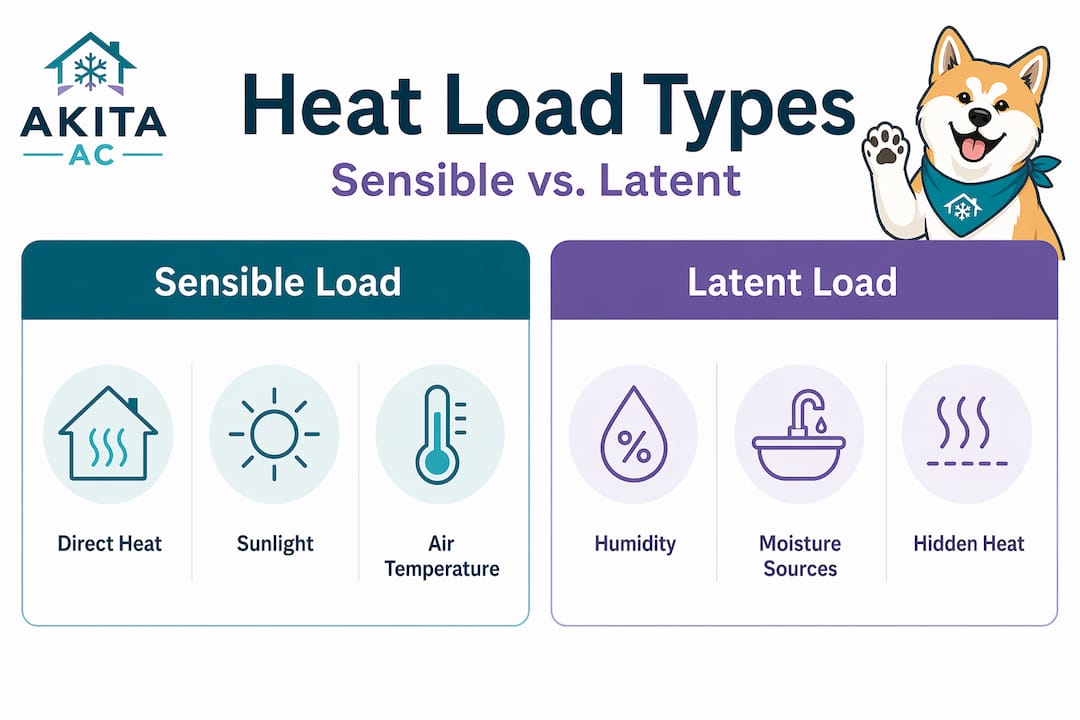
Sensible load refers to heat that directly raises or lowers air temperature. Think of sunlight streaming through a south-facing window on a July afternoon, or the heat radiating from a commercial kitchen into the room next door. Sensible load is what most people picture when they think about heating and cooling.
Latent load refers to moisture in the air. When occupants breathe, cook, or shower, they add water vapour to the indoor environment. Sensible and latent loads must be calculated separately for proper equipment sizing, because a system that only addresses temperature while ignoring humidity will leave you with air that feels muggy and uncomfortable even at the right temperature setting.
The key inputs any calculation must account for include:
- Building dimensions and floor area
- Insulation values in walls, roofs, and floors
- Window size, glazing type, and orientation
- Number of occupants and their activity levels
- Internal heat gains from lighting and appliances
- Local climate data and design temperatures
For residential properties, the recognised standard is Manual J. For commercial buildings, the equivalent is Manual N, which accounts for complex variables like fluctuating occupancy and machinery heat loads. Both methods exist because a detached house in Suffolk and a busy office block in Norwich are profoundly different buildings that need profoundly different analytical approaches.
Why rule-of-thumb sizing causes real problems
You may have encountered contractors who size an HVAC system using a simple square-footage formula. Something like “one ton per 500 square feet” sounds reasonable. The problem is that rule-of-thumb methods carry 40-60% error rates compared to the 95-98% accuracy achieved by a proper Manual J calculation. That gap is not a minor statistical footnote. It translates directly into money wasted and comfort lost.
The oversizing trap
Oversized systems short-cycle, meaning they switch on, reach their set temperature quickly, and shut off before completing a full operating cycle. This feels efficient but it is the opposite. Short cycling means the system never runs long enough to remove humidity from the air, leaving the space feeling damp and clammy. It also puts the compressor under repeated stress, accelerating wear and shortening the equipment’s lifespan significantly.

The undersizing problem
An undersized system faces the opposite challenge. It runs almost continuously during peak conditions and still cannot maintain a comfortable temperature. Your energy bills climb, the equipment degrades from constant operation, and on the hottest or coldest days of the year the system simply cannot cope.
Pro Tip: Ask any contractor quoting for your HVAC installation to show you their load calculation report. If they cannot produce one, or if they quote a system size based purely on square footage, treat that as a red flag and seek a second opinion.
The comparison below shows why the method you choose matters.
| Sizing method | Accuracy | Risk of oversizing | Suitable for |
|---|---|---|---|
| Rule of thumb | 40-60% error rate | Very high | Rough estimates only |
| Manual J | 95-98% accuracy | Very low | All residential properties |
| Manual N | 95-98% accuracy | Very low | Commercial buildings |
How the calculation is actually performed
Understanding what goes into an HVAC load calculation helps you have more informed conversations with installers and ask the right questions. The process is more thorough than most homeowners expect.
The starting point is always a room-by-room analysis rather than a single whole-building average. Manual J is a heat-balance calculation performed room by room, considering three distinct heat transfer mechanisms: conduction (heat passing through solid materials like walls), convection (heat carried by moving air), and radiation (heat transmitted through electromagnetic waves, primarily from solar gain through windows).
Here is what a proper data collection process looks like in practice:
- Measure the building envelope. Every wall, roof section, floor, window, and door is recorded with its dimensions and construction type.
- Assess insulation levels. U-values or R-values for each building element feed directly into the heat transfer calculations.
- Record window specifications. Orientation, glazing type, and any shading devices all affect solar heat gain significantly.
- Conduct a blower door test. Accurate infiltration data from blower door tests significantly improves calculation accuracy. Guessing air leakage rates is one of the most common causes of oversized systems.
- Document occupancy patterns. The number of people in a space, and when they are there, contributes meaningfully to both sensible and latent loads.
- Record appliance and lighting heat gains. A commercial kitchen or server room produces substantial internal heat loads that must be included.
The calculation also uses design day weather data, typically the outdoor temperature exceeded only 1% of the time in a given location. ASHRAE recommends hourly calculations across months rather than single design day snapshots, because peak system load may not coincide with the hottest month due to solar angles and internal gain patterns shifting throughout the year.
Once the sensible and latent loads are established, the engineer calculates the Sensible Heat Ratio (SHR), which is the sensible load divided by the total load. SHR mismatch affects dehumidification performance, causing either muggy conditions or costly reheating even when the total system capacity looks correct on paper.
From calculation to equipment: the full process
The load calculation itself is only the foundation. What follows determines whether that careful analysis actually translates into a well-performing system.
Manual J, Manual S, and Manual D must be completed in sequence for the best results:
- Manual J establishes the heating and cooling loads for each room and the whole building.
- Manual S uses those load results to select equipment with the right capacity and SHR characteristics.
- Manual D designs the ductwork to deliver the correct amount of conditioned air to each room based on its individual load.
Skipping Manual S means your contractor selects equipment based on habit or availability rather than your building’s specific needs. Skipping Manual D means the ductwork may deliver too much air to some rooms and not enough to others, regardless of how accurate the original load calculation was. The impact of getting HVAC sizing right extends well beyond comfort, affecting energy efficiency, equipment longevity, and indoor air quality for the lifetime of the system.
In the UK, building regulations and installation permits increasingly require documented load calculations as part of the approval process. This means that residential HVAC comfort and costs are directly tied to the quality of the upfront calculation work.
Pro Tip: When reviewing proposals from HVAC contractors, ask specifically whether the quote includes Manual J or Manual N calculations, Manual S equipment selection, and Manual D duct design. A contractor offering all three as part of their process is working to a professional standard.
Signs that a previous installation may have used inaccurate load calculations include: rooms that are consistently too warm or too cold, humidity issues persisting despite the system running correctly, unusually high energy bills relative to the system’s rated efficiency, and the system cycling on and off very frequently.
Quick reference: sizing methods compared
When you are ready to commission an HVAC system, or review an existing one, this comparison gives you a clear reference point.
| Standard | Application | What it covers |
|---|---|---|
| Manual J | Residential buildings | Room-by-room heating and cooling loads |
| Manual N | Commercial buildings | Complex occupancy and machinery loads |
| Manual S | All properties | Equipment selection based on load results |
| Manual D | Ducted systems | Ductwork design and air distribution |
| Rule of thumb | Estimates only | Square footage approximations with high error |
Practical advice when speaking to HVAC contractors:
- Request a written load calculation report, not just a verbal system recommendation.
- Confirm that local design temperature data for your area has been used, not national averages.
- Ask how air infiltration has been measured or estimated.
- Check that latent loads and humidity have been addressed in the calculation, not just sensible temperature loads.
Understanding how UK weather affects HVAC requirements is particularly relevant here, since the UK’s variable and often humid climate means latent loads carry more weight than in drier continental climates.
My perspective on why this gets ignored
In my experience working with homeowners and business owners across Suffolk, Norfolk, and Essex, the most frustrating pattern I see is contractors skipping the full Manual J, S, and D process to save time or win a lower quote. The resulting systems often perform adequately under mild conditions, which means the problem only reveals itself on the hottest summer day or the coldest February night. By then, the installer has moved on and the client is left wondering why their expensive system is not delivering.
What I have learned is that oversizing persists partly because it is the safer business decision for a contractor who has not done the calculation properly. A bigger unit is less likely to cause a complaint in mild weather. But the client pays more upfront, more on every energy bill, and replaces the system sooner. I genuinely believe that any homeowner or business owner who understands the difference between rule-of-thumb sizing and a proper Manual J calculation will make better buying decisions and demand more from their contractors. The calculation is not a bureaucratic checkbox. It is the difference between a system designed for your building and one that happens to have been installed in it.
— Akita
Get accurate HVAC sizing from Akita

At Akita, every installation begins with a proper load assessment using Manual J for residential properties and Manual N for commercial buildings. We do not guess system sizes and we do not rely on square-footage rules of thumb. Our certified engineers gather the real data your building requires, from insulation values to infiltration rates, and produce a documented calculation that supports both permit approval and long-term performance.
Whether you are looking at home air conditioning installation across Suffolk, Essex, and Norfolk or need a commercial HVAC solution sized correctly for your business premises, Akita delivers the full process: Manual J or N, Manual S equipment selection, and Manual D duct design as standard. Contact us today for a consultation and find out exactly what your property needs.
FAQ
What is HVAC load calculation in simple terms?
HVAC load calculation is the process of working out exactly how much heating or cooling capacity a building needs, measured in BTUs per hour. It considers factors like insulation, window size, occupancy, and local climate to determine the right system size.
How long does an HVAC load calculation take?
For a typical residential property, a thorough Manual J calculation usually takes between two and four hours to complete on site, plus additional time for software analysis and report preparation. Commercial properties using Manual N take longer due to their added complexity.
What happens if HVAC load calculation is skipped?
Without a proper load calculation, systems are routinely oversized or undersized. Oversized units short-cycle and fail to control humidity, while undersized units cannot maintain comfort during peak conditions, both of which increase energy costs and reduce equipment lifespan.
What is the difference between Manual J and Manual N?
Manual J is used for residential HVAC load estimation and analyses loads room by room. Manual N covers commercial buildings, where variables like fluctuating occupancy, large machinery heat gains, and more complex building geometry require a more involved approach.
Can I estimate my own HVAC load without a professional?
Online calculators can give a rough indication, but they cannot account for your property’s specific insulation levels, actual air leakage, or local climate data accurately. A professional calculation using blower door test data will always be significantly more accurate and is worth the investment before committing to system purchase.