

How to budget for an AC upgrade in 2026: UK homeowners' guide
A single-room split system installed in 2026 typically costs a few thousand pounds all-in; a multi-split covering two or three rooms costs more; and a whole-house ducted system or reversible air-to-air heat pump can be substantially more expensive before grants. Those are your planning brackets. Before you accept any quote, take three immediate steps:
- Ask every installer for their F-Gas company registration certificate and the personal qualification of the technician who will carry out the work. Both are legally required under GB F-Gas regulations.
- Check whether your chosen system qualifies for the Boiler Upgrade Scheme (BUS): air-to-air heat pumps attract a £2,500 upfront voucher; air-to-water heat pumps attract £7,500. The installer claims on your behalf and must show the discount in the quote.
- Collect at least three written, itemised quotes before committing. A single quote gives you no benchmark.
On VAT: installations of eligible energy-saving materials including heat pumps are zero-rated until 31 March 2027, which removes the standard 20% VAT charge from qualifying work in England, Scotland, and Wales. That relief alone can save several hundred pounds on a mid-range install. After 31 March 2027 the rate reverts to 5%.
Table of Contents
- What does an AC upgrade actually cost in 2026? A UK price matrix
- What drives the price of your installation up or down?
- What should a written quote include, and what gets added on?
- Grants, F-Gas legal checks, and 2026 regulatory items you must verify
- How to build a practical budget and financing plan for your upgrade
- Three sample budgets for common UK household upgrades
- How to choose the right installer: questions to ask and red flags to avoid
- How Akita helps homeowners plan and deliver their upgrade
- Key takeaways
- Akita’s fixed-price installations, finance options, and how to get a quote
- Where to verify regulations, grants, and installer certification
What does an AC upgrade actually cost in 2026? A UK price matrix
Installed prices vary more than most homeowners expect, because “installed” means different things to different installers. The table below shows typical all-in ranges for the main system types in 2026, assuming standard access, no major electrical upgrade, and a single-phase domestic supply.
| System type | Typical installed range | What is usually included | Common exclusions |
|---|---|---|---|
| Single-room split (wall-mounted) | £2,000–£4,500 | Unit, standard labour, commissioning, basic controls | Electrical upgrade, scaffolding, bespoke concealment |
| Multi-split (2–3 rooms, one outdoor unit) | £3,500–£7,000 | Units, pipework, standard labour, commissioning | Additional electrical work, structural penetrations |
| Zoned multi-split (4+ rooms) | Higher thousands of pounds | Multiple indoor units, extended pipework, controls | Dedicated circuit, scaffolding, decorative trunking |
| Whole-house ducted system | High thousands to tens of thousands of pounds | Ductwork, air handling unit, controls, full install | Structural works, ceiling access, specialist electrical |
| Reversible air-to-air heat pump | Mid-thousands of pounds | Unit, install, commissioning | MCS certification fee (if BUS claim required), electrical |
Prices at the lower end of each band typically reflect a straightforward installation: ground-floor access, short pipe runs, no existing system to remove. The upper end reflects longer runs, difficult access, or premium-tier equipment.
Manufacturer choice and unit cost
The brand of indoor and outdoor unit affects equipment cost but not your legal compliance obligations. Mitsubishi Electric and Daikin sit at the premium end of the residential market, with units that carry longer manufacturer warranties and higher SCOP ratings. LG and Toshiba offer strong mid-range options with competitive efficiency figures. None of these choices changes the F-Gas or MCS requirements your installer must meet. What they do change is the equipment line item in your quote, which can shift the total by £300–£1,000 per indoor unit depending on the model tier.
For a deeper look at air conditioning upgrades in 2026 and which system types suit different property layouts, Akita’s 2026 upgrade guide covers the options in detail.
What drives the price of your installation up or down?
Most homeowners focus on the unit price. The installation variables are what actually separate a £2,000 quote from a £4,500 quote for the same room.
The main cost drivers
- System type and capacity: A 2.5 kW wall-mounted split for a bedroom costs far less than a 7 kW cassette for an open-plan kitchen-diner. Oversizing or undersizing adds cost either way.
- Property size and layout: More rooms, longer pipe runs between indoor and outdoor units, and awkward routing through walls or ceilings all add labour time and materials.
- Existing infrastructure: If you already have refrigerant pipework from a previous system, a like-for-like replacement is cheaper. Starting from scratch in a solid-wall Victorian terrace is not.
- Electrical work: Many older properties need a dedicated circuit or consumer unit upgrade before an AC system can be safely connected. Budget £300–£800 for this separately if your installer flags it.
- Access and scaffolding: Outdoor units on upper floors or flat roofs may require scaffold or a cherry picker. This can add £400–£1,200 to a job that looks simple on paper.
- Refrigerant type and quantity: Systems using lower-GWP refrigerants (R-32 is now standard on most new residential units) are cheaper to charge than older R-410A systems, but the handling and recovery costs are still a line item.
- Labour rates and regional demand: Rates in London and the South East run higher than in Suffolk, Norfolk, or Essex. Summer bookings attract a premium because demand peaks. Scheduling in spring or autumn often secures a better price.
Cost driver checklist for comparing quotes
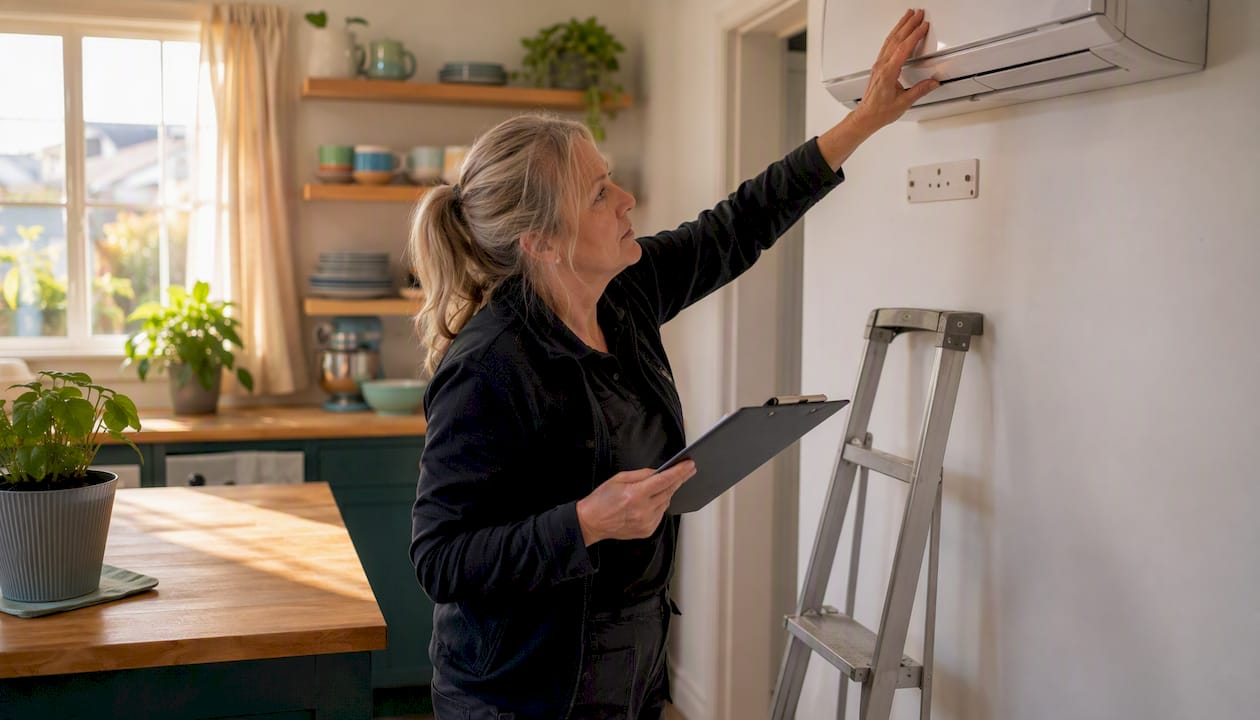
When you receive a quote, check that it specifies: pipe run length and route, electrical work scope, refrigerant type and charge weight, access method for the outdoor unit, and whether old equipment disposal is included. Any quote that omits these is incomplete.
Pro Tip: Add a 15% contingency to your working budget before you start collecting quotes. Supply chain delays on specific outdoor unit models, unexpected electrical work, or a longer-than-quoted pipe run are the three most common reasons a job runs over. Having that buffer means you can say yes to a good installer without renegotiating mid-project.
What should a written quote include, and what gets added on?
A quote that arrives as a single lump sum is not a quote. It is a number. A compliant, comparable written quote should contain all of the following as separate line items.
Core line items every quote must show
- Equipment make, model number, and rated capacity (kW) for every indoor and outdoor unit
- Labour: installation, commissioning, and testing
- Refrigerant: type, charge weight, and handling/recovery costs
- Warranty: manufacturer warranty period and any installer workmanship guarantee, including conditions that could void it
- F-Gas compliance: confirmation that the installer holds company registration and that the technician holds personal qualifications
- VAT: shown separately, with the rate applied (0% for qualifying heat pump installs until 31 March 2027, or 20% for standard cooling-only systems)
Common add-ons to budget for separately
- Electrical upgrade or dedicated circuit (£300–£800)
- Scaffolding or access equipment (£400–£1,200)
- Structural penetrations or core drilling through masonry (£150–£400)
- Condensate drainage run (£100–£300 depending on length)
- Decorative trunking or bespoke concealment (£200–£600)
- Smart controls or app-enabled thermostats (£100–£400 per zone)
- Extended manufacturer warranty beyond the standard period (£150–£500)
- Removal and disposal of old equipment (£100–£250)
Sample quote breakdown for a single-room split (2026 reference)
| Line item | Indicative cost |
|---|---|
| Mitsubishi Electric 2.5 kW wall unit + outdoor unit | £300–£800 |
| Installation labour and commissioning | £400–£600 |
| Refrigerant charge and F-Gas handling | £80–£150 |
| Electrical connection (standard) | £100–£200 |
| Condensate drainage | £80–£150 |
| Disposal of old unit (if applicable) | £100 |
| VAT (0% if qualifying heat pump; 20% if cooling-only) | £0 or £400–£1,200 |
Use this as a reference when requesting quotes. If a quote comes in significantly below this range with no explanation, ask which line items have been omitted.
For ideas on optional upgrade features worth including in your quote request, Akita’s guide to must-have home upgrades covers smart controls, zoning, and efficiency add-ons.
Grants, F-Gas legal checks, and 2026 regulatory items you must verify
This is the section most homeowners skip. It is also the one that can reduce your net cost by thousands of pounds or expose you to a voided warranty and a compliance problem at resale.
Boiler Upgrade Scheme (BUS) grants in 2026
The BUS provides upfront vouchers that installers must claim and pass on as an immediate discount in the quote. You do not apply directly. The grant values confirmed from 21 July 2026 are:
- Air-to-water heat pumps: £7,500 off the installed price
- Ground-source heat pumps: £7,500 off the installed price
- Air-to-air heat pumps: £2,500 off the installed price
The installer must be MCS-certified to claim a BUS voucher. If your installer is not MCS-registered, you cannot access the grant regardless of which system you choose. Always ask for MCS accreditation number before signing anything.
One important caution: not all heat pump types qualify. Exhaust air-to-air heat pumps, for example, have historically been ineligible because they cannot achieve MCS certification. Verify that the specific model your installer proposes is approved before you build the grant into your budget.
F-Gas certification: the legal baseline
F-Gas certification is a legal requirement for any business or individual installing, servicing, or repairing air conditioning and heat pump systems that contain fluorinated refrigerants in the UK. This means two separate checks:
- The company must hold a valid company registration certificate (via REFCOM or an equivalent certifying body).
- The individual technician carrying out the work must hold a personal F-Gas qualification.
Personnel working on systems with 3 kg or more of HFC refrigerant must hold Category I qualifications. Most domestic split systems fall into this category. Company certificates are valid for a minimum of three years, and sole traders are treated as legal persons who need their own company certificate.
Verification checklist
- Ask the installer to provide their REFCOM (or equivalent) company registration number and confirm it is current.
- Ask for the name and personal qualification certificate number of the technician who will carry out the work.
- Check the REFCOM member register online before the job starts.
- If claiming BUS, check the installer’s MCS accreditation number on the MCS register at mcscertified.com.
- Keep copies of all certificates. You will need them for warranty claims, future property sales, and insurance purposes.
Pro Tip: Ask your installer to apply for the BUS voucher before commissioning the system, not after. Vouchers must be in place before the installation is completed for the grant to be valid. An installer who suggests commissioning first and sorting the paperwork later is either unfamiliar with the scheme or cutting corners.
VAT relief reminder: The zero rate of VAT on qualifying energy-saving materials applies in England, Scotland, and Wales from 1 April 2022 to 31 March 2027. After that date, the rate reverts to 5%. If your installation is scheduled for late 2026 or early 2027, confirm the commissioning date in writing to lock in the 0% rate.
How to build a practical budget and financing plan for your upgrade
Budgeting for AC replacement is not just about finding the cheapest quote. It is about knowing the full number before you commit, so there are no surprises at invoice stage.
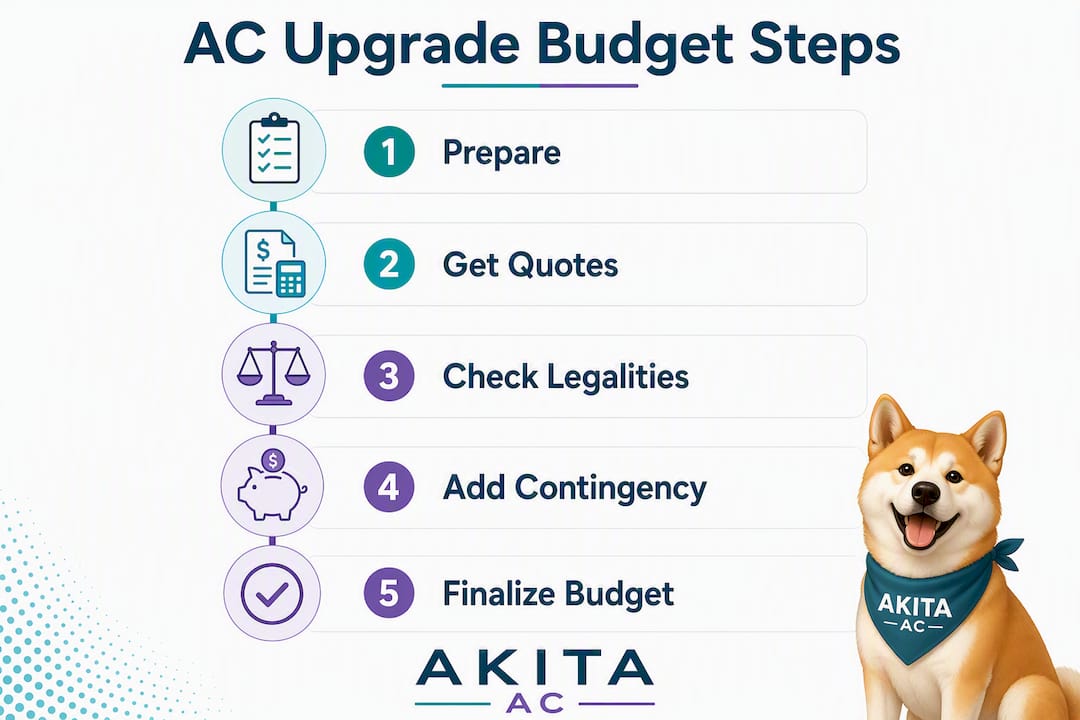
Step-by-step budgeting process
- Assess your needs. Decide how many rooms you want to cool or heat, whether you want heating capability (reversible system), and whether a BUS grant is a realistic option for your property type.
- Obtain three detailed, itemised quotes. Use the line-item checklist from the previous section. Quotes that omit line items are not comparable.
- Apply grant and VAT adjustments. Subtract the applicable BUS voucher value from the gross quote. Confirm whether 0% VAT applies to your installation.
- Add a 15% contingency. Apply this to the net post-grant, post-VAT figure. This covers electrical surprises, access issues, and supply delays.
- Confirm timeline and payment milestones. Agree in writing when the deposit is due, when the balance is payable, and what triggers each payment (typically: deposit on order, balance on commissioning).
- Plan your maintenance budget. Year-one costs are usually low, but factor in an annual service (£80–£150) and filter replacements.
Spreadsheet fields to capture from each quote
| Field | What to record |
|---|---|
| Equipment make, model, and capacity | Exact model number for price comparison |
| Labour and commissioning | Separate from equipment cost |
| Add-ons (electrical, scaffold, drainage) | Itemised, not bundled |
| VAT rate applied | 0%, 5%, or 20% |
| BUS grant deducted | Shown as a line item discount |
| Total net cost | Post-grant, post-VAT |
| Timescale | Weeks from order to commissioning |
| Warranty length | Manufacturer and installer |
Finance options: a short comparison
- Savings: No interest cost, full price transparency. Best if you can cover the net cost without depleting your emergency fund.
- 0% installer finance: Several installers, including Akita, offer interest-free payment plans. Check the term length and whether a credit check applies.
- Personal loan: Rates vary. Useful for larger whole-house installs where the grant does not cover enough of the upfront cost.
- 0% purchase credit card: Works well for single-room installs within the card’s credit limit. Watch the promotional period end date.
- Home improvement loan (secured): Lower rates for larger sums, but your property is at risk if you default. Suitable only for whole-house or commercial-scale projects.
For practical strategies to reduce both upfront and running costs, Akita’s cost-saving HVAC guide for 2026 covers financing approaches alongside efficiency measures.
Three sample budgets for common UK household upgrades
These scenarios are illustrative planning tools. Actual quotes will vary by property, location, and installer.
Scenario A: Single-room split (bedroom or home office)
| Item | Cost |
|---|---|
| Equipment (mid-range, e.g. LG or Toshiba 2.5 kW) | £300–£1,000 |
| Installation labour and commissioning | £400–£600 |
| Electrical connection | £100–£200 |
| Condensate drainage | £80–£150 |
| VAT (20% — cooling-only, not qualifying for 0%) | £400–£1,200 |
| Gross total | £2,000–£4,500 |
| BUS grant (not applicable — cooling-only split) | Not applicable |
| Net cost | £2,000–£4,500 |
| 15% contingency | £300–£675 |
| Budget to set aside | £2,300–£5,175 |

Running costs: a 2.5 kW split used for summer cooling typically adds £80–£150 per year to electricity bills. Annual service: £80–£120. Filter clean: DIY or included in a maintenance plan.
Timeline: 1–3 days from survey to commissioning. Supply delays on specific outdoor unit models can add 2–4 weeks if the model is on back-order.
Scenario B: Multi-split (two-room family home upgrade)
| Item | Cost |
|---|---|
| Equipment (Daikin or Mitsubishi Electric, 2 indoor units) | Low to mid-thousands of pounds |
| Installation labour and commissioning | Mid-thousands of pounds |
| Electrical upgrade (dedicated circuit) | Several hundred pounds |
| Scaffolding (if outdoor unit on upper wall) | Several hundred pounds |
| VAT (0% if reversible heat pump qualifying install) | 0% VAT if qualifying |
| Gross total | Mid-thousands of pounds |
| BUS grant (air-to-air, if MCS-certified installer) | Moderate upfront grant |
| Net cost | Lower thousands |
| 15% contingency | Modest contingency |
| Budget to set aside | Low to mid-thousands of pounds |
Running costs: reversible systems used for both heating and cooling typically save on overall domestic heating demand. Annual service: £100–£150. The energy efficiency benefits of upgrading are most visible in properties currently relying on electric storage heaters.
Timeline: 2–5 days installation. MCS voucher application adds 1–2 weeks to the pre-installation process; plan for this in your scheduling.
Scenario C: Whole-house reversible air-to-water heat pump
| Item | Cost |
|---|---|
| Equipment (air-to-water heat pump, buffer tank, controls) | Several thousand to around ten thousand pounds |
| Installation labour and commissioning | Several thousand pounds |
| Electrical work and dedicated circuit | Several hundred to a thousand pounds |
| Structural and pipework modifications | Several hundred to over a thousand pounds |
| VAT (0% qualifying install until 31 March 2027) | No VAT if qualifying |
| Gross total | Mid-to-high thousands of pounds |
| BUS grant (air-to-water, MCS-certified installer) | Significant upfront grant |
| Net cost | Reduced net cost in thousands |
| 15% contingency | Moderate contingency |
| Budget to set aside | Low to mid-thousands of pounds |
Running costs depend heavily on property insulation and tariff. Annual service: £150–£250. The BUS grant makes this scenario the most financially sensitive to installer MCS status: losing the £7,500 voucher through an uncertified installer doubles the net cost at the lower end.
Timeline: 5–10 days installation. MCS voucher, equipment lead times, and any structural work can extend the project to 6–10 weeks from first survey. Supply chain pressures on heat pump components remain a factor in 2026; order early if you want a spring or early summer commissioning date.
How to choose the right installer: questions to ask and red flags to avoid
The cheapest quote is rarely the best value when the installer is not certified, the warranty is vague, or the BUS voucher process is mishandled.
Questions to ask every installer before signing
- Can you provide your REFCOM (or equivalent) company registration number and the personal F-Gas qualification certificate of the technician doing the work?
- Are you MCS-accredited? If yes, what is your MCS number?
- Have you completed similar installations in my area recently? Can you provide references or examples?
- What is your workmanship warranty, and what conditions could void it?
- What manufacturer warranty does the equipment carry, and do you register it on my behalf?
- How do you handle the BUS voucher process, and at what stage do you apply?
- What insurance do you hold (public liability, employer’s liability)?
- What is your payment schedule, and do you require a deposit before ordering equipment?
Red flags to walk away from
- No F-Gas company certificate or personal qualification provided on request. Every business and individual must hold appropriate certification — an installer who cannot produce it is operating illegally.
- Verbal quotes only, with no written itemised breakdown.
- Pressure to commission before the BUS voucher is issued.
- Unusually low deposit requests (under 10%) with no clear payment milestones, or demands for full payment upfront.
- No local references or examples of recent residential installs.
- Vague warranty terms with no written conditions.
Installer verification steps
Check the REFCOM member register at refcom.org.uk to confirm company registration. Check the MCS register at mcscertified.com for MCS accreditation. Ask to see the technician’s personal qualification certificate before work begins. Keep copies of all certificates, the signed quote, and the commissioning report. These documents matter at the point of property sale, insurance claim, or warranty dispute.
GB F-Gas regulations require that anyone working on F-Gas systems holds their own personal qualifications, even when employed by a certified company. A company certificate alone does not cover an unqualified individual doing the work.
How Akita helps homeowners plan and deliver their upgrade
Akita works with homeowners across Suffolk, Norfolk, and Essex on installations ranging from single-room splits to whole-house reversible heat pump systems. The process starts with a site survey, which is the only reliable way to produce a fixed price: pipe run lengths, electrical supply, access, and existing infrastructure all affect the final number in ways that a phone conversation cannot capture.
What Akita’s service includes
- Fixed-price quotes following a site survey, with all line items shown separately
- F-Gas company registration and individually qualified technicians on every job
- MCS accreditation for BUS-eligible installations, with the voucher process handled on the homeowner’s behalf
- Flexible finance options including interest-free payment plans
- Membership maintenance plans covering annual servicing, priority call-out, and filter checks
- Manufacturer warranties registered on the homeowner’s behalf at commissioning
Akita serves homeowners across Suffolk, Norfolk, and Essex. If you are outside this area, the verification steps and budgeting framework in this guide still apply to any certified local installer you choose.
Key takeaways
A realistic 2026 AC upgrade budget for a UK homeowner starts at £2,000–£4,500 for a single-room split system, and can reach £10,000+ for a whole-house system; BUS grants of up to £7,500 and 0% VAT on qualifying installs can cut the net cost significantly.
| Point | Details |
|---|---|
| Budget ranges by system | Single-room splits: £2,000–£4,500; multi-split (2–3 rooms): £3,500–£7,000; whole-house ducted or heat pump: £8,000–£20,000+. |
| BUS grant impact | Air-to-air heat pumps attract £2,500 off; air-to-water heat pumps attract £7,500 off — both applied as upfront discounts by your MCS-certified installer (as confirmed from 21 July 2026). |
| VAT relief deadline | 0% VAT on qualifying heat pump installations applies until 31 March 2027; confirm commissioning date in writing to lock in the rate. |
| F-Gas is non-negotiable | Both company registration and individual technician qualification are legally required; request certificates before any work begins. |
| Akita’s approach | Akita provides fixed-price quotes after a site survey, handles BUS vouchers, and offers finance plans for homeowners in Suffolk, Norfolk, and Essex. |
The one thing most homeowners get wrong about AC budgeting
The most common mistake is treating the equipment price as the budget. It is not. The equipment is usually 40–60% of the total installed cost on a straightforward job, and on a complex one it can be less than half. The rest is labour, compliance, electrical work, and the contingency you need when the pipe run turns out to be longer than expected or the outdoor unit position requires scaffold.
The second mistake is assuming that a low quote means a good deal. A quote that omits F-Gas handling costs, electrical work, or the commissioning report is not cheaper. It is incomplete. When those items surface mid-project, they surface as variations, and variations are always more expensive than line items agreed upfront.
There is also a timing dimension that most guides ignore. The BUS voucher must be in place before commissioning. An installer who suggests commissioning first and applying for the grant afterwards is either unfamiliar with the scheme or hoping you will not notice the difference. The grant is worth £2,500 or £7,500. It is worth being precise about the sequence.
Air-to-air heat pumps are increasingly worth considering as year-round investments rather than summer-only cooling. Their reversible heating function can reduce overall domestic heating demand, which changes the payback calculation meaningfully for properties currently relying on electric or oil heating. The £2,500 BUS grant for air-to-air systems is modest compared to the £7,500 for air-to-water, but the installation cost is also lower, and the net cost after grant and 0% VAT can make a reversible split system one of the more financially sensible home improvements available in 2026.
Akita’s fixed-price installations, finance options, and how to get a quote
For homeowners in Suffolk, Norfolk, and Essex who want a fixed price rather than a range, Akita’s starting point is a site survey. That survey is what converts the cost brackets in this guide into a number you can actually commit to. It covers pipe run lengths, electrical supply, outdoor unit position, access requirements, and the specific system that fits your property.

Akita installs Mitsubishi Electric, Daikin, LG, and Toshiba systems across the full range of residential applications, from single-room fixed-price installations to multi-room and whole-house heat pump projects. Finance options include interest-free payment plans, and membership maintenance plans are available from commissioning. For BUS-eligible installations, Akita handles the MCS voucher process as part of the job.
To request a site survey and formal fixed-price quote, visit Akita’s domestic air conditioning page. A site visit is required before a final price can be confirmed.
Where to verify regulations, grants, and installer certification
Before you sign a quote or hand over a deposit, check these official sources directly.
- Ofgem Boiler Upgrade Scheme — property owners: — Confirms current grant values, eligibility conditions, and how the installer-led voucher process works. The definitive source for what you are entitled to and what your installer must do.
- GOV.UK — Notice of approved grant categories and values (from 21 July 2026): — The Secretary of State’s formal notice confirming BUS grant categories and values effective from 21 July 2026. Use this to verify the exact grant amount for your system type.
- GOV.UK — Qualifications to work with F-Gas: — The official government guidance on personal qualification requirements for anyone working on F-Gas systems, including installation, servicing, and decommissioning.
- GOV.UK — VAT on energy-saving materials (Notice 708/6): — Explains which installations qualify for 0% VAT and the conditions that apply. Check this before accepting a quote that applies 20% VAT to a heat pump installation.