

Energy efficient HVAC checklist for Suffolk homeowners
TL;DR:
- An efficient HVAC system requires addressing building envelope issues, regular maintenance, and optimal control settings to maximize savings. Homeowners should start with diagnostics, sealing, insulating, and upgrading controls before considering equipment replacement to ensure the best cost-to-benefit ratio. Local grants and incentives can significantly offset upgrade costs for eligible homes in Suffolk, Norfolk, and Essex.
Running an inefficient HVAC system in Suffolk, Norfolk, or Essex doesn’t just push up your energy bills. It means your home is haemorrhaging heat in winter, struggling to stay cool in summer, and working harder than it needs to. An energy efficient HVAC checklist gives you a structured way to spot exactly where your system is letting you down and which fixes will deliver the most meaningful savings. This article walks you through every major action on that checklist, from filter changes and duct sealing to local grant schemes that could cover a significant portion of upgrade costs.
Table of Contents
- Criteria for an energy efficient HVAC system
- Regular maintenance and filter care
- Air sealing and duct insulation checklist
- Thermostat settings and efficient operation
- Grants and local incentives for HVAC upgrades in Suffolk, Norfolk, and Essex
- Comparison of key HVAC efficiency checklist actions
- Rethinking the HVAC efficiency approach for practical homeowner success
- Achieve energy efficient HVAC with expert installation and maintenance
- Frequently asked questions
Criteria for an energy efficient HVAC system
Before you start ticking boxes, you need to know what you’re actually measuring against. The most common mistake homeowners make is focusing on the HVAC unit itself while ignoring everything around it. Your system’s efficiency is only as good as the envelope it’s working within.
The first principle worth understanding is that energy savings are limited by the largest energy consumer in the home, so targeting HVAC and building envelope improvements together produces far better results than tackling either in isolation. In practical terms, that means insulating your loft and sealing draughty windows alongside servicing your heat pump or air conditioning unit.
Here are the core criteria to evaluate when building your checklist for HVAC efficiency:
- Audit your energy bills first. Identify which months show the biggest spikes. If your bills peak in January and July, your heating and cooling are your primary targets.
- Assess your building envelope. Poorly insulated walls, gaps around door frames, and unsealed loft hatches all force your HVAC system to compensate.
- Check your controls. A system controlled by an outdated thermostat, or no thermostat at all, will cycle inefficiently regardless of how modern the equipment is.
- Plan professional maintenance annually. Regular servicing catches refrigerant issues, dirty coils, and electrical faults before they compound into expensive repairs.
- Book a home energy audit. This is the single most useful starting point for any homeowner in Suffolk, Norfolk, or Essex who wants a data-driven improvement plan.
A good HVAC diagnostics guide can help you understand what a professional will assess and which findings matter most for your home.
Regular maintenance and filter care
Maintenance is unglamorous but genuinely transformative. A system that hasn’t been serviced in two years is likely running at a fraction of its potential efficiency, even if it was top-of-the-range when installed.
The U.S. Department of Energy recommends that homeowners clean or replace filters in furnaces, air conditioners, and heat pumps regularly and arrange annual professional maintenance. This applies equally to UK systems. A clogged filter restricts airflow, forces the fan motor to work harder, and can cause the heat exchanger or evaporator coil to overheat or freeze, respectively.
Step-by-step filter and maintenance routine:
- Check your filter every four weeks. Hold it up to the light; if you can’t see light through it, replace or clean it.
- Keep vents and registers clear of furniture, curtains, and stored items. Blocked registers cause pressure imbalances across the system.
- Wipe down the exterior of indoor units every month to prevent dust from entering the unit during operation.
- Clear any debris from outdoor condenser units, particularly after autumn leaf fall in Norfolk and Suffolk.
- Book a professional service annually, ideally in spring before the summer cooling season or in early autumn before heating season begins.
- Check condensate drain lines for blockages, which can cause water damage and reduce system efficiency.
Pro Tip: If you notice your energy bill creeping up between professional services, check the filter first. A blocked filter is responsible for a surprising proportion of mid-cycle efficiency losses and it takes less than two minutes to inspect.
You can follow a detailed residential HVAC maintenance checklist to make sure nothing gets missed. Understanding the broader case for consistency also helps; there’s solid evidence for why regular HVAC maintenance extends system lifespan and keeps running costs down year on year.
Air sealing and duct insulation checklist
Even a perfectly maintained HVAC unit can’t compensate for a leaky duct network. Ducts running through unheated attic spaces or cold crawlspaces lose a significant portion of conditioned air before it even reaches the rooms you’re trying to heat or cool.
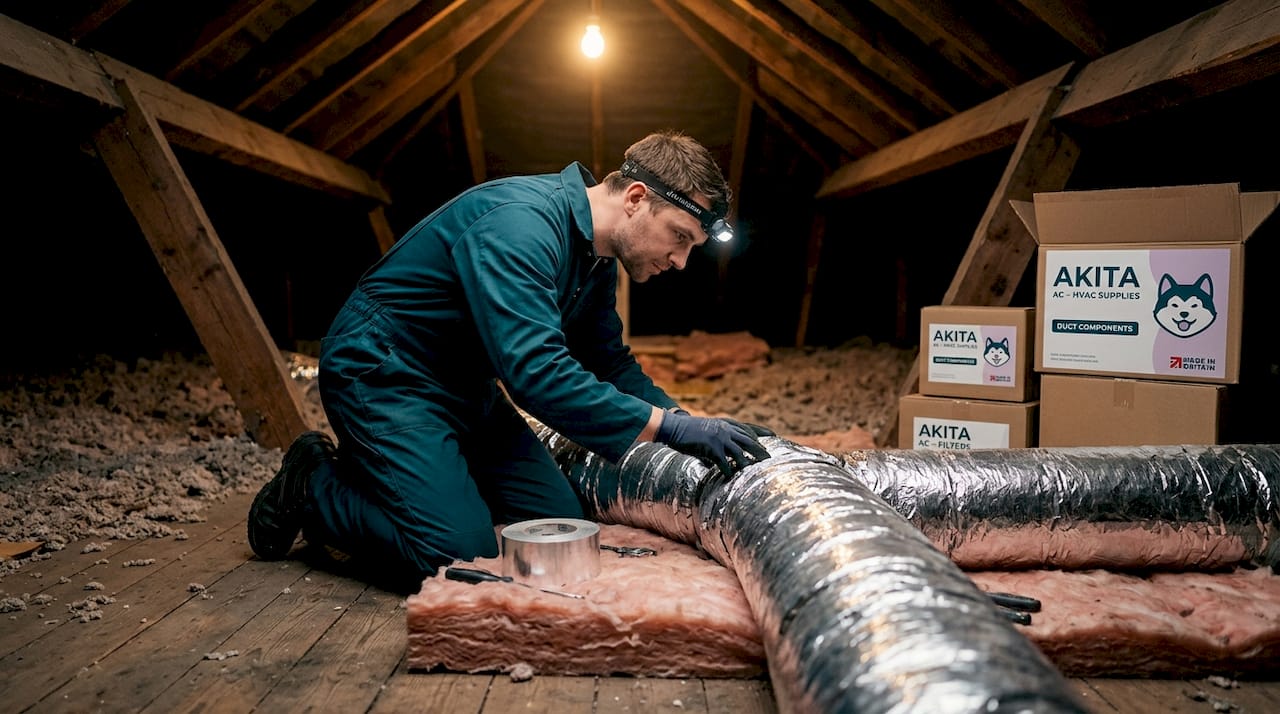
The figures here are stark. Sealing air leaks and insulating ducts in unheated areas can prevent up to 60% heat loss at registers. That’s not a marginal gain. It fundamentally changes how hard your HVAC system has to work.
A simple way to identify duct problems is to run your HVAC system with all supply registers open and check whether airflow is consistent across rooms. Weak or absent airflow from specific registers is a strong indicator of a blockage or leak upstream.
Duct and air sealing action list:
- Visually inspect accessible ductwork in your loft or underfloor spaces. Look for disconnected joints, visible gaps, or foil tape that has peeled away.
- Use mastic sealant or metal-backed foil tape (not standard cloth tape, which degrades quickly) to seal any visible gaps at joints.
- Insulate duct runs that pass through unheated spaces using purpose-made duct wrap insulation.
- Check where services penetrate walls and floors. Gaps around pipes and cables are common but easy to seal with expanding foam or acoustic mastic.
- Inspect loft hatches. An uninsulated, unsealed loft hatch is one of the most overlooked heat loss points in UK homes.
Pro Tip: Don’t assume that because your ducts look intact, they are sealed. The most common leaks occur at joints and fittings, not along straight duct runs. A professional duct pressure test will confirm whether your current sealing is holding.
| Area to inspect | Common problem | Recommended fix |
|---|---|---|
| Duct joints in loft | Gaps at elbows and junctions | Mastic sealant or foil tape |
| Ducts in crawlspaces | Missing or degraded insulation | Duct wrap insulation |
| Register connections | Loose fitting at wall or floor | Re-fix and seal around frame |
| Wall and floor penetrations | Gaps around cables and pipes | Expanding foam or acoustic mastic |
| Loft hatch | Uninsulated, poorly fitted | Foam seal and insulation board |
This duct and airflow section of the checklist is covered in more practical depth in the duct and airflow diagnostics guide if you want to go further before calling a professional.
Thermostat settings and efficient operation
How you use your thermostat matters as much as the system itself. There’s a persistent myth that setting the thermostat to an extreme temperature will heat or cool the home faster. It won’t.
Setting the thermostat colder than normal does not cool your home faster and may actually increase costs by allowing the system to overshoot your comfort target before cycling off. The same applies to cranking the heat up when you arrive home on a cold evening. Your system runs at the same rate regardless of how wide the gap is between current and target temperature.
Thermostat efficiency checklist:
- Programme a schedule that reflects your actual routine. If the house is empty from 8am to 5pm, there’s no reason to maintain full comfort temperature during those hours.
- Set temperature setbacks of around 2 to 3 degrees Celsius when sleeping or when the property is unoccupied. This alone can make a measurable difference to monthly bills.
- Keep thermostats away from heat-generating appliances. A lamp or television near your thermostat will trigger false readings and cause the system to cycle unnecessarily.
- If your current thermostat is non-programmable, upgrading to a programmable or smart model is one of the highest-return low-effort improvements on this entire checklist.
The most underused feature on most thermostats is the schedule. Most homeowners set a fixed temperature and leave it. A well-programmed schedule does the thinking for you and compounds savings every single day.
For more guidance on day-to-day operation, the thermostat operation tips section of our UK maintenance checklist covers seasonal adjustments specific to the East Anglian climate.
Grants and local incentives for HVAC upgrades in Suffolk, Norfolk, and Essex
Improving your HVAC efficiency doesn’t have to be entirely self-funded. There are several schemes available to eligible homeowners across the region, and knowing which ones apply to your situation can make the difference between affording an upgrade this year and postponing it indefinitely.
Suffolk residents may be eligible for free home energy upgrades if their home has an EPC rating of D to G and they meet income or benefit thresholds, with funding available until March 2026. Apply early; these programmes are oversubscribed and funding is allocated on a first-come basis.
For heat pump installations specifically, the Boiler Upgrade Scheme provides £7,500 towards air source or ground source heat pumps through MCS-certified installers. That sum covers a substantial portion of a typical domestic installation.
| Scheme | Who it’s for | What it covers | Notes |
|---|---|---|---|
| Warm Homes Suffolk | EPC D-G, income criteria | Insulation, heating upgrades, draughtproofing | Funding limited, apply early |
| Boiler Upgrade Scheme | Owner-occupiers, no income limit | £7,500 for heat pumps | Requires MCS-certified installer |
| ECO4 | Low income or benefit recipients | Insulation, boilers, solar panels | Via energy suppliers |
| Great British Insulation Scheme | EPC D-G | Loft and cavity wall insulation | Council Tax band eligibility applies |
Before applying for any scheme, check the following:
- Your current EPC rating (available at the GOV.UK Find an Energy Certificate service)
- Whether you or anyone in your household receives qualifying benefits for ECO4 or Warm Homes
- That any installer you appoint is MCS-certified for heat pump grant eligibility
Comparison of key HVAC efficiency checklist actions
Having explored individual checklist steps and incentives, a clear comparison helps you decide where to start and what to prioritise given your budget, time, and home type.
Combining maintenance, air sealing, duct insulation, and thermostat optimisation delivers the best overall savings when tailored to your home’s largest energy uses.
| Action | Effort level | Typical impact | Approximate cost | Best for |
|---|---|---|---|---|
| Filter replacement | Low | Immediate efficiency gain | Under £20 per year | All homeowners |
| Annual professional service | Low to moderate | Sustained efficiency, longer lifespan | £80 to £150 | All HVAC types |
| Duct sealing | Moderate | Up to 60% reduction in duct heat loss | £100 to £400 DIY | Older homes with ductwork |
| Duct insulation | Moderate | Significant heat retention | £200 to £600 | Homes with uninsulated attic ducts |
| Thermostat upgrade | Low | 10 to 15% savings on temperature-related energy use | £50 to £200 | All homes without smart controls |
| Heat pump via grant | High (managed by installer) | 30 to 50% reduction in heating energy | Partly or fully grant-funded | EPC D-G eligible homes |
Rethinking the HVAC efficiency approach for practical homeowner success
Here’s something most HVAC articles won’t tell you. The single biggest waste in home energy improvement isn’t choosing the wrong equipment. It’s replacing equipment in the wrong order.
Homeowners across Suffolk, Norfolk, and Essex regularly invest in new boilers or heat pumps before addressing the building envelope or ductwork. The result is a high-performance system working inside a leaky, poorly distributed home. The gains are real but far smaller than they should be. Starting with whole-home diagnostics and addressing distribution losses before replacing equipment is the only approach that avoids this trap.
Duct airflow testing frequently reveals that what looks like a failing HVAC unit is actually a duct system that’s losing 20 to 30% of its output before it reaches the living space. Fix the ducts first, and in many cases the existing equipment performs well enough that replacement becomes optional rather than urgent.
The right sequence is: diagnose, seal and insulate, optimise controls, then consider equipment upgrades. This isn’t just our view. It’s the approach that consistently produces the best ratio of cost to comfort improvement.
A thorough HVAC diagnostics guide can walk you through what to look for before committing to any major expenditure. Being data-driven at the start saves a significant amount of money at the finish.
Achieve energy efficient HVAC with expert installation and maintenance
With a clear checklist in hand and an understanding of the right sequencing, the next step is having the work done properly.
Akita Air Conditioning works with homeowners across Suffolk, Norfolk, and Essex to install, maintain, and upgrade climate control systems with a focus on genuine efficiency. Our certified engineers assess your home’s specific setup before recommending a system, and our maintenance plans keep that system operating at peak performance year after year. We offer domestic air conditioning installation with transparent, fixed-price quotes, so there are no surprises when it comes to budgeting. If you’re ready to take the first step, browse our fixed price air conditioning installation options and get a quote that reflects exactly what your home needs.
Frequently asked questions
How often should I replace HVAC filters to maintain energy efficiency?
Filters should be cleaned or replaced monthly to maintain proper airflow and prevent energy waste. Homes with pets or high dust levels may need more frequent changes.
What are the signs of leaky air ducts in my home?
Uneven temperatures between rooms, unexplained increases in energy bills, and weak airflow from individual registers are the most common indicators. Hot or cold spots and higher bills are reliable warning signs worth investigating before assuming the problem lies with the HVAC unit itself.
Can I get financial support for upgrading my heating system in Suffolk?
Yes. Suffolk residents may qualify for free home energy upgrades if their home has an EPC rating of D or below and they meet income or benefit criteria. The Boiler Upgrade Scheme is also available without an income limit for heat pump installations.
Does setting my thermostat colder make my home cool faster?
No. Setting the thermostat lower than your target temperature does not speed up cooling and can push energy costs higher by overshooting the comfort level before the system cycles off.
What is the first step before upgrading my HVAC system?
Begin with a whole-home energy audit and a duct airflow test to identify where efficiency is being lost. Home diagnostics and distribution checks help you prioritise the right improvements first and avoid spending on new equipment before simpler fixes are in place.