

Efficient air conditioning for conservatories: UK guide
TL;DR:
- Most UK conservatories face extreme temperature swings due to poor insulation and large glazed surfaces. Upgrading roof insulation and adding passive shading significantly improve efficiency, reducing energy bills and cooling/heating loads. The best long-term comfort is achieved by combining fabric improvements with properly sized, energy-efficient heat pump systems.
Conservatories are one of the most frustrating spaces to keep comfortable in the UK. Scorching in summer, freezing in winter, and often wildly expensive to heat or cool with the wrong system. 53% of UK conservatory owners name temperature control as their biggest complaint, and it is easy to see why. This guide cuts through the noise and gives you a practical, evidence-based framework for choosing the right air conditioning solution. Whether you are dealing with a south-facing glass box or a poorly insulated lean-to, you will find clear answers on what works, what does not, and how to keep your energy bills under control.
Table of Contents
- Setting the stage: Why conservatories are a temperature nightmare
- Selection criteria: What to look for in conservatory air conditioning
- Top air conditioning systems for conservatories
- Comparing systems: Efficiency, comfort, cost, and usability
- Expert view: The fabric-first approach before air conditioning
- Get expert installation for your conservatory air conditioning
- Frequently asked questions
Key Takeaways
| Point | Details |
|---|---|
| Insulation first | Upgrading roof and glass insulation boosts comfort and makes air conditioning far more effective. |
| Heat pumps best | Air-to-air heat pumps provide superior efficiency, heating and cooling, and get government grants. |
| Check system sizing | Consider your conservatory’s size, orientation, and insulation to select the right AC capacity. |
| Running costs matter | Efficient systems like heat pumps cost much less to run than electric heaters or portables. |
Setting the stage: Why conservatories are a temperature nightmare
Most conservatories were built with aesthetics in mind, not thermal performance. Large glazed panels and polycarbonate roofs let in light beautifully, but they also let heat pour in during summer and escape rapidly in winter. The result is a room that swings between extremes, often making it unusable for months at a time.
The roof is the biggest culprit. Conservatories lose 70-80% of heat through the roof, and upgrading to a well-insulated solid or tiled roof can reduce that heat loss by 80-90%. That is not a marginal improvement. It fundamentally changes how the space behaves.
Older polycarbonate roofs carry a U-value of 4.0 or higher. A well-insulated solid roof can bring that figure down to around 0.18, which is closer to what you would expect from a modern external wall. The difference in comfort is night and day.
Here is what makes the problem worse for most conservatories:
- Polycarbonate or single-glazed roofs with U-values of 4.0 or above offer almost no thermal resistance
- South or west-facing orientations mean prolonged direct sun exposure, pushing internal temperatures well above 30°C in summer
- Limited ventilation traps heat and humidity, making the space feel oppressive even on mild days
- Thermal bridging through aluminium frames allows cold to creep in during winter, undermining any heating effort
Upgrading roof insulation alone can save between £200 and £500 annually on energy bills, depending on how often you heat or cool the space. That saving also makes any air conditioning system you install far more effective, because it is not fighting against constant heat gain or loss.
Before you look at any mechanical system, it is worth addressing these fabric issues first. Shading solutions such as external blinds or solar control glass reduce summer heat gain significantly. Trickle vents or roof lanterns improve natural airflow. These passive measures do not replace air conditioning, but they make boosting AC efficiency far easier and cheaper to achieve.
With the scale of temperature issues clear, it is important to know what makes AC work well, or not, in a conservatory.
Selection criteria: What to look for in conservatory air conditioning
Choosing the right system is not simply about picking the most powerful unit you can afford. A poorly matched system wastes energy, fails to deliver comfort, and can cost you more to run than the problem it was meant to solve.
Here are the key criteria to evaluate before making any decision:
- Insulation quality first. Roof insulation cuts heating energy by 32% according to Salford University tests. No AC system compensates fully for a poorly insulated space.
- Capacity for your orientation. South-facing conservatories in full sun require roughly 300W per square metre of cooling capacity. Undersizing is a common and costly mistake.
- Heating and cooling in one unit. UK weather demands year-round flexibility. A system that only cools is only useful half the year.
- Ventilation and shading compatibility. Passive cooling measures such as external blinds and roof vents should work alongside your AC, not against it.
- Regulatory compliance. Building Regulations Part O governs overheating in new and significantly altered dwellings. Check whether your conservatory project triggers any compliance requirements before specifying a system.
- Budget and running costs. Upfront cost is only part of the picture. A cheaper portable unit might cost three times more to run annually than an installed heat pump.
- Government grants. Qualifying air-to-air heat pump installs replacing fossil fuel systems may attract grants of up to £2,500 in 2026, which meaningfully changes the financial case.
Pro Tip: Get your conservatory assessed for solar gain and insulation quality before sizing any AC system. An oversized unit cycles on and off too frequently, wears out faster, and delivers poor humidity control.
Understanding the efficient cooling basics helps you ask better questions when speaking to installers. And if you are already thinking about upgrading AC for energy efficiency, the conservatory is often the best place to start because the gains are so visible.
Armed with these criteria, let us explore the AC system options available for UK conservatories.
Top air conditioning systems for conservatories
Not every system suits a conservatory. Here is an honest breakdown of the main options available to UK homeowners.
Air-to-air heat pumps are the standout choice for most conservatories. They provide both heating and cooling from a single wall-mounted unit, require no ductwork, and can be installed quickly with minimal disruption. Heat pumps achieve a COP of 3-5, meaning they deliver three to five units of heat or cooling for every unit of electricity consumed. That is dramatically more efficient than any electric heater. Air-to-air heat pumps are particularly well suited to conservatories and extensions because they need no ductwork, install quickly, and work year-round.
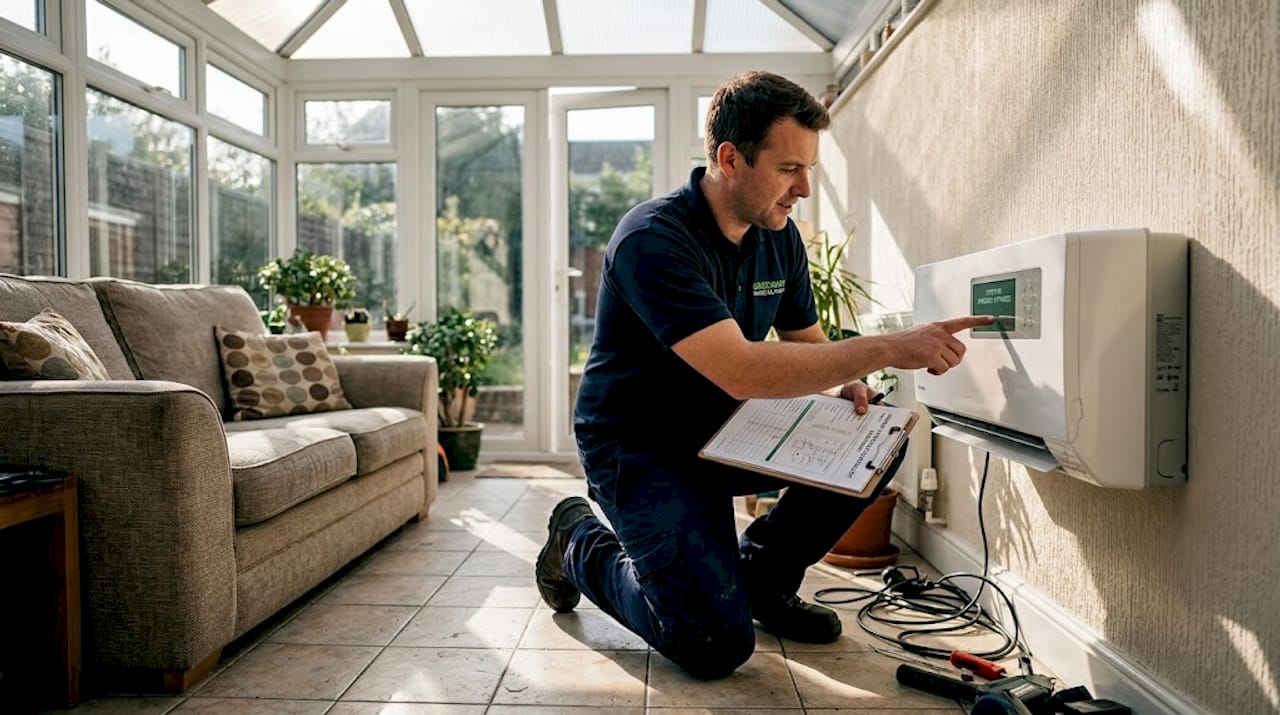
Wall-mounted split systems are closely related to air-to-air heat pumps and are often the same product. Installation typically costs between £1,500 and £3,500, and running costs are substantially lower than electric alternatives. They are quiet, sleek, and controllable via smartphone apps on most modern models.
Portable air conditioners offer flexibility and a low purchase price, but they come with real drawbacks. They are noisy, inefficient, and need a vent hose routed through a window or door, which compromises the seal you are trying to maintain. They are best treated as a short-term fix rather than a proper solution.
Electric panel heaters and fan heaters are simple to install but expensive to run and provide no cooling at all. In a conservatory that already overheats in summer, adding electric-only heating is only solving half the problem.
Pro Tip: Pair your split system with external solar shading before installation. Reducing peak heat gain means you can specify a smaller, cheaper unit that runs more efficiently.
Here is a quick comparison of the main system types:
| System type | Heating | Cooling | Efficiency | Typical install cost |
|---|---|---|---|---|
| Air-to-air heat pump | Yes | Yes | COP 3-5 | £1,500-£3,500 |
| Wall-mounted split system | Yes | Yes | High | £1,500-£3,500 |
| Portable AC unit | Limited | Yes | Low | £300-£700 |
| Electric panel heater | Yes | No | Low | £100-£400 |
For a broader look at what is available, the guide to types of AC for UK homes covers the full range. You can also explore the best AC for UK summer and find out which units perform best in hot weather conditions.
With all major options on the table, how do they stack up for real-world conservatory comfort, cost, and usability?
Comparing systems: Efficiency, comfort, cost, and usability
Choosing between systems comes down to four practical factors: efficiency, comfort output, total cost of ownership, and how easy the system is to live with day to day.
Here is how the main options compare across those dimensions:
- Efficiency. Heat pumps and split systems win outright. A COP of 3-5 means your energy bills are a fraction of what you would pay running electric heaters. Portable units typically achieve a COP of around 1, meaning pound for pound they are the most expensive way to cool a room.
- Comfort output. Installed split systems maintain consistent temperatures with low noise levels. Portable units are louder and less precise. Electric heaters create dry, uneven heat with no humidity control.
- Total cost of ownership. Wall-mounted systems cost £1,500-£3,500 to install, but running costs are up to three times lower than electric heaters. Over five years, the installed system almost always wins financially.
- Usability. Smart controls, programmable schedules, and remote access make modern split systems genuinely easy to manage. Portable units require manual setup each time and are cumbersome to move.
Solid roof insulation changes the equation significantly. Reducing heat loss by up to 90% means your AC system runs less frequently and at lower capacity, saving up to £500 per year. That saving compounds over the life of the system.
Key stat: A conservatory with a solid insulated roof and a properly sized split system can maintain comfortable temperatures year-round at a fraction of the running cost of a portable unit or electric heater combination.
System sizing and orientation matter too. A north-facing conservatory needs less cooling capacity than a south-facing one. Getting this right at the specification stage avoids the twin problems of an underpowered system that cannot cope and an oversized one that short-cycles and wastes energy. Understanding HVAC comfort and savings in practice helps you make that call with confidence.
Comparisons show not all systems are equal. So what is the right choice for your unique home or conservatory?
Expert view: The fabric-first approach before air conditioning
Here is something most AC installers will not tell you: the best air conditioning system in the world will underperform in a poorly insulated conservatory. We have seen homeowners spend £3,000 on a top-spec split system and still struggle with comfort because the roof was leaking heat faster than the unit could compensate.
The smarter approach is to prioritise passive measures before mechanical AC to minimise energy use and comply with UK overheating regulations under Part O. Fix the fabric first. Upgrade the roof. Add external shading. Improve natural ventilation. Then size and install your AC system against a much more stable thermal baseline.
This is not about spending more money before you can have air conditioning. It is about spending money in the right order so that every pound you invest in fabric-first upgrades multiplies the return on your AC investment. A well-insulated conservatory with a modest heat pump will outperform a poorly insulated one with a premium system, every single time. Do not skip the foundations.
Get expert installation for your conservatory air conditioning
Ready to make your conservatory comfortable year-round without watching your energy bills spiral? Akita Air Conditioning installs energy-efficient systems across Suffolk, Norfolk, and Essex, with transparent pricing and flexible finance options to suit your budget.

Whether you need a full domestic AC installation or want to start with a straightforward fixed price AC install, Akita’s team will assess your conservatory’s orientation, insulation, and usage to recommend the right system. We work with UK regulations and grant eligibility to ensure you get the most efficient, compliant solution available. Get in touch today and take the guesswork out of conservatory climate control.
Frequently asked questions
How much does air conditioning for a conservatory typically cost?
Wall-mounted systems cost £1,500-£3,500 to install, with running costs up to three times lower than electric heaters, making them the most cost-effective long-term option.
Does roof insulation really help make air conditioning more efficient?
Yes. Roof upgrades reduce heat loss by 80-90%, which means your AC system runs less often and uses significantly less energy to maintain a comfortable temperature.
Are there any grants for installing heat pumps in the UK?
Government grants of up to £2,500 are available in 2026 for qualifying air-to-air heat pump installations that replace fossil fuel heating systems.
Can portable air conditioners work in a conservatory year-round?
Portable units offer short-term relief in summer but provide no heating in winter and are far less efficient than installed systems, making them a poor choice for year-round comfort.