

Commercial vs residential HVAC: key differences explained
TL;DR:
- Commercial and residential HVAC systems differ significantly in design, regulation, and operation, with commercial systems handling complex zoning, variable occupancy, and stricter compliance standards. Proper sizing, advanced controls, and thorough load calculations are essential for efficiency and compliance in commercial systems, whereas residential systems rely on simpler layouts and standards like ENERGY STAR. Choosing the appropriate HVAC solution depends on building use, size, location, and long-term operational considerations, emphasizing the importance of professional assessment and proper commissioning.
Commercial and residential HVAC systems are defined by fundamentally different design philosophies, regulatory frameworks, and operational demands. A domestic split system serving a three-bedroom home in Suffolk shares almost nothing with the rooftop air handling unit conditioning a multi-storey office block in Norwich, beyond the basic refrigeration cycle. Understanding the difference between HVAC systems built for homes and those built for businesses is not an academic exercise. It determines whether your building stays comfortable, your energy bills stay manageable, and your installation stays compliant.
Commercial vs residential HVAC: what actually separates them?
The core distinction is scale and complexity. Residential HVAC options are designed around a single occupancy type, predictable heat loads, and straightforward comfort targets. Commercial heating and cooling systems must handle variable occupancy, multiple zones with conflicting thermal demands, higher ventilation requirements, and far stricter regulatory oversight.
A home system typically uses a single split unit or a small multi-split arrangement. A commercial building might use air handling units, variable refrigerant flow networks, chilled water systems, or rooftop packaged units feeding dozens of zones simultaneously. The equipment is physically larger, mechanically more complex, and installed in different locations. Residential units sit in gardens or on external walls. Commercial units typically occupy rooftops or plant rooms to preserve usable floor space.
The operational profile also differs sharply. A home is occupied for roughly 12 to 16 hours a day by the same people with broadly similar comfort preferences. A commercial space might run 24 hours, shift between high and low occupancy within the same hour, and serve occupants with widely varying thermal needs across different areas of the building.
What standards govern commercial and residential HVAC systems?
Regulatory compliance is where the two sectors diverge most visibly. ASHRAE 90.1 is the primary energy efficiency standard for commercial HVAC, covering equipment efficiencies, control sequences, and ventilation requirements for non-residential buildings. The International Energy Conservation Code references ASHRAE 90.1 for commercial construction, making it the de facto benchmark across most jurisdictions.
Residential systems operate under separate code pathways. ENERGY STAR certification guides residential product selection, with central air conditioners rated using Seasonal Energy Efficiency Ratios that reflect cooling performance across a full season rather than at peak conditions only. This seasonal approach gives homeowners a realistic picture of annual running costs.
The efficiency metrics themselves differ between sectors. Commercial HVAC uses integrated part-load metrics such as IEER and IPLV, which assess performance across a range of operating conditions rather than at a single peak point. Residential systems are rated using SEER and EER values. Comparing the two using only peak efficiency figures is misleading because commercial systems spend most of their operating hours at partial load, not at peak capacity.
- Residential standards: ENERGY STAR, SEER ratings, and domestic building regulations
- Commercial standards: ASHRAE 90.1, IEER and IPLV efficiency metrics, Title 24 in California
- Shared principle: Both sectors require documented compliance, but commercial documentation is substantially more detailed
Pro Tip: If you are specifying a light commercial system for a small office or retail unit, do not assume residential efficiency ratings apply. Many light commercial installations require commercial-style compliance documentation even when the equipment looks similar in size to a domestic unit.
How do sizing methods differ between commercial and residential systems?
Getting the size right is the single most consequential decision in any HVAC project. Oversizing a residential system causes short-cycling, which reduces efficiency and accelerates component wear. Codes specify maximum oversizing limits of 115% for cooling and 140% for heating in residential installations to prevent this. Undersizing leaves occupants uncomfortable regardless of how well the system is maintained.
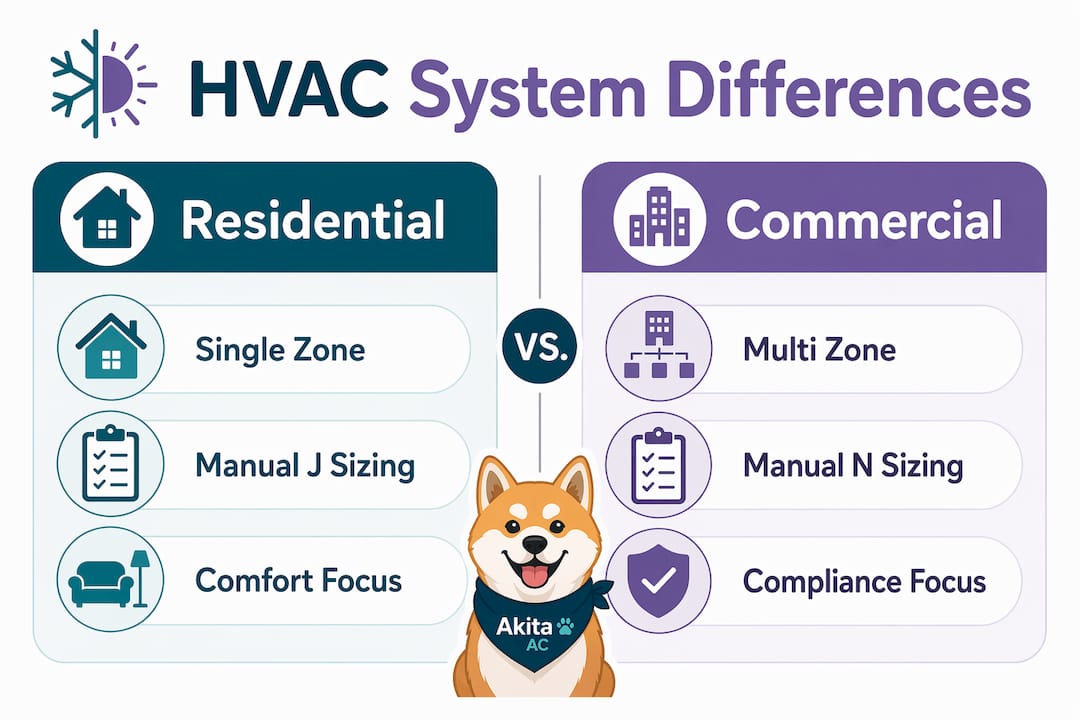
Manual J is the standard load calculation method for residential buildings. It accounts for floor area, insulation values, window orientation, local climate data, and occupancy to produce a heat gain and heat loss figure that drives equipment selection. A properly executed Manual J calculation takes several hours and requires accurate building data. Many residential installations still rely on rough rules of thumb instead, which is why oversizing remains common.
Commercial sizing is considerably more involved. Manual N and simulation tools such as EnergyPlus and eQUEST handle the complexity of multiple zones, diverse occupancy patterns, and varying ventilation demands across a single building. Commercial compliance documentation often requires performance path energy simulations using approved software to satisfy ASHRAE 90.1 and Title 24 requirements.
| Factor | Residential | Commercial |
|---|---|---|
| Primary calculation method | Manual J | Manual N, EnergyPlus, eQUEST |
| Zone complexity | Single zone or simple multi-zone | Multiple zones with independent demands |
| Occupancy variability | Low, predictable | High, variable across hours and areas |
| Compliance documentation | Basic load calculation | Full energy simulation often required |
| Oversizing risk | High without proper calculation | Managed through simulation and part-load metrics |
Pro Tip: For residential projects, always request a full Manual J calculation from your installer rather than accepting a square-footage estimate. An accurate HVAC load calculation protects you from both oversizing and undersizing, and it is the foundation of any energy efficiency claim.
How do control features differ between commercial and residential HVAC?
Control complexity is where HVAC systems for businesses pull furthest ahead of their domestic counterparts. A residential system typically operates from a single thermostat or a simple programmable controller. Modern smart thermostats such as those from Nest or Hive add scheduling and remote access, but the underlying control logic remains straightforward: call for heating or cooling, run until setpoint is reached, stop.
Commercial control sequences are a different discipline entirely. ASHRAE 90.1 compliance requires commercial systems to include documented control sequences covering occupied and unoccupied modes, setback schedules, demand-controlled ventilation, and economiser operation. These sequences must be verifiable during commissioning, not simply installed and assumed to work.
The practical implications for a business are significant:
- Demand-controlled ventilation adjusts fresh air supply based on actual occupancy, measured by CO2 sensors, rather than running at a fixed rate regardless of how many people are present.
- Air economisers use free cooling from outside air when conditions allow, reducing mechanical cooling hours and cutting energy consumption substantially.
- Variable speed drives on fans and pumps modulate output to match actual load rather than running at full speed continuously, which is where most commercial energy savings are realised.
- Unoccupied setback controls reduce conditioning during out-of-hours periods, a basic requirement under most commercial codes but often neglected in practice.
Residential controls prioritise comfort and simplicity. Commercial controls prioritise compliance, energy performance, and operational continuity across a building that may serve dozens of different users simultaneously.
What should you consider when choosing an HVAC system?
The right system is the one matched to your building’s actual use, not the one that looks most impressive on a specification sheet. Several practical factors should shape your decision.
Scale and location. Residential units fit on external walls or in gardens. Commercial rooftop units preserve internal floor space but require structural assessment and roof access for maintenance. If your building has limited outdoor space, the physical placement of equipment is a genuine constraint, not an afterthought.
Upfront cost versus long-term running costs. Commercial systems carry higher capital costs and more complex installation requirements. However, commercial maintenance contracts provide stable, predictable servicing costs driven by compliance obligations, whereas residential maintenance tends to be reactive. A business that treats HVAC servicing as an overhead rather than a planned cost typically pays more over the system’s lifetime. Reviewing HVAC energy saving practices before specifying a system can identify where efficiency gains offset capital expenditure.
Decision timelines. Residential HVAC decisions are typically made quickly, driven by comfort needs and immediate circumstances. Commercial projects involve procurement processes, budget approvals, and longer lead times for larger equipment. Planning for this timeline prevents costly delays when a system reaches end of life unexpectedly.
- Match system type to building occupancy profile, not just floor area
- Factor in maintenance access when selecting equipment location
- Request full load calculations before accepting any equipment recommendation
- Consider the energy efficiency guide for residential purchasing decisions in the UK
- For commercial projects, confirm that control sequences and commissioning are included in the scope, not treated as optional extras
Key takeaways
Commercial and residential HVAC systems require entirely different approaches to design, compliance, and operation, and selecting the wrong type for your building type creates problems that no amount of servicing will fix.
| Point | Details |
|---|---|
| Scale drives system type | Commercial buildings need multi-zone systems; residential needs are met by simpler split or multi-split arrangements. |
| Standards differ by sector | ASHRAE 90.1 governs commercial HVAC; ENERGY STAR and SEER ratings guide residential purchasing decisions. |
| Sizing methods are distinct | Manual J suits residential projects; Manual N and EnergyPlus are required for commercial load calculations. |
| Controls complexity is non-negotiable | Commercial systems must include demand-controlled ventilation, economisers, and setback schedules to meet code. |
| Maintenance models differ | Commercial clients benefit from planned contracts; residential maintenance is typically reactive and replacement-driven. |
Akita’s view on getting the HVAC choice right
The most common mistake we see is businesses applying residential thinking to commercial problems. A small office or retail unit does not need a domestic split system because it looks similar in size to a home. The occupancy patterns, ventilation obligations, and compliance requirements are categorically different, and a system specified without accounting for those factors will underperform from day one.
The reverse also happens. Homeowners occasionally enquire about commercial-grade equipment because they assume bigger means better. Oversizing a residential system is not a safety margin. It is a source of short-cycling, humidity problems, and unnecessary wear that shortens equipment life and raises running costs.
What has changed in recent years is that the gap between the two sectors is narrowing at the lighter end of the commercial spectrum. Variable refrigerant flow systems and modern multi-split arrangements now offer commercial-style zoning and control in formats that suit smaller commercial premises. The technology is there. The challenge is ensuring that the load calculations, control sequences, and commissioning work are done properly, because equipment alone does not deliver a compliant or efficient installation.
The honest advice is this: match the system to the building’s actual use profile, insist on proper load calculations regardless of building size, and treat commissioning and controls as part of the installation scope rather than optional additions. That approach works for a three-bedroom home in Essex and a 2,000 square metre office block in Norwich alike.
— Akita
Expert HVAC installation across Suffolk, Essex, and Norfolk
Whether you are a homeowner looking to install a new system or a business seeking a fully compliant commercial solution, Akita designs and installs climate control systems built around your building’s actual requirements.

Akita covers Suffolk, Essex, and Norfolk with transparent fixed pricing, flexible finance options, and a team experienced in both domestic air conditioning and commercial HVAC installation. Every project starts with a proper assessment, not a guess. If you are ready to discuss your requirements or want straightforward advice on which system suits your property, get in touch with the Akita team today.
FAQ
What is the main difference between commercial and residential HVAC?
Commercial HVAC systems are designed for larger, multi-zone buildings with variable occupancy and must comply with standards such as ASHRAE 90.1, while residential systems serve single homes using simpler equipment rated by SEER and ENERGY STAR criteria.
Can a residential HVAC system be used in a commercial building?
A residential system is not suitable for most commercial applications because it lacks the zoning capability, ventilation controls, and compliance documentation that commercial codes require. Light commercial premises may use systems that look similar to domestic units but must still meet commercial regulatory standards.
How is HVAC sizing calculated for homes versus businesses?
Residential sizing uses Manual J load calculations, while commercial projects rely on Manual N and simulation tools such as EnergyPlus. Both methods account for building characteristics and climate data, but commercial calculations add zone diversity, occupancy variation, and ventilation complexity.
Why do commercial HVAC systems cost more than residential ones?
Commercial systems are larger, mechanically more complex, and require documented control sequences, commissioning, and compliance verification that residential installations do not. The higher upfront cost is offset over time through planned maintenance contracts and energy savings from features such as variable speed drives and demand-controlled ventilation.
How often should commercial HVAC systems be serviced?
Commercial HVAC systems typically require servicing at least twice per year to maintain compliance, preserve warranty conditions, and prevent unplanned downtime. Following HVAC servicing best practices can reduce energy costs by up to 15% compared with reactive-only maintenance approaches.