

Central vs split AC explained: UK homeowner's guide
TL;DR:
- Central air conditioning relies on ductwork and one thermostat to cool an entire home uniformly, while split systems use multiple wall-mounted units to cool individual rooms without ducts. Split systems are generally cheaper, easier to install, and more suitable for retrofitting into older UK homes without existing ductwork. The best system depends on your home’s infrastructure, size, and how you prefer to control indoor temperatures.
Central air conditioning is defined as a duct-based system that cools an entire home from a single indoor air handling unit, while a split system uses multiple wall-mounted indoor units to cool individual rooms independently. Understanding this core difference is the starting point for any homeowner or renter comparing central vs split AC. The two systems share the same goal but take completely different routes to get there. Your home’s size, existing infrastructure, budget, and how you actually use each room will determine which system makes sense. This guide covers how each system works, what installation costs look like in the UK, energy efficiency trade-offs, and which setup suits different homes best.
How do central and split air conditioning systems work?
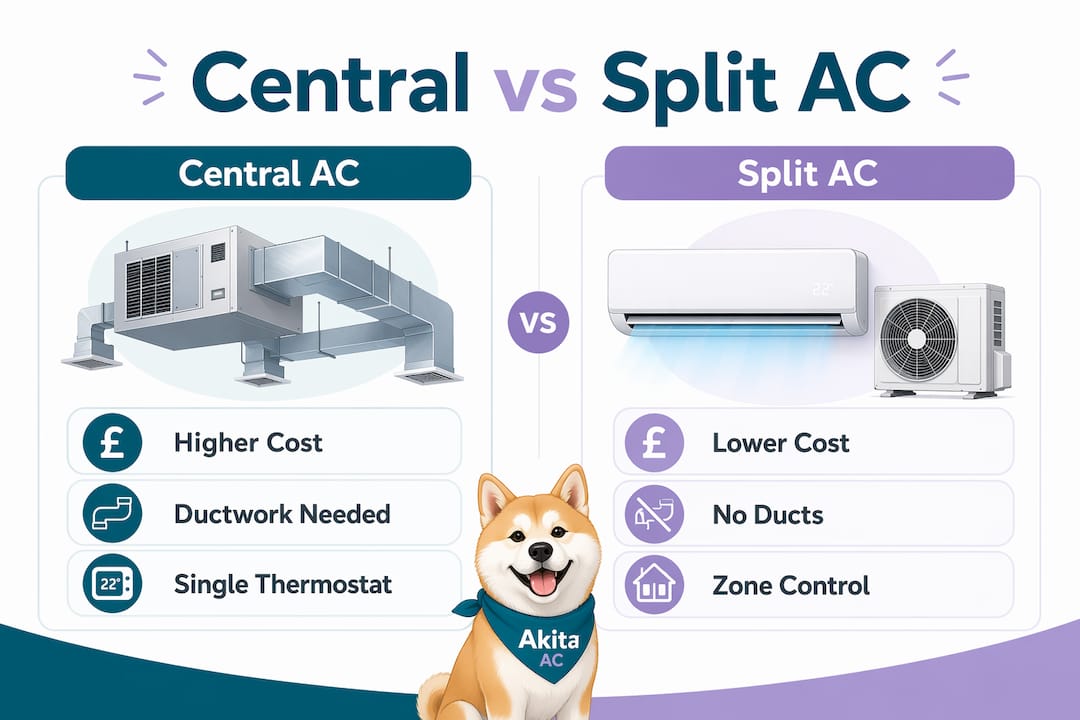
Central AC distributes cooled air through a network of supply ducts connected to one indoor air handling unit. A central thermostat controls the temperature for the whole property. Return ducts pull warm air back to the unit, where it is cooled again and recirculated. The result is uniform cooling across every room, but only if the ductwork is properly designed and sealed.
Split AC uses multiple indoor units connected to a single outdoor condenser. Each indoor unit mounts on a wall and cools the room it serves. There are no ducts involved. The indoor and outdoor units connect via a small pipe carrying refrigerant, which passes through a modest hole in the wall.
The key components of each system break down as follows:
Central AC:
- One indoor air handling unit
- Supply and return duct network throughout the property
- Single outdoor condenser unit
- One central thermostat
Split AC (also called a mini-split or multi-split system):
- Two or more wall-mounted indoor units
- One shared outdoor condenser
- Individual controls per indoor unit
- No ductwork required
The ductless nature of split AC is its defining practical advantage. Installation is simpler and less intrusive, requiring minimal connections compared to running ducts through walls, floors, and ceilings.
What are the installation costs for central vs split AC?
Installation cost is where the two systems diverge most sharply. A single-room split system costs approximately £1,500–£3,000 to install in the UK. A multi-split system covering several rooms can reach up to £7,000. Ducted central AC sits at the top of the range, typically costing between £6,000 and £15,000 depending on the property size and whether ductwork already exists.
The table below compares the two systems across the key installation factors:
| Factor | Central AC | Split AC |
|---|---|---|
| Typical UK install cost | £6,000–£15,000 | £1,500–£7,000 |
| Ductwork required | Yes | No |
| Installation disruption | High (walls, ceilings, floors) | Low (small wall penetration) |
| Best for existing ducts | Yes | Not applicable |
| Suitable for older homes | Only with major works | Yes |
| Installation time | Several days | One to two days |
Central AC installation in a home without existing ducts is a significant building project. Contractors must route ductwork through the fabric of the property, which means opening up walls and ceilings. For a period property or a rented home, that level of disruption is often impractical.
Split systems sidestep this entirely. An engineer mounts the indoor unit on the wall, drills a small hole for the refrigerant pipe, and connects it to the outdoor condenser. Most single-room installations complete in a day. For homeowners in Suffolk, Norfolk, or Essex looking to add cooling without major building works, split systems are the more realistic starting point.
Pro Tip: If your home already has ductwork from an existing heating system, central AC becomes far more cost-effective. Always have a professional assess the duct condition before committing, as poorly sealed ducts will undermine performance regardless of the equipment you choose.
How do central and split systems compare on energy efficiency?
Energy efficiency is not simply about the unit’s rating on paper. AC can consume more than 2,000 kWh per year in an average home. At that scale, even a modest efficiency difference between systems adds up to a meaningful sum on your electricity bill over several years.
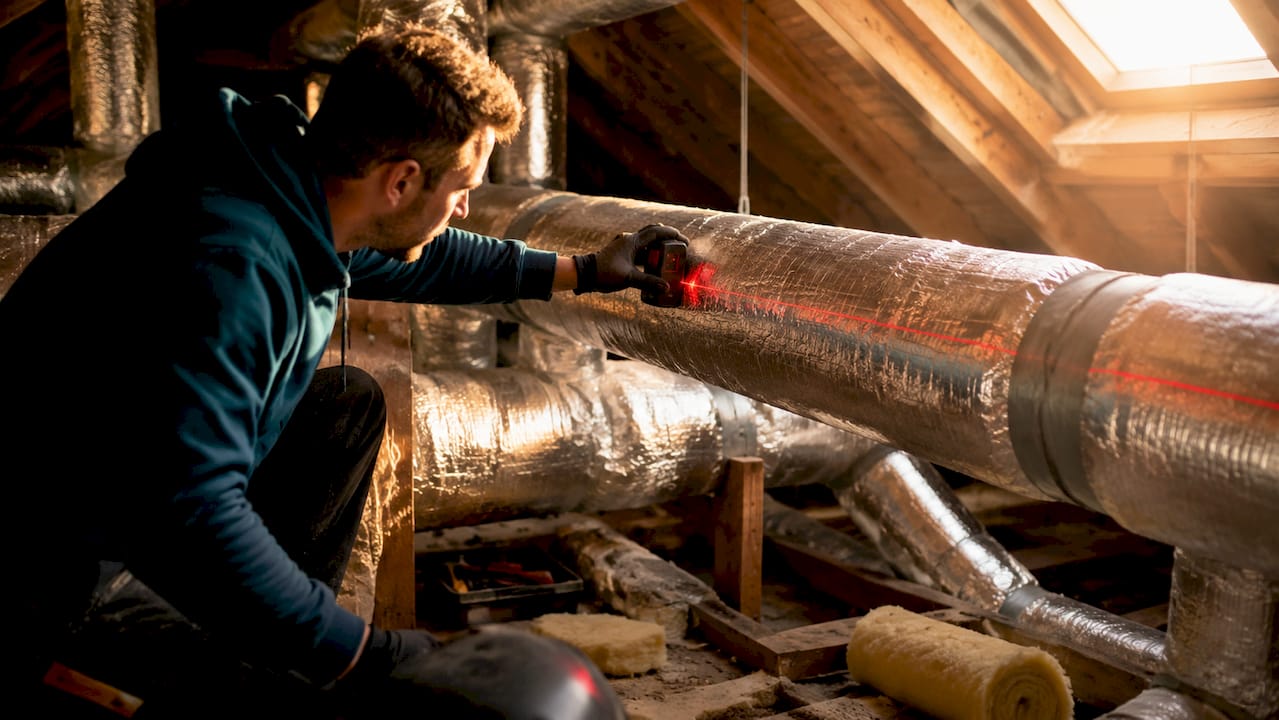
Central AC efficiency depends heavily on duct quality. Duct losses reduce central AC efficiency in real conditions, particularly when ducts pass through unconditioned spaces like loft voids or uninsulated wall cavities. A system with a strong efficiency rating on the specification sheet can perform considerably worse in practice if the ductwork leaks.
Split systems avoid this problem entirely. Each indoor unit delivers cooled air directly into the room it serves, with no duct losses in the chain. Most modern split systems use inverter-driven compressors, which adjust output continuously rather than cycling on and off at full power. This makes them well suited to the variable cooling demands of a typical UK summer.
Practical steps to get the best efficiency from either system:
- Have the system correctly sized by a qualified engineer. Oversized units fail humidity control and cycle inefficiently; undersized units run constantly without reaching target temperatures.
- For central AC, commission a duct pressure test before installation to identify leaks.
- For split systems, use the scheduling and zoning features to avoid cooling unoccupied rooms.
- Service both system types annually to maintain rated efficiency. Dirty filters and coils are the most common cause of performance loss.
For guidance on getting the most from your system once it is installed, Akita’s advice on boosting AC efficiency covers practical steps for UK homes and businesses.
What are the comfort and control differences?
Central AC operates from a single thermostat that sets one temperature for the entire property. Every room receives the same conditioned air. This works well when the whole household has similar preferences and uses most rooms at the same time.
Split systems give each room its own control. A bedroom can run cooler at night while the living room stays warmer during the day. A home office can be cooled during working hours without conditioning rooms that are empty. This zonal flexibility is one of the clearest split system AC advantages for households with varied schedules or mixed preferences.
The comfort differences between the two systems come down to four practical points:
- Temperature consistency. Central AC delivers uniform temperatures across all rooms when the ductwork is properly designed. Split systems can create temperature variation between zones, which is either an advantage or a drawback depending on your household.
- Humidity control. Correct sizing matters for both systems. An oversized unit cools the air too quickly without running long enough to remove humidity effectively. This leaves rooms feeling clammy even at the right temperature.
- Noise. Split indoor units produce a low background hum. Central AC is quieter at room level because the main mechanical components sit in a plant room or loft, though duct noise can be an issue in some installations.
- Flexibility for changing needs. A multi-split system can be expanded by adding indoor units to the outdoor condenser, up to its rated capacity. Central AC is harder to extend once the ductwork is fixed.
Which system suits your home best?
The right choice depends on your home type, existing infrastructure, and how you use the space. There is no universal answer, but the patterns are clear.
| Home type | Best system | Reason |
|---|---|---|
| Large home with existing ducts | Central AC | Uniform cooling, lower marginal cost |
| Older home without ducts | Split AC | Avoids major building works |
| Flat or small house | Split AC | Lower cost, simpler install |
| Rental property | Split AC | Minimal disruption, portable value |
| New build with HVAC design | Central AC | Ducts integrated from the start |
| Home with varied room usage | Split AC | Zonal control saves energy |
Central AC suits large, modern homes where uniform cooling across every room is the priority and ductwork is already in place. The central air conditioning benefits are most apparent in properties where the whole house is occupied simultaneously and a consistent indoor climate is the goal.
Split systems are the better fit for the majority of UK homes. Most British properties were built without ductwork, making central AC a significant retrofit project. Split AC is increasingly popular for retrofit installations in older homes precisely because it adds effective cooling without structural disruption. For renters, a split system installed by a landlord is far less intrusive and easier to remove or relocate than a ducted system.
Resale value is worth considering too. A well-installed multi-split system adds demonstrable value to a UK property. Central AC is less common in British homes, so its value contribution depends on the local market and buyer expectations. For advice on choosing energy efficient AC, Akita’s guide covers the key criteria to weigh up before committing to a system.
Key takeaways
Central AC suits homes with existing ductwork, while split systems are the practical choice for most UK retrofits due to lower cost, simpler installation, and room-by-room control.
| Point | Details |
|---|---|
| System operation | Central AC uses ducts and one thermostat; split AC uses wall units with individual controls. |
| Installation cost | Split systems cost £1,500–£7,000; central AC typically costs £6,000–£15,000 in the UK. |
| Energy efficiency | Split systems avoid duct losses and allow zonal control, reducing wasted energy. |
| Comfort and control | Split AC lets each room run at a different temperature; central AC delivers uniform cooling. |
| Best fit | Split suits most UK homes; central AC is best where ducts already exist. |
Akita’s view on choosing between central and split AC
The question I hear most often is: “Which one is cheaper to run?” The honest answer is that it depends on how the system is installed and used, not just which type it is. A poorly sealed central AC duct system will cost more to run than a well-specified split system in the same house, even if the central unit has a higher efficiency rating on paper.
What I have found working with homeowners across Suffolk, Norfolk, and Essex is that most people underestimate the condition of their existing ductwork. If you are considering central AC because you already have ducts, get them tested before you commit. Leaky ducts are the single biggest hidden cost in central AC ownership, and they are easy to miss without a proper assessment.
Split systems have improved enormously in recent years. Modern inverter units from manufacturers like Mitsubishi Electric and Daikin operate efficiently even at partial load, which is exactly the condition they spend most of their time in during a British summer. The technology gap between split and central has narrowed to the point where, for most UK homes, split is the stronger choice on efficiency, cost, and practicality.
My advice: do not choose a system based on price alone. Think about how you actually use your home, which rooms need cooling and when, and what disruption you are willing to accept during installation. A professional site assessment costs little and can save you from an expensive mistake.
— Akita
Akita’s air conditioning installation services for UK homes
Choosing between central and split AC is easier with expert advice specific to your property.

Akita installs both split and ducted air conditioning systems across Suffolk, Norfolk, and Essex, with fixed pricing and no hidden costs. Whether you need a single-room split unit or a whole-home solution, Akita’s engineers carry out a full site assessment before recommending a system. Every installation comes with a warranty and ongoing maintenance options. For homeowners ready to move forward, Akita’s domestic air conditioning installation page covers the full range of residential services and pricing. You can also explore energy efficient AC options to find a system that keeps running costs low year after year.
FAQ
What is the main difference between central and split AC?
Central AC cools an entire home through a duct network controlled by one thermostat. Split AC uses individual wall-mounted units to cool specific rooms independently, with no ductwork required.
Is split AC cheaper to install than central AC in the UK?
Yes. A single-room split system costs approximately £1,500–£3,000 to install, while central AC typically costs between £6,000 and £15,000 depending on property size and whether ductwork already exists.
Which system is more energy efficient?
Split systems generally perform better in real conditions because they avoid duct losses and allow room-by-room control. Central AC can match split efficiency when ducts are well sealed and the system is correctly sized.
Can I add more rooms to a split AC system later?
Yes. A multi-split outdoor condenser can support additional indoor units up to its rated capacity, making split systems more flexible for phased installations than central AC.
Which system is better for older UK homes?
Split AC is the better choice for older UK homes. Most British properties were built without ductwork, so installing central AC requires significant structural work. Split systems need only a small wall penetration and can be installed with minimal disruption.