

Why seasonal servicing matters for your HVAC system
TL;DR:
- Regular seasonal HVAC servicing twice a year prevents breakdowns and extends equipment lifespan. It also maintains warranty coverage and saves energy costs, making it a cost-effective property management practice. Neglecting maintenance leads to higher repair expenses and significantly shorter system life.
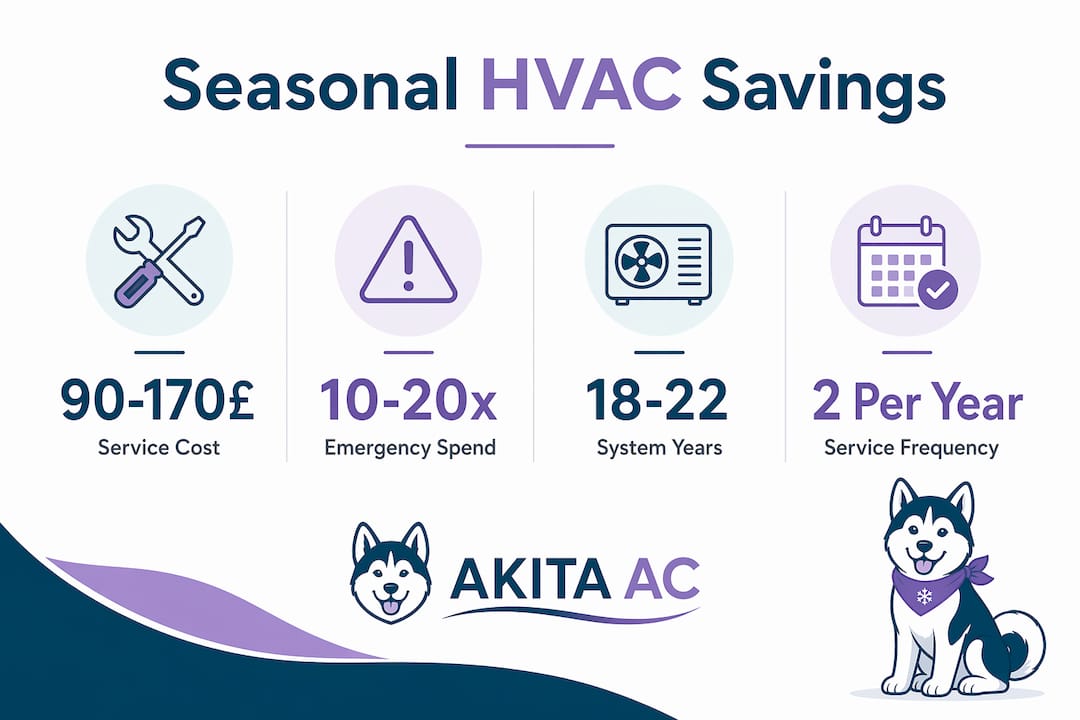
Seasonal servicing is the proactive maintenance performed on HVAC systems twice a year, before the cooling and heating seasons, to prevent breakdowns, reduce energy costs, and prolong equipment life. The industry term for this practice is “preventive HVAC maintenance,” and it covers everything from coil cleaning to refrigerant checks. Systems with documented annual maintenance last 18–22 years compared to 11–14 years without it, and operate 15–25% more efficiently. That gap in lifespan represents tens of thousands of pounds in avoided replacement costs. Akita recommends two visits per year as the baseline for any residential or commercial system in the UK.
Why seasonal servicing is necessary for HVAC systems
Seasonal servicing covers a specific set of technical tasks that address the most common causes of HVAC failure. A qualified engineer will inspect and clean the evaporator and condenser coils, check refrigerant levels, test electrical connections, replace filters, and assess capacitor health. Each of these tasks targets a known degradation pattern that worsens silently between uses.
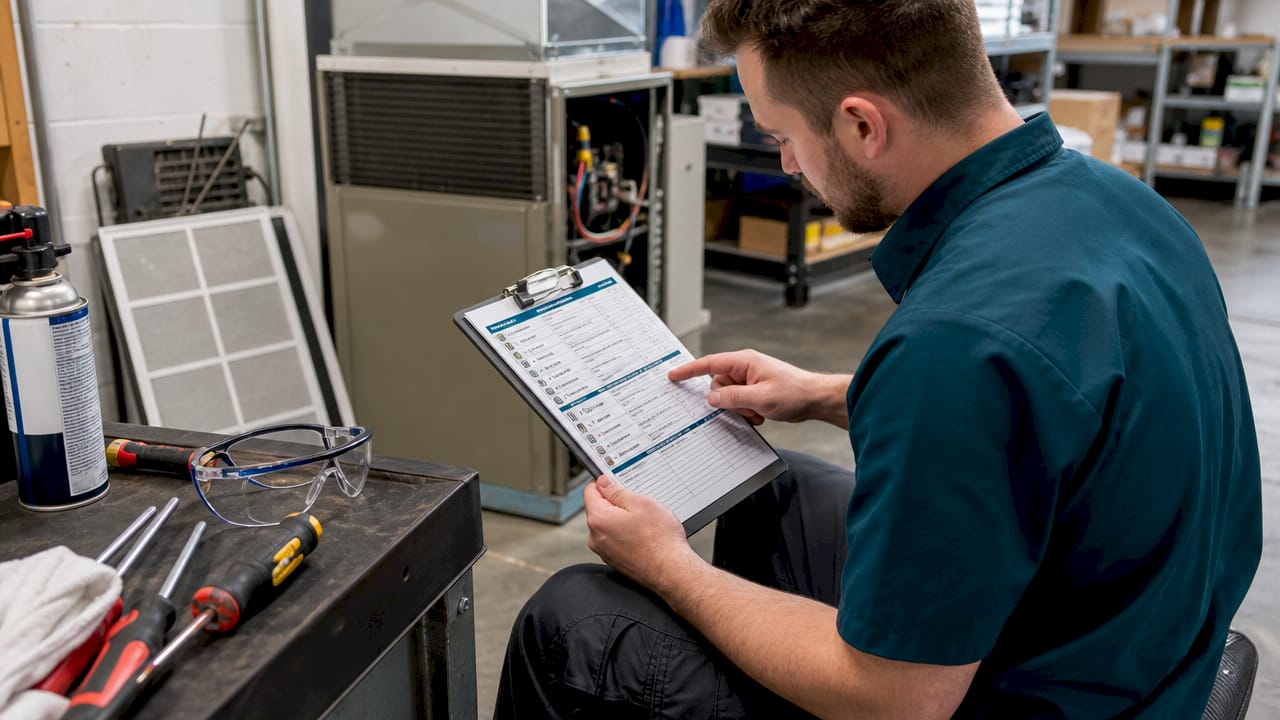
Coil fouling is one of the most damaging and least visible problems. A thin layer of dust on the evaporator coil forces the compressor to work harder, raising energy consumption and heat stress on components. Capacitor fatigue is equally insidious: capacitors weaken gradually and then fail suddenly, usually on the hottest or coldest day of the year when the system is under maximum load.
A professional HVAC tune-up costs between £90 and £170 and takes 60–90 minutes. That is a short window to catch problems that would otherwise escalate into expensive failures. Neglecting this twice-yearly visit does not just risk a breakdown. It guarantees a steady decline in efficiency that shows up on every energy bill.
- Coil cleaning: removes debris that restricts airflow and raises operating temperatures
- Refrigerant check: confirms correct charge levels to maintain cooling capacity
- Electrical inspection: identifies loose connections and worn contacts before they cause failures
- Filter replacement: restores airflow and protects internal components from particulate damage
- Capacitor and contactor test: flags components approaching end of life before they fail under load
- Condensate drain flush: prevents blockages that cause water damage and system shutdowns
Pro Tip: Ask your engineer to provide written measurements, not just a verbal “all clear.” Documented readings for refrigerant pressure, airflow, and electrical draw are the proof you need for warranty claims and future diagnostics.
What are the financial and energy savings from regular servicing?
The financial case for periodic maintenance is straightforward. Documented annual maintenance produces efficiency gains that translate to annual energy savings of approximately £240–£640 for a typical home. That saving compounds year on year, making the cost of a service visit recover itself within months.
Emergency repairs tell the opposite story. Homeowners who neglect seasonal checks spend 10–20 times more on emergency repairs over 5–10 years compared to maintenance costs. A single compressor replacement can cost more than a decade of twice-yearly service visits. The maths strongly favours prevention.
Peak-season emergency call-outs carry an additional financial penalty. Emergency repairs during peak seasons cost more due to higher demand and overtime labour rates. A fault that would cost £150 to fix in march can cost two or three times that in july when every engineer in the region is fully booked.
| Scenario | Typical cost | Frequency |
|---|---|---|
| Twice-yearly professional service | £90–£170 per visit | Twice per year |
| Annual energy savings from maintained system | £240–£640 | Per year |
| Emergency repair call-out (peak season) | Significantly elevated | Unpredictable |
| Compressor or major component replacement | Several thousand pounds | Once if neglected |
The table above makes the pattern clear. Preventive maintenance is a fixed, predictable cost. Emergency repair is an unpredictable, high-stakes expense. Industry experts treat seasonal servicing as a financial document protecting capital investment, not a routine chore. That framing is accurate. Every service record adds to the provable value of your system.
How does seasonal servicing protect warranties and extend HVAC lifespan?
Warranty protection is one of the most overlooked reasons why regular servicing matters. Major HVAC brands require documented professional service annually to uphold 10-year parts warranties. Skipping a single year can void coverage on components like compressors, which are among the most expensive parts in any system.
The consequences of a voided warranty are severe. Skipping professional servicing frequently voids manufacturer warranties on parts such as compressors, leading to costly out-of-pocket repairs that could have been preventable. A compressor failure outside warranty cover can cost as much as a new system installation. That risk disappears with a simple annual service record.
Lifespan data reinforces the same argument. Systems with documented maintenance last 18–22 years, while neglected systems average just 11–14 years. That is up to eight additional years of service from the same capital investment. For a business owner running multiple systems across a commercial property, that difference is substantial.
- Keep every service report: dated engineer reports form the paper trail that validates warranty claims
- Use a Gas Safe or F-Gas registered engineer: manufacturer warranties often specify qualified technicians
- Schedule before the warranty anniversary: do not let the calendar slip past the annual requirement
- Store records digitally: a scanned PDF of each report protects against lost paperwork
Pro Tip: When selling a property, a complete service history for the HVAC system adds demonstrable value. Buyers and surveyors treat documented maintenance the same way they treat a full service history for a car.
For a detailed look at how HVAC maintenance extends lifespan, Akita’s guide covers the practical steps behind warranty compliance and long-term system care.
When and how should you schedule seasonal servicing?
Timing matters as much as frequency. The best months for HVAC servicing are spring, typically march to april, and autumn, typically september to october. Spring servicing prepares the cooling system before summer demand peaks. Autumn servicing readies the heating function before the first cold snap arrives.
Off-peak scheduling carries a practical advantage beyond cost. Engineers have more availability, appointment slots are shorter, and there is no pressure to rush a job because of a waiting list. Booking in advance also means you choose your preferred engineer rather than accepting whoever is available in an emergency.
Choosing the right service provider requires care. A superficial £40–£70 tune-up is often a lead-generation tactic rather than a genuine maintenance visit. A thorough service uses instrument-based measurements and produces a written report. If an engineer cannot tell you the refrigerant pressure reading or the airflow measurement, the visit has not delivered real value.
- Book in march or september to secure off-peak availability and avoid emergency pricing
- Confirm the engineer holds F-Gas certification for any system containing refrigerant
- Request a written report with measured readings, not just a checklist of tasks completed
- Replace filters yourself between visits to maintain airflow and reduce the load on the system
- Clear the outdoor unit of leaves, debris, and overgrown vegetation before the engineer arrives
Coil cleaning technique is worth understanding. Correct cleaning of outdoor condenser coils requires spraying water outward from inside after removing the top fan grille. Spraying inward from outside pushes debris deeper into the coil fins, reducing efficiency and risking damage. A qualified engineer will know this. A cheap tune-up operator often will not.
Pro Tip: Set a calendar reminder for the first week of march and the first week of september. Treat it like a boiler service: non-negotiable, annual, and always worth the time.
What common issues does seasonal servicing prevent?
Seasonal servicing prevents common failure modes including dirty coils, weakening capacitors, and clogged condensate lines. These three faults account for the majority of emergency call-outs during peak summer and winter periods. Each one develops gradually and is invisible to the untrained eye until it causes a complete shutdown.
The timing of failures is not random. Systems that have been sitting unused through spring or autumn accumulate dust, biological growth, and moisture damage. When they are switched on at full load during the first heatwave or cold snap, the stress on already-degraded components triggers failure. Proactive servicing prevents these breakdowns and the peak-season price hikes that come with emergency call-outs.
Seasonal servicing is not a guarantee of zero faults. The purpose of seasonal servicing is to catch early-stage component degradation before it becomes an emergency. That distinction matters. A well-serviced system will still age, but it ages predictably and on your schedule, not the system’s.
- Dirty evaporator coils: reduce heat exchange efficiency and force the compressor to overwork
- Weakening capacitors: fail suddenly under load, causing complete system shutdown
- Clogged condensate lines: cause water overflow, triggering safety shutoffs and potential water damage
- Refrigerant leaks: reduce cooling capacity and damage the compressor if left unchecked
- Corroded electrical contacts: create resistance, heat, and eventual circuit failure
For a full breakdown of common HVAC problems that regular servicing prevents, Akita’s homeowner guide covers the most frequent faults seen across UK residential and commercial systems.
Key takeaways
Seasonal HVAC servicing, performed twice yearly, is the single most cost-effective action a homeowner or business owner can take to protect system efficiency, warranty validity, and long-term equipment lifespan.
| Point | Details |
|---|---|
| Service twice per year | Schedule in spring and autumn to prepare the system before peak heating and cooling demand. |
| Lifespan nearly doubles | Documented maintenance extends system life to 18–22 years versus 11–14 years without servicing. |
| Warranty requires proof | Major manufacturers void 10-year parts warranties without annual documented professional service. |
| Emergency costs far exceed maintenance | Neglected systems cost 10–20 times more in emergency repairs over a 5–10 year period. |
| Choose substance over price | A £40–£70 tune-up rarely delivers real maintenance; insist on written, instrument-based reports. |
Akita’s view: servicing is property management, not optional maintenance
After years of working with homeowners and businesses across Suffolk, Norfolk, and Essex, the pattern is consistent. The clients who call Akita in a panic during a july heatwave almost always skipped their spring service. The clients who never have emergencies almost always have a service history going back years.
The framing of seasonal servicing as an optional extra is the most expensive mistake a property owner can make. A system that costs £3,000 to install deserves the same care as a car. Nobody drives 50,000 miles without an oil change and expects the engine to perform. The same logic applies to an air conditioning unit running at full load through a British summer.
What I find most telling is the warranty angle. Manufacturers do not require documented servicing out of bureaucratic habit. They require it because the data shows that maintained systems fail less and last longer. When a manufacturer ties a 10-year warranty to annual service records, they are telling you exactly what the system needs to reach its designed lifespan.
Treat the service report as a financial document. File it with your property records. If you sell the property, it adds value. If a component fails under warranty, it is your proof. If you are a business owner with multiple systems, it is your evidence of due diligence. The cost is modest. The protection is significant.
— Akita
Akita’s seasonal servicing for homes and businesses
Akita’s engineers cover residential and commercial HVAC systems across Suffolk, Norfolk, and Essex, with twice-yearly service visits that produce full written reports and instrument-based measurements.
Every Akita service visit is carried out by F-Gas certified engineers who understand manufacturer warranty requirements and document every measurement. Whether you need domestic air conditioning serviced and maintained or a full commercial HVAC programme for your business premises, Akita provides the paperwork, the expertise, and the reliability that keeps your system running at its best. Contact Akita to book your next seasonal service and protect your investment before the next peak season arrives.
FAQ
What is seasonal HVAC servicing?
Seasonal HVAC servicing is a professional maintenance visit carried out twice a year, typically in spring and autumn, covering coil cleaning, refrigerant checks, electrical inspection, and filter replacement to keep the system running efficiently.
How much does a seasonal HVAC service cost in the UK?
A professional HVAC tune-up costs between £90 and £170 and takes 60–90 minutes. Visits priced below £70 are often superficial and do not deliver the instrument-based checks needed for genuine maintenance.
Does skipping a service void my HVAC warranty?
Yes. Major HVAC manufacturers require documented annual professional servicing to uphold 10-year parts warranties. Skipping a service can void cover on expensive components such as compressors.
How long does a well-maintained HVAC system last?
Systems with documented annual maintenance last 18–22 years on average. Systems without regular servicing typically last only 11–14 years, representing a significant reduction in return on investment.
When is the best time to book an HVAC service?
Book in march or april before the cooling season, and again in september or october before the heating season. Off-peak scheduling avoids delays, higher emergency rates, and limited engineer availability.