

Eco-friendly refrigerants: a practical guide for UK homeowners
Eco-friendly refrigerants are substances with low or zero global warming potential (GWP) and negligible ozone depletion potential (ODP), used in place of older high-GWP gases such as R134a or R404A. The main families are natural refrigerants, including CO2 (R744), ammonia (R717), propane (R290) and isobutane (R600a), and low-GWP synthetics such as R1234yf and R32. In practical terms:
- Domestic fridges and freezers almost universally use R600a (isobutane) in new units sold in the UK.
- Heat pumps and split air conditioning increasingly use R290 (propane) or R32, with R744 appearing in some commercial heat pump designs.
- Large commercial and industrial refrigeration often relies on R717 (ammonia) or R744 (CO2) for their outstanding efficiency and near-zero climate impact.
Choosing the right refrigerant matters because the role of refrigerants in cooling directly affects both your energy bills and your system’s long-term regulatory resilience under the UK’s tightening F-gas rules.
Key takeaways
Eco-friendly refrigerants with low or zero GWP are the most future-proof choice for UK owners, but efficiency, leakage control and certified installation matter just as much as the gas itself.
| Point | Details |
|---|---|
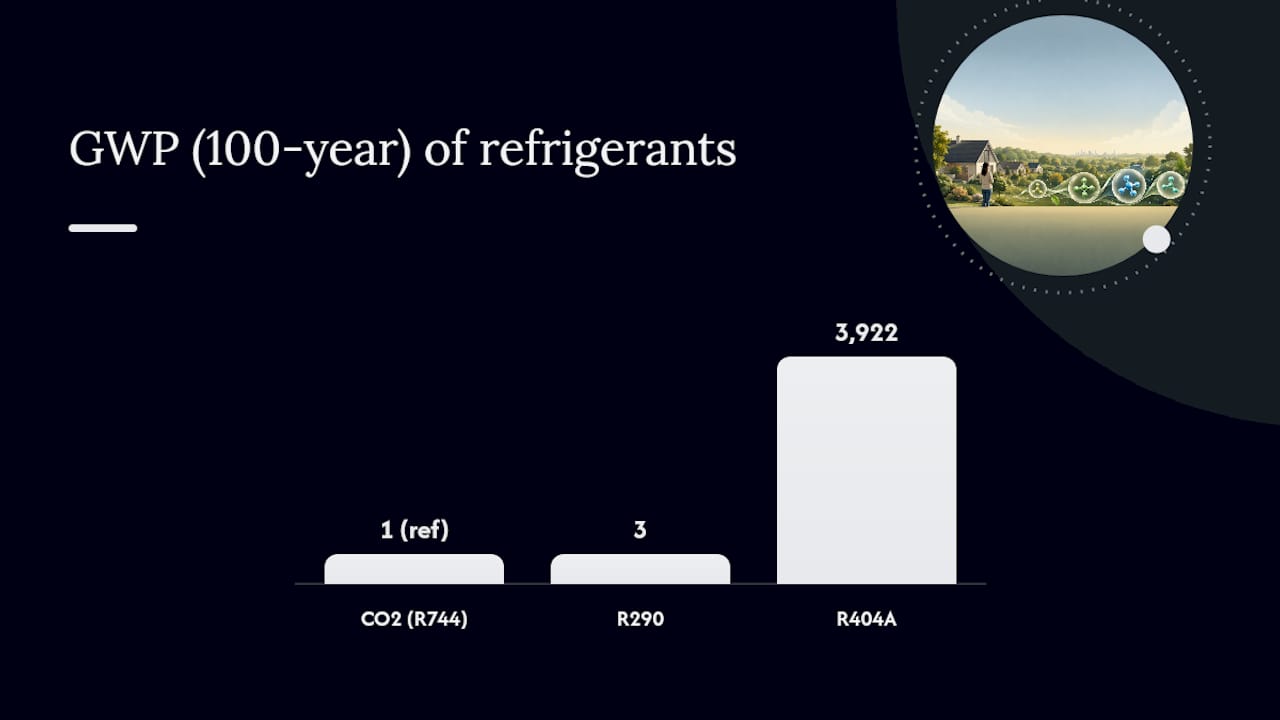
| GWP is the core metric | Eco-friendly refrigerants have low or zero GWP; R290 and R600a score around 3, R744 scores 1. |
| Natural refrigerants lead on future-proofing | R290, R600a, R744 and R717 face no phasedown pressure and often deliver lower lifetime costs. |
| Leakage and efficiency shape total impact | A low-GWP gas in a leaky or inefficient system can still carry a high TEWI; regular servicing matters. |
| UK phasedown is tightening from 2027 | Defra’s proposals tighten HFC phasedown steps from 2027; R410A and R404A systems face rising costs. |
| Akita covers the full process | Akita’s F-gas certified engineers survey, recommend, install and maintain eco-friendly systems across Suffolk, Norfolk and Essex. |
Table of Contents
- How do the main eco-friendly refrigerants compare?
- What actually makes a refrigerant eco-friendly?
- Natural refrigerants: CO2, ammonia and hydrocarbons explained
- Low-GWP synthetics: where R1234yf and R32 fit in
- UK safety rules, F-gas regulation and what they mean for you
- How to find out what refrigerant your appliance uses
- How to choose the right refrigerant or system for your home or business
- Why many UK installers favour natural refrigerants for the long term
- The UK refrigerant phasedown timeline
- How eco-friendly refrigerants perform in UK climate conditions
- What UK installers must know: safety standards and certification
- Emerging refrigerants and future developments in the UK market
- What installers actually tell homeowners
- Akita can help you identify, service and upgrade your system
- Sources
How do the main eco-friendly refrigerants compare?
Quick guide for domestic owners:
- Best for fridges and freezers: R600a
- Best for home heat pumps and split A/C: R290 or R32 (check system design)
- Commercial refrigeration or large heat pumps: R744 or R717 depending on scale and design
- Avoid new equipment using R134a or R404A; bans on high-GWP gases in new products are already in force
What actually makes a refrigerant eco-friendly?
Three metrics do the real work here, and understanding them stops you being misled by vague marketing claims.
GWP (Global Warming Potential) measures how much heat a gas traps in the atmosphere over 100 years relative to CO2, which scores 1. R404A scores around 3,922. R290 scores 3. That gap is why the UK F-gas regulation targets high-GWP gases so aggressively: a small leak from an older system can release the equivalent of several tonnes of CO2.
ODP (Ozone Depletion Potential) measures damage to the stratospheric ozone layer. All modern refrigerants, including HFCs and HFOs, score zero here. The battle shifted to GWP once CFCs and HCFCs were phased out under the Montreal Protocol.
TEWI (Total Equivalent Warming Impact) is the metric that catches people out. It combines direct emissions from leakage with indirect emissions from the energy the system consumes over its lifetime. A refrigerant with a GWP of 3 still causes climate harm if the system runs inefficiently or leaks badly. Sector analysis confirms that leakage reduction and good maintenance are as important as refrigerant choice for cutting total greenhouse gas impact.
The RACHP (refrigeration, air conditioning and heat pump) sector accounts for the majority of F-gas use in Great Britain, which is why the government’s regulatory focus lands squarely on this industry.
Hitting those targets through regular servicing matters as much as which gas is inside.
Natural refrigerants: CO2, ammonia and hydrocarbons explained
Natural refrigerants are the most future-proof options available, but each comes with specific design and safety requirements that make them unsuitable for a simple swap-in approach.
CO2 (R744)
CO2 has a GWP of exactly 1 and zero ODP. It operates at much higher pressures than conventional refrigerants, which means purpose-built pipework, components and controls. In practice, that makes it the standard choice for large supermarket refrigeration in the UK and an increasingly common option for commercial heat pumps. Some domestic heat pump manufacturers are now offering R744 units, though the higher system cost reflects the engineering involved.
Ammonia (R717)
Ammonia has a GWP of zero and exceptional thermodynamic efficiency, which is why it has powered industrial cold stores and food processing plants for over a century. The catch is toxicity: ammonia is classified B2L (toxic, mildly flammable), so its use is governed by strict safety codes of practice and is essentially limited to industrial and large commercial plants with trained operators. It is not a domestic option.
Hydrocarbons: R290 and R600a
R290 (propane) and R600a (isobutane) both have a GWP of around 3 and excellent thermodynamic properties. Hydrocarbons are widely used in domestic refrigerators across Europe precisely because they work well in small hermetic systems. The flammability classification (A3) is the key constraint: charge sizes are strictly limited, typically to 150g or less in domestic appliances, and the sealed design of a fridge or freezer keeps that charge safely contained.
R290 is now appearing in small split air conditioning units and heat pumps, where its efficiency advantage over older HFCs is measurable. The charge limit for A/C systems is typically 150g per circuit, which shapes system design considerably.
Pro Tip: If your domestic fridge was manufactured after around 2000, it almost certainly uses R600a. Check the dataplate on the back or inside the door frame — you will see “R600a” printed there. This matters because you should never attempt to top up or handle the charge yourself; a certified engineer is required even for a small hermetic system.
Water and air
Water (R718) and air (R729) are genuinely zero-impact refrigerants used in niche applications: absorption chillers, some industrial drying processes and specialised low-temperature systems. They are not relevant for domestic or standard commercial HVAC, but worth knowing exist.
Low-GWP synthetics: where R1234yf and R32 fit in
Not every application can use a natural refrigerant today. That is where low-GWP synthetics earn their place.
R1234yf is an HFO (hydrofluoroolefin) with a GWP of around 4, compared with over 1,400 for R134a, which it largely replaced in mobile air conditioning. It has a slight A2L flammability classification (mildly flammable), which requires specific handling but is manageable in well-designed systems. Its ODP is zero.
R32 is a single-component refrigerant with a GWP of 675, substantially lower than R410A (GWP ~2,088), which it is replacing in many split air conditioning and heat pump systems. It offers good efficiency in moderate climates and is now the dominant refrigerant in new domestic split A/C units sold in the UK. It is classified A2L, so certified handling is still required.
The appeal of both gases for manufacturers is that they allow near-drop-in or manageable redesigns from older HFC systems, lowering the cost of transition compared with a full switch to natural refrigerants. For owners, that means better availability of service engineers and parts in the short term. The trade-off is that R32, at GWP 675, still carries meaningful climate impact compared with R290 or R600a, and its long-term regulatory trajectory under the UK phasedown is less certain than natural alternatives.
Availability and cost: R32 equipment is widely stocked by UK distributors and is currently the most accessible low-GWP option for domestic A/C. R1234yf is standard in new cars and some commercial chillers. Both cost more than legacy HFCs per kilogram, but the charge sizes in modern systems are smaller, which partly offsets that.
UK safety rules, F-gas regulation and what they mean for you
The UK F-gas Regulation controls the production, use and disposal of fluorinated greenhouse gases. Under GOV.UK guidance, anyone working with HFCs, PFCs or SF6 must follow rules covering handling, reporting and containment. Key points for owners and installers:
- Phasedown of HFCs: The UK is progressively reducing the total quantity of HFCs that can be placed on the market. Defra’s consultation proposes tightening phasedown steps from 2027, with further reductions planned through to 2050.
- Product bans: High-GWP refrigerants are already banned in certain new equipment categories, including domestic refrigerators and some commercial refrigeration.
- Charge limits for hydrocarbons: Flammable refrigerants such as R290 and R600a are permitted in domestic appliances within strict charge-size limits. Exceeding those limits requires additional safety engineering.
- Certification: Any engineer handling F gases must hold a relevant qualification, typically under the City & Guilds or REFCOM framework in the UK. Natural refrigerants such as ammonia and CO2 require additional competence training due to toxicity and pressure risks.
- Reporting: Operators of systems containing 5 tonnes CO2-equivalent or more of F gas must keep records and arrange annual leak checks. Larger systems have more frequent check requirements.
The RACHP sector’s dominant share of F-gas use in Great Britain means that regulatory tightening will continue to drive up the cost and reduce the availability of high-GWP refrigerants. Systems running on R404A or R410A are already feeling this pressure.
For safety and handling of legacy refrigerants such as R410A, certified technicians follow specific codes of practice that cover leak detection, recovery and safe disposal.
How to find out what refrigerant your appliance uses
Most owners have no idea what gas is inside their fridge, heat pump or air conditioning unit. Finding out takes about two minutes.
- Dataplate: Look for a metal or printed label on the back of a fridge, inside the door frame, or on the outdoor unit of a heat pump or A/C system. It will state the refrigerant designation (e.g. “R290”, “R32”, “R410A”) and the charge weight in grams or kilograms.
- User manual: The specification page lists the refrigerant type and charge.
- Service sticker: Engineers often attach a label after a service visit noting the gas type and any top-up quantity.
- Compressor label: On older units without a clear dataplate, the compressor itself (usually at the back of a fridge) carries a label with refrigerant information.
Once you know the refrigerant, you can assess whether your system uses a gas subject to phasedown pressure. If it contains R404A, R410A or R134a in an A/C or heat pump context, it is worth discussing a replacement timeline with a certified engineer.
Never attempt to top up, recover or handle refrigerant yourself. Even small charges of R290 or R600a are flammable, and F-gas rules make it illegal for uncertified individuals to handle F gases.
Pro Tip: Keep a simple record, either a photo of the dataplate or a note in your boiler/appliance folder, showing the refrigerant type, charge weight and the date of the last service. This saves time at every future service visit and is required information if you ever need to report under F-gas rules.
How to choose the right refrigerant or system for your home or business
The right choice depends on your application, building, and how long you plan to keep the equipment. Work through this checklist before speaking to an installer:
- Application type: Domestic fridge? Split A/C? Heat pump? Commercial cold room? Each has a different range of suitable refrigerants.
- Building occupancy and ventilation: Flammable or toxic refrigerants require adequate ventilation and, in some cases, gas detection. A densely occupied space has different requirements from a plant room.
- Leakage risk tolerance: A well-maintained hermetic system leaks very little. A poorly maintained large system with many joints can leak significantly. Factor in your maintenance commitment.
- Efficiency targets: If you are replacing an old system, compare seasonal efficiency ratings (SCOP for heat pumps, SEER for cooling) across refrigerant options.
- Upfront versus lifecycle cost: Natural refrigerant systems often cost more to design and install but can deliver lower running costs and avoid future refrigerant price spikes.
- Technician availability: R32 engineers are plentiful in the UK. R290 heat pump specialists are growing in number but still less common. R717 requires specialist industrial contractors.
Questions to ask your installer:
- What refrigerant do you recommend, and why is it the best fit for my application?
- Are you certified to handle that refrigerant, and what qualifications do your engineers hold?
- What safety measures are in place for flammable or high-pressure gases?
- What is the expected SCOP or SEER, and how does that compare with my current system?
- What will refrigerant replacement cost in five and ten years, given the phasedown trajectory?
Pro Tip: *Ask for a total cost of ownership estimate, not just the installation price. Add projected annual energy costs (based on the system’s efficiency rating and your usage) to likely refrigerant servicing costs over ten years.
For homeowners planning a renovation that involves HVAC changes, understanding how refrigerant choice affects system selection early in the project avoids costly redesigns later.
Why many UK installers favour natural refrigerants for the long term
The Institute of Refrigeration is clear that refrigerant selection is a balance of GWP, efficiency, safety and longevity, and that planning for long-term regulatory resilience should be central to any decision. Experienced installers take that seriously.
The core argument for natural refrigerants is not environmental idealism. It is financial risk management. Systems running on R410A or R404A are already seeing higher refrigerant costs as HFC quotas tighten. Equipment that cannot be cost-effectively retrofitted to a lower-GWP gas risks becoming a stranded asset: expensive to service, difficult to insure, and eventually impossible to recharge legally.
Natural refrigerant heat pumps can offer superior efficiency and lower lifetime costs despite higher initial design or safety costs. In UK climate conditions, R290 heat pumps in particular show strong seasonal performance, partly because propane’s thermodynamic properties suit the moderate temperature ranges typical of British winters.
The safety and training implications are real. Working with R290 requires A3 flammability competence; CO2 requires high-pressure system training; ammonia requires specialist industrial certification. Installers who invest in that training are positioning themselves for a market that is moving in one direction.
Pro Tip: When evaluating a quote for a new heat pump or A/C system, ask specifically whether the refrigerant used will still be freely available and competitively priced in 2035. If the installer cannot answer that confidently, it is a signal to probe further.
Industry guidance consistently points to early planning as the most cost-effective strategy. Waiting until a high-GWP system fails before considering alternatives typically means paying a premium for emergency replacement rather than a planned, efficient upgrade.
The UK refrigerant phasedown timeline
The UK’s F-gas phasedown is not a distant event. It is already under way, and the schedule is tightening.
What has already happened:
- Domestic refrigerators and freezers: banned from using HFCs in new equipment since 2015 (EU origin, retained in UK law).
- Stationary refrigeration equipment with GWP above 2,500: banned in new equipment since 2020.
- Servicing of refrigeration equipment with GWP above 2,500 using virgin (non-reclaimed) refrigerant: banned since 2020.
What is coming:
- The current UK HFC phasedown schedule reduces the total quantity of HFCs placed on the market in steps. Defra’s consultation proposes tightening those steps from 2027, with further reductions continuing through 2030 and beyond to 2050.
- Additional product bans on high-GWP refrigerants in new equipment categories are expected as the phasedown progresses.
- As HFC quotas shrink, the price of gases such as R410A and R134a for servicing existing equipment will continue to rise.
The practical implication: if your heat pump or air conditioning system uses R410A, plan for replacement within the next five to ten years. Waiting until the system fails will mean replacing it under tighter supply and higher cost conditions.
How eco-friendly refrigerants perform in UK climate conditions
UK weather sits in a moderate band: winters rarely drop below -10°C in most regions, and summers rarely exceed 35°C. That range suits several eco-friendly refrigerants particularly well.
For home heating and cooling (heat pumps and split A/C):
R290 (propane) performs strongly across the UK’s typical operating range. Its thermodynamic properties allow high efficiency at the moderate outdoor temperatures common in Suffolk, Norfolk, Essex and similar regions. R32 is the current mainstream choice for domestic splits, offering a meaningful efficiency improvement over R410A systems at similar outdoor temperatures.
R744 (CO2) heat pumps excel at producing high-temperature hot water, which makes them well-suited to UK homes with existing radiator systems rather than underfloor heating. Their efficiency at low ambient temperatures is excellent, though the high-pressure design adds cost.
For commercial refrigeration:
R744 transcontinental systems (transcritical CO2) are now standard in many UK supermarkets and food service operations. They handle the UK’s mild climate efficiently and avoid the refrigerant cost exposure of HFC-based systems. R717 (ammonia) remains the benchmark for large cold stores and food processing plants where the scale justifies the safety infrastructure.
For domestic fridges and freezers:
R600a operates efficiently across the narrow temperature range of a domestic appliance. Its low charge size means the flammability risk is well-managed in a sealed unit, and its efficiency in this application is hard to beat. Eco-friendly HVAC upgrades for homes increasingly combine R600a appliances with R290 or R32 heat pump systems for a low-GWP whole-home approach.
What UK installers must know: safety standards and certification
Any engineer handling F gases in the UK must hold a qualification recognised under the F-gas Regulation. The main routes are:
- City & Guilds 2079 (Handling Refrigerants): the standard qualification for engineers working with F gases in refrigeration and air conditioning.
- REFCOM registration: the UK’s industry register for F-gas certified companies and engineers, administered by ACRIB.
- Additional competence for natural refrigerants: R717 (ammonia) requires specific safety training aligned with IIAR (International Institute of Ammonia Refrigeration) standards or equivalent UK codes. R744 (CO2) high-pressure systems require pressure systems competence under the Pressure Systems Safety Regulations 2000. R290 in A/C applications requires A3 flammability handling competence.
GOV.UK guidance is explicit that certain F gases require specific competence before handling. Employers are responsible for ensuring their engineers hold the correct qualifications for the refrigerants they work with.
For owners, the practical check is simple: ask to see the engineer’s F-gas certificate and confirm their company is REFCOM registered before any work begins. An unqualified person handling refrigerant is both illegal and a safety risk.
Emerging refrigerants and future developments in the UK market
The refrigerant market is not standing still. Several developments are worth tracking if you are making a long-term investment decision.
HFO blends: Blends combining HFOs with HFCs (such as R454B and R452B) are appearing as lower-GWP replacements for R410A in some commercial systems. They offer a more manageable transition for manufacturers but carry higher GWPs than pure natural refrigerants.
R290 in larger systems: The charge-size limits that currently restrict R290 to small systems are being revisited by standards bodies. IEC 60335-2-40, the international safety standard for heat pumps and air conditioners, has been updated to allow larger R290 charges under specific safety conditions. UK adoption of updated standards will open R290 to a wider range of system sizes.
Solid-state and alternative cooling technologies: Magnetic refrigeration, thermoelectric cooling and thermoacoustic systems are in commercial development. None are yet practical for mainstream domestic or commercial HVAC, but they represent a longer-term horizon beyond conventional vapour-compression refrigerants.
R516A and other low-GWP blends: Several new blends with GWPs below 150 are entering the market as transitional options for specific applications. Their long-term regulatory status under the UK phasedown is not yet fully established, which is a reason to treat them cautiously for new long-life equipment.
The types of air conditioning systems available in the UK are evolving quickly as manufacturers respond to the phasedown. Checking the refrigerant specification before purchasing any new system is now a basic due-diligence step.
What installers actually tell homeowners
The gap between what homeowners assume and what installers know is wider than most people realise.
For small domestic systems, a good installer will almost always recommend R290 or R32 for new split A/C or heat pump installations. R290 is the more future-proof choice; R32 is more widely available and slightly easier to service with the current pool of UK engineers. Either is a sound choice over R410A.
For commercial systems, the conversation shifts quickly to R744 or R717 depending on scale. A small commercial cold room might suit R290 or R744; a large food processing plant will almost certainly need R717.
Common misunderstandings to correct:
- “Natural” does not mean automatically safe. R290 is propane. R717 is ammonia. Both require specific safety design and certified handling. The word “natural” describes origin, not risk level.
- A low-GWP refrigerant in a poorly maintained system can still have a high climate impact through leakage and energy waste.
- Retrofitting an existing R410A system to R32 is not always straightforward. Some components, seals and lubricants are incompatible. Always get a written assessment before assuming a retrofit is viable.
Red flags that your equipment may be using a legacy high-GWP refrigerant:
- The system was installed before 2015 and has never had a refrigerant assessment.
- The dataplate shows R410A, R404A, R134a (in an A/C or heat pump context), or R22.
- Your engineer mentions difficulty sourcing refrigerant or quotes a significantly higher price than last time.
- The system requires frequent top-ups, suggesting leakage that is both costly and environmentally damaging.
Akita can help you identify, service and upgrade your system
Choosing the right refrigerant for your home or business is straightforward when you have a certified engineer who knows the UK regulatory picture. Akita installs, services and maintains air conditioning and heat pump systems across Suffolk, Norfolk and Essex, with a focus on eco-friendly, energy-efficient solutions that will not become a liability as the F-gas phasedown tightens.

Whether you need a domestic air conditioning installation with a modern low-GWP refrigerant, a commercial system designed around R744 or R290, or simply a survey to identify what gas your current equipment uses, Akita’s F-gas certified engineers handle the full process. Every job starts with a site survey and a written recommendation, followed by a transparent fixed-price quote. Finance options are available for larger installations. To book a survey or get a quote, visit Akita or call the team directly.
Sources
These are the primary sources to consult for regulation, phasedown timelines and installer certification:
- F gas Regulation in Great Britain: Reform of the HFC phasedown - Defra - Citizen Space
- F gas regulation in Great Britain
For any action that involves handling, recovering or disposing of refrigerant, consult a REFCOM-registered, F-gas certified engineer. Regulations in this area carry real penalties, and the safety risks of amateur handling are not theoretical.