

The role of regular maintenance in HVAC efficiency
TL;DR:
- Regular HVAC maintenance involves scheduled inspections, cleaning, and testing to ensure systems operate efficiently and last longer. It prevents energy waste, upholds warranty validity, and avoids costly emergencies by detecting issues early. Routine service in the UK is essential for compliance, efficiency, and protecting investments.
Regular HVAC maintenance is defined as the scheduled programme of professional inspections, cleaning, and testing that keeps heating, ventilation, and air conditioning systems running at their designed capacity. The industry term for this is Planned Preventive Maintenance, or PPM. Structured maintenance programmes can recover 8–20% of wasted energy in commercial buildings, while neglected systems lose up to 5% efficiency every year. For homeowners and business owners in Suffolk, Norfolk, and Essex, the role of regular maintenance is not optional. It is the single most effective way to protect your investment, control energy bills, and stay on the right side of UK warranty and compliance requirements.
What does professional HVAC maintenance actually involve?
Professional HVAC servicing covers far more than a quick visual check. A qualified engineer carries out a structured set of tasks that directly affect how well your system performs and how long it lasts.
A typical professional service includes:
- Coil cleaning: Dirty evaporator and condenser coils force the system to work harder, raising energy consumption and accelerating wear.
- Filter replacement or cleaning: Blocked filters restrict airflow, reducing output and straining the motor.
- Refrigerant leak checks: Even a small refrigerant loss degrades cooling capacity and can trigger F-Gas compliance issues for commercial operators.
- Electrical connection testing: Loose or corroded connections cause faults and, in worst cases, fire risk.
- Condensate drain cleaning: Blocked drains cause water damage and can trigger automatic system shutdowns.
Professional maintenance detects hidden issues such as incorrect system sizing, installation errors, and airflow problems that owners would never spot themselves. That early detection prevents small faults from becoming expensive failures.
For residential systems, once yearly is the minimum. Commercial systems require at least twice yearly servicing, and critical environments such as server rooms or food preparation areas benefit from quarterly visits. F-Gas regulations also require documented leak inspections for commercial systems containing refrigerant above certain charge thresholds. Keeping accurate service records is not just good practice. It is a legal obligation for many commercial operators.

Pro Tip: Schedule your annual service in early spring, before the summer cooling season begins. Engineers are less busy, appointments are easier to book, and any faults are fixed before you need the system most.
A seasonal maintenance checklist is a practical tool for homeowners who want to stay on top of basic tasks between professional visits.
How does regular upkeep improve efficiency and cut energy costs?
The link between maintenance and energy consumption is direct and measurable. A system running with dirty coils, a clogged filter, or low refrigerant draws more electricity to deliver the same output. Over time, that inefficiency compounds.
“A heat pump not serviced for two years can see its Seasonal Coefficient of Performance drop from 3.5 to 2.8, increasing electricity use by roughly 20%.”
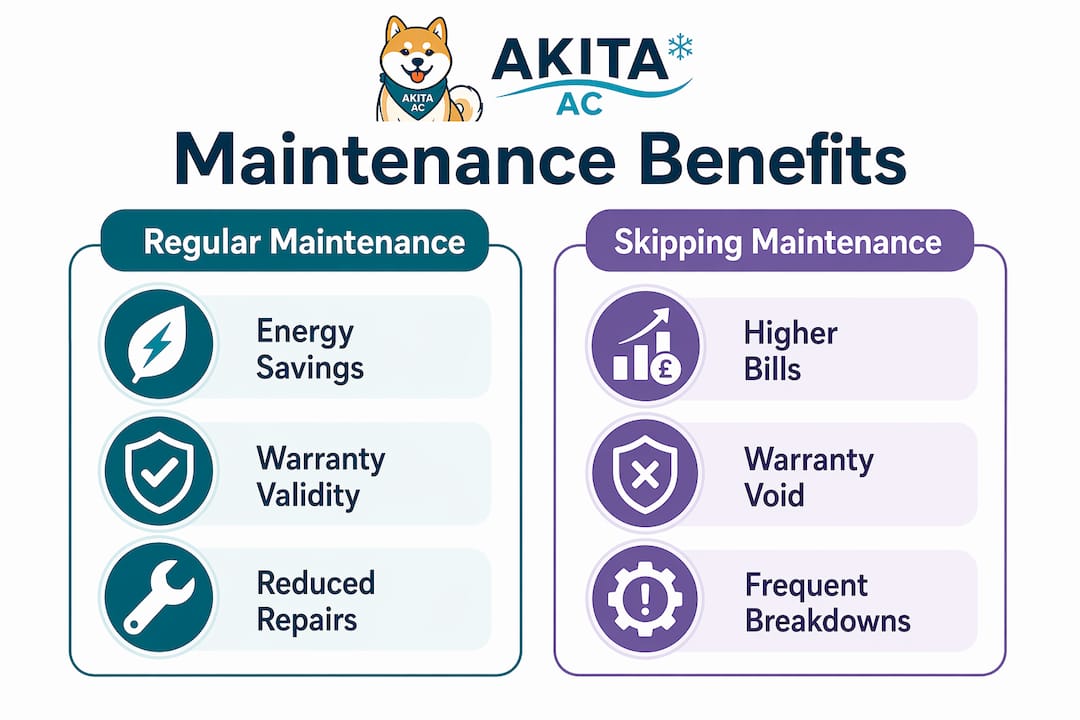
That figure matters because the SCOP drop from 3.5 to 2.8 represents a real and measurable increase in your electricity bill, with no improvement in comfort. You pay more for less. Skipping a single annual service on a heat pump increases electricity use by 8–12%. That cost accumulates every month until the next service.
The table below illustrates the financial difference between a maintained and a neglected system over a typical year.
| Factor | Maintained system | Neglected system |
|---|---|---|
| Annual energy efficiency | Operating near rated output | Up to 5% loss per year |
| Electricity consumption | Baseline | 8–20% higher |
| Heat pump SCOP (example) | 3.5 | 2.8 after two years |
| Risk of breakdown | Low | Significantly higher |
| EPC band impact | Stable or improving | Declining |
Building operational drift is a related problem that many owners underestimate. Operational drift causes significant energy waste as systems gradually fall out of calibration, controls drift from their settings, and airflow becomes unbalanced. Maintenance corrects that drift. Commercial buildings rated D or E on their Energy Performance Certificate can move up one or two EPC bands through maintenance alone, without any capital investment in new equipment. That is a meaningful improvement in building value and running costs.
Why does maintenance matter for warranty validity and legal compliance?
Missing a scheduled service does not just affect performance. It can void your warranty entirely and expose you to costs that run into thousands of pounds.
UK heat pump manufacturers require annual servicing by an MCS-certified installer to keep the warranty valid. MCS, the Microgeneration Certification Scheme, is the UK industry standard for renewable energy and heat pump installations. Skipping that annual visit means the manufacturer is no longer obligated to cover component failures.
The financial consequences are serious:
- Compressor failure: One of the most common major faults, typically costing £1,500–£3,000 to repair or replace.
- PCB (printed circuit board) failure: Electronic control failures are expensive and, without warranty cover, fall entirely on the owner.
- Refrigerant leaks: Under F-Gas regulations, commercial operators must carry out documented leak inspections at intervals determined by refrigerant charge size. Failure to comply risks fines and enforcement action.
- Documented service records: Without these, proving compliance or warranty eligibility becomes very difficult.
Skipping MCS-certified annual service not only causes inefficiency but exposes owners to legal and warranty risks, leading to expensive repairs not covered by warranty. For business owners, the compliance dimension adds another layer of urgency. F-Gas enforcement has become more active in the UK, and the penalties for non-compliance are not trivial.
Pro Tip: Always ask your engineer for a written service report after every visit. Keep these records in a dedicated folder, physical or digital. If a warranty claim arises, that paperwork is your evidence.
What are the real costs of skipping maintenance?
The financial case for PPM contracts becomes clear when you compare planned costs against emergency repair scenarios. Planned maintenance has a fixed, predictable annual cost. Emergency repairs do not.
Maintenance contracts cost less annually than emergency repairs and reduce downtime and energy costs for commercial HVAC systems. That saving is not just about the repair bill itself. It includes the cost of business disruption when a system fails during a heatwave or a cold snap, the cost of temporary cooling or heating hire, and the productivity loss while staff work in uncomfortable conditions.
Total Cost of Ownership is the right framework for this decision. A maintenance contract looks like an overhead until you compare it against a single emergency call-out, a compressor replacement, or a week of lost productivity. Viewed across three to five years, the contract almost always wins.
| Scenario | Planned maintenance | No maintenance contract |
|---|---|---|
| Annual cost | Fixed, budgeted | Zero until failure |
| Emergency call-out | Unlikely, covered | Unpredictable, full cost |
| System downtime | Minimal | Potentially days |
| Energy bills | Controlled | Rising year on year |
| Warranty status | Valid | At risk |
Safety is another factor that rarely gets enough attention. Early fault detection during a routine service catches electrical faults, refrigerant leaks, and pressure issues before they become hazards. For commercial premises, that early detection also reduces liability exposure.
How can you build an effective HVAC maintenance plan?
A structured maintenance plan does not need to be complicated. The key is combining professional servicing with regular owner checks, then documenting everything.
- Set your service frequency. Residential systems need a minimum of one professional service per year. Commercial systems need at least two, with quarterly checks for high-demand environments.
- Book services in advance. Do not wait for a fault to appear. Book your next service at the end of each visit so the date is locked in.
- Carry out monthly owner checks. Clean or inspect filters, clear debris from outdoor units, and check that controls are set correctly. These tasks take minutes and prevent avoidable faults.
- Document every visit. Record the date, engineer name, tasks completed, and any issues noted. This log is your warranty evidence and your fault-history record.
- Choose a qualified provider. For heat pumps, use an MCS-certified engineer. For F-Gas systems, confirm the engineer holds a valid F-Gas qualification. Credentials matter for both compliance and quality.
- Review your plan annually. As your system ages or your building use changes, your maintenance needs may change. A five-year-old system in a busy commercial kitchen needs more attention than a new residential unit.
An effective HVAC maintenance plan tailored to UK regulations gives you a clear framework for all of the above. For business owners, a commercial HVAC maintenance workflow adds the operational detail needed to manage multiple systems across a site.
Pro Tip: Use a year-round indoor air maintenance guide to structure your monthly owner checks by season. Different times of year bring different demands on your system, and your checks should reflect that.
Key takeaways
Regular HVAC maintenance is the most cost-effective way to protect system efficiency, preserve warranty cover, and avoid expensive emergency repairs.
| Point | Details |
|---|---|
| Efficiency recovery | Structured maintenance recovers 8–20% of wasted energy in commercial buildings. |
| Warranty protection | MCS-certified annual servicing is required to keep heat pump warranties valid in the UK. |
| Cost of neglect | A heat pump SCOP can drop from 3.5 to 2.8 without servicing, raising electricity use by roughly 20%. |
| Compliance obligation | F-Gas regulations require documented leak inspections for commercial systems above set refrigerant thresholds. |
| PPM value | Planned maintenance contracts cost less annually than a single emergency repair and reduce downtime. |
Akita’s view on why maintenance gets neglected
The most common reason owners skip maintenance is not cost. It is the absence of an obvious problem. A system that appears to be working feels like a system that does not need attention. That perception is exactly where the money gets lost.
At Akita, we see this pattern regularly. A homeowner calls because their heat pump is struggling in cold weather. When we inspect it, the coils are caked in debris, the filter has not been changed in three years, and the SCOP has dropped well below its rated value. The system was “working” the whole time. It was just costing far more to run than it should have been, and the warranty had quietly lapsed.
The regulations are also tightening. MCS requirements, F-Gas obligations, and EPC standards are all moving in the same direction: more accountability, more documentation, and less tolerance for neglect. Owners who treat maintenance as optional will find that position increasingly expensive to hold.
The practical fix is simple. Treat your HVAC service the same way you treat your boiler service or your car’s MOT. Put it in the diary, book it in advance, and keep the paperwork. The cost of a professional service is a fraction of the cost of a compressor. That comparison should make the decision straightforward.
— Akita
Akita’s maintenance and installation services
Protecting your HVAC system starts with professional installation and continues with expert servicing. Akita provides fixed-price air conditioning installation and maintenance for homeowners and businesses across Suffolk, Norfolk, and Essex, with full compliance with UK warranty and F-Gas requirements.
Whether you need domestic air conditioning for your home or a fully managed solution for your commercial premises, Akita’s engineers are MCS-aware and experienced in keeping systems running at their best. For businesses, Akita’s commercial air conditioning service covers installation, planned maintenance, and fast repair response. If your system needs attention now, Akita’s AC repair service offers prompt, professional fault resolution across the region.
FAQ
How often should an HVAC system be professionally serviced?
Residential systems need at least one professional service per year. Commercial systems require a minimum of two services annually, with quarterly checks recommended for high-demand environments such as server rooms or food preparation areas.
Does skipping a service void my heat pump warranty?
Yes. UK heat pump manufacturers require annual servicing by an MCS-certified installer to keep the warranty valid. Missing that service means costly repairs such as compressor or PCB failures will not be covered.
How much energy can regular maintenance save?
Structured maintenance programmes recover 8–20% of wasted energy in commercial buildings. Skipping a single annual heat pump service increases electricity consumption by 8–12%.
What is F-Gas compliance and does it apply to me?
F-Gas regulations require commercial operators to carry out documented refrigerant leak inspections at intervals set by the size of the refrigerant charge. Residential owners are generally not directly subject to F-Gas obligations, but the engineer carrying out any refrigerant work must hold a valid F-Gas qualification.
What is the difference between a PPM contract and a one-off service?
A PPM (Planned Preventive Maintenance) contract schedules regular visits at a fixed annual cost, covering inspections, cleaning, and minor adjustments. A one-off service covers a single visit with no ongoing commitment. PPM contracts typically cost less over time and reduce the risk of unexpected breakdowns and emergency call-out fees.