

Save $100 a Year on Heat Pump Running Costs in US Homes With Pro Fixes
Most US homeowners pay a moderate amount monthly to run a heat pump, with yearly costs varying significantly depending on climate and home size. The single biggest driver isn’t the equipment brand or even the house itself. It’s the product of your electricity rate and the unit’s seasonal efficiency (SCOP). Get either wrong and your bill swings by hundreds of dollars a year. The sections below walk through real examples, the formula behind them, and the fixes that move the needle most.
TL;DR:
- Homeowners should accurately assess their heat demand, system efficiency, and local utility rates to predict actual operating costs effectively.
- Improving insulation, reducing flow temperatures, and optimizing thermostat settings can cut heat pump bills by up to 25 percent without system replacement.
- Proper system sizing and commissioning by professionals are crucial to prevent efficiency losses that can cost hundreds of dollars annually.
- Heat pumps tend to be more cost-effective than oil, propane, or resistance electric heating when electricity prices are favorable relative to fuel costs.
Table of Contents
- Typical heat pump running costs by home size and climate
- What affects your heat pump running costs
- How to calculate your own heat pump running cost
- How to reduce heat pump running costs without replacing the system
- Maintenance and unexpectedly high bills
- Heat pumps versus gas, oil, propane, and electric resistance
- What Akita sees on real installs
- Akita’s survey, commissioning and maintenance plans
- Where to check your own numbers
- Sources
Typical heat pump running costs by home size and climate
Three households, three very different bills, same basic physics.
A small condo with typical annual heat demand and a well-commissioned system with moderate SCOP values typically incurs a lower annual heating cost. A 3-bedroom suburban home with heat demand around 10 to 14,000 kWh lands at $1,000 to $1,600 annually with a similar efficiency band, and that’s the profile most closely matching NREL’s ResStock modelling for typical US housing stock. A large detached house with higher heat demand, especially in colder climates, tends to have higher annual heating costs even with decent system efficiency.
These figures assume electricity priced between 13 and 25 cents/kWh, which covers most of the range in EIA’s regional price tables. States like Hawaii and California sit at the top of that band; parts of the Pacific Northwest and the South sit near the bottom.
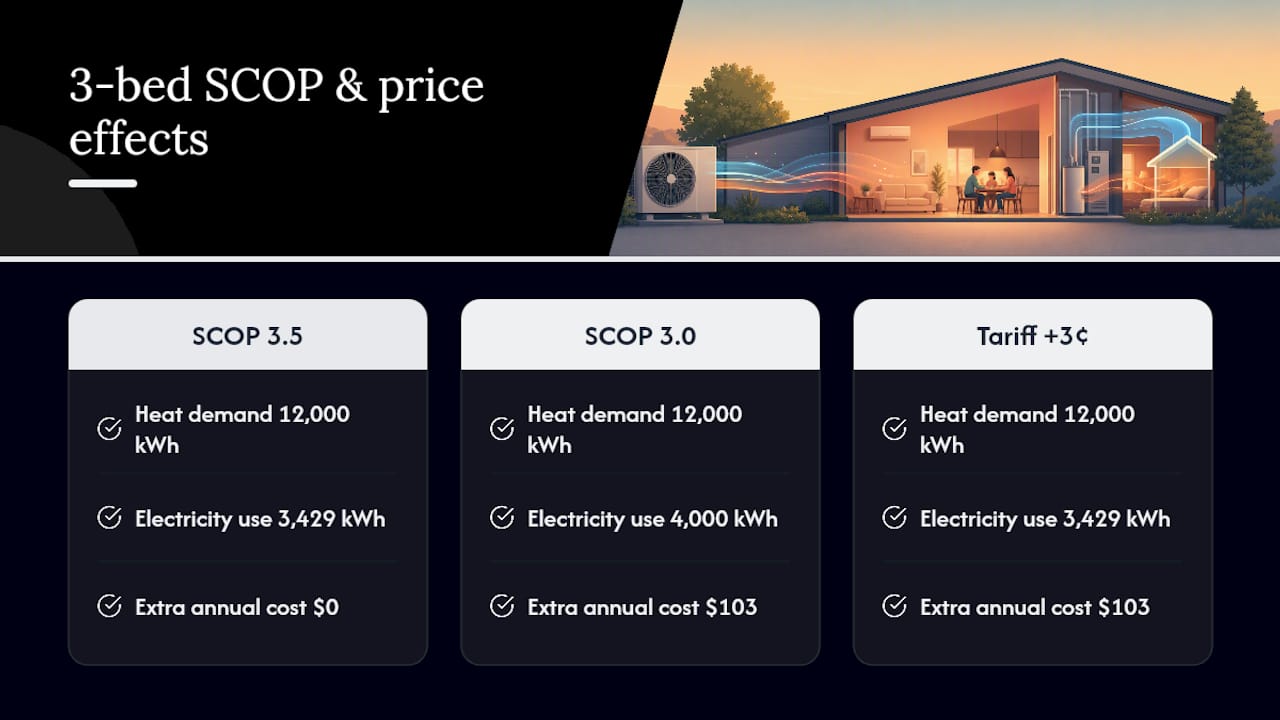
A 0.5 SCOP swing costs more than you’d think. Take the 3-bed example at 12,000 kWh heat demand. At a SCOP of 3.5, that’s 3,429 kWh of electricity. Drop to a SCOP of 3.0 (a common result of poor commissioning or an undersized system) and you need 4,000 kWh instead. At 18 cents/kWh, that’s an extra $103 a year from efficiency loss alone. A 3 cent/kWh tariff increase on the same 3,429 kWh adds about $103 too. Efficiency and electricity price carry roughly equal weight in your final bill.
What affects your heat pump running costs
Two categories of variable decide your bill: what you can control, and what you can’t.
- SCOP, COP, and HSPF measure efficiency differently. COP is instantaneous efficiency at one outdoor temperature; SCOP averages that across a full heating season; HSPF is the American measure used on equipment labels. A unit rated HSPF 10 performs very differently on a mild Georgia winter than on a Minnesota one, because seasonal averages absorb the cold snaps.
- Your electricity tariff matters beyond the headline rate. Standing charges, tiered pricing, and time-of-use plans all shift the real cost per kWh you actually pay.
- Home heat demand is set by insulation, airtightness, and how high you set the thermostat, not by the heat pump itself.
- System quality (correct sizing, proper commissioning, and a flow temperature matched to your radiators or ductwork) often has more impact on your bill than the unit’s spec sheet.
- Habits like running long, steady cycles instead of short bursts, and how much hot water you use, both feed into the total.
How to calculate your own heat pump running cost
You don’t need an engineering degree, just three numbers: your home’s heat demand in kWh, your system’s SCOP, and your electricity rate.
- Divide annual heat demand by SCOP to get the electricity used for heating. Example: 12,000 kWh ÷ 3.4 = 3,529 kWh.
- Multiply that figure by your rate in cents/kWh, then add any annual standing charge. Using the EIA’s average residential rate, roughly 17 cents/kWh nationally: 3,529 kWh × $0.17 = $600 for heating electricity.
- Divide by 12 for a rough monthly figure, about $50 a month for this example, though winter months will run well above that and summer months near zero (heating only).
The real value here is running your own numbers twice. Recalculate with SCOP 3.0 instead of 3.4, and the same home costs $680 a year rather than $600. Recalculate at 20 cents/kWh instead of 17, and it’s $706. Before you compare quotes or fuels, gather your home’s approximate heat demand (a heat-loss survey gives you the real figure), your system’s rated SCOP, and your actual utility rate from a recent bill. Guessing any one of the three makes the whole exercise unreliable.
How to reduce heat pump running costs without replacing the system
Most homeowners can cut their bill by 10 to 25% using what they already have installed.
- Move to a time-of-use or heat-pump-friendly tariff and shift heating and hot water into the cheapest hours where your utility offers one.
- Lower the flow temperature. Dropping from 55°C to 45°C typically improves efficiency noticeably, though it may need larger radiators or a longer run time to compensate.
- Fix draughts and add loft or wall insulation before touching the heat pump itself. It’s usually the cheapest lever available and reduces the heat demand figure in every calculation above.
- Add smart thermostats with weather compensation so the system modulates output instead of cycling hard on and off.
- Avoid short, high-power bursts. Heat pumps are more efficient running longer at lower output than cycling like a furnace.
Pro Tip: Pre-heat your home during off-peak electricity hours rather than waiting until the coldest part of the evening. A heat pump holding steady temperature is almost always cheaper to run than one playing catch-up.
Maintenance and unexpectedly high bills
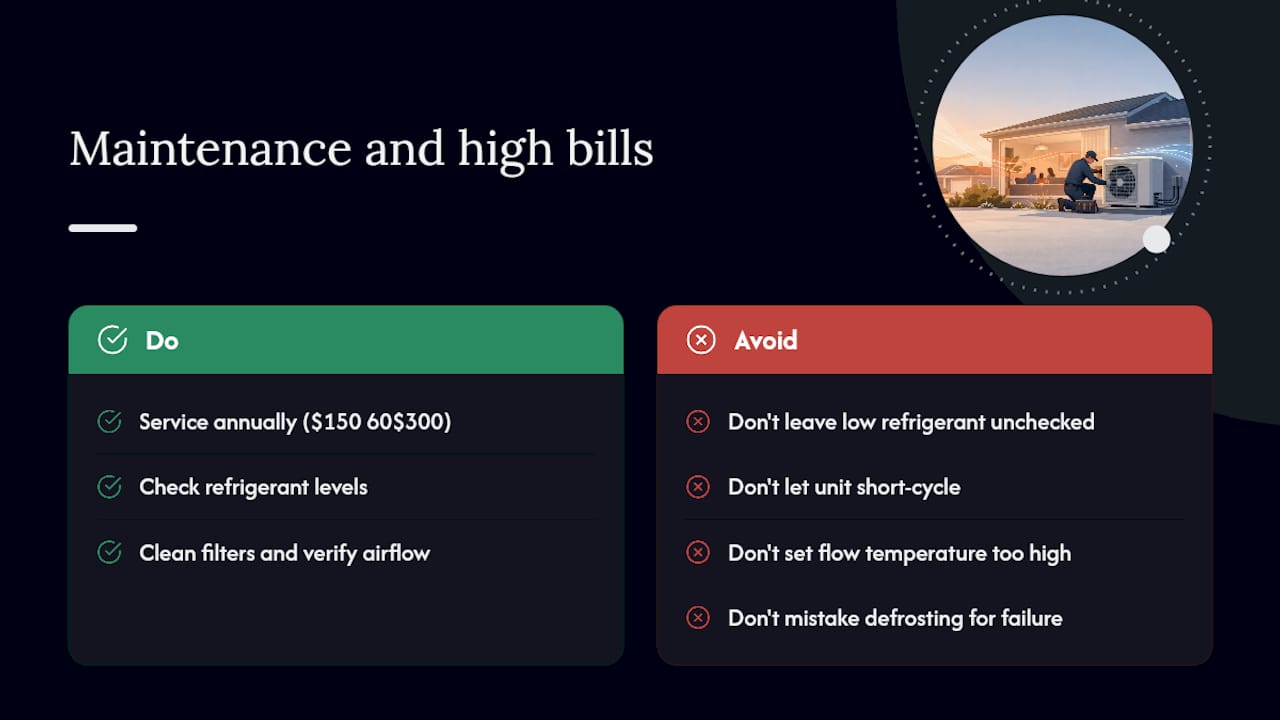
Annual servicing typically runs $150 to $300 and covers refrigerant checks, filter cleaning, and airflow verification, broadly in line with the intervals NYSERDA recommends for cold-climate systems. Low refrigerant, an oversized unit short-cycling, or a flow temperature set too high all quietly inflate bills without any obvious fault. Hot water heating and frequent defrost cycles in freezing weather also pull down winter COP, which is normal, not a sign of failure.
Heat pumps versus gas, oil, propane, and electric resistance
The comparison hinges on what’s called the spark gap: your electricity price divided by your gas or propane price per equivalent unit. When that ratio is favourable and your SCOP is decent, heat pumps win outright.
- You’ll typically save money switching from oil, propane, or electric resistance heating, since those are usually the most expensive fuels to run, an effect Rewiring America’s analysis confirms across most US regions.
- Warmer climates favour heat pumps almost automatically, since SCOP stays high all winter.
- Gas can still win in poorly insulated homes, on high electricity tariffs, or where a heat pump runs a SCOP below 2.8. EIA’s fuel price series is worth checking against your own utility rates before assuming either fuel is cheaper.
Movement in either fuel price can flip this calculation within a single winter, which is why the spark gap needs rechecking rather than assumed.
What Akita sees on real installs
Field commissioning consistently separates the SCOP a homeowner expects from what they actually get. Undersized units, high default flow temperatures, and rushed setup routinely cost 0.3 to 0.5 SCOP, which is real money every winter. A proper heat-loss survey and careful commissioning almost always beat buying a higher-rated unit and hoping. DIY tweaks like tariff switching and thermostat scheduling help, but sizing and flow temperature need a professional eye.
— Akita
Akita’s survey, commissioning and maintenance plans
Getting the running costs above in practice comes down to correct sizing and proper commissioning, not the badge on the unit. Akita’s heat-loss surveys establish your home’s real heat demand before a system is specified, so the SCOP you’re quoted is closer to the SCOP you’ll actually get through a Suffolk, Norfolk or Essex winter.

Beyond the install, Akita’s maintenance plans keep refrigerant levels and airflow in check so efficiency doesn’t quietly slide over a few seasons, the same drift covered in our piece on why regular HVAC maintenance saves energy. Pricing is transparent from the quote stage, and flexible finance options mean the upfront cost doesn’t have to dictate the specification. If you’re weighing up a switch, our guide to what heat pump installation costs is a useful next read. To get your own numbers, request a domestic installation survey and Akita will size the system to your actual home, not a rule of thumb.
Where to check your own numbers
For rates specific to your state, use EIA’s electricity price tables. NREL’s ResStock data offers regional heat-demand benchmarks, and state programmes like NYSERDA publish incentive and performance guidance worth checking alongside your own utility’s tariff page.
This article is general information, not a substitute for advice from a qualified financial advisor. Consult a qualified financial professional about your own circumstances before acting on anything here.
Sources
- EIA — electricity monthly tables
- Rewiring America — A guide to cutting costs with heat pumps
- NYSERDA — heat pump maintenance fact sheet