

Commercial HVAC troubleshooting steps: a technician's guide
TL;DR:
- Following a systematic diagnostic process prevents costly part replacements and ensures accurate fault identification in commercial HVAC systems.
- Proper preparation, including tools, documentation, and BMS data review, streamlines troubleshooting and supports compliance.
Commercial HVAC troubleshooting steps are a sequence of systematic diagnostic actions designed to identify and fix operational faults in commercial heating, ventilation, and air conditioning systems. The industry term for this process is structured fault diagnosis, and it covers everything from power supply checks to BMS trend analysis. Skipping steps costs money. Replacing expensive parts without verifying simpler causes, such as stuck electronic expansion valves on VRF systems, is one of the most common and costly mistakes in commercial HVAC maintenance. UK compliance standards including TM44 inspections, SFG20 preventive maintenance scheduling, and F-Gas logging all depend on thorough, documented diagnostics. Getting this process right protects your building, your budget, and your regulatory standing.
What do you need before starting commercial HVAC troubleshooting?
Effective fault diagnosis starts before you touch any equipment. Arriving on site without the right tools or documentation wastes time and risks misdiagnosis.
Essential tools for the job
Every technician should carry a core set of diagnostic instruments:
- Multimeter for measuring voltage, continuity, and resistance at control terminals
- Refrigerant pressure gauges to assess circuit charge and identify leaks
- Airflow meter to verify supply and return air volumes against design specifications
- Actuator and valve tester to confirm mechanical travel and signal response
- Coil cleaner and inspection torch for visual checks on heat exchangers and drain trays
These tools cover the three main fault categories: electrical, mechanical, and refrigerant circuit issues. Without them, you are guessing rather than diagnosing.
Documentation and system records
Access to the right paperwork is as important as the right tools. Collect the following before starting:
- Original commissioning records and wiring diagrams
- Manufacturer service manuals for all installed plant
- Maintenance logs structured to SFG20 task intervals, including filter change dates and leak test records
- Asset register entries showing system age, refrigerant type, and previous fault history
SFG20 is the UK standard for preventive maintenance scheduling. It protects against negligence claims and insurance rejection by defining task intervals for filter changes, leak tests, and electrical inspections.
Pro Tip: Pull the last 24–48 hours of BMS trend data before any physical inspection. Reviewing setpoints, schedules, and sensor readings in advance often reveals the fault category before you open a single panel.
Step-by-step commercial HVAC troubleshooting process
A structured approach prevents the most expensive mistake in HVAC diagnostics: replacing parts before confirming the root cause. Follow this sequence every time.
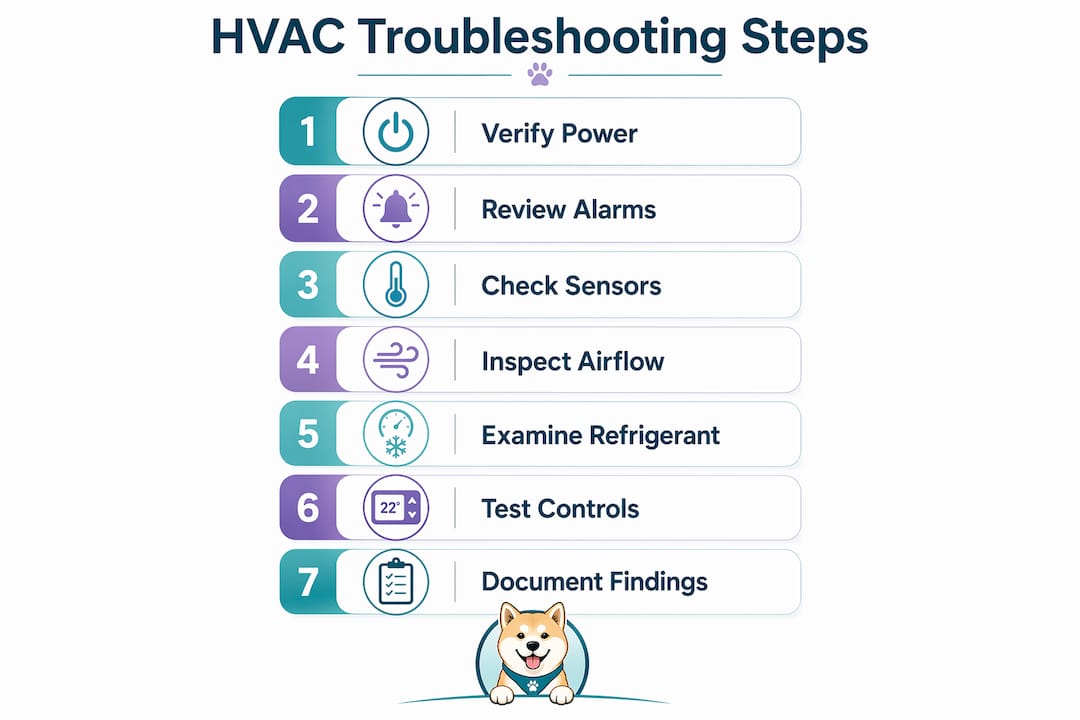
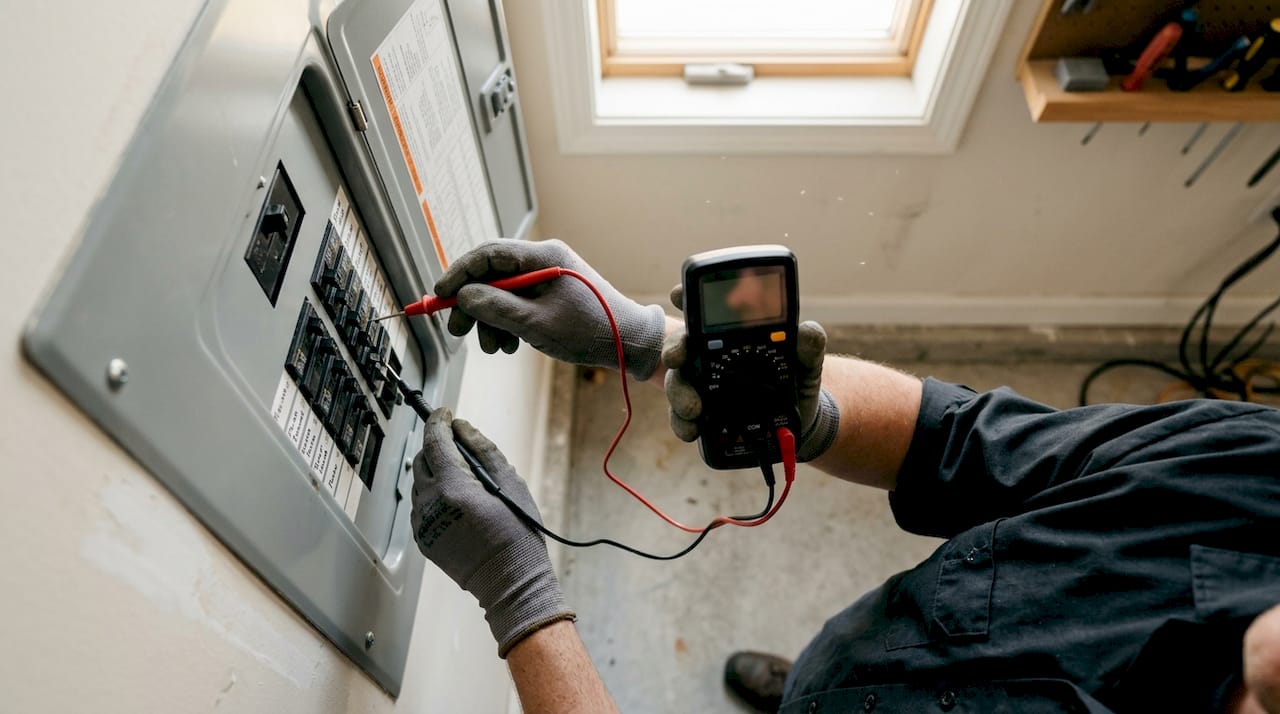
Step 1: Verify power supply and protection devices
Start at the distribution board. Confirm that all isolators, fuses, and circuit breakers are in the correct position. A tripped breaker that resets immediately points to an overload or short circuit downstream. Record the fault code if the protection device has a trip log.
Step 2: Review BMS alarms and recent trend data
Log into the building management system and pull the active alarm list. Systematic diagnostics include reviewing 24–48 hour BMS trends and verifying setpoints and schedules before any physical repairs. This step alone resolves a significant proportion of callouts that turn out to be scheduling errors or setpoint drift rather than hardware faults.
Step 3: Check sensors and calibration
Faulty temperature or pressure sensors produce incorrect control signals, causing the system to behave erratically without any mechanical failure present. Compare sensor readings against a calibrated reference instrument. A sensor reading 5°C high will cause a cooling system to run continuously without ever satisfying the setpoint.
Step 4: Inspect airflow and filtration
Most common causes of commercial HVAC failure include dirty filters, refrigerant leaks, degraded electrical components, and blocked drains. Check filter differential pressure or inspect visually. Measure supply air volumes with an airflow meter and compare against the design specification. A blocked filter reduces airflow, raises coil temperatures, and can trigger high-pressure trips that look like refrigerant faults.
Step 5: Inspect the refrigerant circuit
Connect refrigerant gauges and record suction and discharge pressures. Compare against the manufacturer’s operating envelope for the ambient conditions on the day. Low suction pressure typically indicates a refrigerant leak or a blocked expansion device. High discharge pressure points to condenser fouling or insufficient airflow across the outdoor unit.
Step 6: Verify control signals and actuator function
Control failures often arise from configuration or signal mismatches rather than hardware faults. Use a multimeter to verify signal type and supply voltage at actuator terminals before assuming the device has failed. Testing whether a signal is 0–10V or 3-point floating at the terminal prevents unnecessary actuator replacement. This single check resolves a large proportion of apparent control faults.
| Fault category | Typical symptoms | Primary diagnostic tool |
|---|---|---|
| Electrical | Tripped breakers, motor overloads, blown fuses | Multimeter, clamp meter |
| Mechanical | Noise, vibration, reduced airflow, water leaks | Airflow meter, visual inspection |
| Refrigerant circuit | Poor cooling or heating, icing, pressure alarms | Refrigerant gauges, leak detector |
| Controls and BMS | Erratic behaviour, setpoint not achieved, false alarms | BMS terminal, multimeter at actuators |
Step 7: Document findings before any repair
Write down every measurement, observation, and alarm code before touching a component. This record protects you legally, supports the asset register, and gives the next engineer a starting point if the fault returns. Avoid the “shotgun” approach of replacing multiple parts simultaneously. It makes root cause identification impossible and inflates repair costs.
Pro Tip: Follow the commissioning sequence when diagnosing complex faults: mechanical completion first, then hydraulics, then electrical and BMS, then control loop tuning. This sequence, recommended in HVAC controls guidance, prevents you from chasing control faults that are actually caused by unresolved mechanical issues.
How do you use BMS data and alarm logs for faster diagnostics?
The building management system is the most underused diagnostic tool on most commercial sites. Used correctly, it cuts troubleshooting time significantly by separating systemic faults from localised ones.
BMS alarms are diagnostic tools. Logging alarm patterns with weather conditions, occupancy schedules, and timestamps reveals whether faults are environmental or mechanical in origin. A fault that appears only on cold mornings before the building reaches occupancy temperature is almost certainly a setpoint or schedule issue, not a compressor failure.
Practical steps for effective BMS analysis:
- Export alarm logs with timestamps for the past 48–72 hours and sort by frequency and recurrence
- Correlate alarm events with any recent maintenance activity, setpoint changes, or BMS software updates
- Review temperature control loops for signs of hunting or offset, which indicate poor PID tuning rather than sensor failure
- Check actuator feedback signals within the BMS to confirm that physical valve position matches the commanded position
- Note occupancy patterns alongside fault times to distinguish schedule-driven issues from continuous faults
Logging alarm patterns before any physical intervention often reveals the nature of faults and whether they relate to schedule overrides or genuine mechanical failure. This approach also produces a ready-made evidence pack to share with specialist engineers if escalation is needed. For a deeper understanding of how BMS data integrates with fault diagnosis, the BMS integration guide from Akita covers the practical application in commercial settings.
Pro Tip: When sharing BMS data with an external engineer, export trend graphs rather than raw data tables. A visual trend showing temperature drift over 12 hours communicates the fault pattern far more clearly than a spreadsheet of numbers.
What compliance records must you maintain during troubleshooting?
UK regulatory requirements are not optional, and documentation gaps create real operational and financial risk. Non-compliance in documentation leads to downtime and operational risk. Maintaining a digital register of HVAC assets and logs is best practice for any commercial site.
The three key compliance frameworks for UK commercial HVAC are:
- TM44 inspections: Mandatory every 5 years for systems over 12 kW. Reports must be retained for audits. Failure to comply can result in penalty notices from local authorities.
- F-Gas logging: Required for systems containing refrigerants with a global warming potential equivalent to 5 tonnes of CO2 or more. Leak check frequency and refrigerant handling records must be maintained by a certified engineer.
- SFG20 maintenance records: Task completion records aligned to SFG20 intervals demonstrate due diligence and protect against insurance rejection following system failures.
Every troubleshooting visit should result in an updated service record. Record the fault found, the diagnostic steps taken, any parts replaced, and the system condition on departure. A commercial HVAC maintenance workflow that integrates compliance documentation into each visit prevents the accumulation of record gaps that create audit problems later. Digital asset registers that hold commissioning data, F-Gas logs, and TM44 reports in one place are the most reliable way to stay audit-ready at all times.
Key takeaways
Structured fault diagnosis, supported by BMS data and compliant documentation, is the most reliable way to resolve commercial HVAC faults without unnecessary part replacements.
| Point | Details |
|---|---|
| Prepare before you diagnose | Gather BMS trend data, wiring diagrams, and maintenance logs before touching any equipment. |
| Follow a fixed diagnostic sequence | Work from power supply through sensors, airflow, refrigerant circuit, and controls in order. |
| Verify control signals at the terminal | Test signal type and voltage at actuator terminals before assuming a device has failed. |
| Log alarm patterns with context | Correlate BMS alarms with occupancy, weather, and recent changes to identify root causes faster. |
| Maintain compliance records on every visit | Update F-Gas logs, TM44 records, and SFG20 task completions during each troubleshooting visit. |
What I have learned from years of commercial HVAC diagnostics
The most expensive mistake I see on commercial sites is the rush to replace hardware. A technician arrives, finds a fault code, orders a part, fits it, and the system fails again within a week. The root cause was never identified. A structured HVAC repair workflow prevents this by forcing a diagnostic sequence before any component is touched.
The second most common problem is siloed knowledge. Mechanical engineers who do not understand control signals, and controls engineers who do not understand refrigerant circuits, both make the same error: they diagnose within their comfort zone rather than following the fault. Cross-discipline knowledge is not a luxury in commercial HVAC. It is the baseline for accurate diagnosis.
Digital tools change this picture significantly. A CMMS that holds fault history, a BMS with trend logging, and a digital asset register with compliance records give any engineer a running start on every callout. The pattern recognition that used to take years of site-specific experience is now available on a tablet before you leave the van. The technicians who use these tools consistently resolve faults faster and generate fewer repeat callouts. That is not an opinion. It is what the data shows every time.
— Akita
Akita’s commercial HVAC services for UK facilities
Akita supports facility managers and HVAC technicians across Suffolk, Norfolk, and Essex with commercial air conditioning installation, maintenance, and compliance services built around UK regulatory requirements.
Every Akita commercial service visit includes documentation aligned to TM44 and F-Gas obligations, so your asset register stays current without additional administrative effort. Fixed-price engineering support removes budget uncertainty, and Akita’s team holds the certifications required for F-Gas handling and refrigerant leak testing. Whether you need a one-off diagnostic visit or an ongoing maintenance programme, Akita provides the technical depth and compliance knowledge that commercial sites require. Contact Akita to book a consultation or schedule a service visit for your site.
FAQ
What are the first steps in commercial HVAC troubleshooting?
Start by verifying power supply and reviewing BMS alarm logs before any physical inspection. Checking setpoints and 24–48 hour trend data resolves a significant proportion of faults without opening any equipment.
How often are TM44 inspections required for commercial HVAC systems?
TM44 inspections are mandatory every 5 years for air conditioning systems over 12 kW in UK commercial buildings. Reports must be retained and made available for audit on request.
What does SFG20 cover for HVAC maintenance?
SFG20 defines task intervals for filter changes, leak tests, and electrical inspections across commercial building services. Following SFG20 schedules protects against negligence claims and insurance rejection after system failures.
How do I avoid unnecessary part replacements during fault diagnosis?
Verify control signal type and supply voltage at actuator terminals with a multimeter before assuming any device has failed. Document all measurements and follow a fixed diagnostic sequence rather than replacing components based on fault codes alone.
When is F-Gas logging required for a commercial HVAC system?
F-Gas logging is required for systems containing refrigerants with a global warming potential equivalent to 5 tonnes of CO2 or more. Records must be maintained by a certified engineer and cover leak checks, refrigerant additions, and handling activities.