

BMS integration in HVAC: what professionals need to know
TL;DR:
- BMS integration connects HVAC equipment to a centralized system using open protocols for better control and monitoring. It delivers energy savings, faster fault detection, and supports proactive maintenance in commercial buildings. Proper planning, data normalization, and protocol selection are essential for successful implementation.
BMS integration in HVAC is defined as the process of connecting heating, ventilation, and air conditioning equipment to a centralised Building Management System (BMS) using standard communication protocols to enable unified monitoring, control, and optimisation. The industry term you will encounter most often is “building automation integration,” though BMS integration is the phrase most professionals use in practice. HVAC controls form the foundation of this architecture, linking sensors, direct digital controllers (DDC), and software dashboards into a single operational platform. Platforms such as Johnson Controls Metasys and standards bodies such as ASHRAE have shaped how this integration is specified and delivered across commercial buildings. When done correctly, BMS integration gives building managers real-time visibility over climate, energy consumption, and equipment health from one interface.
What is BMS integration in HVAC and how does it work?
BMS integration in HVAC is built across three distinct layers: the field layer, the automation layer, and the management layer. Each layer has a specific role, and the system only performs well when all three communicate reliably.

The field layer contains the physical devices: temperature sensors, humidity probes, CO₂ detectors, variable air volume (VAV) boxes, damper actuators, and fan coil units. These devices generate the raw data that drives every decision the BMS makes. The automation layer sits above the field layer and consists of DDC controllers that process sensor inputs and execute control logic, such as adjusting a chiller setpoint or modulating a supply air damper. The management layer is the software dashboard where building managers view trends, set schedules, raise alarms, and generate energy reports.
Communication between layers depends on open protocols. BACnet (Building Automation and Control Networks) is the dominant standard for interoperability across manufacturers. Modbus is widely used for older plant equipment such as chillers and boilers. LonWorks appears in some legacy installations, particularly in European commercial buildings. In multi-vendor environments, protocol gateways translate between these standards so that a Siemens controller can report data to a Honeywell dashboard without custom engineering.
| Layer | Components | Common protocols |
|---|---|---|
| Field | Sensors, actuators, VAV boxes | Analogue signals, Modbus |
| Automation | DDC controllers, PLCs | BACnet, Modbus, LonWorks |
| Management | SCADA dashboards, BMS software | BACnet/IP, web services |
Pro Tip: Before specifying any controller, confirm it supports BACnet/IP natively. Proprietary protocols lock you into a single vendor and make future upgrades significantly more expensive.
How does BMS integration improve energy efficiency and HVAC control?
HVAC systems account for 40%–60% of commercial building energy consumption. That single figure explains why BMS integration is the first place most building managers look when they need to cut operating costs.
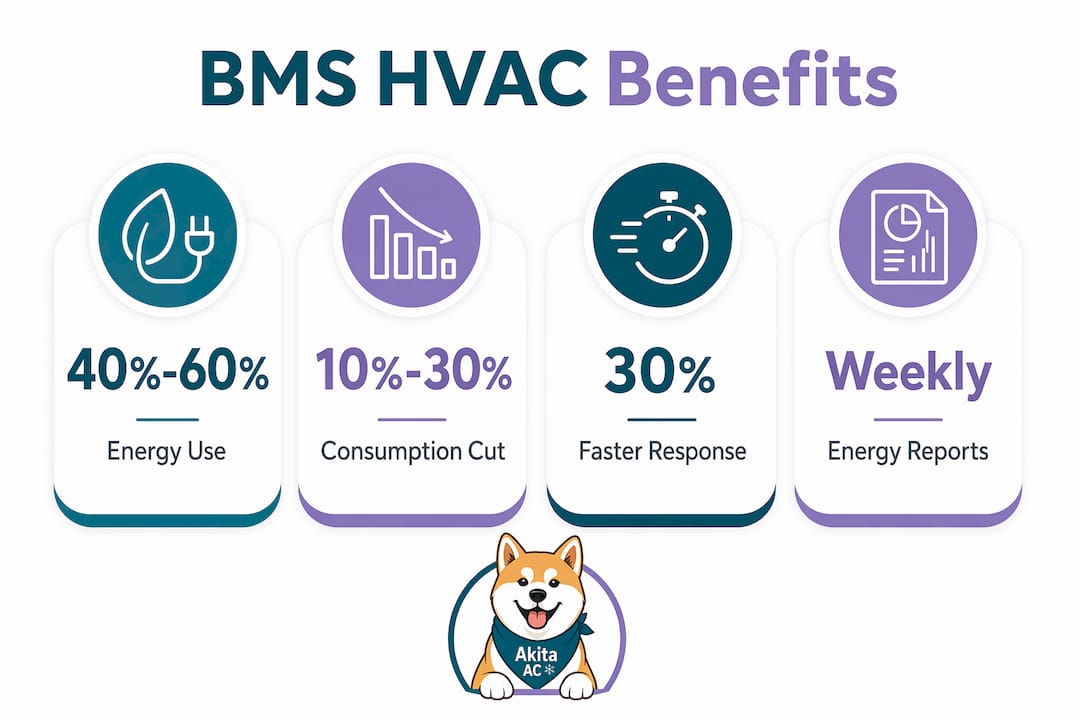
A well-configured BMS reduces that consumption by 10%–30% through occupancy-based scheduling, setpoint optimisation, and the elimination of conflicting operations. Conflicting operations are more common than most people realise: a heating coil and a cooling coil running simultaneously in the same air handling unit is a textbook example of energy waste that a BMS catches immediately. Lighting, which accounts for 15%–25% of commercial building energy, can also be managed through the same platform, with BMS-managed lighting delivering savings of up to 38%.
Centralised monitoring also changes how quickly problems are resolved. A well-implemented BMS manages 60%–80% of commercial building energy and reduces response time to issues by approximately 30%. That reduction comes from automated fault detection and alarm routing, which means an engineer receives a notification before a tenant raises a complaint.
Key operational benefits of HVAC automation integration include:
- Occupancy scheduling: HVAC runs only when spaces are occupied, cutting overnight and weekend energy waste.
- Remote monitoring: Facilities teams manage multiple sites from a single dashboard without travelling to each location.
- Demand-controlled ventilation: CO₂ sensors modulate fresh air supply in real time, reducing fan energy while maintaining air quality.
- Integrated fault alarms: Abnormal conditions trigger alerts automatically, reducing diagnostic time.
- Energy reporting: Automated reports support sustainability audits and tenant billing.
Pro Tip: Set up automated weekly energy reports from day one. Most BMS platforms generate these natively, and the data becomes your baseline for proving ROI to building owners and finance teams.
What challenges should professionals anticipate in BMS integration?
Real BMS integration is not simply about connecting devices. It is an architectural discipline that requires normalised data structures, consistent naming conventions, and careful compatibility planning before a single cable is pulled.
Retrofit projects carry the highest risk. Legacy equipment compatibility must be checked early. Without that check, you discover mid-project that a 20-year-old chiller communicates only via a proprietary serial protocol, forcing either a costly gateway purchase or full equipment replacement. Neither outcome is welcome when you are already on site.
Commissioning BMS control loops demands expert tuning of PID (proportional-integral-derivative) parameters. Incorrect PID settings cause hunting, where a valve oscillates continuously rather than settling at the correct position. Signal compatibility is equally critical: a 0–10V control signal sent to an actuator expecting a 4–20mA input produces zero movement and is frequently misdiagnosed as a faulty actuator.
Common pitfalls in BMS integration projects:
- Skipping a point schedule audit. Undefined or duplicated data points create dashboard chaos that takes months to untangle.
- Assuming all BACnet devices are equal. BACnet compliance varies widely; always request a Protocol Implementation Conformance Statement (PICS) from the manufacturer.
- Underestimating commissioning time. Control loop tuning on a large air handling unit can take several days per unit.
- Neglecting cybersecurity. BMS platforms connected to IP networks require firewall rules and access controls from day one.
- Poor contractor coordination. Mechanical, electrical, and controls contractors working in silos produce integration gaps that are expensive to fix after handover.
Pro Tip: Confirm signal types at every actuator before writing control logic. A five-minute check on site prevents hours of fault-finding during commissioning.
How can building managers shift from reactive to proactive HVAC maintenance?
Modern BMS platforms move building managers from reactive to proactive maintenance through predictive analytics and historical trend logging. Reactive maintenance means waiting for something to break. Proactive maintenance means identifying the pattern that precedes the failure and acting before the breakdown occurs.
Trend logging is the mechanism that makes this possible. A BMS records thousands of data points continuously: supply air temperature, chilled water differential pressure, motor current draw, filter pressure drop. When a bearing begins to fail on a supply fan, motor current rises gradually over weeks before the fan trips. A building manager reviewing trend data spots that rise and schedules a bearing replacement during planned downtime rather than an emergency call-out at 2am.
BMS integration also supports compliance with sustainability standards such as BREEAM and net-zero targets by providing verified energy performance data. That compliance record directly affects property valuation and lease attractiveness, which matters to asset managers as much as it does to facilities teams. For predictive HVAC maintenance to deliver its full value, the BMS must be configured to log the right points at the right intervals from the outset.
Benefits of proactive maintenance enabled by BMS:
- Reduced emergency call-out costs and unplanned downtime.
- Extended equipment lifespan through condition-based servicing.
- Verified compliance data for BREEAM, EPC, and net-zero reporting.
- Scalable monitoring across multi-site portfolios from a single platform.
- Improved tenant satisfaction through consistent comfort conditions.
| Maintenance approach | Trigger | Typical outcome |
|---|---|---|
| Reactive | Equipment failure | High cost, unplanned downtime |
| Preventive | Fixed schedule | Moderate cost, some unnecessary work |
| Proactive (BMS-enabled) | Trend data and analytics | Lower cost, minimal downtime |
What practical steps should professionals follow for effective BMS integration?
Successful HVAC automation integration follows a structured sequence. Skipping steps early creates problems that compound at every stage that follows.
- Conduct a full system audit. Document every piece of HVAC plant, its age, communication capability, and current control method. This audit determines whether you need gateways, replacements, or straightforward integration.
- Define your protocol strategy. Select BACnet/IP as the primary protocol wherever possible. Document which legacy devices will require Modbus or gateway translation.
- Establish data naming conventions. Point naming conventions and point mapping are crucial for a manageable BMS dashboard. Agree on a naming standard before any controller is programmed.
- Check hardware compatibility. Verify signal types at every actuator and sensor. Confirm DDC controller I/O counts match the point schedule.
- Commission methodically. Tune PID loops on each control system individually before integrating them into the wider BMS. Test alarm routing and confirm notifications reach the right people.
- Train the end users. A BMS that nobody knows how to use delivers none of its potential. Schedule structured handover training for facilities and maintenance teams.
- Schedule regular software updates. BMS platforms release firmware and security patches. Outdated software introduces both performance and cybersecurity risks.
Pro Tip: Establish your data-naming conventions before any hardware is installed. Retrofitting a naming standard onto a live BMS with hundreds of points is one of the most time-consuming tasks in building automation.
Key takeaways
BMS integration in HVAC is the architectural process of unifying sensors, controllers, and software across three layers using open protocols to reduce energy consumption, improve control, and enable proactive maintenance.
| Point | Details |
|---|---|
| Three-layer architecture | Field, automation, and management layers must all communicate reliably for BMS to function correctly. |
| Energy savings are measurable | HVAC BMS integration delivers 10%–30% energy reductions in commercial buildings with verified data. |
| Protocol selection is critical | BACnet/IP is the preferred open standard; always request a PICS document from device manufacturers. |
| Data normalisation prevents chaos | Agree on point naming conventions before installation to keep dashboards manageable and auditable. |
| Proactive maintenance pays dividends | Trend logging and predictive analytics reduce emergency call-outs and extend equipment lifespan. |
Akita’s view on where BMS integration is heading
The buildings I see most often in Suffolk, Norfolk, and Essex fall into two camps. The first group has invested in BMS integration and is reaping measurable energy savings, faster fault resolution, and credible sustainability reporting. The second group is still running standalone HVAC units with no central visibility, paying for reactive repairs, and struggling to meet increasingly demanding EPC requirements.
What strikes me most is how often the gap between these two groups comes down not to budget but to planning. The buildings that struggle with BMS integration almost always skipped the data normalisation phase. They connected devices successfully but ended up with dashboards full of cryptically named points that nobody can interpret. That is not a technology failure. It is a process failure, and it is entirely avoidable.
The direction of travel is clear. Cloud-based BMS platforms and AI-assisted fault detection are moving from pilot projects into mainstream deployment. Johnson Controls, Siemens, and Schneider Electric are all investing heavily in analytics layers that sit above traditional BMS architecture. Buildings that have clean, well-structured data today will integrate these tools far more easily than those that do not.
My honest advice: treat BMS integration as a long-term infrastructure investment, not a one-off installation project. The buildings that get the most from it are the ones where facilities teams understand the system, review trend data regularly, and treat the BMS as a living tool rather than a set-and-forget controller. That mindset shift is what separates buildings that meet net-zero targets from those that merely aspire to.
— Akita
Ready to integrate your HVAC system with a BMS?
Akita installs and maintains modern air conditioning systems across Suffolk, Norfolk, and Essex, with the technical capability to support BMS integration for both new builds and retrofit projects. Whether you manage a single commercial premises or a multi-site portfolio, Akita’s engineers understand the protocol requirements, commissioning demands, and data structuring work that separates a functional BMS from a genuinely useful one.

From commercial air conditioning installation designed for BMS compatibility to domestic systems with smart control capability, Akita specifies equipment that works within open-protocol environments from day one. If you are planning an integration project or want to understand what your existing system can support, speak to the Akita team for straightforward, experience-based guidance.
FAQ
What is BMS integration in HVAC?
BMS integration in HVAC is the connection of heating, ventilation, and air conditioning equipment to a centralised Building Management System using communication protocols such as BACnet or Modbus. This allows unified monitoring, scheduling, and control of all building climate systems from a single platform.
How does BMS work in HVAC systems?
A BMS collects data from field-layer sensors and actuators, processes it through DDC controllers at the automation layer, and presents it via a management-layer software dashboard. Operators use that dashboard to adjust setpoints, review alarms, and generate energy reports in real time.
What are the main advantages of BMS in HVAC for commercial buildings?
The primary advantages include energy savings of 10%–30%, a reduction in issue response time of approximately 30%, occupancy-based climate scheduling, and verified data for sustainability compliance frameworks such as BREEAM.
Which communication protocol is best for BMS integration?
BACnet/IP is the preferred protocol for new BMS integration projects because it is an open standard supported by most major manufacturers including Johnson Controls, Siemens, and Honeywell. Modbus remains useful for legacy plant equipment that does not support BACnet natively.
Can existing HVAC systems be retrofitted with BMS integration?
Yes, but a compatibility audit is required before work begins. Older equipment may need protocol gateways or replacement controllers to communicate with a modern BMS platform. Skipping this audit is the most common cause of cost overruns in retrofit integration projects.